

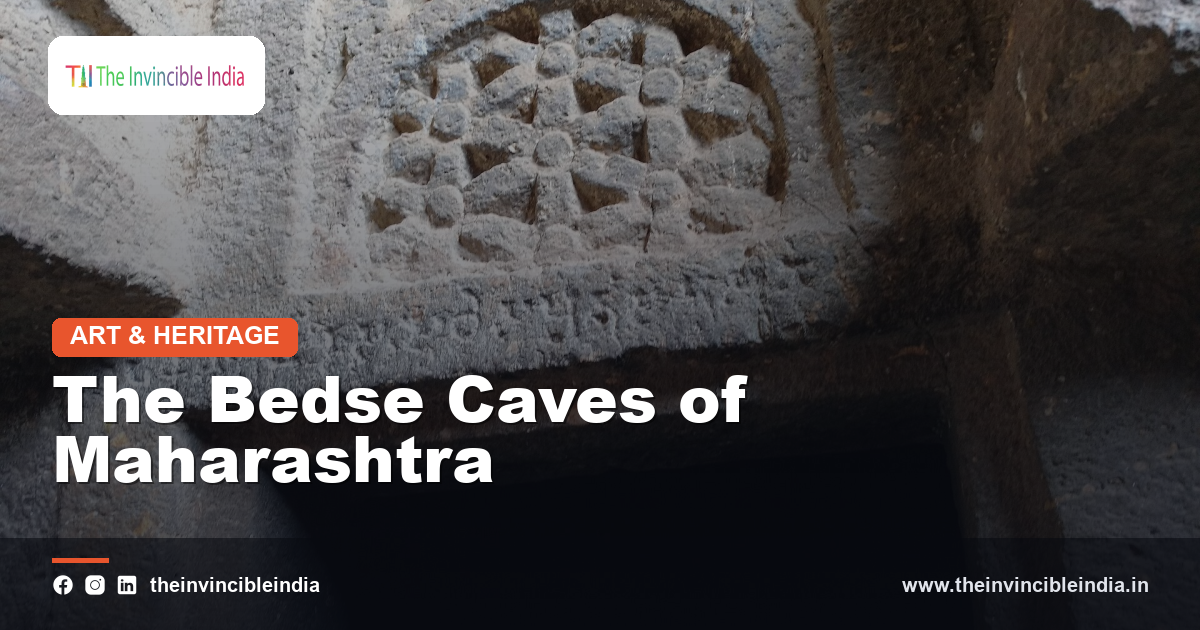
The Bedse Caves, also spelled Bedsa Caves and sometimes called the Bedse Leni, are a small group of ancient Buddhist rock-cut caves in the Maval region of Maharashtra, close to the town of Kamshet in the hills of the Western Ghats. Carved in the centuries around the turn of the Common Era, they contain a lofty chaitya hall and a monastic dwelling that reflect the early, austere phase of Buddhist cave architecture. Their carved halls belong to the same stone-cutting tradition described in the guide to Indian sculpture, and they stand quietly near the better known caves of Karla and Bhaja. This guide explains their history, design and meaning.
Quick answer: The Bedse Caves (also spelled Bedsa Caves) are a group of early Buddhist rock-cut caves near Kamshet in the Maval region of Pune district, Maharashtra, India. They are generally dated to about the first century BCE to the first century CE and are known for a fine apsidal chaitya hall with tall octagonal pillars and a rock-cut stupa. They are among the best preserved early cave monuments of the Western Ghats.
Key Takeaways
- The Bedse Caves are a small group of Buddhist rock-cut caves in the Maval region of Pune district, Maharashtra.
- They are generally assigned to the early centuries around the turn of the Common Era, in the period of Satavahana influence.
- The main monument is an apsidal chaitya hall with a rock-cut stupa at its far end.
- The porch is famous for tall octagonal pillars topped by carved animals and figures.
- A nearby vihara once housed Buddhist monks, and several water cisterns were cut into the rock.
- The caves lie close to Bhaja, Karla and Kamshet, making them easy to combine on a single heritage trip.
The sections below describe how the caves were made, how they are arranged and what a visitor can still see today.
Quick Facts
| Detail | Information |
|---|---|
| Location | Near Kamshet, Maval region, Pune district, Maharashtra |
| Also known as | Bedsa Caves, Bedse Leni, Bedse Chaitya |
| Type | Early Buddhist rock-cut chaitya hall and vihara |
| Approximate era | About the first century BCE to first century CE |
| Notable feature | Apsidal chaitya hall with octagonal pillars and a rock-cut stupa |
| Setting | Hillside of the Western Ghats overlooking a green valley |
What Are the Bedse Caves?
The Bedse Caves are a small group of Buddhist rock-cut caves excavated into a basalt hillside in the Western Ghats of Maharashtra. They include a large chaitya, which is a prayer hall built around a sacred stupa, and a vihara, which is a dwelling for monks. Together these spaces formed a complete monastic establishment in which devotion, study and daily life took place side by side. Unlike many later cave complexes, Bedse is modest in scale and almost free of figure sculpture inside its main hall, so its beauty lies in proportion, space and carefully shaped stone. The caves belong to the earliest phase of Buddhist architecture in the Deccan, when builders imitated timber structures in solid rock. They therefore offer a clear and unspoiled view of how Buddhist sacred space was first imagined in western India.
Where Are the Bedse Caves Located?
The Bedse Caves are located in the Maval region of Pune district in Maharashtra, a short distance from the town of Kamshet. They sit on the slope of a hill that rises above a green valley, and the setting is typical of the Western Ghats with its basalt cliffs, grassy ridges and seasonal streams. The caves are reached from the village of Bedse, from where a footpath climbs to the entrance. Their position is close to the famous caves of Bhaja and Karla, which lie along the same historic route between the coast and the plateau. The area is also known for hill forts and trekking trails, so the caves are often visited together with other sites. The location makes the Bedse Caves both peaceful and conveniently placed within a wider cluster of early Buddhist monuments.
How Old Are the Bedse Caves?
The Bedse Caves are generally dated to the period around the first century BCE and the first century CE, which places them among the early Buddhist caves of western India. Scholars assign this date mainly on the basis of architectural style, because the form of the pillars, the plan of the hall and the simple carving all resemble other datable early caves in the region. Inscriptions in the early Brahmi script, recording gifts to the monastery, also support an early date. Exact years remain a matter of scholarly discussion, and different writers propose slightly different ranges. What is clear is that Bedse belongs to the formative age of rock-cut architecture, before the elaborate figure carving of later centuries. The age of the Bedse Caves therefore makes them valuable evidence for the first great phase of Buddhist cave building in the Deccan.
Who Built the Bedse Caves and Why?
The Bedse Caves were excavated by the Buddhist monastic community with the support of lay donors, a pattern seen across the early caves of the Western Ghats. Merchants, local officials and ordinary devotees often paid for the carving of halls, cells and cisterns, and they recorded their gifts in short inscriptions. The region at this time was linked with the wider political and commercial world of the Satavahana period, which encouraged trade and religious patronage. The purpose of the caves was both spiritual and practical, since they gave monks a place for worship, shelter during the rains and quiet for meditation. Making such a cave required planning, skilled labour and steady funding over many years. The building of the Bedse Caves thus reflects a partnership between monks, merchants and craftsmen that sustained early Buddhism in western India.
What Was the Historical Setting of the Bedse Caves?
The historical setting of the Bedse Caves was a landscape of trade routes that crossed the Western Ghats between the Konkan coast and the interior plateau. Passes in the hills carried goods such as textiles, spices and other merchandise, and traders on these routes needed places to rest during the monsoon. Buddhist monasteries filled this need by offering shelter, and in return they received gifts that supported further excavation. This explains why so many early caves, including Bedse, Bhaja, Karla and others, lie close to old highways. The monks did not live apart from society but formed part of a network of exchange, learning and devotion. Understanding this setting shows that the Bedse Caves were not isolated retreats but active institutions linked with the economic life of the region, which helps explain their careful construction.
How Were the Bedse Caves Made?
The Bedse Caves were made by cutting directly into a hillside of hard volcanic rock, working from the top downwards so that the carvers never had to stand beneath unfinished stone. Workers first marked out the facade and then removed the rock in stages with iron chisels and hammers, shaping the hall, the pillars and the ceiling from a single mass. The result is architecture that is subtractive rather than built, with every form emerging from the mountain itself. The craftsmen copied features of wooden buildings, such as ribbed ceilings and sloping pillars, even though these were not structurally needed in stone. This careful imitation shows how closely rock-cut architecture grew out of earlier timber traditions. The method of making the Bedse Caves therefore reveals both great technical skill and a deep respect for older building forms.
What Is the Plan of the Bedse Chaitya Hall?
The chaitya hall at Bedse follows the classic apsidal plan of early Buddhist prayer halls, with a long rectangular nave that ends in a rounded apse. A row of pillars separates the central nave from narrow side aisles, which allowed worshippers to walk around the stupa in the traditional act of circumambulation. The ceiling forms a barrel vault and was originally fitted with wooden ribs that echoed the structure of timber halls. A large horseshoe-shaped window above the entrance admitted light that fell directly toward the stupa. The overall effect is of a tall and solemn space that draws the eye toward the sacred centre. The plan of the Bedse chaitya hall thus demonstrates the careful union of function and symbolism that characterises early Buddhist architecture.
What Are the Pillars of Bedse Famous For?
The pillars of Bedse are famous for the porch in front of the chaitya, where tall octagonal columns rise from pot-shaped bases and are crowned with carved capitals. These capitals are usually described as bearing kneeling animals, such as elephants and horses, with small human figures seated upon them. The carving is bold and vivid, and it forms one of the few decorative flourishes in an otherwise restrained design. Inside the hall the pillars are plainer and are octagonal in section, and they lean slightly inward, a feature copied from timber construction. The porch pillars give the facade a monumental character and announce the sacred space within. For this reason the pillars of Bedse are regarded as among the finest examples of early Buddhist column design in the Western Ghats.
What Is the Stupa Inside the Bedse Chaitya?
The stupa inside the Bedse chaitya is a rock-cut dome standing at the rounded end of the hall, and it serves as the focus of worship. Unlike an image of the Buddha, which came later, the stupa itself symbolised the presence and the teachings of the Enlightened One. It consists of a cylindrical drum topped by a dome and a square railing-like element known as the harmika, which once carried a wooden umbrella as a sign of honour. Devotees walked around it in a clockwise direction while reciting prayers or meditating on the Buddha. The stupa is cut from the same rock as the hall and is therefore inseparable from it. The stupa at Bedse thus remains a powerful reminder of the earliest stage of Buddhist devotion, in which sacred form mattered more than figure sculpture.
What Does the Vihara at Bedse Show?
The vihara at Bedse is a monastic dwelling cut into the rock, and it shows how monks lived and studied in the early centuries of Buddhism. It generally consists of a central hall surrounded by small cells, each with a stone bed or bench where a monk could rest. The hall served for gatherings, teaching and shared meals, while the cells gave privacy for meditation. Such an arrangement reflects the monastic rule of simple living and communal discipline. The vihara is plain in style, but its proportions are carefully judged and the rock is smoothly dressed. Although less visited than the chaitya, it completes the picture of a working monastery. The vihara at Bedse therefore helps visitors understand the daily rhythm of monastic life that once filled these caves.
What Do the Inscriptions and Cisterns Tell Us?
The inscriptions and cisterns at Bedse tell us about the donors who supported the monastery and the practical needs of the monks. Short records in the early Brahmi script note gifts made by individuals, and they offer valuable evidence about who patronised Buddhism in the region. Rock-cut cisterns, carved into the hillside, collected rainwater during the monsoon and supplied the community through the dry months. This careful management of water shows the practical intelligence of the builders. Such small details are as important as grand architecture, because they reveal how the monastery functioned from day to day. Together the inscriptions and cisterns show that the Bedse Caves were a lived-in institution supported by a community of givers, and they add human detail to what might otherwise seem only a silent monument.
How Do the Bedse Caves Compare with Karla and Bhaja?
The Bedse Caves compare closely with the neighbouring caves of Karla and Bhaja, since all three belong to the same early tradition of Buddhist rock-cut architecture in the Western Ghats. Karla has the largest and best preserved chaitya hall of the group, while Bhaja is known for its early vihara and its ancient apsidal hall. Bedse sits between them in scale but is admired for its elegant porch pillars and its harmonious proportions. Seen together, the three sites show how builders gradually refined the plan and decoration of the chaitya hall. Visitors who travel to all three can follow this development in stone. The comparison with Karla and Bhaja therefore places the Bedse Caves within a larger story of artistic experiment and shows why each site deserves its own visit.
What Does Bedse Show About Early Buddhism in the Western Ghats?
Bedse shows that early Buddhism in the Western Ghats was a thriving religion supported by trade, devotion and skilled craftsmanship. The absence of Buddha images in the main hall points to an early phase in which the Buddha was honoured through symbols, above all the stupa. The caves also reveal a monastic life organised around discipline, learning and shared resources. Their placement along trade routes demonstrates the close link between religion and commerce. Over time the religion changed and later caves in the Deccan, such as those at Ajanta, were richly painted and sculpted with Buddha figures. Bedse remains valuable because it preserves the earlier and simpler stage. In this way the Bedse Caves help explain how Buddhist art and practice developed across the Indian subcontinent.
How Can Visitors Reach and Enjoy the Bedse Caves?
Visitors can reach the Bedse Caves by travelling to the Kamshet area in the Maval region and then continuing by road to the village of Bedse. From the village a short and gentle climb leads to the caves, and sturdy shoes are advisable on the stone steps and paths. The best seasons are usually the cooler months and the early monsoon, when the valley is green, although paths may be slippery after rain. Early morning light is ideal for appreciating the carving and the quiet atmosphere of the hall. Visitors should check current access rules, carry water and respect the sanctity of the site by avoiding damage to the stone. With a little planning, a visit to the Bedse Caves becomes a calm and rewarding half-day excursion into ancient India.
Why Are the Bedse Caves Important?
The Bedse Caves are important because they preserve one of the clearest and most graceful examples of an early Buddhist chaitya hall in India. They demonstrate how builders translated wooden architecture into stone, how monasteries were organised and how lay patrons supported religion. The site also adds to the story of the Satavahana-era Deccan, when trade, faith and art flourished together. For students of architecture the caves are a living textbook of early forms, from the apsidal plan to the carved pillar capitals. For travellers they offer an uncrowded setting in which to experience ancient India in a landscape of hills and valleys. The importance of the Bedse Caves therefore lies in their beauty, their historical evidence and their power to connect the present with a distant and thoughtful past.
The Bedse Caves Today
The Bedse Caves today stand as a protected heritage site in the Maval hills, valued by scholars, trekkers and pilgrims alike. They remain a quiet alternative to busier cave monuments, and many visitors appreciate the calm of the hall and the sweep of the surrounding valley. Conservation efforts focus on protecting the rock from weathering, water seepage and careless visitors, and responsible behaviour by tourists is essential to that work. Researchers continue to study the architecture and inscriptions for what they reveal about early Buddhism and trade. The caves also remind modern visitors of the skill and patience of ancient craftsmen who shaped a mountain into a place of prayer. The Bedse Caves thus continue to speak across the centuries, offering a simple but enduring expression of India’s Buddhist heritage.
Sources & Further Reading
- Archaeological Survey of India (asi.nic.in).
- Maharashtra Tourism, Government of Maharashtra (maharashtratourism.gov.in).
Frequently Asked Questions
What are the Bedse Caves?
The Bedse Caves are a group of early Buddhist rock-cut caves near Kamshet in the Maval region of Pune district, Maharashtra. They include a large apsidal chaitya hall with a stupa and a vihara for monks. They are known for their elegant pillars and simple, harmonious design.
How old are the Bedse Caves?
The Bedse Caves are generally dated to about the first century BCE to the first century CE. This estimate rests on architectural style and early Brahmi inscriptions. Exact dates remain debated among scholars.
Where are the Bedse Caves located?
The Bedse Caves are located in the Maval region of Pune district in Maharashtra, close to the town of Kamshet. They lie on a hillside above the village of Bedse. They are near the caves of Bhaja and Karla.
What is the Bedse chaitya famous for?
The Bedse chaitya is famous for its tall octagonal porch pillars topped with carved animals and figures, and for its apsidal hall with a rock-cut stupa. Its plan and proportions are considered a fine example of early Buddhist architecture. The restrained design emphasises space and light.
How are the Bedse Caves different from Karla and Bhaja?
The Bedse Caves are smaller than Karla, which has the largest chaitya hall of the group, and differ from Bhaja, which is known for its early vihara. Bedse is admired for the elegant carving of its porch pillars. All three belong to the same early Buddhist tradition.
What is the best time to visit the Bedse Caves?
The best time to visit is generally from the monsoon months through the cooler season, when the valley is green and the weather is pleasant. Care is needed on slippery paths after rain. Early morning visits offer the best light and the fewest crowds.


