

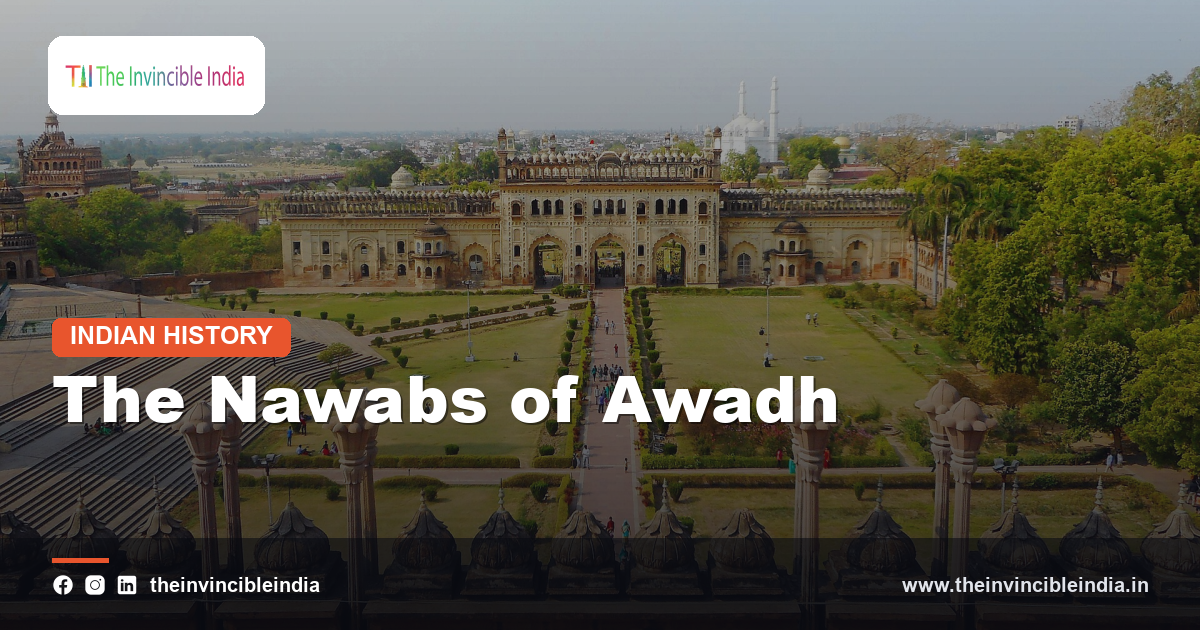
The Nawabs of Awadh, also written as the Nawabs of Oudh or the Nawab Wazirs of Awadh, were a line of Mughal governors who became hereditary rulers of a rich region of the Gangetic plain in the eighteenth century. Their territory, centred on Faizabad and later on Lucknow, lay in what is now Uttar Pradesh. The dynasty was of Persian Shia origin and presided over a court that became a leading centre of poetry, music, dance, food and architecture. Its story overlaps with the decline of imperial power described in our guide to the Mughal Empire. Specific years are given here only in general terms.
Quick answer: The Nawabs of Awadh were a dynasty of Mughal-appointed governors who became hereditary rulers of the Awadh region in present-day Uttar Pradesh during the eighteenth century, first from Faizabad and then from Lucknow. They remained nominally loyal to the Mughal emperor but acted independently and later allied with the East India Company. Their court is famed for the Imambaras, Urdu poetry, Kathak and Awadhi cuisine until annexation in the mid-nineteenth century.
Key Takeaways
- The Nawabs of Awadh began as Mughal governors and became hereditary rulers of the Awadh region in the eighteenth century.
- Saadat Khan Burhan-ul-Mulk is traditionally named as the founder of the dynasty.
- The capital moved from Faizabad to Lucknow under Asaf-ud-Daula in the late eighteenth century.
- The Bara Imambara, Chhota Imambara and Rumi Darwaza are major monuments of the Nawabi age.
- Wajid Ali Shah, the last ruler, was a patron of Kathak, poetry and theatre before the British annexed Awadh in the mid-nineteenth century.
- Lucknow culture, including Urdu literature, chikankari embroidery and Awadhi cooking, owes much to the Nawabi court.
Read on for the history, culture, and legacy in detail.
Quick Facts
| Detail | Information |
|---|---|
| Dynasty | Nawabs of Awadh (Oudh), later Kings of Awadh |
| Region | Awadh, present-day Uttar Pradesh |
| Capitals | Faizabad, then Lucknow |
| Founder | Saadat Khan Burhan-ul-Mulk |
| Last Ruler | Wajid Ali Shah |
| Cultural Legacy | Imambaras, Urdu poetry, Kathak, Awadhi cuisine, chikankari |
Who Were the Nawabs of Awadh?
The Nawabs of Awadh were a family of Shia nobles of Persian descent who governed one of the richest provinces of the Mughal Empire and made it a nearly independent kingdom. The province of Awadh, also spelled Oudh, occupied the fertile land between the Ganga and the Himalayan foothills and had long been valued for its grain and its trade. As Mughal power weakened after the early eighteenth century, provincial governors gained autonomy, and the Awadh governors were among the most successful in turning office into inheritance. They kept the Mughal titles of Nawab and Wazir while holding real power themselves. The dynasty is therefore a good example of how successor states emerged from an imperial framework. Its rulers valued refinement, patronage and diplomacy as much as war.
How Did the Awadh Dynasty Begin?
The Awadh dynasty began when Saadat Khan Burhan-ul-Mulk, a noble from Khorasan in Persia, was appointed governor of Awadh by the Mughal emperor in the early eighteenth century. He moved to the province, established order among local landholders and gradually passed the office to his relatives, laying the foundation for hereditary rule. His successor and nephew Safdar Jung served at the imperial court in Delhi as a high minister while still holding Awadh, which added to the family’s prestige. Details of appointments and titles are known from Persian chronicles, though the exact dates need care. The key point is that the founder created a stable administration, a loyal army and a network of alliances with local chiefs. These foundations allowed the dynasty to prosper while the empire around it declined.
Why Is Faizabad Significant in Awadh History?
Faizabad is significant because it served as the early capital of the Nawabs and was developed into a handsome city by Shuja-ud-Daula, the third ruler of the line. Located on the river Ghaghara near ancient Ayodhya, it became a centre of administration, markets and military training. Shuja-ud-Daula built a fort, gardens and a tomb for his family and attracted artists, merchants and soldiers from many regions. His wife, Bahu Begum, later held great wealth and influence in the city. After the court moved to Lucknow, Faizabad declined in political importance but retained its monuments, including the garden Gulab Bari and the mausoleum of Bahu Begum. The city shows the first phase of Nawabi culture before the more famous Lucknow period began.
What Role Did Shuja-ud-Daula Play at the Battle of Buxar?
Shuja-ud-Daula played a major role at the Battle of Buxar in the mid-eighteenth century, where he joined the deposed Bengal Nawab Mir Qasim and the Mughal emperor Shah Alam II against the East India Company. The allied armies were defeated by the Company forces, and the result strengthened British power in eastern India. After the battle, Awadh signed treaties that required payments and eventually allowed British troops to be stationed in the state at its own expense. Historians regard Buxar as a decisive event because it gave the Company authority over the revenues of a wide region. For Awadh it began a long relationship of dependence, which would shape the later fate of the kingdom. Exact terms and dates are best checked in specialist histories.
Why Did the Capital Move to Lucknow?
The capital moved to Lucknow under Asaf-ud-Daula in the late eighteenth century, probably to place the court farther from the influence of his mother and to take advantage of a central position in the province. Lucknow had existed for centuries as a town with local nobles and a Mughal administrative history, and it now grew rapidly as courtiers, artists and craftsmen arrived. Asaf-ud-Daula is remembered as a generous ruler who spent heavily on building and charity, a reputation preserved in the saying about his generosity. The move gave the dynasty a new cultural centre and created the city that most people associate with Nawabi Awadh. Lucknow’s later fame in poetry, music and cuisine began in these decades, when the court became a magnet for talent from Delhi and beyond.
What Is the Bara Imambara and Why Was It Built?
The Bara Imambara is a vast religious and architectural complex in Lucknow built by Asaf-ud-Daula for Shia mourning ceremonies, and it is one of the most celebrated monuments of the Nawabi period. It was constructed, according to tradition, during a time of famine to provide employment, which is why local memory links it with charity. The central hall is a very large vaulted chamber supported without pillars, and the building is connected to a stepwell, a mosque and a maze of passages known as the Bhul Bhulaiya. The complex shows the technical skill of the builders and the importance of Muharram observance in the culture of Awadh. It remains an active site for religious gatherings and a major attraction for visitors. Its construction methods are admired by architects today.
What Is the Rumi Darwaza?
The Rumi Darwaza is a monumental gateway in Lucknow, also called the Turkish Gate, and it stands as a symbol of the city and of Nawabi architecture. It was built in the late eighteenth century under Asaf-ud-Daula near the Bara Imambara and is decorated with ornate arches, brackets and plaster ornament in the Awadhi style. The gateway is often compared in form to monumental entrances in the Ottoman world, which explains its popular name, although it follows Indian building techniques and materials. It marks the western approach to the old city and has long served as an emblem of Lucknow. Like many Nawabi monuments, it was made of lime plaster over brick, a flexible technique that allowed intricate decoration. It shows how Awadh builders blended earlier Mughal forms with new ideas.
How Did the Nawabs Become Kings?
The rulers of Awadh took the royal title of king, Padshah, in the early nineteenth century under Ghazi-ud-Din Haidar, a change encouraged by the British to separate Awadh from the Mughal emperor in Delhi. Until then the rulers had held the titles of Nawab and Wazir, which meant that they were officially servants of the Mughal court. The new title gave the dynasty independent prestige and was accompanied by a crown, a coinage and court ceremonies. Politically the shift was more symbolic than real, since the kingdom stayed bound to Company power through treaties and a resident. Culturally it encouraged splendid court ritual, public display and building. The change reflects the way colonial politics sometimes used old titles to reshape the loyalties of princely states.
What Is Ganga-Jamuni Tehzeeb?
Ganga-Jamuni tehzeeb is the name given to the composite culture of Awadh, in which Hindu and Muslim traditions blended in language, festival, food and manners. The term refers to the Ganga and Yamuna rivers, whose confluence is a symbol of mixing, and it describes the courtesy and refinement that people associate with Lucknow. Under the Nawabs, Hindus served as ministers, poets, bankers and generals, and festivals such as Holi and Muharram were widely shared. Hindu and Muslim poets wrote in the same Urdu idiom and celebrated each other’s stories. Historians note that the idea can be idealised, since real society had divisions, but the pattern of cooperation was genuine and is an important part of the cultural memory of the region. It remains a source of pride in modern Uttar Pradesh.
Why Is Lucknow Famous for Urdu Poetry?
Lucknow is famous for Urdu poetry because the Nawabi court offered patronage, audiences and a settled society that allowed poets to flourish after the disruption of Delhi. Poets migrated from the old imperial capital, and Mir Taqi Mir, one of the greatest Urdu poets, spent his later years in Lucknow. A distinct Lucknow school emerged, known for polished language, ornate imagery and attention to grammar and diction. Among its best-known voices were Nasikh and Atish. The city also became the home of the marsiya, an elegy on the tragedy of Karbala, brought to a high art by poets such as Mir Anis and Mirza Dabeer. The poetry gatherings called mushairas became social institutions. Lucknow thus helped to shape the Urdu literary canon for later centuries.
What Is the Lucknow Contribution to Kathak and Music?
Lucknow contributed a graceful, expressive school of Kathak, often called the Lucknow gharana, and it also nurtured thumri and other light classical music. Under the later Nawabs, especially Wajid Ali Shah, dancers and musicians found strong support, and the style stressed delicate abhinaya, or expression, along with refined footwork. The court was also a centre for tawaifs, women artists who were trained in poetry, music and etiquette and who formed an important part of the cultural world, though their story is complex. Wajid Ali Shah himself composed songs and staged a dance-drama tradition known as Rahas. The connections between court and art explain why Kathak and thumri still carry the name of Lucknow. These forms remain taught and performed today in India and abroad.
What Is Awadhi Cuisine?
Awadhi cuisine is the refined cooking tradition of the Nawabi court, known for slow-cooked dishes in a method called dum pukht, delicate spicing and a variety of kebabs, biryanis, breads and sweets. The kitchens of Awadh developed an elite culture of food in which cooks competed to create subtle flavours and soft textures, and stories describe dishes designed to please a ruler without teeth. Dishes such as galouti kebab, kakori kebab, nihari and sheermal are associated with the region, as are many vegetarian preparations. The cuisine reflects the blending of Persian, Mughal and local ingredients and techniques. Food in Awadh was both hospitality and art, an extension of the court’s idea of refinement. Today Lucknow’s restaurants and street stalls keep that heritage alive, though recipes vary.
What Is Chikankari?
Chikankari is a delicate form of white-on-white embroidery associated with Lucknow, and it reached its highest development under Nawabi patronage. Artisans stitch floral and leaf patterns on fine fabrics such as muslin and cotton, using many different stitches to create texture and shadow effects. Tradition links the craft to Persian influence, and the court supported its makers by buying garments and gifting them. Women from many households form a large part of the workforce, often working at home in a system that has changed with modern markets. Chikankari has received legal recognition as a geographical product of the Lucknow region. The craft is a clear example of how courtly taste could sustain a village industry for generations. Buying from reputable cooperatives helps to support artisans fairly.
Who Was Wajid Ali Shah?
Wajid Ali Shah was the last king of Awadh, remembered as a poet, composer and patron of the performing arts rather than as a warrior. He built the Qaisarbagh palace complex in Lucknow, wrote songs and plays, and supported theatre and dance, including the Rahas tradition. His reputation in colonial writing was often negative, with critics accusing him of neglecting government, but modern historians view such judgments with caution because they served the interests of annexation. His reign saw administrative problems and growing British pressure, and he did not have the military means to resist. In the mid-nineteenth century the Company removed him from the throne and sent him to Calcutta, where he lived in exile in the Metiabruz area. His artistic legacy outlived his political fall.
Why Did the British Annex Awadh?
The British East India Company annexed Awadh in the mid-nineteenth century on the grounds of alleged misgovernment, although the decision also served financial and strategic interests. The Company had long controlled the state through treaties, a resident and subsidiary troops, and it coveted Awadh’s revenue and its location. The governor-general of the time ordered the takeover, and the king was deposed and pensioned. The action caused deep resentment among nobles, soldiers, landholders and ordinary people, many of whom lost their livelihoods or status. Awadh also supplied many soldiers to the Company’s army, who saw the annexation as a betrayal. Historians count it among the causes of the great uprising of 1857, and its memory remains a sensitive part of the history of Lucknow.
What Happened in Lucknow During 1857?
Lucknow became one of the major centres of the uprising of 1857, and Begum Hazrat Mahal, a wife of Wajid Ali Shah, led resistance on behalf of her young son, who was proclaimed ruler. The siege of the British Residency became one of the best-known episodes of the revolt, and ruins of the Residency still stand as a memorial and museum. Fighting involved sepoys, local landholders and ordinary townspeople, and it continued for many months before British forces recaptured the city. The Begum eventually withdrew to Nepal and did not return to India. Her role has been honoured in modern times as an example of leadership in the first major challenge to colonial rule. Details of battles and casualty counts vary, so accounts should be read with care.
The Nawabs of Awadh and Their Legacy Today
The legacy of the Nawabs of Awadh today is found in Lucknow’s monuments, its language, its cooking, its crafts and its reputation for courtesy. The Imambaras, the Rumi Darwaza, Kaiserbagh and other buildings are protected heritage sites and draw many visitors. Urdu poetry, Kathak, thumri and chikankari remain living traditions supported by institutions, festivals and practitioners. The idea of Ganga-Jamuni tehzeeb continues to inspire discussions about plural culture in North India. Challenges include conservation, crowding and the pressure of modern development on old neighbourhoods. A knowledgeable visit that respects religious spaces and local craftspeople helps to sustain the heritage. The Awadh story shows how a successor state, in less than a century and a half, left a cultural mark far larger than its political life.
Sources & Further Reading
- Archaeological Survey of India (asi.nic.in).
- Ministry of Culture, Government of India (indiaculture.gov.in).
Frequently Asked Questions
Who were the Nawabs of Awadh?
The Nawabs of Awadh were hereditary rulers of the Awadh region of present-day Uttar Pradesh, descended from Mughal governors of Persian Shia origin. They governed first from Faizabad and then from Lucknow until the mid-nineteenth century.
Who founded the Awadh dynasty?
Saadat Khan Burhan-ul-Mulk is traditionally named as the founder of the Awadh dynasty. He was appointed Mughal governor of Awadh in the early eighteenth century and laid the basis for hereditary rule.
Who built the Bara Imambara?
The Bara Imambara in Lucknow was built by Nawab Asaf-ud-Daula in the late eighteenth century. Tradition says it was constructed during a famine to give employment to local people.
Who was the last ruler of Awadh?
Wajid Ali Shah was the last king of Awadh. The British East India Company deposed him in the mid-nineteenth century and sent him into exile near Calcutta.
Why is Lucknow famous for its culture?
Lucknow is famous for its culture because the Nawabs patronised poets, musicians, dancers, cooks and craftspeople. This produced the Lucknow school of Urdu poetry, Kathak, Awadhi cuisine, chikankari and the polite manners called tehzeeb.
How did the rule of the Nawabs end?
The rule of the Nawabs ended when the East India Company annexed Awadh in the mid-nineteenth century, citing misgovernment. The takeover caused widespread anger and is counted among the causes of the 1857 uprising.


