

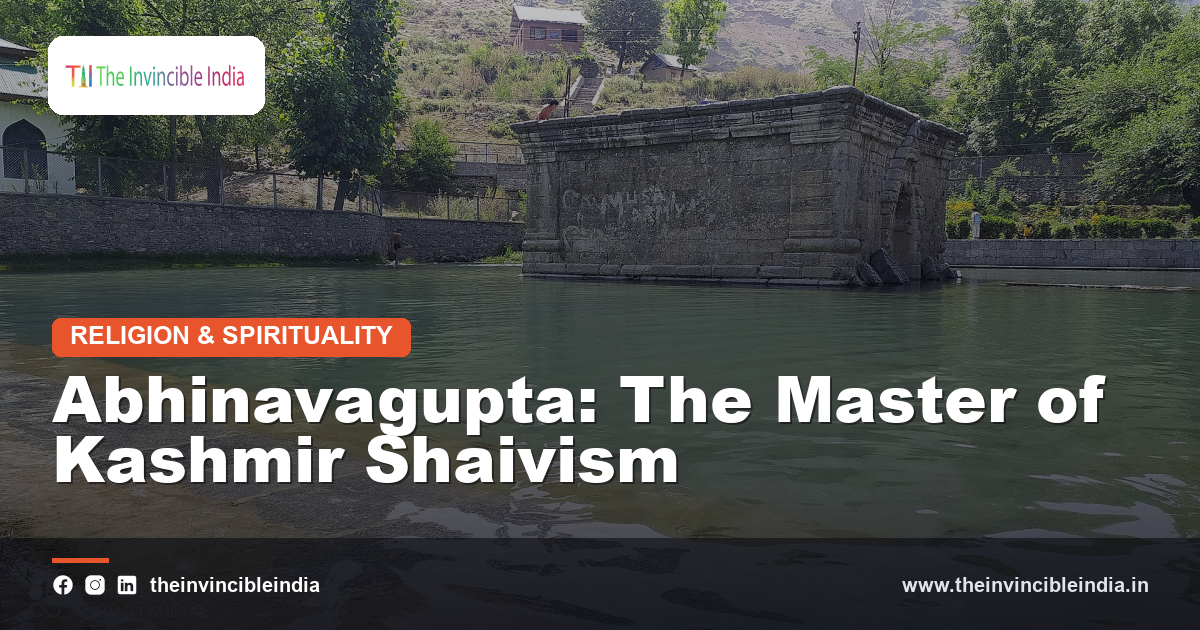
Abhinavagupta, also written Abhinava Gupta or called Abhinavaguptapada, is the Kashmiri philosopher, mystic and aesthetician who gave the non-dual Shaiva tradition of Kashmir its fullest and most systematic form. Working in the tenth and eleventh centuries, he drew together the Trika and Pratyabhijna streams of Shaivism, wrote the monumental Tantraloka and composed commentaries that remain central to Indian theories of art and drama. His thought stands among the high points of Shaivism, and it continues to attract scholars and practitioners across the world.
Quick answer: Abhinavagupta is a Kashmiri philosopher, tantric master and theorist of aesthetics who lived around the turn of the first millennium and became the supreme authority of Kashmir Shaivism. He is best known for the Tantraloka, a vast work on the Trika system, for his writings on the Pratyabhijna school of recognition, and for commentaries that shaped the Indian theory of rasa. His influence reaches across philosophy, religion and the arts of India.
Key Takeaways
- Abhinavagupta was a Kashmiri philosopher and mystic active in the tenth and eleventh centuries.
- His great work, the Tantraloka, gives a comprehensive account of the Trika system of Shaivism.
- He expounded Pratyabhijna, the philosophy of recognition, which teaches that the self is identical with Shiva-consciousness.
- His commentary Abhinavabharati on the Natyashastra became a foundation of Indian aesthetic theory.
- His Locana commentary on the Dhvanyaloka is a landmark of Sanskrit literary criticism.
- Kashmir Shaivism, the tradition he perfected, is a non-dual system that sees the world as the free expression of Shiva.
The sections below explain the life, works, teachings and continuing legacy in more detail.
Quick Facts
| Detail | Information |
|---|---|
| Also known as | Abhinava Gupta, Abhinavaguptapada |
| Region | Kashmir, India |
| Era | Tenth to eleventh century CE |
| Tradition | Kashmir Shaivism (Trika and Pratyabhijna) |
| Major work | Tantraloka |
| Aesthetic work | Abhinavabharati and Locana |
| Language | Sanskrit |
| Significance | Foremost thinker of Kashmir Shaivism |
Who Was Abhinavagupta?
Abhinavagupta was a scholar, philosopher and mystic of Kashmir who flourished around the end of the tenth century and the beginning of the eleventh. He is regarded as the greatest figure in the tradition of Kashmir Shaivism and as one of the finest minds in the history of Indian thought. His writings in Sanskrit range from metaphysics and ritual to poetics and the theory of drama.
Beyond this, the details of his life are partly known from his own works, in which he mentions teachers and his family, and partly from later tradition. Because dates in early Indian history are often approximate, the era is stated in general terms. What is certain is his towering reputation among later scholars of Shaiva and literary traditions.
What Is Kashmir Shaivism?
Kashmir Shaivism is a non-dual philosophical and religious tradition that arose in Kashmir and teaches that all reality is the expression of a single conscious principle, Shiva. It is sometimes called Trika Shaivism, after its threefold structure, and its philosophical wing is known as Pratyabhijna. Unlike strictly monistic systems that treat the world as illusion, it regards the world as a real manifestation of divine freedom.
The tradition draws on scriptural sources called the Agamas and on a line of teachers who interpreted them. It values both knowledge and practice, and it integrates ritual, yoga and contemplation. Abhinavagupta occupies the pinnacle of this tradition as its great synthesiser.
What Does Trika Mean?
Trika means threefold, and it refers to the triads that structure the Shaiva system of Kashmir. These include the three energies of will, knowledge and action, and the three levels of reality associated with Shiva, Shakti and the individual soul. The term also points to a set of scriptures and a particular approach to worship.
Trika thought treats the divine as both transcendent and immanent, so that ordinary experience becomes a field of recognition. Abhinavagupta organised these ideas into a coherent framework and showed how the many practices of the tradition fit together. His work made the Trika a complete system of metaphysics, ritual and liberation.
What Is the Tantraloka?
The Tantraloka is Abhinavagupta’s greatest work, a very large Sanskrit poem in verse that presents the entire system of the Trika. Its title is often rendered as the Light on the Tantras. It covers philosophy, the paths of spiritual practice, ritual, initiation and the nature of liberation.
The work draws on earlier scriptures and shows how their teachings form a unified doctrine. Because of its scale and subtlety, it is considered demanding even for specialists, and later writers produced summaries such as the Tantrasara. The Tantraloka is valued as the most comprehensive encyclopedia of the Kashmiri Shaiva tradition.
What Is Pratyabhijna Philosophy?
Pratyabhijna is the philosophy of recognition, which holds that liberation consists in recognising one’s own nature as identical with the supreme consciousness of Shiva. The word means re-cognition, the recognition of something that was always present. The school was formulated by Somananda and developed by his disciple Utpaladeva before Abhinavagupta.
Abhinavagupta wrote major commentaries on Utpaladeva’s verses, among them the Isvarapratyabhijnavimarsini. These works argue that the self is not bound in any final sense but only forgets its freedom. The path to release is therefore a path of remembering, supported by teaching, grace and contemplation.
Who Were His Teachers and Predecessors?
Abhinavagupta studied under several teachers, and he names them in his writings with great respect. Among them were masters of the Trika, of the Krama tradition and of literary and dramatic theory. He is known to have learned from experts in different fields, which helps explain the breadth of his work.
His predecessors in the philosophical line include Vasugupta, traditionally associated with the Shiva Sutras, as well as Somananda and Utpaladeva. This lineage provided the materials which he refined. The picture is of a scholar who honoured his teachers while bringing a new level of synthesis to their insights.
Why Is Abhinavagupta Important in Indian Aesthetics?
Abhinavagupta is important in aesthetics because his commentaries shaped the classical Indian understanding of art, emotion and the experience of beauty. He wrote the Abhinavabharati, a commentary on the Natyashastra, the ancient treatise on drama attributed to Bharata, and the Locana, a commentary on the Dhvanyaloka of Anandavardhana. Together they form a cornerstone of Sanskrit literary theory.
His approach links the experience of art with spiritual experience, treating aesthetic delight as a glimpse of the consciousness that underlies all things. This union of philosophy and poetics is one of the distinctive achievements of Indian thought. Later critics returned to his writings as an authority.
What Is the Theory of Rasa?
The theory of rasa is the Indian doctrine that the audience of a drama or poem savours a universalised emotional flavour, called rasa, rather than the personal feeling of the characters. Bharata’s Natyashastra names the classical rasas, such as love, heroism and compassion. Abhinavagupta explained how these emotions are experienced by a spectator in a state of detached delight.
He also gave special attention to shanta rasa, the flavour of peace, which he connected with the highest spiritual calm. His analysis treats art as a path to a refined awareness that resembles contemplation. This idea made rasa a central concept in Indian music, dance, theatre and literature.
What Is Dhvani and Why Does the Locana Matter?
Dhvani is the theory of suggestion, the idea that the deepest meaning of poetry lies in what is suggested beyond the literal words. Anandavardhana set out this doctrine in the Dhvanyaloka, and Abhinavagupta wrote the Locana to explain and defend it. The title means the eye, suggesting that the commentary gives sight to the text.
The Locana ties suggestion to the experience of rasa and treats it as the soul of poetry. Its arguments helped establish dhvani as the mainstream view in Sanskrit literary theory. The commentary remains a standard guide for students of classical poetics.
What Are His Other Major Works?
Abhinavagupta’s other major works include the Paramarthasara, a concise verse summary of non-dual teaching, the Malinivijayavarttika, a study of an important scripture of the Trika, and the Tantrasara, a shorter exposition of his system. He is also credited with texts on ritual and devotional hymns. The catalogue of his writings shows an extraordinary range.
Some of these works are brief and meant for initiates, while others are massive and technical. Taken together, they show an intellect that moved between metaphysics, practice and art with ease. Specialists continue to edit and translate them, and new studies appear regularly.
How Does Kashmir Shaivism View the World and the Self?
Kashmir Shaivism views the world as a real expression of the free creative power of Shiva, and it sees the self as essentially identical with that consciousness. Creation is described as a play in which the one reality manifests as many, without being divided. This outlook affirms the world instead of rejecting it.
Bondage is explained as a self-limitation, and liberation as a recognition of one’s inherent freedom. The tradition therefore values every sphere of life as a possible field for realisation. Abhinavagupta’s writings present this vision with unusual clarity and depth.
What Is the Role of Shakti in His System?
Shakti is the dynamic power of Shiva, and in the Trika system she is inseparable from the divine consciousness. Shiva and Shakti are described as two aspects of one reality, like fire and its heat. Through her, the universe appears, is sustained and is withdrawn.
Abhinavagupta emphasises that the divine power operates in the faculties of perception and action, so that ordinary experience is shot through with the sacred. The teaching connects the individual with a larger cosmic rhythm. It also explains why art, knowledge and ritual can all become modes of recognition.
Where Did Abhinavagupta Live and What Does Tradition Say of His End?
Abhinavagupta lived in Kashmir, in the region of the Vitasta river, which is today part of the Union Territory of Jammu and Kashmir. Tradition places his later life in meditation and teaching among a circle of disciples. A widely repeated devotional account says that he entered a cave with many followers and was not seen again.
This story is associated in tradition with the Bhairava cave near Beerwah, and it should be read as a pious tradition and not as verified history. Visitors still show interest in the site, which is linked with his memory. The account expresses the reverence in which later generations held him.
How Did His Thought Spread and Influence Later Traditions?
His thought spread through disciples, commentaries and manuscripts, and it influenced Shaiva and literary traditions well beyond Kashmir. Writers such as his student Kshemaraja carried the teaching forward in works of their own. Manuscripts of his texts travelled across the subcontinent.
In modern times, translations and scholarly studies have brought Kashmir Shaivism to a worldwide audience. Universities and research institutes now study his philosophy, and practitioners of yoga and meditation draw on his teachings. The reach of his ideas shows how a regional tradition can speak to universal questions.
How Does Abhinavagupta Relate to Other Streams of Shaivism?
Abhinavagupta relates to other streams of Shaivism as a thinker who respected diversity within a shared devotion to Shiva. The wider Shaiva world includes the Shaiva Siddhanta of the south, the Lingayat tradition and the Nath path, each with its own emphasis. Kashmir Shaivism stands out for its non-dual outlook and its intellectual rigour.
Readers who wish to see the larger picture can explore the history of devotion to Shiva across India, including temples, philosophies and festivals. Abhinavagupta’s work forms one of the most sophisticated chapters in that history. It shows how worship and thought can enrich one another.
Abhinavagupta Today
Abhinavagupta today is studied as a philosopher, a mystic and a pioneering theorist of aesthetics, and his texts are read in Sanskrit and in translation. His ideas on recognition, consciousness and art continue to attract scholars of religion, literature and the performing arts. Dancers, actors and musicians still speak of rasa in terms he helped to clarify.
His lasting significance lies in the way he joined deep metaphysics with an appreciation of beauty and human experience. The master of Kashmir Shaivism remains one of the most respected figures in the intellectual heritage of India.
Sources & Further Reading
- Ministry of Culture, Government of India (indiaculture.gov.in).
- Sahitya Akademi, India’s National Academy of Letters (sahitya-akademi.gov.in).
Frequently Asked Questions
Who was Abhinavagupta?
Abhinavagupta was a Kashmiri philosopher, mystic and aesthetician of the tenth and eleventh centuries and the foremost thinker of Kashmir Shaivism. He wrote the Tantraloka and important commentaries on drama and poetics.
What is the Tantraloka?
The Tantraloka is Abhinavagupta’s greatest work, a vast Sanskrit poem that presents the whole system of the Trika. It covers philosophy, ritual, initiation and the nature of liberation.
What is Pratyabhijna?
Pratyabhijna is the philosophy of recognition in Kashmir Shaivism, which teaches that liberation is the recognition of one’s identity with Shiva-consciousness. It was developed by Somananda and Utpaladeva and expounded by Abhinavagupta.
What did Abhinavagupta contribute to Indian aesthetics?
Abhinavagupta contributed the Abhinavabharati, a commentary on the Natyashastra, and the Locana, a commentary on the Dhvanyaloka. These works shaped the theories of rasa and dhvani in Sanskrit literary criticism.
Is Kashmir Shaivism dualist or non-dual?
Kashmir Shaivism is a non-dual tradition that regards all reality as the expression of one conscious principle, Shiva. Unlike some monistic schools, it treats the world as a real manifestation and not as illusion.
Where did Abhinavagupta live?
Abhinavagupta lived in Kashmir, in the valley of the Vitasta river, in what is today Jammu and Kashmir. Tradition links the end of his life with a cave near Beerwah, though this is a devotional account.


