

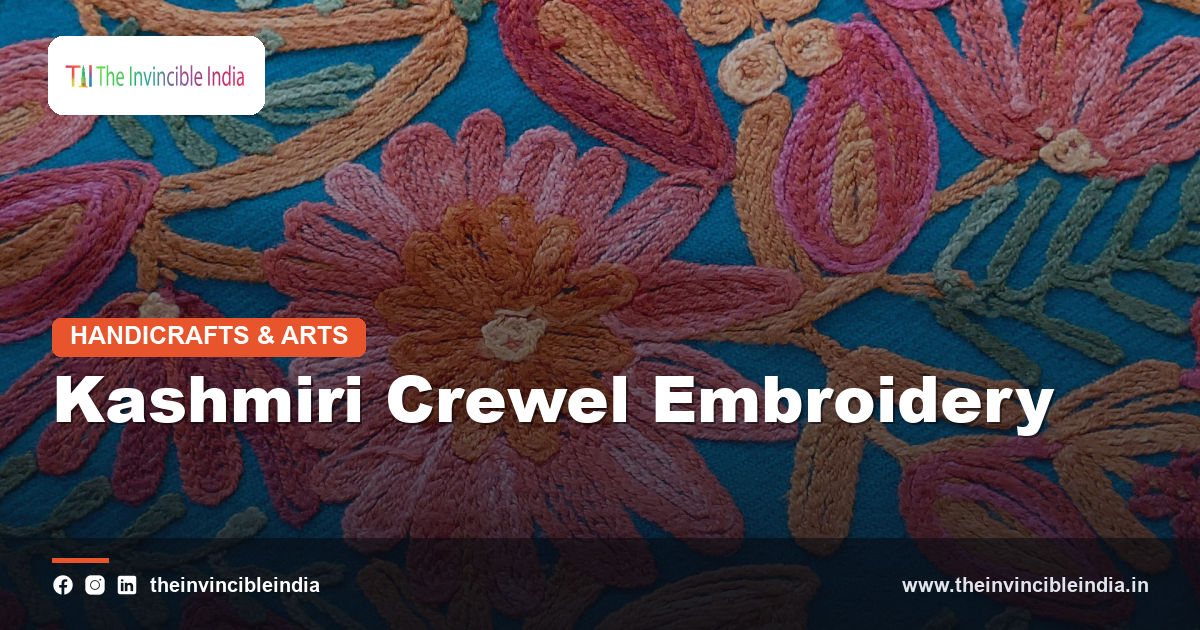
Kashmiri crewel embroidery is a traditional needlework of the Kashmir Valley in which bold floral and leaf designs are worked in chain stitch on cloth, using a hooked needle known locally as the aari. It is also called crewel work, Kashmir chain stitch or aari work, and it is closely associated with Srinagar and the surrounding valley. Crewel pieces are valued as furnishing textiles, especially curtains, cushion covers, bedspreads and wall hangings, because the stitched surface is textured and durable. Where the fine needlework of Kashida embroidery is delicate and detailed, crewel is broader, bolder and more sculptural in effect.
Quick answer: Kashmiri crewel embroidery is a handcrafted chain-stitch needlework of the Kashmir Valley, worked with a hooked needle on cotton, wool or similar cloth to create bold floral and leaf designs. Also known as crewel work or aari work, it is used mainly for curtains, bedspreads, cushion covers and other furnishings. The craft is centred on Srinagar and remains an important source of livelihood for Kashmiri artisans.
Key Takeaways
- Kashmiri crewel embroidery is a chain-stitch needlework tradition of the Kashmir Valley in northern India.
- It is also known as crewel work, aari work or Kashmir chain stitch.
- The stitching is done with a hooked needle, which makes a continuous looped chain on the cloth.
- Typical motifs include flowers, leaves, vines, birds and the chinar leaf.
- Crewel is used mainly for curtains, bedspreads, cushion covers, rugs and wall hangings.
- The craft is practised by artisans in and around Srinagar and supports many households in the valley.
The sections below explain the origins, technique, motifs and continuing role of this craft.
Quick Facts
| Detail | Information |
|---|---|
| Type | Chain-stitch hand embroidery |
| Region | Kashmir Valley, Jammu and Kashmir |
| Main centre | Srinagar |
| Tool | Hooked needle (aari) |
| Typical motifs | Flowers, leaves, vines, birds |
| Main products | Curtains, bedspreads, cushions, wall hangings |
What Is Kashmiri Crewel Embroidery?
Kashmiri crewel embroidery is a form of hand embroidery in which designs are created in chain stitch, forming a continuous looped line that fills the surface of the cloth. The word crewel originally refers to a type of loosely twisted wool yarn used in embroidery, and the term has come to describe the style of bold, raised needlework made with it. In Kashmir the work is usually done with a hooked needle that draws thread through the fabric from above. The result is a rich, textured surface with strong outlines and filled shapes. Because the stitches are thick and close, crewel gives furnishing fabrics a distinctive depth. The craft is therefore best known as a tactile, decorative embroidery of the valley.
Where Is Crewel Work Made in Kashmir?
Crewel work is made in the Kashmir Valley, with Srinagar as the main centre of the craft. Artisans work in homes and small workshops in the city and in surrounding towns and villages. Kashmir has a long reputation for textile arts, including shawl weaving, carpet making and several kinds of embroidery, and crewel forms part of this broad ecosystem of skills. The valley’s climate, with cold winters and an indoor life during the colder months, has historically encouraged needlework as a household occupation. The craft is thus rooted in a place where woollen textiles and decorative furnishings have always mattered. Crewel is closely identified with Srinagar and the valley around it.
How Did Crewel Embroidery Develop in Kashmir?
Crewel embroidery developed in Kashmir as part of the valley’s wider textile and embroidery heritage, which was shaped by contact with Central Asian and Persian artistic ideas. Exact dates for the beginning of the craft are not firmly established, and popular stories about its origin should be treated with caution. What is clear is that chain-stitch embroidery was long practised in the region and that the hooked-needle method became closely associated with Kashmir. Demand from visitors and traders over many generations encouraged artisans to adapt designs to curtains, covers and furnishings. The craft therefore grew through steady local practice and gradual adaptation. Its history is best described as a continuing tradition rather than a single founding moment.
What Is the Aari Needle?
The aari is a hooked needle used to make chain stitch in Kashmiri crewel and related embroidery. It resembles a small crochet hook set in a handle, and the artisan holds it above the cloth while the thread is supplied from below. With each movement the hook catches the thread and pulls a loop to the surface, linking one loop to the next into a continuous chain. This method allows quick, even stitching and gives the characteristic raised look. A skilled worker can follow curves and fill large areas with ease. The aari is therefore the key tool of the craft, and mastery of it distinguishes experienced crewel embroiderers from beginners.
Which Fabrics and Threads Are Used?
Kashmiri crewel is worked on sturdy base cloths such as cotton, wool and linen-type fabrics, which can hold dense stitching without puckering. The threads are traditionally woollen, which gives a soft, matte and slightly raised finish, though cotton and other yarns are also used for particular products. Thread colours range from earthy natural tones to bright hues, depending on the design and the market. The base cloth is chosen to suit the use, so that curtains, bedspreads and cushion covers each receive an appropriate weight. Careful choice of cloth and thread helps the embroidery last through years of use. Material selection is therefore an important part of making a good crewel piece.
What Motifs Appear in Kashmiri Crewel?
Kashmiri crewel is known above all for floral and vegetal motifs inspired by the natural beauty of the valley. Flowers, leaves, trailing vines, fruit and birds are arranged in flowing patterns, often with a large central bloom or a repeating border. The chinar leaf, linked with the maple-like trees of Kashmir, is a familiar motif in the region’s art. Designs are usually stylised, with simplified shapes and strong outlines that suit the bold chain stitch. Symmetry and balance guide the layout, so that the finished piece feels harmonious. The motifs make crewel a visual expression of the valley’s gardens and landscape, and they give the craft its immediately recognisable character.
How Is a Crewel Design Made?
A crewel design is made in several steps that move from pattern to finished embroidery. A design is first prepared and transferred to the cloth, traditionally by tracing or stencilling the outline. The embroiderer then stretches the fabric on a frame so that it stays taut. Using the aari, the worker stitches the outlines and then fills the shapes in chain stitch, working steadily across the surface. Colours are changed as the design requires, and the finished embroidery is trimmed and prepared for use. The process demands patience and a steady hand, since even tension and regular stitches define the quality of the work. Careful stages produce the smooth, rich finish expected of good crewel.
What Is Crewel Embroidery Used For?
Crewel embroidery is used mainly for home furnishings, because its heavy, textured stitching suits curtains, bedspreads, cushion covers, wall hangings and rugs. The embroidery adds warmth and visual interest to interiors, and the sturdy cloth wears well over time. Crewel pieces are also made as upholstery fabrics and decorative panels. In recent years designers have used crewel motifs on garments, bags and accessories, extending the craft beyond the home. The wide range of uses has helped the tradition adapt to changing tastes. Crewel is therefore valued both as a practical furnishing textile and as a decorative art, and its versatility supports continued demand for the work.
How Does Crewel Differ from Other Kashmiri Embroidery?
Crewel differs from other Kashmiri embroidery in its bold chain stitch, thick thread and large-scale designs. Sozni, the fine needlework used on shawls, relies on delicate stitches that mimic woven patterns, and Kashida embroidery is generally finer and more detailed than crewel. Crewel, by contrast, uses the hooked aari needle and produces a raised, looped surface that reads clearly from a distance. The result is well suited to large furnishing pieces rather than fine garments. These differences show how varied Kashmiri embroidery is, with each type matched to a use and an aesthetic. Crewel therefore stands as the sturdy, decorative branch of the valley’s needlework family.
Who Are the Artisans Behind the Craft?
The artisans behind Kashmiri crewel are skilled embroiderers who learn the craft through family and workshop apprenticeship. Designs and techniques pass from experienced workers to younger ones, and a team may divide tasks such as pattern preparation, stitching and finishing. In many households the work is a major source of income, and it supports small businesses linked to the wider craft economy of Srinagar. The skill is learned by long practice rather than by formal study. Artisans carry the knowledge of motifs and colours in memory and habit. Their expertise is the real foundation of the craft, which depends on human hands and trained eyes rather than machines.
Why Is Crewel Work Important to Kashmiri Heritage?
Crewel work is important to Kashmiri heritage because it carries the valley’s love of flowers, gardens and decorative craft into everyday objects. The embroidery links present-day artisans with a long tradition of textile skill and keeps alive designs that reflect local landscape and taste. It also supports livelihoods in a region where handicrafts are a significant part of cultural and economic life. As a portable and durable art, crewel has carried the name of Kashmir to homes far beyond the valley. The craft thus acts as both a cultural emblem and an economic resource, and its survival matters for the continuity of Kashmiri artistic identity.
How Should Crewel Pieces Be Cared For?
Crewel pieces should be cared for gently, because the raised chain stitch and woollen thread can be damaged by rough handling. Gentle cleaning, often by dry cleaning or careful hand washing as advised for the particular cloth and thread, helps preserve colour and texture. Direct strong sunlight can fade dyes, so curtains and hangings last longer when protected from harsh light. Pieces should be stored folded in a dry, clean place and kept away from moths and damp. Careful handling prevents snagging of the looped stitches. With sensible care, a well-made crewel textile can remain attractive for many years, and good maintenance is part of respecting the labour that went into the work.
How Can You Recognise Genuine Handwork?
Genuine hand-worked crewel can be recognised by the slight irregularity of its chain stitches, the dense and even coverage of the design and the neatness of the reverse side. Machine imitations often show a flatter surface, perfectly uniform stitches and a different structure of thread on the back. Handwork tends to feel fuller and more dimensional, with a pleasing richness in the looped line. Buyers who wish to support artisans can ask about the maker, the workshop and the method used. Looking closely at the stitching is the simplest test. Knowing these signs helps people appreciate the skill involved and choose authentic work with confidence.
What Challenges Does the Craft Face?
The crewel craft faces challenges common to many traditional handicrafts, including competition from cheaper machine-made imitations and uncertain market demand. Rising costs of materials and the long hours required for handwork can make it difficult for artisans to earn a steady living. Younger people may also look to other occupations that offer more predictable income. Disruptions in the region over the years have affected trade and tourism, which are important to the craft. Support from cooperatives, training programmes and fair-trade markets can help address these pressures. Understanding the challenges explains why careful buying and public appreciation matter, since they sustain the people who keep the tradition alive.
Kashmiri Crewel Embroidery Today
Kashmiri crewel embroidery today continues as a living craft that serves both traditional furnishing markets and modern interior design. Artisans in Srinagar and the valley still stitch curtains, covers and hangings by hand, and designers adapt crewel motifs to new products and colour schemes. Exhibitions, craft fairs and online platforms have widened the audience for the work. The tradition remains a symbol of Kashmiri artistry, combining skill, floral beauty and practical use. As long as artisans continue to pass on the aari technique and buyers value handmade quality, crewel will remain a vibrant part of the valley’s cultural and economic life.
Sources & Further Reading
- Ministry of Textiles, Government of India (texmin.nic.in).
- Development Commissioner (Handicrafts), Government of India (handicrafts.nic.in).
Frequently Asked Questions
What is Kashmiri crewel embroidery?
Kashmiri crewel embroidery is a chain-stitch needlework of the Kashmir Valley, worked with a hooked needle on cloth to create bold floral and leaf designs. It is mainly used for curtains, bedspreads, cushion covers and other furnishings.
What stitch is used in Kashmiri crewel work?
Chain stitch is the stitch used in Kashmiri crewel work. It is made with a hooked needle called the aari, which pulls loops of thread through the cloth to form a continuous chain.
Where is crewel embroidery made in Kashmir?
Crewel embroidery is made in the Kashmir Valley, with Srinagar as its main centre. Artisans also work in surrounding towns and villages.
What is crewel embroidery used for?
Crewel embroidery is used for curtains, bedspreads, cushion covers, rugs, upholstery and wall hangings. Designers also use its motifs on bags, garments and accessories.
What is the difference between crewel and Kashida embroidery?
Crewel uses bold chain stitch with a hooked needle and large designs, mainly for furnishings. Kashida embroidery is generally finer and more detailed, and it is often used on shawls, garments and smaller items.
How can you tell if crewel embroidery is handmade?
Handmade crewel shows slightly varied chain stitches, a full and dimensional surface and a neat reverse side. Machine work usually looks flatter and more uniform.


