

The Scindia dynasty of Gwalior, also spelled Sindhia, Shinde or Scindhia, was a Maratha family that rose in the service of the Peshwas in the eighteenth century and later ruled the princely state of Gwalior in central India. Their title was Maharaja, and their rulers are often listed with the honorific Srimant. From a base in Malwa they became one of the most powerful forces in north India, and their capital eventually settled at Gwalior. The origins and early career of the family are partly traditional, so this guide keeps to general terms where records differ. The larger setting is described in our history of the Maratha Empire.
Quick answer: The Scindia dynasty of Gwalior was a Maratha ruling family, founded by Ranoji Scindia in the service of the Peshwas, that became a leading power in north India in the eighteenth century and later ruled the princely state of Gwalior until it joined India after independence. They are remembered for Mahadji Scindia’s role in Delhi, for Jai Vilas Palace and for patronage of music and public works.
Key Takeaways
- The Scindias were a Maratha family that rose from military service under the Peshwa Baji Rao I, with Ranoji Scindia as the founder.
- Mahadji Scindia restored Maratha power in north India after the defeat at Panipat and acted as protector of the Mughal emperor at Delhi.
- The family used the title Maharaja and eventually made Gwalior, with its famous hill fort, their capital.
- Jai Vilas Palace in Gwalior, built in the nineteenth century, remains the family residence and a major museum.
- The Scindias patronised classical music, and Gwalior is regarded as the home of an influential musical gharana.
- After independence the state of Gwalior merged into India, and later family members entered democratic politics.
Read on for the history, culture, and legacy in detail.
Quick Facts
| Detail | Information |
|---|---|
| Dynasty | Scindia (Sindhia, Shinde), Maratha rulers of Gwalior |
| Founder | Ranoji Scindia, general under the Peshwa Baji Rao I |
| Title | Maharaja |
| State | Gwalior, a princely state in central India |
| Landmarks | Gwalior Fort and Jai Vilas Palace |
| Legacy | Maratha power in the north, music patronage, modern politics |
Who Were the Scindias?
The Scindias were a Maratha family of warriors and administrators who rose to royal rank in the eighteenth century through service to the Peshwas. Their surname appears in different forms, including Shinde and Sindhia, and the family claimed a long local pedigree in the Maratha country of present-day Maharashtra. Some traditions describe their earlier standing as village headmen, while later court histories emphasise nobler descent, and the question of origins is debated. What is not in doubt is that the family produced several capable military leaders who built a state in Malwa and then in the north. Their rise belongs to the larger story of the Maratha confederacy, in which commanders won territory by service and ability. The Scindias thus began as soldiers of the Peshwa and ended as one of the major ruling houses of India.
What Is Known About Ranoji Scindia?
Ranoji Scindia is the founder of the dynasty, a cavalry officer who rose to high command under the Peshwa Baji Rao I. A popular story says he began as a modest attendant and was noticed for his loyalty, though such tales are traditional and cannot be fully verified. What the sources agree on is that he took part in the Maratha expansion into Malwa and received territorial rights, including a base in Ujjain, the old city on the Shipra river. From there he collected revenue, kept troops and supported the Peshwa’s campaigns. His death left a family with a solid regional footing and a group of capable sons. Ranoji’s importance lies in establishing the pattern of service, grants and local governance that later Scindia rulers expanded into a major power.
How Did the Scindias Rise in Malwa?
The Scindias rose in Malwa by combining military service with careful management of revenue rights granted by the Peshwa. Malwa, a fertile plateau on the route between the Deccan and the north, had come under Maratha influence after the campaigns of Baji Rao I, and the Scindias and Holkars received shares of its income. Ujjain served as a capital and a centre of administration, with its ancient temples and river ghats adding religious prestige. By collecting taxes, keeping order and maintaining troops, the family established itself as a regional power rather than simply a military arm of Pune. Their position in Malwa also placed them on the road to Delhi, so that later generations could move easily between central India and the Mughal capital. This regional base gave the family strength to act on a larger stage.
Why Is Mahadji Scindia So Important?
Mahadji Scindia is the most important figure of the dynasty because he rebuilt Maratha power in north India after the defeat at Panipat and became the leading military force around Delhi. Having survived the battle, he returned to the north in the following years and worked to recover influence over the Mughal emperor Shah Alam II, whom he escorted back to Delhi and served as protector. He used his position to extend Maratha authority across large areas of Hindustan and to reorganise the army. His diplomacy also helped end the first war with the British, since he acted as a mediator in the settlement known as the Treaty of Salbai. Historians admire his political realism and administrative talent. His death left a gap, but the strong position he had built lasted into the next generation.
How Did the Scindia Army Change Under Mahadji?
The Scindia army changed under Mahadji by adding disciplined infantry and artillery trained on European lines to the traditional Maratha cavalry. To build this force he employed European officers, the best known being the Savoyard commander Benoit de Boigne, and established arms factories and foundries to supply the troops. Regular pay and drill gave the army greater cohesion than a collection of feudal levies. The reforms reflected an awareness that warfare was changing and that cavalry alone could not face modern firearms and cannon. The new army won several important victories and increased Mahadji’s influence in north India. It also showed how Indian rulers adapted European methods without surrendering their own political aims. The reforms therefore form one of the best-known examples of military modernisation in eighteenth-century India.
What Role Did the Scindias Play in Delhi?
The Scindias played the role of guardians of the Mughal court in Delhi, acting in the name of the emperor while exercising real power. After Mahadji brought Shah Alam II back to the capital, Maratha officers handled defence, revenue and appointments on behalf of the emperor, who retained his title but little independent authority. The arrangement gave the Marathas a legal claim to govern large territories and gave the emperor protection from rival chiefs. It lasted until the early nineteenth century, when British forces defeated Scindia armies in the Second Anglo-Maratha War and took control of Delhi. The episode shows how the declining Mughal throne remained a source of legitimacy even for powerful rulers who did not claim it. The Scindias’ Delhi years remain a famous chapter in the late history of the capital.
How Did Gwalior Become the Scindia Capital?
Gwalior became the Scindia capital when the family moved its headquarters from Ujjain to the old fort city in the early nineteenth century, after the territorial settlements that followed the Anglo-Maratha wars. Gwalior was already a famous stronghold, with a great hill fort that had been held by Tomar Rajputs, Mughals and many others over the centuries. Under Scindia rule a new town grew at the foot of the hill, known as Lashkar, named after the army camp from which it started. The location offered a central position between north and central India, with good routes and a secure fortress. The move marked the shift of the dynasty from a roaming military power to a settled princely state. Gwalior has remained the symbol of the family ever since.
What Is Gwalior Fort Known For?
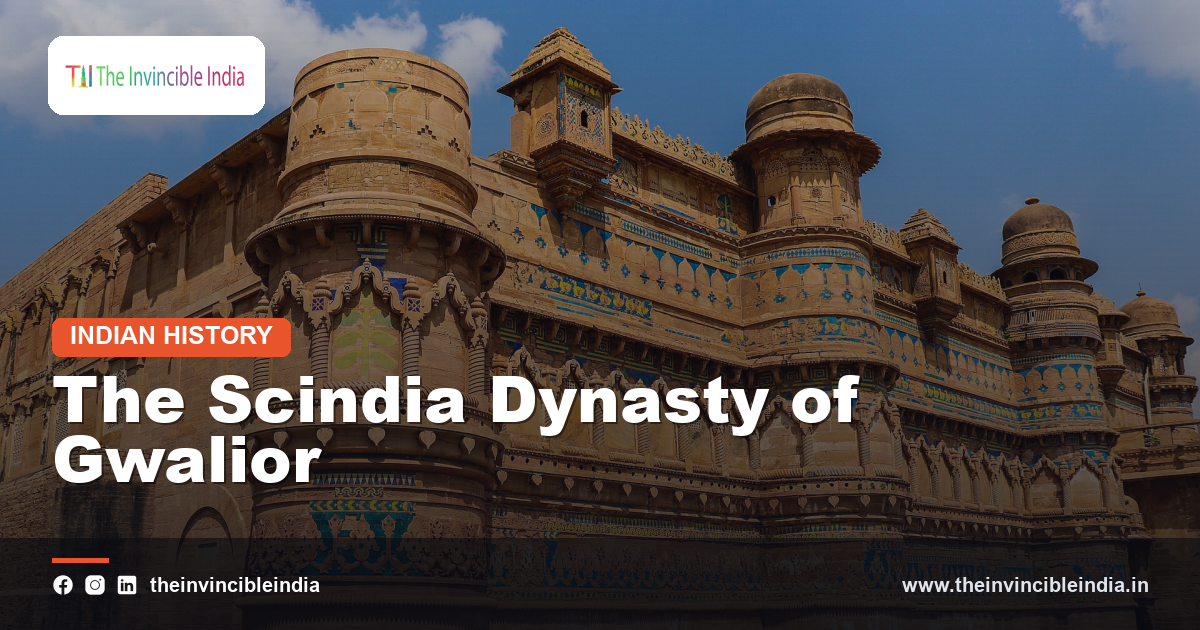
Gwalior Fort is known as one of the most impressive hill forts in India, standing on a long sandstone rock above the city and containing palaces, temples and water tanks. The Man Mandir Palace, built by the Tomar ruler Man Singh in the early sixteenth century, is celebrated for its tile and stone decoration. The fort also holds the Teli ka Mandir, a high temple, and the twin Sas-Bahu temples, along with Jain rock sculptures cut into the cliff. Over the centuries it served as a fortress, a prison for state captives and a symbol of political power. The Scindias held the fort and used it for administration and ceremony. Today it is a protected monument and a major tourist destination, a place where the layers of Indian history are visible in a single hill.
What Is Jai Vilas Palace?
Jai Vilas Palace is the grand nineteenth-century residence of the Scindia family in Gwalior, built in a European-inspired style and now partly open as a museum. Maharaja Jayajirao Scindia had it constructed, with the design drawing on Italian and other classical influences, and its halls include a huge durbar hall decorated with large chandeliers. Popular lore says the strength of the ceiling was tested with heavy loads before the lights were hung, a story often told to visitors, though such details are traditional. The museum displays weapons, carriages, paintings, furniture and personal objects, offering a view of princely life in the colonial period. The palace is part of a wider tradition in which Indian rulers combined local and European styles to express rank. It remains one of the most visited landmarks of Madhya Pradesh.
How Did the Scindias Deal With the British?
The Scindias dealt with the British first as opponents in the Anglo-Maratha wars and then, from the early nineteenth century, as subordinate allies within the system of princely states. After defeat in the second war the family signed treaties that limited its independence and accepted British influence in its affairs. Over the later nineteenth century the rulers of Gwalior generally cooperated with the colonial government, and the state kept its internal administration under a British Resident’s oversight. During the revolt of 1857 the Gwalior ruler stayed on the British side, though some of his troops joined the rebels, and the fort city saw serious fighting in 1858. Views on this stance vary among historians and local memory. The story is a clear example of how Indian rulers had to adapt to a new balance of power.
What Was Gwalior Like as a Princely State?
Gwalior as a princely state was one of the larger and better-known states of central India, with a ruler who held the title Maharaja and a distinct administration, army and courts. Under the later Scindia rulers the state built railways, irrigation works, schools and hospitals, and the capital gained broad roads and public buildings. The rulers took part in imperial ceremonies, and the state was entitled to a high rank in the order of precedence of princely India. Alongside modern institutions the court preserved older customs, including religious festivals and state processions. As with other princely states, the degree of reform depended on the ruler, and historians assess the record with both praise and criticism. Gwalior’s state period left a visible mark on the architecture and public institutions of the region.
How Did the Scindias Patronise Music and Culture?
The Scindias patronised music and culture by supporting court musicians, building palaces and temples and encouraging scholarship in Gwalior. The city is regarded as the home of the Gwalior gharana, one of the oldest schools of Hindustani classical music, and the earlier Tomar court of Man Singh is credited with promoting the dhrupad tradition there. The tomb of the legendary musician Tansen at Gwalior draws musicians every year to an annual festival that continues the old tradition. The Scindia court also encouraged painting, architecture and the observance of religious festivals. These patronage habits turned Gwalior into a cultural centre as well as a political one. The tradition lives on in the concerts and teaching institutions of the city, showing how royal support helped preserve a living art over many generations.
How Did the Scindias Join Independent India?
The Scindias joined independent India when the ruler of Gwalior signed the instrument of accession after 1947, and the state was merged with neighbouring princely states to form a new Indian unit. In the first years after independence Gwalior became part of the union called Madhya Bharat, in which the Scindia ruler served as a leading figure, and this unit was later merged into the larger state of Madhya Pradesh. Like other princes, the family gave up its sovereign powers in return for privy purses and the retention of private property, arrangements that were later changed by constitutional amendment. The transition was peaceful and represented one of the great political integrations of the twentieth century. It ended royal rule in Gwalior but did not end the family’s public role in the region.
What Is the Scindia Family Role in Modern India?
The Scindia family remained active in public life after independence, with several members entering politics at both state and national levels. Vijaya Raje Scindia became a prominent leader of a major political party, and her family continued the tradition, with later generations serving as members of parliament and ministers. The family also manages heritage properties in Gwalior, including parts of Jai Vilas Palace, and is associated with schools, trusts and cultural events. Opinions about their political careers vary, as with any public figures, and this guide does not take a political position. The family illustrates how many former ruling houses adapted to democracy by turning old local standing into elected roles. Their continuing influence is part of the reason the Scindia name remains widely known across central India.
The Scindia Dynasty Today
The Scindia dynasty today is remembered through the monuments of Gwalior, the museum at Jai Vilas Palace and the continuing public presence of the family. Visitors to the city can see the fort, the palace, the old royal chhatris and the tomb of Tansen, each linking to a different layer of the story. Historians still debate the character of Mahadji Scindia’s achievement, the role of European-trained troops and the place of the Marathas in the decline of the Mughals. Gwalior’s music festivals and schools keep the cultural legacy alive. The dynasty stands for the northward energy of the Maratha confederacy and for the later adaptation of princely India to a new age. Its history connects the Deccan, central India and Delhi in a single narrative, which is why the Scindias remain central to Indian history.
Sources & Further Reading
- Archaeological Survey of India (asi.nic.in).
- Ministry of Culture, Government of India (indiaculture.gov.in).
Frequently Asked Questions
Who founded the Scindia dynasty?
Ranoji Scindia founded the Scindia dynasty as a general in the service of the Peshwa Baji Rao I in the early eighteenth century. He received rights in Malwa and used Ujjain as his base.
Why is Mahadji Scindia famous?
Mahadji Scindia is famous for restoring Maratha power in north India after Panipat and for acting as protector of the Mughal emperor in Delhi. He also modernised his army with European-trained infantry and artillery.
Where is Jai Vilas Palace?
Jai Vilas Palace is in Gwalior, Madhya Pradesh. It is the nineteenth-century residence of the Scindia family and part of it is open to the public as a museum.
What is Gwalior Fort famous for?
Gwalior Fort is famous for its hilltop setting, the Man Mandir Palace, the Teli ka Mandir and the Sas-Bahu temples. It is one of the best-known forts of central India.
Did the Scindias fight the British?
Yes, the Scindias fought the British in the Anglo-Maratha wars and were defeated in the early nineteenth century. After that they became subordinate allies within the princely state system.
What happened to Gwalior state after 1947?
Gwalior state acceded to India and was merged into the union of Madhya Bharat, which later became part of Madhya Pradesh. The ruling family gave up sovereign powers but stayed active in public life.


