

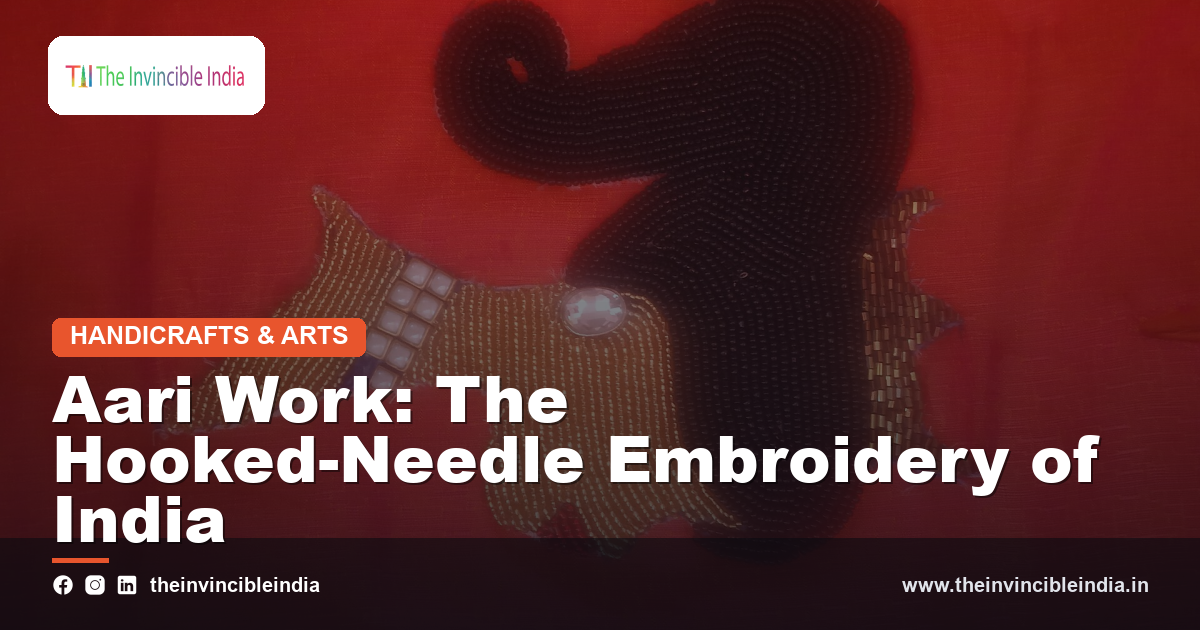
Aari work is the hooked-needle embroidery of India, a decorative craft in which a long, slim hook is used to pull thread, zari and beads through fabric to build dense, glowing designs. It is also written as ari work or arri work, and in parts of South India it is widely known as maggam work. The technique is closely related to the fine chain-stitch traditions of Kashmir and Kutch, and it sits alongside regional embroidery such as Kashida embroidery as one of the great needle arts of the subcontinent. Today it decorates bridal blouses, sarees, lehengas, shawls and home furnishings, carrying a courtly elegance from workshops large and small.
Quick answer: Aari work is a form of Indian embroidery in which a long hooked needle, the aari, is used to make chain stitches on fabric held taut on a frame. It is worked with silk thread, zari, beads and sequins, and it is found in Kashmir, Gujarat, Rajasthan, Uttar Pradesh and South India. It is valued for fast, even, richly textured surface decoration on bridal and festive clothing.
Key Takeaways
- Aari work is hooked-needle embroidery that forms chain stitches with a long, slim hook rather than a straight needle.
- It is also called ari work, arri work, tambour-style embroidery and, in Telugu-speaking regions, maggam work.
- The fabric is stretched on a wooden frame so that the worker can hold the hook above and the thread below.
- Silk thread, metallic zari, beads, sequins and stones are the usual materials.
- Aari work is found in many regions, including Kashmir, Gujarat, Rajasthan, Uttar Pradesh and the southern states.
- It is used most often for bridal wear, sarees, blouses, lehengas and festive garments.
The sections below explain the tools, stitches, regional traditions, design language and present-day life of this craft.
Quick Facts
| Detail | Information |
|---|---|
| Type | Hooked-needle embroidery |
| Also called | Ari work, arri work, maggam work |
| Tool | Aari, a long hooked needle |
| Core stitch | Chain stitch |
| Materials | Silk thread, zari, beads, sequins |
| Regions | Kashmir, Gujarat, Rajasthan, Uttar Pradesh, South India |
What Is Aari Work?
Aari work is a style of Indian embroidery that uses a hooked needle to form chain stitches on fabric. Instead of passing a straight needle in and out of the cloth, the worker holds the aari above the fabric and guides a thread from below, pulling it up through the surface in a series of interlocking loops. The result is a raised, rope-like line that can be run in curves, filled in as solid colour or layered with beads and sequins. Because the hook moves quickly and keeps each loop even, the technique lends itself to designs that are rich, dense and regular. Aari work is therefore prized for bridal and festive garments where an elaborate surface is wanted. In simple terms, it is chain-stitch embroidery made with a hook, and that single tool gives the craft its name, its speed and its distinctive look.
Where Does Aari Work Come From?
Aari work belongs to the long tradition of hook-based chain-stitch embroidery found across South and Central Asia, and no single village or date can be given as its birthplace. Regional forms developed in Kashmir, Gujarat, Rajasthan, Uttar Pradesh and the south, each with its own materials and motifs. The craft is generally connected with the Persian-influenced court culture of the Mughal period, when metallic thread and lavish surface decoration were central to royal textiles, though the hook-and-chain-stitch principle is older and more widespread than any one court. The word aari is commonly linked with the pointed hooked tool itself, and the name has come to stand for the whole technique. Because the craft grew in many places at once, Aari work is best understood as a shared Indian tradition with local variations rather than the possession of one region.
How Did Aari Work Develop in the Courts and Workshops?
Aari work developed as a workshop craft in which skilled embroiderers served royal courts, noble households and wealthy merchant families. Rich garments, canopies, saddle cloths and hangings were decorated with silk and metallic thread, and the speed of hook embroidery suited the large, ornate surfaces that patrons wanted. Embroidery workshops, often organised in family and community lines, passed skills from one generation to the next, and designs were drawn on paper, pricked and transferred to cloth. As royal patronage declined, the craft moved into the wider market of weddings and festivals, where the demand for decorated clothing remained strong. Hook embroidery also spread among artisan communities who practised it as a household occupation. In this way a courtly technique became an everyday livelihood, and the craft survived by adapting to new customers while keeping its core method intact.
What Is the Aari Hook Needle?
The aari is a long, slender needle with a small hook at its tip, mounted in a handle so that it can be held like a pen. The hook catches the thread from beneath the fabric and draws it up as a loop, and the loops are locked together to form the chain. Needles of different thicknesses are used for different tasks, with finer hooks suited to silk thread and delicate outlines, and sturdier ones for heavier threads and beadwork. For beads and sequins the same hook is often used to pick up each piece and fix it with a stitch, which makes the tool unusually versatile. The skill lies in the steady hand and the even tension of the thread held below the cloth. A good embroiderer works the hook with rhythmic ease, producing stitches of uniform size that give the finished work its polished appearance.
How Does the Aari Frame Work?
The aari frame, often called an adda, holds the fabric stretched tight so that the worker can use both hands freely. Fabric is fixed along the edges of a wooden frame, and the embroiderer sits with the frame raised on supports or rested across the knees. One hand guides the hook from above while the other feeds thread from below, so the two hands work in constant coordination. A taut surface is essential because loose cloth would pucker, distort the chain stitch and spoil the design. The frame also keeps the pattern steady, which is useful when working a traced outline or a printed design from a stencil. In many workshops several workers sit around a large frame and share a long length of cloth, such as a saree border or a lehenga panel. The frame, in short, is as important as the hook in producing even and accurate embroidery.
What Stitches Define Aari Work?
The basic stitch of Aari work is the chain stitch, in which each loop is drawn through the one before it to form a continuous link. Variations of this one stitch create outlines, fillings and textured surfaces, depending on how close the lines are placed and how the thread is handled. Closely packed rows of chain stitch can fill a motif with solid colour, while a single line can draw the delicate stem of a vine or the edge of a petal. Beads, sequins, stones and pearls are added with the same hook, often using a small knot to secure each piece. Embroiderers also combine chain stitch with other methods, such as couching metallic thread or adding hand-applied mirror work, to create contrast. Mastery of the chain stitch and its many treatments is the foundation of the art, and it explains how a single tool can yield such varied results.
Which Materials Are Used in Aari Work?
Aari work uses silk thread, cotton thread and zari, the metallic thread that gives Indian textiles their characteristic shimmer. Beads, sequins, pearls, small stones and cut glass are added to build texture and sparkle. The fabric may be silk, cotton, georgette, velvet, net or wool, and the choice depends on the garment and the weight of embroidery to be carried. Heavily worked pieces need a firm base cloth or a lining so that they do not sag under the weight of the decoration. Traditional zari was made with real metal wrapped around a silk or cotton core, while modern work often uses synthetic metallic yarn that is lighter and more affordable. Thread colours are selected to match or contrast with the ground, and gold, silver, deep reds and jewel tones remain especially popular. Material and technique together determine how rich the finished piece will look.
What Is Aari Work in Kashmir?
Kashmir is one of the best-known homes of hooked-needle embroidery, where the craft is worked in chain stitch on shawls, pherans, stoles and furnishings. Kashmiri hook embroidery is often described as a cousin of crewel work, using wool or silk on a cotton or woollen ground, and it is celebrated for flowing floral designs. Common motifs include chinar leaves, lotuses, irises, almond blossoms, birds and vines, all drawn from the landscape and gardens of the valley. Work may be done in bold, saturated colours or in delicate tones, and the lines of the chain stitch can be seen clearly on the surface. The craft sits alongside other Kashmiri embroidery traditions, such as sozni and tilla work, as part of a rich textile heritage. Artisans, many of them working from home, continue to create hook-embroidered pieces that reflect the valley’s love of nature.
How Is Aari Work Practised in Gujarat and Kutch?
In Gujarat, particularly in the Kutch region, hook embroidery is practised as a fine chain-stitch craft with a long community tradition. It is often associated with the Mochi community of Kutch, whose embroiderers were historically known for hook-worked chain-stitch designs on clothing and furnishings. Kutchi hook embroidery commonly uses silk thread on cotton or satin, with floral and peacock motifs, geometric borders and rows of tiny repeating forms. Designs may be outlined and then filled so closely that the stitching appears almost like a woven pattern. Gujarat’s embroidery heritage is diverse, with many communities having their own stitches and styles, and the hook-based work forms one distinctive strand. Today Kutchi artisans produce bags, cushions, hangings and garments for both local and wider markets. The tradition shows how a technique shared across India can take a vivid regional identity.
What Is Maggam Work in South India?
Maggam work is the name used, especially in Telugu-speaking regions, for hook embroidery that has become a hallmark of South Indian bridal blouses and sarees. The word maggam refers to the frame and loom setup on which the embroidery is done, and by extension it names the craft. Maggam work typically uses zari, silk thread, beads, stones, sequins and cut glass to build heavy, jewel-like designs around the neckline, sleeves and back of a blouse. Motifs include peacocks, mangoes, lotuses, temple towers, creepers and abstract paisleys. Its popularity grew with the wedding market, where elaborate blouses are paired with silk sarees such as Kanjeevaram silk. Many workshops employ specialist embroiderers who have refined particular motifs. Maggam work shows how Aari techniques have become a vital part of contemporary South Indian fashion.
How Does Aari Work Differ From Zardozi?
Aari work differs from zardozi mainly in the tool and in the nature of the stitch. Aari uses a hooked needle that forms chain stitches, whereas zardozi traditionally uses a straight needle to couch heavy metallic thread, wire, pearls and stones onto the fabric in a raised, sculptural way. The two crafts are often combined in one garment, with hook-worked chain stitch providing outline and fill while zardozi supplies relief and weight. Zardozi is associated with Mughal courts and centres such as Lucknow and Agra, and its richly textured surface is heavy and formal. Aari work, being quicker and lighter, adapts more easily to everyday and semi-formal clothing. Many embroiderers are skilled in both and move between them as a design requires. Understanding this difference helps buyers and admirers recognise what each craft contributes to the finished textile.
What Motifs and Designs Appear in Aari Work?
Aari motifs draw heavily on nature, architecture and the decorative language of Indian art. Floral forms such as lotuses, roses, marigolds and creepers are among the most common, along with birds like peacocks and parrots. Paisley, or the mango-shaped buta, appears frequently, as do geometric borders, scrolling vines and temple-inspired arches. In bridal work, auspicious symbols such as the kalash, elephants and stylised mandalas may be included. Regional styles show differences, with Kashmiri work leaning toward flowing floral vines, Kutchi work toward bold repeating forms and South Indian work toward heavy zari and bead designs. The scale of a motif is chosen to suit its position on the garment, whether on a narrow border or across a full panel. This design vocabulary links Aari work with the broader visual heritage of Indian crafts.
Why Is Aari Work Popular for Bridal and Festive Wear?
Aari work is popular for bridal and festive wear because it can create a lavish, decorated surface that matches the scale of a celebration. A bridal lehenga, saree or blouse is expected to look rich and ornate, and hook embroidery delivers this with consistent quality and relative speed. The use of zari, beads and sequins catches light beautifully, which suits ceremonies held in the evening and in lamp-lit halls. Aari also allows personalisation, since designs can be adapted to a bride’s preferences, a family’s traditions or a particular colour scheme. Embroidered borders, necklines and sleeves frame the wearer and give a garment its finishing flourish. Because it is both ornamental and adaptable, the craft has become a standard element of wedding wardrobes across India, linking tradition with the contemporary fashion industry.
Who Are the Aari Artisans?
Aari work is carried out by artisans working in homes, small workshops and larger production units, and in many places it is a family occupation. Skills are learned through years of practice, beginning with simple outlines and progressing to complex fills and beadwork. In some regions the craft is passed within particular communities, while in others workshops hire trainees from many backgrounds. A large proportion of embroiderers are women, many of whom work from home and combine embroidery with household responsibilities, though male artisans are also prominent in workshop settings. Master embroiderers are valued for their precision, speed and ability to interpret complex designs. Government agencies, cooperatives and non-profit organisations have supported training, design development and market access for artisans. The human skill behind each piece is the true source of its value, and recognising it supports the livelihoods that keep the craft alive.
How Should Aari Embroidery Be Cared For?
Aari embroidery should be cared for gently, because metallic thread, beads and delicate silk can be damaged by rough handling. Heavily worked garments are best dry cleaned by specialists, and they should be stored folded in soft cotton or muslin cloth away from direct sunlight and moisture. Zari can tarnish over time when exposed to damp air, so a dry storage space is important. Garments should be refolded occasionally to prevent permanent creases along the embroidered areas, and sharp objects should be kept away from the surface to avoid snagging the loops. Perfume and chemicals should not be applied directly to the embroidery. With patient care, hook-embroidered pieces can last for many years and may even be passed from one generation to the next. Proper care respects the labour that has gone into the work and preserves the beauty of the craft.
Aari Work Today
Aari work today remains one of the most widely practised embroidery crafts in India, thriving in both traditional workshops and modern design studios. Fashion designers use it to give contemporary silhouettes a handcrafted finish, and bridal wear continues to be its largest market. Machine-made imitations exist, but hand hook embroidery is still distinguished by its depth, irregular charm and the skill it demands. Training programmes and artisan groups work to improve design quality, fair pricing and access to buyers. Online platforms have also widened the audience for embroiderers in smaller towns. The challenge is to protect the livelihoods of skilled workers while keeping standards high. As a living craft that links royal workshops with modern weddings, Aari work continues to show how a simple hooked needle can carry a rich cultural legacy forward.
Sources & Further Reading
- Ministry of Textiles, Government of India (texmin.nic.in).
- Ministry of Culture, Government of India (indiaculture.gov.in).
Frequently Asked Questions
What is Aari work?
Aari work is a form of Indian embroidery that uses a long hooked needle to make chain stitches on fabric held on a frame. It is worked with silk thread, zari, beads and sequins to create rich decoration.
What is the difference between Aari work and Maggam work?
Maggam work is the South Indian, especially Telugu, name for hook embroidery that is closely related to Aari work. Both use a hooked needle on a frame, but maggam work usually refers to the heavy zari, stone and bead designs on bridal blouses and sarees.
What tool is used in Aari embroidery?
Aari embroidery uses a slender needle with a small hook at the tip, called an aari. The hook draws thread up through the fabric from below to form interlocking chain stitches.
Is Aari work the same as zardozi?
No, Aari work is not the same as zardozi, although the two are often combined. Aari uses a hooked needle for chain stitch, while zardozi uses a straight needle to couch heavy metallic thread and stones in raised designs.
Where is Aari work practised in India?
Aari work is practised in Kashmir, Gujarat and Kutch, Rajasthan, Uttar Pradesh and several southern states. Each region has its own motifs, materials and community traditions.
How should Aari embroidered clothes be washed?
Heavily embroidered Aari garments should be dry cleaned by a specialist rather than washed at home. Zari and beads can tarnish or loosen with rough washing, so gentle handling and dry storage are advised.


