

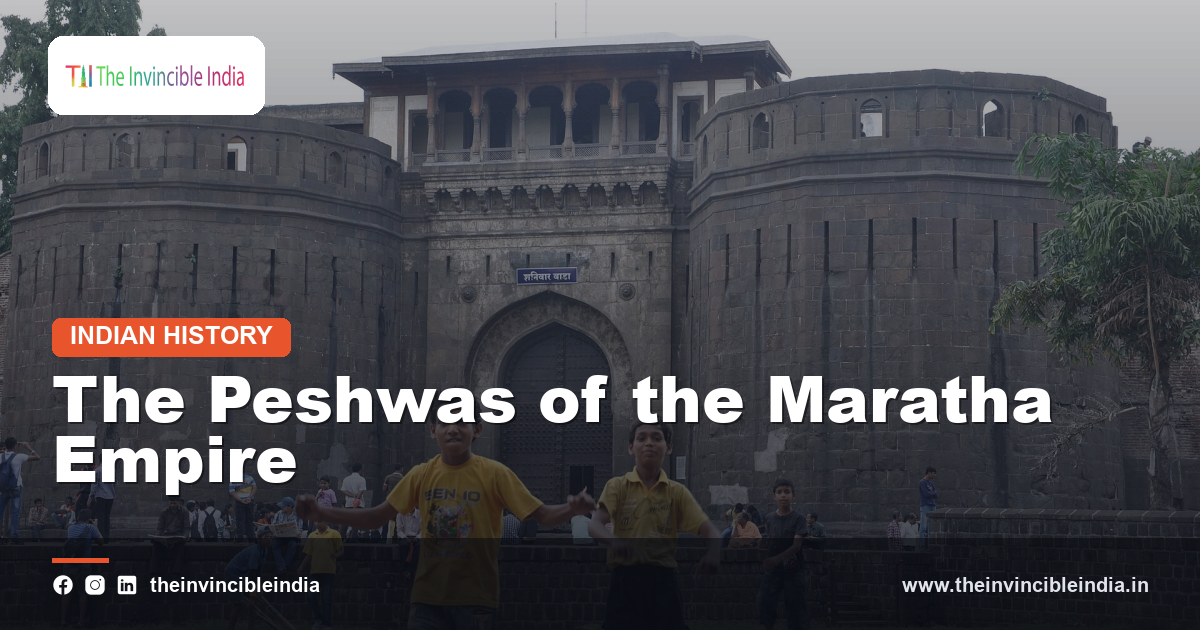
The Peshwa, also written Peshva or called the Pant Pradhan in older Marathi usage, was the chief minister of the Maratha kings and, from the early eighteenth century, the real head of the Maratha state. The office began as one of the eight ministerial posts of the Maratha court and later passed in a single Brahmin family, the Bhat family from the Konkan coast, who ruled from Pune. Their era saw the Maratha power spread across much of the subcontinent and then meet its limits against Afghan and British forces. Many exact dates are well recorded but this guide keeps to general terms. The wider story is told in our history of the Maratha Empire.
Quick answer: The Peshwa was the chief minister of the Maratha kings, an office that became hereditary in the Bhat family and, from the early eighteenth century, made the Peshwas the real rulers of the Maratha confederacy from their capital at Pune. They are remembered for the military expansion under Baji Rao I, the defeat at Panipat, the recovery under Madhavrao I, and the end of the office after the Anglo-Maratha wars.
Key Takeaways
- The Peshwa began as the chief minister in the council of eight ministers at the court of Chhatrapati Shivaji and his successors.
- The office became hereditary in one Konkanastha Brahmin family, beginning with Balaji Vishwanath, and shifted real power from the Chhatrapati to the Peshwa.
- Baji Rao I is remembered as the great cavalry commander who extended Maratha influence into Malwa, Gujarat and Bundelkhand.
- Pune, with the palace-fortress Shaniwar Wada, became the political capital of the Maratha confederacy.
- The Maratha defeat at the Third Battle of Panipat was a major setback, but the Peshwa Madhavrao I revived Maratha power afterwards.
- The Peshwa office ended in the early nineteenth century after the Third Anglo-Maratha War, when Baji Rao II surrendered to the British.
Read on for the history, culture, and legacy in detail.
Quick Facts
| Detail | Information |
|---|---|
| Office | Peshwa, chief minister of the Maratha kings |
| Ruling family | Bhat family of the Konkan, Chitpavan Brahmins |
| Capital | Pune, with the fortified palace Shaniwar Wada |
| Era | Eighteenth century to the early nineteenth century |
| Best-known Peshwa | Baji Rao I, the cavalry commander |
| End of rule | Third Anglo-Maratha War, then a British pension |
What Is a Peshwa?
A Peshwa was the principal minister of a Maratha king, responsible for administration, finance and war, and the word comes from Persian usage meaning the one who leads or goes in front. In the court of Chhatrapati Shivaji the title belonged to the head of the Ashta Pradhan, the council of eight ministers who advised the ruler and managed departments of the state. At first the Peshwa was a servant of the throne, appointed and removed by the king, and had no hereditary claim. Over time, as the Chhatrapatis grew weaker and the ministers grew stronger, the office changed in character and became the centre of power. This transformation explains why historians often speak of Peshwa rule rather than royal rule for most of the eighteenth century. The office thus moved from an advisory post to the seat of government.
How Did the Office Begin Under Shivaji?
The office began under Shivaji, who organised his young kingdom with eight ministers, each in charge of a field such as finance, foreign affairs, justice or the army, and the Peshwa stood at their head. Tradition names Moropant Pingle as the first holder of the post during Shivaji’s time, and the Peshwa was expected to combine administrative skill with loyalty to the throne. At this stage the post was not passed from father to son. After Shivaji’s death the Maratha state faced civil conflict and a long struggle against Mughal armies, which strained the court and the ministers. Those pressures prepared the ground for a stronger Peshwa, because the king needed able administrators and generals who could hold the realm together. The early office was therefore functional rather than dynastic.
Who Was Balaji Vishwanath?
Balaji Vishwanath was the first Peshwa of the Bhat family and is regarded as the founder of the hereditary Peshwa line. He came from a Chitpavan Brahmin family of the Konkan coast and served the Maratha court as a revenue officer and diplomat before being appointed Peshwa by Chhatrapati Shahu. His skill lay in negotiation: he helped Shahu settle disputes with rival Maratha chiefs and secured recognition of Maratha rights to collect revenue in Mughal territories. This diplomacy strengthened the throne and strengthened the Peshwa in turn. After his service the office passed to his son, which began the pattern of inheritance. Historians therefore see his period as the true beginning of Peshwa rule, because he combined administration, alliance-making and military support into a durable system for the Maratha state.
Why Is Baji Rao I Remembered as a Great Commander?
Baji Rao I is remembered as a great commander because he used fast cavalry, bold marches and flexible tactics to extend Maratha influence far beyond the Deccan. Succeeding his father as Peshwa while still young, he campaigned in Malwa, Gujarat and Bundelkhand and challenged the power of the Nizam of Hyderabad, defeating him in a well-known engagement near Palkhed. He also led a daring march close to Delhi, which showed that the Mughal capital could no longer rely on its old strength. Popular tradition says he never lost a battle, though historians prefer to speak of his campaigns in general terms and to avoid sweeping claims. His work set the pattern for later Maratha expansion in the north. His career made the Peshwa the chief military leader as well as the chief administrator.
How Did the Peshwas Govern the Maratha Confederacy?
The Peshwas governed the Maratha confederacy through a loose partnership between the central government at Pune and powerful commanders who ruled large regions in their own right. Families such as the Scindias, Holkars, Gaekwads and the Bhosles of Nagpur received territory or revenue rights in return for military service. The Peshwa acted as the head of this system and as the keeper of the Chhatrapati’s authority, which stayed symbolically at Satara. This arrangement allowed rapid expansion, because each commander could raise troops locally and campaign with independence. It also created tension, since distant chiefs sometimes followed their own interests, especially after strong Peshwas were gone. The confederacy therefore combined central direction with regional autonomy, a balance that worked well in a time of growth and less well in a time of crisis.
What Were Chauth and Sardeshmukhi?
Chauth and Sardeshmukhi were the two main revenue claims through which the Marathas drew income from lands beyond their core territory. Chauth was a share of the revenue of a district, traditionally described as one quarter, collected in return for protection from raids, while Sardeshmukhi was an additional levy claimed on the basis of the Maratha king’s hereditary right as the overlord of the region. The Mughal court accepted these claims in some provinces after negotiation, and the arrangement gave the Marathas a legitimate income stream outside their own lands. Critics of the time saw these levies as demands backed by force, and historians still discuss how far they were taxation and how far tribute. They were nevertheless central to the finances of the Peshwa era and helped to fund the cavalry armies of the confederacy.
How Did Pune Become the Peshwa Capital?
Pune became the Peshwa capital because the Peshwas chose it as their administrative base and invested in its growth during the eighteenth century. The town already had a long history as a settlement, and the Bhat family settled there in the early years of Baji Rao I. Over the following decades the Peshwas built palaces, temples, markets, bridges and water works, and the city expanded in a series of residential quarters known as peths, each named after a weekday. Bankers, merchants, scholars and craftsmen settled to serve the court, which made Pune a commercial and cultural centre. While the Chhatrapati stayed at Satara, real government moved to Pune, which became known as the seat of Maratha power. The city still preserves this heritage in its old wadas and in the layout of its historic core.
What Is Shaniwar Wada Known For?
Shaniwar Wada is known as the grand palace-fortress of the Peshwas in Pune, begun in the time of Baji Rao I and used as the centre of Peshwa government for generations. It was a large complex with massive stone walls, bastions and several gates, of which the Delhi Darwaza is the most famous, and it contained halls, fountains and residences built with stone and timber. A great fire in the early nineteenth century destroyed most of the interior, and today the surviving walls, gates and foundations are protected as a heritage monument. The Wada is also remembered in popular memory for the tragic death of the young Peshwa Narayanrao inside its precincts, a story that has inspired plays and tales. It stands as a symbol of Peshwa authority and of the dramatic history of Pune.
What Happened at the Third Battle of Panipat?
The Third Battle of Panipat was a major clash in the mid-eighteenth century in which a large Maratha army, led in the field by Sadashivrao Bhau, fought the Afghan ruler Ahmad Shah Abdali and his allies near Panipat north of Delhi. The Maratha forces had advanced north to defend the declining Mughal order and to assert Maratha influence there, during the Peshwaship of Balaji Baji Rao, also known as Nanasaheb. The battle ended in a heavy defeat, with great loss of life among soldiers and noncombatants alike, and the Peshwa’s own son Vishwasrao died in the field. Exact figures differ in the sources and are debated. The defeat stopped Maratha expansion in the north for a time and darkened the end of Nanasaheb’s life, yet it did not destroy the confederacy.
How Did Madhavrao I Revive Maratha Power?
Madhavrao I revived Maratha power after Panipat by restoring discipline, rebuilding armies and reasserting Maratha authority in both the Deccan and the north. Becoming Peshwa while young, he first had to manage a dispute with his uncle Raghunathrao, then turned to campaigns against rivals such as Hyder Ali of Mysore and to the recovery of influence in Malwa and Hindustan. Contemporaries and later historians praise his sense of justice, his care for administration and his ability to hold the confederacy together. His early death from illness was a heavy loss, and many writers regard it as the moment when the Peshwa system lost its best chance of lasting stability. His reign shows that the Maratha state could recover from a great defeat, but it also shows how much the system depended on strong leadership at the top.
Who Was Nana Phadnavis?
Nana Phadnavis was the chief administrator and statesman of the later Peshwa period, famous for holding the Maratha government together during years of rivalry and weak rulers. He served as a minister of finance and records under several Peshwas and became the leading figure of the council known as the Barbhai, which governed on behalf of the infant Peshwa Madhavrao II after the death of Narayanrao. Under his guidance the Marathas negotiated the Treaty of Salbai, which ended the first war with the British East India Company and was seen as a diplomatic success. He is also remembered for a careful, cautious approach to politics and for a lasting reputation as a clever planner. His death removed the central pillar of the government, and soon afterwards the Peshwa state entered a period of steep decline.
How Did the Anglo-Maratha Wars Affect the Peshwas?
The Anglo-Maratha wars gradually reduced the Peshwas from independent rulers to dependents of the British East India Company. Quarrels among the Maratha chiefs and the weakness of Peshwa Baji Rao II led him to accept a subsidiary alliance with the Company at Bassein in the early nineteenth century, which gave the British great influence over Pune. The agreement caused anger among other Maratha leaders and led to a second war, in which the Scindias and Bhosles were also defeated. A final conflict, the Third Anglo-Maratha War, broke out after the Peshwa attempted to throw off British control. Marathi tradition remembers the period as a time of tragic division, since a shared military heritage could not overcome rivalry among the chiefs. The wars therefore ended the political independence of the Maratha confederacy.
How Did the Peshwa Rule Come to an End?
Peshwa rule ended in the early nineteenth century when Baji Rao II was defeated by the British in the Third Anglo-Maratha War and surrendered. After engagements in the Pune region, including the well-remembered fight at Koregaon Bhima, the Peshwa fled and was eventually pursued, and he accepted terms offered by Sir John Malcolm. The British abolished the office, annexed the Peshwa’s territories and granted him a pension, settling him at Bithoor near Kanpur. Nana Saheb, the adopted heir of Baji Rao II, later became a leading figure in the revolt of 1857 after the pension was refused to him. With the end of the office the Maratha confederacy lost its central head, and the former Peshwa lands became part of the Bombay Presidency. The line of Peshwas thus closed after about a century of dominance.
What Was the Peshwa Contribution to Culture and Religion?
The Peshwa contribution to culture and religion included building temples, supporting scholars and encouraging festivals, arts and public works in Pune and across the Maratha lands. The family patronised temples on the Parvati hill, Hindu pilgrimage places along the Godavari and Krishna rivers, and the building of ghats, tanks and wells. Marathi poetry, the folk forms of powada and lavani, and Sanskrit learning all received support, and the court also welcomed musicians and storytellers. The worship of Ganesha enjoyed special honour in Pune, with Ganesha temples and household observances that later grew into larger public celebrations. Alongside this religious patronage the Peshwas relied on Brahmin administrators, merchants and bankers, which shaped the social structure of Pune. Their cultural legacy therefore combines devotion, learning and urban building.
The Peshwas Today
The Peshwas today are remembered through Pune’s historic buildings, Marathi literature, folk performance and the continuing debates of historians about their rise and fall. Shaniwar Wada, the Delhi Darwaza, the old wadas of the peths and temples such as those on Parvati hill give visitors a physical link to the period. Museums and archives in Pune hold documents, paintings and objects from the age, and scholars still study the vast Peshwa Daftar records that describe administration and finance. Opinions about the Peshwas vary: some admire their military success and statecraft, while others examine social questions and the limits of their government. Balanced study accepts both views. The Peshwas stand as a major chapter in Indian history, showing how a ministerial office became the driving force behind one of the largest powers of the eighteenth century.
Sources & Further Reading
- Archaeological Survey of India (asi.nic.in).
- Ministry of Culture, Government of India (indiaculture.gov.in).
Frequently Asked Questions
What was the role of the Peshwa?
The Peshwa was the chief minister of the Maratha kings and, from the early eighteenth century, the effective ruler of the Maratha state. He controlled administration, finance and the army from the capital at Pune.
Who was the first Peshwa of the Bhat family?
Balaji Vishwanath was the first Peshwa of the Bhat family and is seen as the founder of the hereditary line. He served Chhatrapati Shahu and secured Maratha revenue rights through diplomacy.
Who was the greatest Peshwa?
Baji Rao I is widely regarded as the greatest Peshwa in military terms, while Madhavrao I is admired for administration and recovery after Panipat. Opinions vary, so the answer depends on the criteria used.
Where is Shaniwar Wada located?
Shaniwar Wada is located in Pune, Maharashtra, in the historic core of the city. It was the palace-fortress of the Peshwas, and its surviving walls and Delhi Darwaza gate are protected as a monument.
Why did Peshwa rule end?
Peshwa rule ended because the Peshwa Baji Rao II was defeated by the British East India Company in the Third Anglo-Maratha War and surrendered. The office was abolished and the Peshwa’s territory was annexed.
What happened to the Peshwa after the defeat?
The last Peshwa, Baji Rao II, received a pension from the British and lived at Bithoor near Kanpur. His adopted son Nana Saheb later became a leader in the revolt of 1857.


