

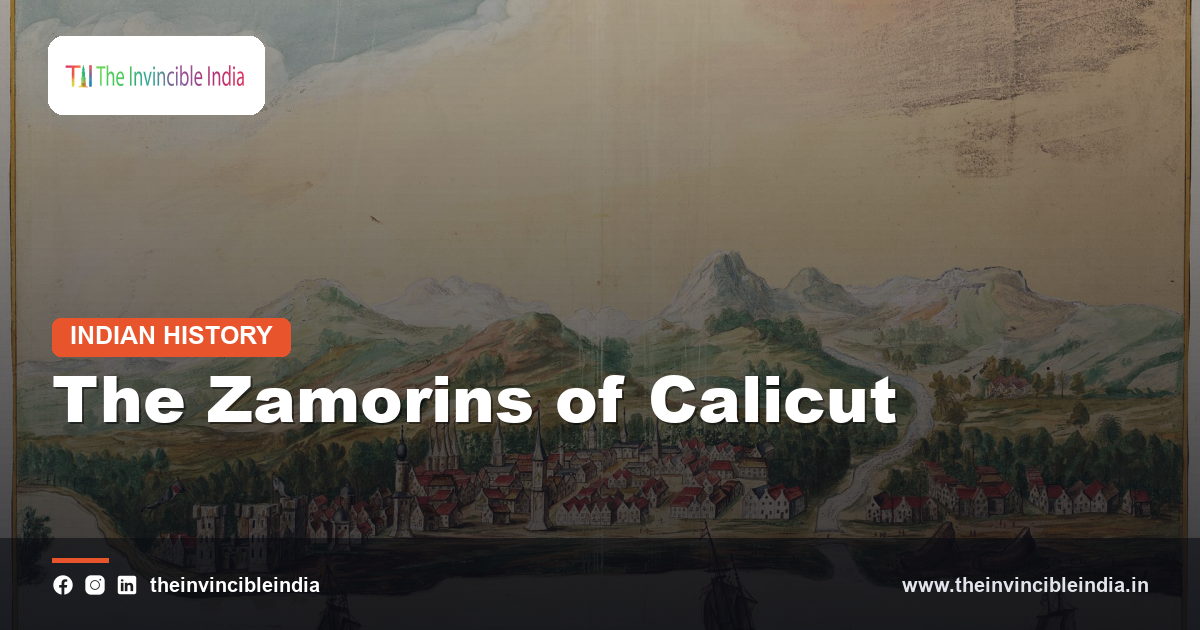
The Zamorin of Calicut, also spelled Samorin and called Samoothiri or Saamoothiri in Malayalam, was the title of the Hindu rulers of Kozhikode, the great pepper port on the Malabar coast of present-day Kerala. The royal house was known as the Nediyiruppu Swaroopam and, in the Portuguese records, as the lords of Calicut. For several centuries the Zamorins controlled one of the richest harbours of the Indian Ocean and welcomed traders from Arabia, China and Europe. Exact dates for the early dynasty are debated, so this guide keeps to general terms. The southern political setting also appears in our guide to the Vijayanagara Empire.
Quick answer: The Zamorin of Calicut was the title of the Hindu kings of Kozhikode on the Malabar coast of Kerala, rulers of the Nediyiruppu Swaroopam who controlled a great spice port, welcomed Vasco da Gama in the late fifteenth century, then fought the Portuguese for generations until Mysore and the British ended their power in the eighteenth century.
Key Takeaways
- The Zamorin was the title of the rulers of Calicut, today’s Kozhikode, in northern Kerala, belonging to the Nediyiruppu Swaroopam.
- Calicut was one of the greatest spice ports of the Indian Ocean, attracting Arab, Chinese, Persian and later European traders.
- Vasco da Gama reached Calicut by sea in the late fifteenth century, opening the direct sea route from Europe to India.
- The Kunjali Marakkars, naval commanders under the Zamorins, fought the Portuguese along the Malabar coast.
- The Zamorins gave their name to the Mamankam festival of Tirunavaya and to the Revathi Pattathanam, a gathering of scholars.
- Mysore’s invasion in the later eighteenth century ended Zamorin rule, and Calicut passed to the British Malabar district.
Read on for the history, culture, and legacy in detail.
Quick Facts
| Detail | Information |
|---|---|
| Title | Zamorin (Samoothiri) of Calicut |
| Royal house | Nediyiruppu Swaroopam |
| Capital | Calicut (Kozhikode), Kerala |
| Known for | Spice port, welcome to Vasco da Gama |
| Naval allies | Kunjali Marakkars |
| End of power | Mysore invasion, then British Malabar |
Who Were the Zamorins of Calicut?
The Zamorins of Calicut were the Hindu kings of Kozhikode, a coastal state in northern Kerala, and they ruled from the medieval period until the late eighteenth century. The title Zamorin is a European form of the Malayalam Samoothiri or Saamoothiri, often explained as meaning lord of the sea, although the exact origin of the word is debated. The ruler came from a family of the Eralpad line and belonged to the Nediyiruppu Swaroopam, which followed the matrilineal custom of inheritance common in Kerala. At the height of their power the Zamorins dominated a large area of the Malabar coast and were counted as the strongest rulers of the region. They governed with the help of chiefs, ministers and powerful noble families. Their rule gave Calicut a political importance equal to its commercial fame.
How Did the Nediyiruppu Swaroopam Rise?
The Nediyiruppu Swaroopam rose in the medieval period from an inland seat at Nediyiruppu to control the coast at Calicut, according to Kerala tradition. Chronicles such as the Keralolpathi say the family received its land and sword from the last Chera Perumal, and some versions describe the founder as a young relative who was granted only a small territory by the departing king. Scholars treat these stories with caution, since they were written down later and mix history with legend. What the evidence does show is that, by the time foreign travellers visited, the Zamorin was an established ruler of a thriving port. The rise of the house was linked to its ability to protect merchants and to expand through marriage alliances and wars against neighbouring chiefs. The dynasty thus grew from a modest holding into a major coastal power.
Why Was Calicut Such an Important Port?
Calicut was an important port because it lay at the centre of the Malabar pepper coast and offered safe trade, low duties and fair treatment to foreign merchants. Ships from Arabia, Persia, East Africa, China and Southeast Asia visited its roadstead, and the town became a meeting place of the Indian Ocean world. Pepper, ginger, cardamom, cotton cloth and timber were the main goods, and the Zamorin’s government earned revenue from duties and gifts. Visitors from distant lands, including the Moroccan traveller Ibn Battuta and the Chinese fleet commanders of the early Ming period, described the city’s busy markets and its welcome to strangers. The prosperity of Calicut shows the power of commerce to build a state. The port was the foundation of Zamorin authority and the main reason outsiders sought alliance with the ruler.
How Did the Zamorins Treat Foreign Traders?
The Zamorins treated foreign traders with a policy of tolerance and protection, which was a key reason Calicut flourished. Arab and other Muslim merchants settled in large numbers, built mosques and formed influential communities, and their descendants are the Mappila Muslims of Kerala. The rulers allowed them to follow their own customs, appointed a harbour master from the merchants themselves and respected their trade rules. Chinese, Jewish and Gujarati traders also did business in Calicut. This open approach attracted wealth and made the city a hub of exchange between East and West. It also meant that the Zamorin depended on the goodwill of the merchants, especially the Muslim trading elite, who formed part of his navy and treasury. The tolerant character of Calicut is often noted by historians as one of its defining features.
What Happened When Vasco da Gama Arrived?
Vasco da Gama reached Calicut by sea in the late fifteenth century, completing the first direct voyage from Europe to India around the southern tip of Africa, and he was received by the Zamorin. The event opened a new chapter in world history by connecting Europe to the spice-producing coast without relying on overland and Arab middlemen. The meeting did not go well, since the gifts of the Portuguese seemed modest to the court and the language barrier created friction, but da Gama managed to load cargo and return home. The Portuguese came back in greater force soon afterwards. Accounts of details differ between Portuguese and Indian sources. The arrival remains one of the best-known moments of Indian maritime history, marking the start of European power in the Indian Ocean.
Why Did the Zamorin Fight the Portuguese?
The Zamorin fought the Portuguese because they tried to control the spice trade by force, attack ships of other nations and demand a monopoly on the sea lanes. The Portuguese sought exclusive access to pepper and required ships to carry their passes, which went against the open trade that Calicut had long upheld. They allied with the rival rulers of Cochin and Cannanore and built forts along the coast. In response the Zamorin fought a long series of naval and land engagements, sometimes with considerable success and sometimes with heavy losses. The struggle lasted for generations, shaping the history of the coast and the fortunes of many merchant families. Historians describe it as one of the earliest contests between an Asian maritime state and European expansion, marked by both resistance and compromise.
Who Were the Kunjali Marakkars?
The Kunjali Marakkars were a family of Muslim sea captains who served as admirals of the Zamorin’s fleet and became legendary for their resistance to Portuguese power. Their name is linked with fast, light ships and with raids that harassed Portuguese shipping along the Malabar coast. They operated from bases such as Kottakkal, near Vadakara, and some accounts credit them with using early forms of coordinated naval tactics. A later Kunjali eventually became so powerful that relations with the Zamorin broke down, and the Portuguese took advantage of the split. The family is still remembered in Kerala through stories, songs and films. Because the evidence for individual members is partly based on Portuguese records and local tradition, details vary. They remain symbols of Indian naval pride and of the maritime history of Kerala.
What Is the Mamankam Festival?
Mamankam was a great festival held on the banks of the Bharathapuzha river at Tirunavaya, which was one of the most important gatherings of medieval Kerala. It took place once in twelve years and drew traders, chiefs and pilgrims from across the region. The Zamorin eventually claimed the right to preside over the event, a claim that brought him into conflict with other chiefs who regarded themselves as the traditional hosts. Tradition says that warriors known as Chaver, sent by the rival ruler, would try to attack the Zamorin on the festival grounds, often in suicidal charges. The accounts of these episodes come from folk ballads and later records, and some details are debated. Mamankam remains a famous example of the mix of religion, politics and trade in Kerala history.
What Was the Revathi Pattathanam?
The Revathi Pattathanam was an annual assembly of scholars held at the Tali temple in Calicut under the patronage of the Zamorin, where learned men debated and received honours. It took place in the month associated with the star Revathi, and scholars of philosophy, grammar, logic and literature competed before the king and a panel of judges. Winners received gifts and titles, and the event gave Calicut a reputation as a centre of Sanskrit learning. The Zamorins also supported poets and astronomers, and Kerala produced important traditions of mathematics and astronomy in the medieval period. The scholarly gatherings show that the Zamorin court valued the life of the mind alongside trade and war. Such patronage enhanced the prestige of the dynasty and kept Calicut at the forefront of intellectual life in southern India.
What Is the Tali Temple in Calicut?
The Tali temple in Kozhikode is a historic Shiva temple that served as one of the main religious and cultural centres of the Zamorins and is linked to the Revathi Pattathanam. The name comes from a word meaning a temple or a small shrine. Located in the old town near the heart of Kozhikode, it was patronised by the royal family and remained a place of ritual and learning. Kerala temples of this period had a distinctive architecture with sloping roofs, wooden carving and courtyards, and the Tali temple belongs to that tradition. Much of the older structure has changed over time, and details of its early history are debated. The temple nevertheless survives as an emblem of the Zamorin heritage, a place where religious devotion, royal patronage and scholarship came together.
How Did the Zamorins Relate to Cochin and Vijayanagara?
The Zamorins related to Cochin as rivals and to Vijayanagara as a distant but important power on the political horizon of southern India. Cochin, to the south, was a smaller state that often sought help from outsiders against Calicut, and the two kingdoms fought many wars. Vijayanagara, the great empire of the Tungabhadra region, had contact with Calicut through trade and diplomacy, and the Persian envoy Abdur Razzaq, who visited Calicut in the fifteenth century, also travelled to the Vijayanagara court. The exact nature of Calicut’s relations with the empire is debated, but the Zamorin appears to have kept his independence. The links show that Kerala’s politics were connected to the wider south. Calicut dealt with its neighbours by a mix of war, marriage and negotiation.
How Did Mysore Change Calicut's Fortunes?
Mysore changed Calicut’s fortunes when Hyder Ali invaded Malabar in the later eighteenth century and brought the Zamorin’s kingdom under his control. The Zamorin of the time faced a powerful army, and according to tradition the ruler took his own life rather than submit, while the royal family and many nobles fled to Travancore. Mysore ruled the region for some years, and Hyder’s son Tipu Sultan continued the administration, which brought changes to the revenue system and caused disruption in local society. Different accounts of this period exist, and historians continue to discuss its effects. The invasion marked the end of the Zamorin’s independent rule over Calicut, although members of the family remained influential. It was a turning point from which the old dynasty did not recover its full political power.
What Happened After the British Arrived?
After the British arrived, Calicut became part of the Malabar district in the Madras Presidency, and the Zamorin’s family lost its sovereign rights. Following the defeat of Tipu Sultan, the British Company took control of Malabar and organised its administration through collectors and courts. The Zamorin received an allowance and kept his position as head of a large landholding family, and Calicut developed as a regional trading town. Resistance to British rule continued in the region, including the uprising led by Pazhassi Raja further north and later rural revolts. The Zamorin family thus moved from rulers to landed nobles and community leaders. This change reflects the broader pattern across India, where old dynasties either lost power or retained ceremonial and social status under colonial rule.
What Is the Zamorin Legacy in Kerala Culture?
The Zamorin legacy in Kerala culture includes a tradition of religious tolerance, strong maritime identity, patronage of scholarship and a lasting reputation as defenders of the coast. Kozhikode developed a mixed culture in which Hindu, Muslim, Christian and Jewish communities lived together, and its cuisine, music and language still reflect this blend. The city is also known for the halwa that is sold in its old streets, a sweet linked to the town in popular memory, though its exact origin is traditional. Folk songs and ballads such as the Vadakkan Pattukal recall warriors of the period. The memory of the Zamorins is preserved in family histories, local museums and festival customs. Their era remains a source of pride in Kerala as a time when the region stood at the centre of the world’s trade.
The Zamorins of Calicut Today
The Zamorins of Calicut today are remembered through the heritage of Kozhikode, the writings of historians and the descendants of the royal family, who still hold a ceremonial position in some temple traditions. Visitors can see the Tali temple, the old quarters of Mishkal Mosque and Kuttichira, the beach at Kappad, where a memorial marks the landing of Vasco da Gama, and the museums that explain the history of the port. Researchers continue to compare Portuguese, Arabic, Chinese and Malayalam sources to build a fuller picture of the dynasty. The Zamorin story is often used in teaching as an example of how an Asian state engaged with the early European presence in the Indian Ocean. It shows a ruler who ruled by trade, tolerance and naval power. Calicut remains one of the best-known names in Kerala history.
Sources & Further Reading
- Archaeological Survey of India (asi.nic.in).
- Ministry of Culture, Government of India (indiaculture.gov.in).
Frequently Asked Questions
What does Zamorin mean?
Zamorin is the European form of the Malayalam title Samoothiri or Saamoothiri, borne by the rulers of Calicut. It is often explained as lord of the sea, though the origin of the word is debated.
Where was the Zamorin kingdom located?
The Zamorin kingdom was centred on Calicut, now Kozhikode, on the Malabar coast of northern Kerala. It controlled a long stretch of coast and the pepper trade of the region.
Why is Calicut famous in history?
Calicut is famous as the port where Vasco da Gama landed in the late fifteenth century and as one of the greatest spice ports of the Indian Ocean. The Zamorins ruled the city during this time.
Who were the Kunjali Marakkars?
The Kunjali Marakkars were Muslim naval commanders in the service of the Zamorin who fought the Portuguese along the Malabar coast. They are remembered in Kerala as heroes of coastal defence.
What was the Mamankam festival?
Mamankam was a great festival held every twelve years on the banks of the Bharathapuzha at Tirunavaya in Kerala. The Zamorin claimed the right to preside over it, which led to conflict with rival chiefs.
How did Zamorin rule end?
Zamorin rule ended with the invasion of Malabar by Hyder Ali of Mysore in the later eighteenth century. After the defeat of Mysore, the region became the British Malabar district.


