

The Kingdom of Cochin, also called Kochi or the Perumpadappu Swaroopam after its ruling house, was a princely state on the Malabar coast of present-day Kerala that lasted from the medieval period until the mid-twentieth century. Its rulers were known as the Cochin Rajas, and their capital moved over time between several seats before settling near Tripunithura and the harbour of Kochi. The kingdom was small but strategically placed, and it was the first Indian state to ally with the Portuguese in the early sixteenth century. Early dates are debated, so this guide uses general terms. For the wider southern setting see our guide to the Chola dynasty.
Quick answer: The Kingdom of Cochin was a princely state on the Malabar coast of Kerala, ruled by the Perumpadappu family, that controlled the harbour of Kochi and the spice trade, allied with the Portuguese and later the Dutch and British, and joined the new state of Kerala after Indian independence. Its legacy includes Mattancherry Palace, Fort Kochi and a cosmopolitan culture.
Key Takeaways
- The Kingdom of Cochin was a Kerala state ruled by the Perumpadappu Swaroopam, a royal house with traditional links to the old Chera Perumals.
- Its capital region around Kochi gave it control of a natural harbour at the centre of the pepper and spice trade.
- Cochin was the first Indian ruler to welcome the Portuguese, a decision that shaped its relations with the Zamorin of Calicut.
- Mattancherry Palace, Paradesi Synagogue and Fort Kochi are the best-known heritage sites of the Cochin story.
- Under the ruler Shaktan Thampuran, Cochin carried out reforms and the Thrissur Pooram festival gained its present form.
- Cochin joined the union of Travancore-Cochin after independence, which became part of Kerala in the mid-twentieth century.
Read on for the history, culture, and legacy in detail.
Quick Facts
| Detail | Information |
|---|---|
| Kingdom | Cochin (Kochi), a princely state of Kerala |
| Ruling house | Perumpadappu Swaroopam |
| Region | Central Kerala, Malabar coast |
| Key places | Kochi, Tripunithura, Mattancherry, Thrissur |
| Famous for | Spice trade, harbour, early European contact |
| Fate | Merged into Travancore-Cochin, then Kerala |
What Was the Kingdom of Cochin?
The Kingdom of Cochin was a historic state in central Kerala, on the Malabar coast of south-western India, ruled for many centuries by the Perumpadappu family. Its territory lay between the kingdoms of Calicut to the north and Travancore to the south, and it included a long strip of backwaters, rice fields, coconut groves and spice-growing hills. The rulers were known as Cochin Rajas, and the kingdom was often referred to by the name of its chief port, Kochi. Although the state was small compared with large empires of the north, its harbour gave it importance far beyond its size. It stood at the meeting point of Indian, Arab, Chinese and European trade. For that reason the history of Cochin is often told as the story of a port kingdom that survived by skilful diplomacy.
Who Were the Perumpadappu Swaroopam?
The Perumpadappu Swaroopam was the royal house of Cochin, a Kerala dynasty whose family name comes from the old seat of Perumpadappu in the south of present-day Malappuram district. Kerala traditions say the family descended from the line of the Chera Perumals, the old kings who ruled the region, and received a share of the kingdom when the last Perumal divided his realm. Historians treat this account with care, since it rests on local chronicles such as the Keralolpathi rather than on early inscriptions, and the exact steps are debated. Over time the family moved its centre of gravity south, towards the coastal region around Kochi. Its system of succession followed the matrilineal custom common in Kerala. The Perumpadappu Swaroopam thus represents the long continuity of Kerala’s own royal traditions.
How Did Cochin Become a Harbour Kingdom?
Cochin became a harbour kingdom when the Kochi estuary opened as a natural port after a great flood in the Periyar river changed the coastline in the medieval period, according to tradition. The older port of Muziris, once a famous centre of Indian Ocean trade, declined, and Kochi took its place as the chief harbour of the region. Ships found a sheltered anchorage in the broad backwaters, and merchants from Arabia, China and other lands visited to buy pepper and other spices. The rulers collected port duties and encouraged traders to settle. The exact dates of these changes are debated by scholars. The development shows how natural change, trade and politics combined to shape the fortunes of the kingdom. From then on the harbour was the economic heart of Cochin.
Why Was the Spice Trade So Important to Cochin?
The spice trade was important to Cochin because pepper, cardamom, ginger and other spices grown in Kerala’s hills were among the most valuable goods in world commerce. Merchants carried these products from Cochin to markets in West Asia, the Mediterranean, East Africa and later Europe, and the revenues funded the state, its palaces and its temples. Local trading communities, including Muslim merchants, Jews, Syrian Christians and Hindu traders, were involved in buying, storing and shipping the spices. The rulers sought to attract European buyers because they offered new markets, and this interest explains much of Cochin’s foreign policy. The reliance on a single trade made the kingdom vulnerable to changes in the market, yet it also gave the state leverage. Spices connected a small coastal kingdom to the whole Indian Ocean world.
Why Did Cochin Ally With the Portuguese?
Cochin allied with the Portuguese in the early sixteenth century because the Raja wanted protection against the powerful Zamorin of Calicut, who had long dominated the region. Following the arrival of Vasco da Gama on the Malabar coast, the Portuguese sought a friendly port, and the ruler of Cochin received them and allowed a trading post and later a fort. The Portuguese built Fort Immanuel at Kochi and used the town as their early headquarters in India. Vasco da Gama died at Kochi on a later voyage and was first buried there. The alliance brought Cochin European arms and a share of trade, but it also tied the kingdom to a foreign power that sought to control commerce. It was therefore a bargain of protection against loss of full independence.
What Was the Rivalry Between Cochin and Calicut?
The rivalry between Cochin and Calicut was a long competition between two Kerala kingdoms over trade, territory and political status. The Zamorin of Calicut was the stronger of the two for much of the medieval period, and he sometimes exercised pressure on Cochin and its neighbours. Cochin turned to outside powers, first the Portuguese and later the Dutch, to balance this pressure. Wars were fought along the border, and each side tried to win the support of local chiefs. The competition also had a commercial side, since both ports sought to attract the same merchants. Historians view the rivalry as an important factor in Kerala’s openness to European powers, because each kingdom looked abroad to gain an edge. The conflict is explored from the northern side in our guide to the Zamorins of Calicut.
What Is Mattancherry Palace?
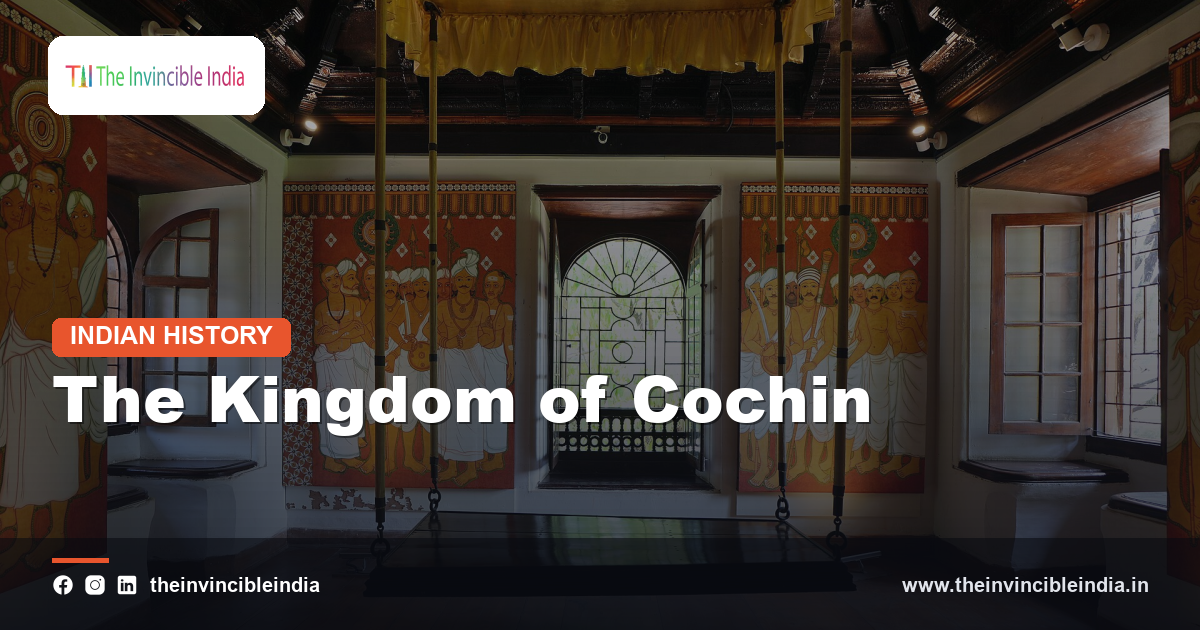
Mattancherry Palace, often called the Dutch Palace, is a royal residence in Kochi that now serves as a museum and is the best-known building associated with the Cochin rulers. According to tradition it was built by the Portuguese and presented to the Raja of Cochin in the mid-sixteenth century, and the Dutch later repaired and extended it, which gave it the popular name. It follows the Kerala style of building, with a central courtyard, sloping tiled roofs and a temple within the complex. Inside, the walls carry vivid mural paintings illustrating scenes from the Ramayana and from Hindu mythology, painted in the traditional Kerala style. The palace also displays coronation robes, portraits and royal objects. It is a notable example of cultural blending between local and European influence.
What Is the Paradesi Synagogue?
The Paradesi Synagogue in the Jew Town area of Mattancherry is the oldest active synagogue in the Commonwealth, according to widely repeated local accounts, and it is built next to the royal palace. It was constructed in the later sixteenth century by the Malabar Jewish community with the permission of the Raja of Cochin, a sign of the tolerant policy of the court. The building is famous for its hand-painted blue and white floor tiles from China, its hanging lamps and its carved wooden ark. Jewish traders had lived on the Kerala coast for many centuries, and the community prospered under the protection of the rulers. Most of the community has since moved away, but the synagogue remains a living monument and a major sight. It reflects the cosmopolitan character of Cochin.
How Did the Dutch Replace the Portuguese?
The Dutch replaced the Portuguese at Cochin in the mid-seventeenth century when the Dutch East India Company, acting with the support of local rulers including the Zamorin, took Fort Immanuel and the town. The change of power was part of a larger struggle between European trading companies in the Indian Ocean. Dutch rule brought new building, including the Dutch Cemetery and other structures, and the company managed the pepper trade through contracts with the Raja. The ruler of Cochin remained in place, but his policies were shaped by the Company’s interests. The Dutch also repaired the palace in Mattancherry and supported scholarship, such as the botanical work Hortus Malabaricus. The period reveals how Cochin continued to survive by shifting alliances among stronger powers while keeping its own throne.
Who Was Shaktan Thampuran?
Shaktan Thampuran, also known as Rajarshi Rama Varma, was a late eighteenth-century ruler of Cochin remembered for reforms, strong administration and cultural patronage. He reorganised the administration, strengthened the treasury, and reduced the power of local chiefs who had grown too independent. He is credited with founding the Thrissur Pooram, the grand temple festival of elephants, music and fireworks, as a way to unite temples in the region around the Vadakkunnathan temple. Tradition also describes him as a stern but fair ruler who took an interest in the arts. The exact details of some of the stories about him are legendary. His reign came at a time of great pressure from Mysore and the British, and his work helped Cochin enter the next century with a stable state. He remains one of the best-known Cochin kings.
How Did Cochin Deal With Mysore and the British?
Cochin dealt with Mysore and the British by first accepting the overlordship of Mysore after its invasion of Malabar and then turning to a treaty with the British East India Company. In the later eighteenth century Hyder Ali and his son Tipu Sultan extended Mysore power into Kerala, and Cochin agreed to pay tribute to preserve its throne. When British forces defeated Tipu, Cochin made an agreement with the Company that placed it under British protection. From that time the state was a princely state within the British system, with a Resident supervising its relations. This arrangement ended its independent foreign policy but protected the dynasty. The period shows the pattern of survival through submission that marked many small Indian kingdoms in the age of expanding empires.
What Role Did the Paliath Achans Play?
The Paliath Achans were a noble family of Cochin who served the kingdom as hereditary prime ministers and commanders for many generations. They held high office from the early modern period onwards, and their influence at court was large, sometimes rivalling that of the Raja himself. The family’s ancestral house at Chendamangalam near Kochi preserves a museum of their history and objects. They were known for diplomacy with the Dutch and for managing the state’s finances and armies, and their status shows the importance of powerful noble families in Kerala politics. Their influence declined with the reforms and changing system of the nineteenth century. The Paliath Achans offer a useful example of how a royal house depended on loyal ministerial families, and their story is widely taught in Kerala’s regional history.
How Did Cochin Culture Develop?
Cochin culture developed as a blend of Kerala tradition and the influences of many seafaring peoples who visited or settled in the port. Temples and palaces followed the Kerala architectural style, while Kochi also saw Portuguese churches, Dutch houses, Jewish synagogues, Arab mosques and Chinese fishing nets. The rulers patronised Sanskrit learning, Kathakali, Koodiyattam and temple festivals, and Tripunithura became a centre of classical arts. Cochin’s Hill Palace, built for the rulers in the nineteenth century, is now a heritage museum. The mingling of languages, foods and customs in the port gave the region a cosmopolitan identity that still marks Kochi. This culture was the product of trade rather than conquest, and its variety is one of the most distinctive features of the Cochin legacy.
How Did the Kingdom of Cochin End?
The Kingdom of Cochin ended when it merged with its neighbour Travancore soon after Indian independence, and the combined state was later absorbed into the new state of Kerala. The ruler acceded to the Indian union, and in 1949 the two states were joined as the state of Travancore-Cochin, with the Maharaja of Travancore serving as head for a period. In the reorganisation of states in the mid-twentieth century, this unit was combined with the Malabar district of Madras to form Kerala. The Cochin royal family kept its palaces and ceremonial position, and its members remain respected figures in cultural life. The change closed a long chapter of princely rule while keeping the heritage of the kingdom in the public memory of Kerala. The merger is regarded as part of the larger integration of India.
The Kingdom of Cochin Today
The Kingdom of Cochin today lives on in the heritage of Kochi, Tripunithura and the many palaces, temples and churches that mark the old territory. Visitors can see Mattancherry Palace, the Paradesi Synagogue, Fort Kochi, the Chinese fishing nets and the Hill Palace Museum, which together tell the story of a trading kingdom. The Thrissur Pooram continues each year as a major festival, and the old royal family still takes part in ceremonies. Scholars study the kingdom as a case of how a small state used trade and diplomacy to survive among larger powers. Kochi is now a major port and cultural city, and the historic quarters are protected and visited by many travellers. Cochin remains an important part of Kerala’s identity and a model of coexistence among many communities.
Sources & Further Reading
- Archaeological Survey of India (asi.nic.in).
- Ministry of Culture, Government of India (indiaculture.gov.in).
Frequently Asked Questions
Which dynasty ruled the Kingdom of Cochin?
The Perumpadappu Swaroopam ruled the Kingdom of Cochin. This royal house traditionally traced its descent from the old Chera Perumals of Kerala.
Why was Cochin important in history?
Cochin was important because its harbour at Kochi was a major centre of the spice trade and the first Indian port to ally with the Portuguese. This brought it into contact with Arab, Chinese and European merchants.
What is Mattancherry Palace known for?
Mattancherry Palace is known for its Kerala-style architecture and its vivid Ramayana murals. It is also called the Dutch Palace because the Dutch repaired it, and it is now a museum in Kochi.
Who was Shaktan Thampuran?
Shaktan Thampuran was a late eighteenth-century ruler of Cochin remembered for administrative reform and for founding the Thrissur Pooram festival. He is one of the best-known kings of the state.
When did the Kingdom of Cochin end?
The Kingdom of Cochin ended in the years after Indian independence, when it merged with Travancore in 1949. The combined state became part of Kerala in the mid-twentieth century.
Where can I see Cochin heritage today?
Cochin heritage can be seen in Kochi at Mattancherry Palace, the Paradesi Synagogue, Fort Kochi and the Hill Palace Museum at Tripunithura. The Paliath Achan house at Chendamangalam is another site.


