

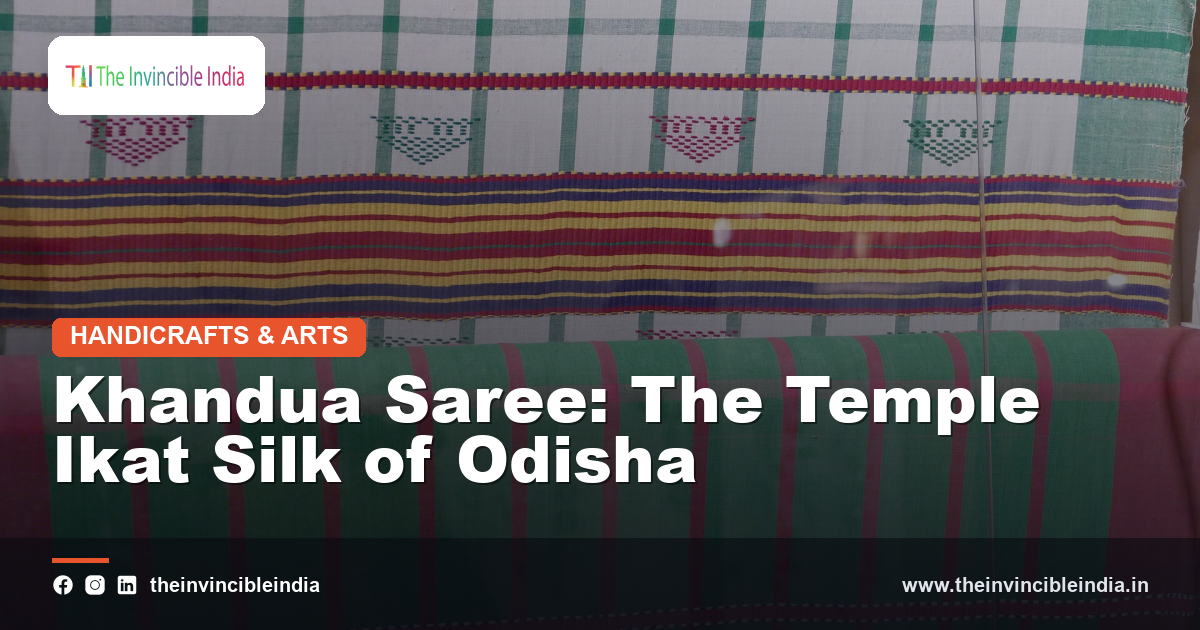
The Khandua saree is a handwoven silk ikat textile of Odisha, woven with tie-dyed threads and traditionally connected with the temple of Lord Jagannath at Puri. It is also known as Khandua pata, Khandua silk or the Nuapatna Khandua after its best-known weaving centre, and it is celebrated for rich colours, devotional motifs and borders that sometimes carry lines of sacred poetry. The cloth stands among the great regional weaves of India, just as Pochampally ikat does in Telangana, yet it has an identity of its own rooted in the temple culture of the eastern coast. Khandua is woven for the deities and is also prized as an Odia wedding textile.
Quick answer: The Khandua saree is a traditional handloom silk saree of Odisha made by the ikat method, in which threads are tie-dyed before weaving to form patterns. It is closely associated with the Jagannath temple of Puri and with the weaving town of Nuapatna, and its borders and pallu carry temple motifs and sometimes verses from the Gita Govinda. It is valued as a ceremonial and wedding textile of Odia culture.
Key Takeaways
- The Khandua saree, also called Khandua pata, is an ikat silk textile from Odisha.
- Its patterns are formed by tie-dyeing the weft threads before weaving, a method known in Odisha as bandha.
- The textile is linked with the Jagannath temple at Puri, where Khandua cloth is used in the service of the deities.
- Nuapatna and Maniabandha are among the best-known weaving centres.
- Typical motifs include the conch, wheel, lotus, fish, elephant and temple-inspired designs, and borders may carry verses from the Gita Govinda.
- The saree is traditionally associated with Odia weddings and religious occasions.
The sections below explain its history, weaving method, motifs, regions and cultural role.
Quick Facts
| Detail | Information |
|---|---|
| Type | Handwoven ikat silk saree |
| Also called | Khandua pata, Nuapatna Khandua |
| State | Odisha |
| Key weaving centres | Nuapatna, Maniabandha |
| Technique | Weft ikat (bandha tie-dye) |
| Cultural link | Jagannath temple, Puri; Odia weddings |
What Is the Khandua Saree?
The Khandua saree is a handloom silk saree of Odisha in which the patterns are created by tie-dyeing the threads before they are woven. It is also called Khandua pata, since pata means silk in Odia, and it is one of the most revered textiles of the state. The saree is known for its glowing colours, particularly reds, maroons and yellows, and for compact, well-defined motifs that seem to float in the weave. Many pieces carry decorated borders and a richly patterned pallu, the end piece of the saree, and some include lines of devotional verse woven into the cloth. It has long been connected with temple service and with auspicious family occasions such as weddings. In short, the Khandua saree is a ceremonial textile that joins technical skill with spiritual meaning, and it remains a symbol of Odia identity.
Where Does the Khandua Saree Come From?
The Khandua saree comes from the coastal and central regions of Odisha, where weaving of ikat silk has a long and respected tradition. Its best-known centre is Nuapatna in Cuttack district, a weaving village whose artisans have been closely tied to the temple of Lord Jagannath. Maniabandha is another important weaving centre, and weaving families in nearby villages have also contributed to the craft. The region’s culture of temple devotion, trade and festival created steady demand for fine silk cloth. Skills have been handed down within weaving families over many generations, so that knowledge of design and dyeing is deeply local. Because of this strong association with specific villages, the textile is often named after its place, as in Nuapatna Khandua. The geography of the saree is therefore inseparable from the story of its making.
How Is the Khandua Linked to the Jagannath Temple?
The Khandua is linked to the Jagannath temple of Puri through the use of the cloth in the service of the deities. Tradition holds that Khandua pata is woven for the temple and used in the clothing and decoration of the deities on special occasions, and weaving families in Nuapatna are described as having served this role over generations. The link gives the textile a sacred status quite different from that of an ordinary commercial fabric. Devotees regard the cloth as a form of offering, and the weaver’s work is understood as a service to the Lord. Details of ritual practice are specific to the temple and its servitors, so they are best learned from temple sources. What can be said in general is that the bond between loom and sanctuary is central to the meaning of Khandua, giving it its devotional depth.
What Is the History of the Khandua Pata?
The history of the Khandua pata is bound up with the temple culture of Odisha, and its precise origin is not documented with a single date. Silk weaving and ikat dyeing flourished along the eastern coast for centuries, supported by temples, courts and the movement of goods through ports and pilgrimage routes. The Jagannath tradition at Puri became a powerful centre of patronage, encouraging weavers to produce cloth of exceptional quality for ritual use. Over time, certain families specialised in making Khandua and passed down their designs and methods. The craft later reached a wider public as part of the broader recognition of Indian handlooms, and the saree entered the wardrobes of Odia families as a treasured heirloom. Its history is therefore one of continuity, in which devotion, community skill and patronage have combined to keep a distinctive textile alive.
What Does Ikat Mean in Khandua Weaving?
Ikat is a method of patterning cloth in which threads are tied and dyed in a planned design before they are placed on the loom. In Odisha the tie-dye technique is known as bandha, and in Khandua weaving it is usually applied to the weft threads, which are then woven so that the dyed sections come together to form the pattern. Because the design exists in the yarn before weaving starts, the weaver must align every thread with great care. The characteristic look of ikat is a softly feathered edge on each motif, caused by tiny shifts between threads, and it gives the cloth its lively quality. The technique appears in several Indian regions, and each has its own style. In Khandua, the method is used to make the compact temple motifs and decorative bands that define the saree.
How Is a Khandua Saree Woven?
A Khandua saree is made through a long sequence of tasks that begins with preparing the silk yarn and ends with weaving on the handloom. The yarn is first prepared and measured, then the pattern is planned, often with a design drawn on paper that guides the tying. Sections of the weft yarn are tied tightly so that dye cannot reach them, and the bundles are dipped in dye baths in the required colours. The process may be repeated several times for multicolour designs, after which the dried yarn is untied and arranged in the correct order. On the loom, the weaver passes the dyed weft through the warp, adjusting each thread to match the design. The finished cloth emerges slowly, since every motif depends on exact alignment. The whole process is shared among members of weaving households, each contributing a specialised skill.
What Materials and Dyes Are Used?
Khandua sarees are woven mainly in silk, with cotton sometimes used in related cloth, and the silk may be mulberry or tussar depending on the piece. Silk gives the saree its sheen, softness and ability to take rich colour, which suits the vivid palette of the style. Traditionally dyes were drawn from natural sources, and plant and mineral colours produced the warm reds, yellows and earth tones associated with temple textiles. Today many weavers use modern dyes as well, chosen for reliability and range, while some artisans continue to work with natural colours for special orders. The choice of dye influences the final feel and price of the saree. Quality yarn, careful dyeing and sound weaving together determine how well the cloth wears over time. Material and method thus share equal importance in making a durable and beautiful Khandua.
What Motifs Are Found on Khandua Textiles?
Khandua motifs are drawn from temple symbolism, nature and everyday life, and they are usually compact, repeated and neatly outlined. Common forms include the shankha or conch, the chakra or wheel, the lotus, fish, elephants, peacocks, flowers and temple towers. Some of these symbols are tied to the iconography of Lord Jagannath and Vaishnava worship, while others belong to the wider decorative vocabulary of Odisha. Borders often feature repeating bands and may include geometric patterns, and the pallu usually carries the most elaborate imagery. The motifs are arranged so that they appear to flow along the length of the saree, creating a rhythm that the eye can follow. Each symbol carries cultural meaning, so the saree reads almost like a visual text. This language of forms is part of what makes Khandua instantly recognisable among Indian ikat textiles.
Why Are Gita Govinda Verses Woven Into Khandua?
Verses from the Gita Govinda are woven into some Khandua cloth because the poem is deeply connected with the Jagannath tradition of Odisha. The Gita Govinda is a Sanskrit lyrical work attributed to the poet Jayadeva, celebrating the love of Radha and Krishna, and its verses are sung and revered in Puri. Weavers have woven lines of the poem into borders or bands using the ikat method, so that text itself becomes a decorative element of the cloth. This practice joins literature, devotion and craft in a single object, and it demonstrates the high skill required to render letters in tie-dyed yarn. Such sarees are often regarded as especially auspicious and are valued as collector’s items. The poetry on the cloth reminds the wearer of the cultural world from which the Khandua emerged, making it a wearable text.
What Colours Are Typical of the Khandua Saree?
The typical colours of the Khandua saree are red, maroon, yellow, orange and deep earth tones, often combined with darker accents. Red and yellow have strong ritual associations in Odisha, and they are chosen for ceremonial wear and festive occasions. The saree may have a single dominant colour on its body with contrasting borders and pallu, or it may use several colours within the patterned sections. The soft, feathered edges that arise from ikat dyeing give these colours a gentle depth that printed cloth does not have. Skilled dyers balance the shades so that motifs stand out clearly against the ground. Over time new palettes have appeared, including greens, blues and pastels, but the traditional reds and yellows remain the heart of the style. Colour in Khandua is therefore both aesthetic and symbolic, and it is carefully chosen.
Why Is Khandua Linked to Odia Weddings?
Khandua is linked to Odia weddings because the saree is regarded as an auspicious textile suitable for the bride and for family ritual. In Odia tradition, a Khandua pata is closely associated with marriage ceremonies, and it is often given or worn at the wedding as a sign of blessing and prosperity. Families may treasure the cloth for generations, bringing it out for important occasions. The saree’s temple heritage and its devotional motifs give it a sacred quality that fits the solemnity of a marriage. Practices vary by family and locality, so customs differ from one household to another. What remains consistent is the high regard in which the textile is held as a gift and heirloom. Its role in weddings explains why demand for Khandua continues even as clothing fashions change.
How Does Khandua Differ From Sambalpuri Ikat?
Khandua differs from Sambalpuri ikat mainly in its region of origin, its temple associations and its typical look. Sambalpuri ikat comes from western Odisha, around Sambalpur, Bargarh and Sonepur, and it is known for bold, flowing designs in which both warp and weft may be tie-dyed. Khandua is a coastal textile, tied to the Jagannath tradition, and it tends toward finer silk, compact motifs and ceremonial character. Both are celebrated examples of Odisha’s ikat heritage and share the basic principle of tie-dyeing yarn before weaving. Understanding the distinction helps readers appreciate the diversity of weaving within a single state. Each style reflects the history, patronage and taste of its home area. Placing Khandua beside Sambalpuri shows that Odisha is not one textile tradition but a family of related traditions with a common technique.
Who Are the Khandua Weavers?
Khandua weavers are artisans from traditional weaving families, especially those of Nuapatna and neighbouring villages, who have inherited their skills over generations. Work is usually divided within the household, with some members preparing yarn, others tying and dyeing, and others weaving at the loom. Women often contribute significantly to preparatory and finishing tasks, while the loom work is carried out by skilled weavers of all ages. The sense of service to the temple has historically shaped the identity of these families, giving their work a spiritual dimension. Training takes years of practice, since accuracy in tying and alignment cannot be rushed. Cooperatives, craft councils and government agencies have supported weavers through design development, exhibitions and marketing. Recognising the human skill behind each saree is essential to understanding why the textile is so highly valued.
How Should a Khandua Saree Be Cared For?
A Khandua saree should be cared for as a delicate silk textile, ideally with dry cleaning by a trusted specialist. Home washing can fade the dyes and distort the fine ikat edges, so it is generally avoided. When not in use, the saree should be folded in soft cotton or muslin and kept in a cool, dry place away from direct sunlight and moisture. Refolding it along different lines from time to time prevents permanent creases that can weaken silk fibres. Perfume, hair oil and perspiration should not touch the cloth for long, since they can stain or damage the surface. Airing the saree in shade occasionally helps keep it fresh. With careful treatment, a Khandua can last for decades and pass from one generation to the next, retaining the beauty that makes it such a treasured possession.
Khandua Saree Today
The Khandua saree today remains a proud symbol of Odisha’s weaving heritage, valued by families, collectors and designers alike. Weavers continue to produce the traditional temple textile while also creating sarees, stoles, dupattas and dress materials for wider markets. Handloom promotion, craft fairs and cooperative marketing have increased the visibility of Khandua beyond the state, and designers have introduced new colours and combinations. The main challenges are competition from machine-made imitations and the need to secure fair earnings for weavers. Efforts to document patterns, train younger artisans and certify authentic handloom products support the craft’s future. Alongside other treasured regional crafts such as Warli painting, Khandua shows how local traditions can carry a community’s faith and artistry into the present. As long as the loom continues, the legacy of the temple ikat will endure.
Sources & Further Reading
- Ministry of Textiles, Government of India (texmin.nic.in).
- Ministry of Culture, Government of India (indiaculture.gov.in).
Frequently Asked Questions
What is a Khandua saree?
A Khandua saree is a handwoven ikat silk saree of Odisha, made by tie-dyeing the weft threads before weaving. It is also called Khandua pata and is associated with the Jagannath temple of Puri and with Odia weddings.
Where is the Khandua saree made?
The Khandua saree is made in Odisha, with Nuapatna in Cuttack district and Maniabandha among the best-known weaving centres. Weaving families in these villages have practised the craft for generations.
What is the meaning of Khandua pata?
Khandua pata is the Odia name for the traditional Khandua silk cloth, where pata means silk. The term refers to the ikat silk textile used in temple service and ceremonial wear.
Why is the Khandua saree important in Odisha?
The Khandua saree is important in Odisha because of its link with the Jagannath temple and its role as an auspicious wedding textile. It is also a symbol of the state’s ikat weaving heritage.
How is Khandua different from Sambalpuri saree?
Khandua is a coastal silk textile tied to the Jagannath tradition, while Sambalpuri comes from western Odisha and is known for bolder flowing ikat designs. Both use the tie-dye ikat method but differ in region, character and typical motifs.
How should I care for a Khandua saree?
A Khandua saree should be dry cleaned by a specialist and stored folded in soft cotton away from sunlight and damp. Avoid home washing, perfume and long contact with perspiration to protect the dyes and silk.


