

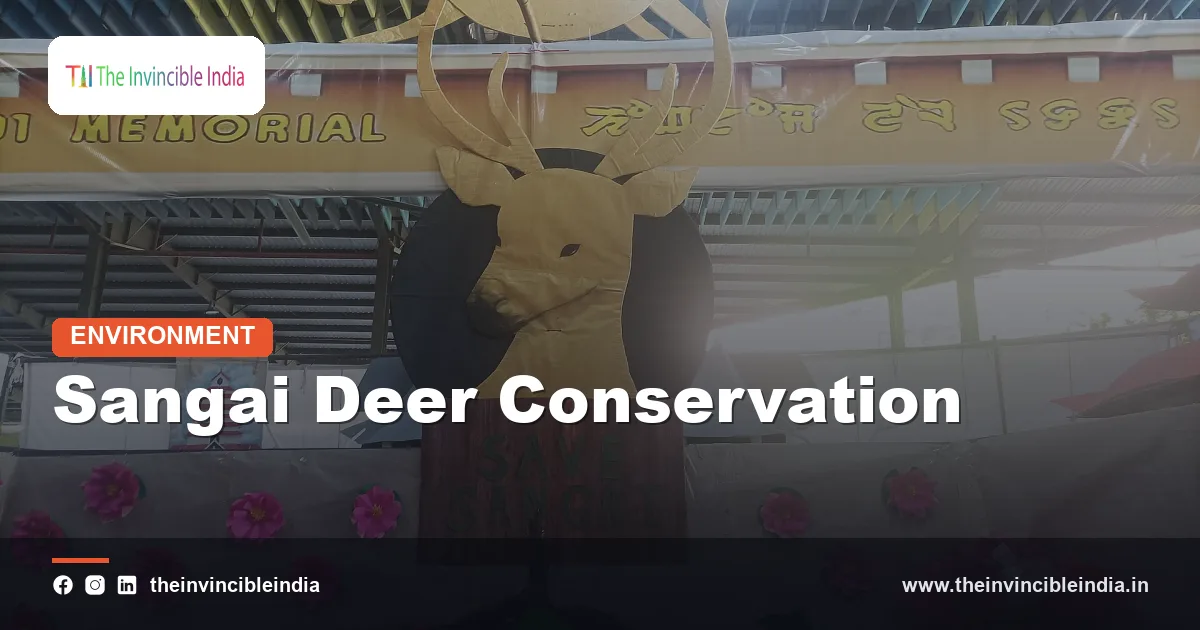
The Sangai is the Manipur brow-antlered deer (Rucervus eldii eldii), a critically endangered subspecies of Eld’s deer that is found naturally only in Manipur, in north-east India, and is the state animal of Manipur. Its entire wild population lives on the floating vegetation mats called phumdis in Keibul Lamjao National Park, the world’s only floating national park, on the southern edge of Loktak Lake. Because the animal seems to bounce lightly across the shifting mats, it is widely known as the “dancing deer”.
Sangai deer conservation in India is one of the country’s most closely watched species-recovery stories. The deer was feared extinct in the early 1950s, was rediscovered in 1953, and has since climbed back from a handful of animals to a few hundred. Its future still depends on the health of a single lake, a single park and a single fragile habitat.
| Attribute | Details |
|---|---|
| Common names | Sangai, Manipur brow-antlered deer, dancing deer |
| Scientific name | Rucervus eldii eldii (earlier written Cervus eldii eldii) |
| Range | Naturally restricted to Keibul Lamjao National Park, Bishnupur district, Manipur |
| Habitat | Floating phumdis (mats of vegetation, soil and organic matter) on Loktak Lake |
| Park status | Sanctuary in 1966; national park in 1977; about 40 square kilometres |
| Legal protection | Schedule I of the Wildlife (Protection) Act, 1972; Eld’s deer is listed in CITES Appendix I |
| Lake status | Loktak Lake is a Ramsar wetland of international importance (designated 1990) |
| Cultural status | State animal of Manipur; symbol of the annual Sangai Festival |
Key Takeaways
- The Sangai is the Manipur brow-antlered deer, a subspecies of Eld’s deer that occurs naturally only in Manipur, India.
- Keibul Lamjao National Park on Loktak Lake is the only floating national park in the world and the last natural home of the Sangai.
- The Sangai was believed extinct in 1951 and was rediscovered in 1953, and a count in the mid-1970s found only about a dozen animals.
- Phumdis, the floating mats that support the Sangai, have been thinning, and the Ithai barrage built for the Loktak hydroelectric project is widely discussed as one factor.
- Because every wild Sangai descends from a very small surviving population, inbreeding and the risk of a single disaster remain major conservation concerns.
- The Sangai is protected under Schedule I of the Wildlife (Protection) Act, 1972, which gives it the highest level of legal protection in India.
What is the Sangai?
The Sangai is a medium-sized deer in the family Cervidae that is the Manipur subspecies of Eld’s deer, and the Manipuri name is often explained as meaning “the animal that looks at you”. The wider species, Eld’s deer, was named after a British army officer, Lieutenant Percy Eld, who encountered it in Manipur in the nineteenth century. Two other subspecies live in South-East Asia, the Thamin of Myanmar and the Siamese Eld’s deer of Thailand, Laos, Cambodia and Vietnam, but the Sangai is the only one found in India.
An adult Sangai stands roughly 110 to 120 centimetres at the shoulder. Males are heavier than females and have a darker brown coat, while females and young animals are paler. The Sangai is a herbivore that grazes mainly on grasses, reeds and sedges that grow on the phumdis, and it is most active in the early morning and late afternoon.
What sets the animal apart from other deer is its antlers. A mature stag carries long antlers with a forward-pointing brow tine, and the brow tine and the main beam form one continuous, gracefully curved line. This feature gives the animal its descriptive English name, brow-antlered deer.
Why is the Sangai called the dancing deer?
The Sangai is called the dancing deer because it moves with a springing, high-stepping gait across the soft, swaying surface of the phumdis, which looks like dancing to an observer. The deer has long, splayed hooves that spread its weight over a wider area, and this helps it avoid sinking into the floating mat.
The nickname also captures the visual impression of a stag with graceful antlers moving through tall grass and mist on the lake. Wildlife writers, tourism campaigns and the Manipur government use the phrase widely, and a Sangai image appears in the state’s tourism branding. The name is a popular description rather than a scientific term, but it has become closely tied to the identity of the deer.
What is Keibul Lamjao National Park?
Keibul Lamjao National Park is a protected area of about 40 square kilometres in Bishnupur district of Manipur, on the south-eastern part of Loktak Lake, and it is the only floating national park in the world. The area was first protected as a sanctuary in 1966 specifically for the Sangai, and it was upgraded to a national park in 1977.
The park lies a short distance south of Imphal, the capital of Manipur. Much of the protected area is not solid ground at all but a thick carpet of phumdis, with scattered raised hillocks such as Pabot, Toya and Chingjao that rise from the lake and provide firmer ground for the animals. The park is also home to other wildlife, including the hog deer, the otter, various fish and many resident and migratory water birds that use the Loktak wetland.
The park is at the heart of the larger Loktak wetland system. Loktak is the largest freshwater lake in north-east India, and in 1990 it was designated a Ramsar site, a wetland of international importance under the Ramsar Convention. Later it was also placed on the Montreux Record, the Ramsar list of sites where ecological change is occurring or likely to occur, which reflects concern about its condition.
What are phumdis and how do they float?
Phumdis are floating islands made of a heterogeneous mass of vegetation, soil and organic matter in various stages of decomposition, and they float because the decomposing plant material traps gas and stays lighter than water. The mats can be anywhere from a few tens of centimetres to a couple of metres thick, and the thickest are strong enough to carry the weight of a deer, a person or even a small hut.
Phumdis form when aquatic plants such as reeds, grasses and sedges grow densely, die and rot, and their roots knit together into a floating raft. Local fisher communities also use phumdis. They live on floating huts, and they build circular fishing enclosures called athaphum from the mats.
The mats are alive and changing. In a healthy cycle, as the water level falls in the dry season, the underside of the phumdis touches the lake bed and absorbs nutrients and moisture, which helps the mat renew itself. Then the monsoon raises the lake and the mats float again. This yearly rhythm is the foundation of the Sangai’s habitat, and any change in the lake’s natural water cycle can alter it.
How close did the Sangai come to extinction?
The Sangai came so close to extinction that it was declared extinct in 1951 and then rediscovered in 1953, and a later survey in the mid-1970s counted only about 14 animals. In the nineteenth and early twentieth centuries the deer was found across the wetlands of the Manipur valley, but its range collapsed as marshes were drained for rice cultivation, settlements expanded and hunting continued.
Conservation writers credit the naturalist E. P. Gee with confirming that the deer survived in the Loktak area in 1953. This sighting led to the establishment of the sanctuary and the beginning of formal protection. The low point in numbers came in the 1970s, when the whole population fitted into one small corner of the lake.
Since then, protection, anti-poaching patrols and the park’s status have allowed the herd to grow. Official counts in recent years have put the population at a few hundred animals, a large increase from the dozen or so of the mid-1970s, though still a very small number for a wild species.
How has the Sangai population changed over time?
The Sangai population has moved from widespread presence in the Manipur valley, to apparent extinction in the early 1950s, to a bottleneck of roughly 14 animals in the 1970s, and to a few hundred in recent decades. The table below summarises the main milestones.
| Period | Milestone |
|---|---|
| Nineteenth century | Eld’s deer described from Manipur; the deer occurs widely in marshes of the valley |
| Early twentieth century | Habitat loss and hunting reduce numbers sharply |
| 1951 | The Sangai is feared extinct |
| 1953 | A surviving population is confirmed at Keibul Lamjao |
| 1966 | Keibul Lamjao is declared a wildlife sanctuary |
| Mid-1970s | A count finds only about 14 animals |
| 1977 | The area is upgraded to a national park |
| 1983 | The Ithai barrage on the Manipur river is commissioned for the Loktak hydroelectric project |
| Recent decades | Counts record a few hundred animals, with ongoing monitoring by the forest department |
Numbers from field counts should be read with care. The Sangai lives in dense vegetation on a floating surface, so counting methods vary by year, and the exact figure can change with the method used.
What threats does the Sangai face?
The main threats to the Sangai are shrinking and thinning phumdis, altered water levels in Loktak Lake, a very small and genetically narrow population, and pressure from human activity around the lake. These factors combine, so a problem for the habitat quickly becomes a problem for the animal.
Shrinking and thinning phumdis
The area and thickness of healthy phumdis in the park have declined over the decades. Thinner mats cannot carry the weight of the deer as well, and they offer less food, so the effective habitat becomes smaller than the park’s map area suggests.
Water-level changes and hydropower
The Ithai barrage, built across the Manipur river downstream of Loktak and linked to the Loktak hydroelectric project of the National Hydroelectric Power Corporation (NHPC), keeps the lake at a higher level for much of the year. Researchers and local groups argue that the phumdis therefore no longer settle onto the lake bed in the dry season, which reduces their nutrient intake and weakens the mats. The causes of the decline are debated, since pollution, nutrient load from surrounding farmland and settlements, and siltation also play a part.
Inbreeding and a single population
Every wild Sangai descends from a small group that survived the mid-twentieth-century bottleneck. A narrow gene pool raises the risk of inbreeding and reduces the population’s ability to withstand disease. With all the wild animals concentrated in a single park, one major flood, epidemic or habitat failure could affect the entire population.
Human pressure
Poaching was once a major cause of decline and is now limited by patrols, but disturbance from fishing, encroachment, burning of vegetation and the movement of people around the park still creates pressure. Stray and domestic animals on the margins of the wetland can also disturb the deer.
How does the Ithai barrage affect the Sangai?
The Ithai barrage affects the Sangai mainly by changing how water rises and falls in Loktak Lake, which in turn changes how the phumdis form, float and regenerate. The barrage was commissioned in 1983 as part of the Loktak hydroelectric project, which supplies power to the north-eastern grid.
Before the barrage, the lake level followed a more natural seasonal pattern, with a lower dry-season level that let the underside of the phumdis touch the bed. After the barrage, the water stays higher, and the phumdis have been described as remaining afloat for longer periods and losing their natural renewal cycle.
This is a policy question with several sides. The project provides electricity, irrigation support and flood regulation for the region, while conservationists point to the cost to the wetland and its fauna. Successive management plans have tried to balance these needs, including the Loktak Protection Act, 2006 and the Loktak Development Authority, which manages the lake and surrounding area.
How is the Sangai legally protected and managed?
The Sangai is legally protected as a Schedule I species under the Wildlife (Protection) Act, 1972, which prohibits hunting and gives the species the highest level of statutory protection in India. Eld’s deer is also listed in Appendix I of CITES, the Convention on International Trade in Endangered Species, which bans international commercial trade.
On the ground, the Manipur Forest Department manages Keibul Lamjao National Park. Its work includes anti-poaching patrols, regular population monitoring, control of access, and removal of excess or unhealthy phumdis in the surrounding lake. Wildlife scientists from institutions such as the Wildlife Institute of India have contributed ecological studies and recovery recommendations.
Several complementary measures are discussed in conservation planning:
- Protecting and restoring the phumdi habitat, including managing lake water levels where possible.
- Reducing pollution and sedimentation flowing into Loktak Lake from its catchment.
- Maintaining a captive population, such as the animals kept at the Manipur Zoological Garden at Iroisemba near Imphal.
- Exploring a second, safe wild population in another suitable wetland, so the species does not depend on one site.
- Working with the fishing communities of Loktak so livelihoods and conservation can go together.
Why does the Sangai matter to Manipur’s culture?
The Sangai matters to Manipur’s culture because it is the state animal and a symbol of the region’s identity, appearing in folklore, art and public life. Manipuri legend associates the deer with the Meitei people and their old traditions of hunting and ritual, and the animal has long appeared in the cultural imagination of the Imphal valley.
The Manipur government’s annual Sangai Festival, held in November, uses the deer as its emblem. The festival, which began as a tourism event and was later renamed after the animal, showcases the state’s dance, music, handloom, handicrafts and cuisine, and it draws visitors from within India and abroad. The festival’s name keeps public attention on the deer, and conservationists note that a popular emblem can build public support for protection.
Because the deer lives only in Manipur, it is also an example of “endemic” wildlife, meaning a species found naturally in one place and nowhere else in the world. The loss of the Sangai from Keibul Lamjao would therefore mean the loss of the subspecies in the wild.
What does the future of Sangai conservation look like?
The future of Sangai conservation depends on keeping the phumdi habitat healthy, widening the species’ geographic safety net, and sustaining community support around Loktak Lake. The recovery of the population from a dozen animals to a few hundred shows that strong protection works, but it does not remove the structural risks of a single site.
Wildlife biologists describe a long-term approach in three parts. First, the habitat in the park must be monitored and restored so that phumdis stay thick and productive. Second, genetic and health monitoring should guide breeding programmes, including the zoo population. Third, a second wild population, if a suitable wetland is found and secured, would reduce the risk that a single event could wipe out the species.
Loktak is also a lifeline for tens of thousands of people who fish, farm and live on and around the lake. For this reason, any plan that protects the Sangai must also take the livelihoods of these communities into account, and many conservationists argue that a lasting solution will be one that benefits both the wetland and the people.
Bottom Line
The Sangai is the Manipur brow-antlered deer, and it has survived near-extinction thanks to protection of a single floating habitat at Keibul Lamjao National Park. Its recovery is real but fragile, because the deer depends on the health of Loktak Lake’s phumdis and has a narrow genetic base. Sangai conservation is therefore as much about managing a wetland as it is about protecting an animal.
Frequently Asked Questions
What is the Sangai deer?
The Sangai is the Manipur brow-antlered deer, a subspecies of Eld’s deer found naturally only in Manipur in north-east India. It is the state animal of Manipur and is known as the dancing deer for the way it moves across floating vegetation. It lives in Keibul Lamjao National Park on Loktak Lake.
Why is the Sangai called the dancing deer?
The Sangai is called the dancing deer because it walks with a springing gait across the swaying floating mats of the park. Its long, splayed hooves help it stay on top of the soft phumdis. The nickname is a popular description rather than a scientific term.
Where does the Sangai live?
The Sangai lives in Keibul Lamjao National Park, on the south-eastern part of Loktak Lake in Bishnupur district of Manipur. The park is the only floating national park in the world. This is the only place where the deer survives naturally in the wild.
How many Sangai are left?
Recent counts have recorded a few hundred Sangai, compared with only about 14 in the mid-1970s. The exact number varies by survey and counting method. The population is still very small, which is why the species remains a conservation priority.
What are the main threats to the Sangai?
The main threats are the thinning and shrinking of phumdis, changes in Loktak’s water levels linked to the Ithai barrage, inbreeding in a small population, and human pressure around the lake. Because all wild animals live at one site, a single flood or disease outbreak could be very damaging. Conservation planning therefore aims to restore the habitat and create a second population.
Is the Sangai protected by law?
Yes, the Sangai is protected under Schedule I of the Wildlife (Protection) Act, 1972, which gives it the highest level of protection in India. Eld’s deer is also listed in CITES Appendix I, which prohibits international commercial trade. The Manipur Forest Department manages Keibul Lamjao National Park.
{“@context”:”https://schema.org”,”@graph”:[{“@type”:”FAQPage”,”mainEntity”:[{“@type”:”Question”,”name”:”What is the Sangai deer?”,”acceptedAnswer”:{“@type”:”Answer”,”text”:”The Sangai is the Manipur brow-antlered deer, a subspecies of Eld’s deer found naturally only in Manipur in north-east India. It is the state animal of Manipur and is known as the dancing deer for the way it moves across floating vegetation. It lives in Keibul Lamjao National Park on Loktak Lake.”}},{“@type”:”Question”,”name”:”Why is the Sangai called the dancing deer?”,”acceptedAnswer”:{“@type”:”Answer”,”text”:”The Sangai is called the dancing deer because it walks with a springing gait across the swaying floating mats of the park. Its long, splayed hooves help it stay on top of the soft phumdis. The nickname is a popular description rather than a scientific term.”}},{“@type”:”Question”,”name”:”Where does the Sangai live?”,”acceptedAnswer”:{“@type”:”Answer”,”text”:”The Sangai lives in Keibul Lamjao National Park, on the south-eastern part of Loktak Lake in Bishnupur district of Manipur. The park is the only floating national park in the world. This is the only place where the deer survives naturally in the wild.”}},{“@type”:”Question”,”name”:”How many Sangai are left?”,”acceptedAnswer”:{“@type”:”Answer”,”text”:”Recent counts have recorded a few hundred Sangai, compared with only about 14 in the mid-1970s. The exact number varies by survey and counting method. The population is still very small, which is why the species remains a conservation priority.”}},{“@type”:”Question”,”name”:”What are the main threats to the Sangai?”,”acceptedAnswer”:{“@type”:”Answer”,”text”:”The main threats are the thinning and shrinking of phumdis, changes in Loktak’s water levels linked to the Ithai barrage, inbreeding in a small population, and human pressure around the lake. Because all wild animals live at one site, a single flood or disease outbreak could be very damaging. Conservation planning therefore aims to restore the habitat and create a second population.”}},{“@type”:”Question”,”name”:”Is the Sangai protected by law?”,”acceptedAnswer”:{“@type”:”Answer”,”text”:”Yes, the Sangai is protected under Schedule I of the Wildlife (Protection) Act, 1972, which gives it the highest level of protection in India. Eld’s deer is also listed in CITES Appendix I, which prohibits international commercial trade. The Manipur Forest Department manages Keibul Lamjao National Park.”}}]}]}


