

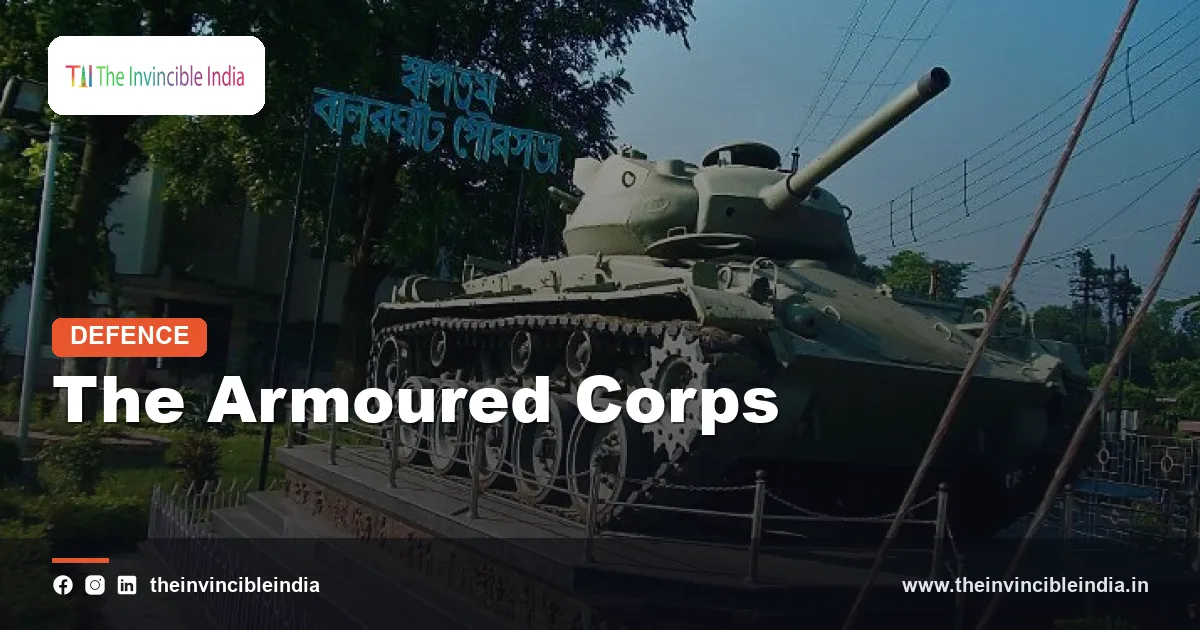
The Armoured Corps is the tank and mechanised arm of the Indian Army, a combat arm built around armoured fighting vehicles that delivers firepower, mobility and shock action on the battlefield and is often called the “arm of decision”. The Indian Armoured Corps was formed in 1938 by uniting the mechanised cavalry regiments of the British Indian Army, and it carries forward the traditions of some of the oldest horsed cavalry units in the country.
The Armoured Corps today operates main battle tanks such as the T-72, the T-90 Bhishma and the indigenous Arjun, together with armoured reconnaissance vehicles. Its training hub is the Armoured Corps Centre and School at Ahmednagar in Maharashtra. This explainer covers the corps’ lineage, famous regiments, tanks, role in mechanised warfare and landmark battles such as Asal Uttar in 1965.
| Attribute | Details |
|---|---|
| Full name | Armoured Corps (Indian Army) |
| Type | Combat arm of the Indian Army specialising in tank and armoured warfare |
| Formed | 1938, as the Indian Armoured Corps, from mechanised cavalry regiments |
| Lineage | Cavalry regiments of the British Indian Army, some dating to the eighteenth and nineteenth centuries |
| Tank types in service | T-72, T-90 Bhishma (Russian-origin, built under licence in India) and the Arjun (indigenous) |
| Training centre | Armoured Corps Centre and School (ACC&S), Ahmednagar, Maharashtra |
| Ranks of enlisted personnel | Cavalry-style ranks such as Sowar, Daffadar and Risaldar |
| Famous actions | Zoji La (1948), Asal Uttar (1965), Chawinda and Phillora (1965), Basantar (1971) |
Key Takeaways
- The Armoured Corps is the Indian Army’s tank arm, formed in 1938 as the Indian Armoured Corps by mechanising the cavalry regiments of the British Indian Army.
- The Indian Armoured Corps keeps cavalry traditions alive, with regiments such as Skinner’s Horse, Hodson’s Horse, Poona Horse and Deccan Horse tracing their roots to earlier cavalry units.
- The main battle tanks of the Indian Armoured Corps include the Russian-origin T-72 and T-90 Bhishma, both built under licence in India, and the indigenously designed Arjun.
- The Armoured Corps Centre and School at Ahmednagar in Maharashtra is the training home of the Indian Armoured Corps.
- The Battle of Asal Uttar in September 1965, fought near Khem Karan in Punjab, saw Indian forces halt a major Pakistani armoured thrust, and the area became known as Patton Nagar.
- Two Param Vir Chakra awards are associated with the Poona Horse: Lieutenant Colonel A.B. Tarapore in 1965 and Second Lieutenant Arun Khetarpal in 1971.
What is the Armoured Corps of the Indian Army?
The Armoured Corps is the arm of the Indian Army that fights with tanks and other armoured vehicles, using armour, firepower and speed to break through enemy defences and exploit gaps. It is one of the army’s combat arms, alongside the infantry, artillery and others.
The corps is known as the “arm of decision” because armoured formations, in combination with infantry and artillery, can move quickly and deliver a decisive blow in battle. Its units are called armoured regiments, and many of them still use the traditional names of cavalry regiments.
The Armoured Corps also includes armoured reconnaissance units, which move ahead of main forces to find the enemy and gather information. The corps works closely with mechanised infantry, which travels in armoured infantry combat vehicles to fight alongside tanks.
How did the Indian Armoured Corps originate?
The Indian Armoured Corps originated in 1938, when the British Indian Army began replacing the horse with armoured vehicles and grouped its mechanised cavalry regiments into a new corps. The change reflected lessons from the First World War, in which tanks had shown their power.
Before mechanisation, India’s cavalry was made up of regiments of horsemen, many raised in the eighteenth and nineteenth centuries. During the 1930s and early 1940s these regiments were gradually converted to armoured cars and tanks, and during the Second World War Indian armoured units fought in North Africa, Italy and Burma.
Milestones in the corps’ history
- Eighteenth and nineteenth centuries: Raising of early cavalry units, such as the Governor’s Bodyguard, which later became the President’s Bodyguard.
- 1938: Creation of the Indian Armoured Corps and the start of mechanisation.
- Second World War: Indian armoured units serve in several theatres.
- 1947: Independence and partition lead to the division of regiments between India and Pakistan.
- 1948: Light tanks cross the Zoji La pass in Jammu and Kashmir.
- 1950s onward: Induction of tanks such as the Sherman, Centurion and later the Vijayanta, followed by Soviet-origin tanks.
After independence the Armoured Corps was reorganised, and the regiments allotted to India continued their traditions under the same names or under new ones.
Which are the famous regiments of the Armoured Corps?
The famous regiments of the Armoured Corps include Skinner’s Horse, Hodson’s Horse, Poona Horse, Deccan Horse, Central India Horse, the 61st Cavalry and the President’s Bodyguard. Each has a distinctive heritage that dates to the cavalry era.
| Regiment | Known for |
|---|---|
| Skinner’s Horse (1st Horse) | Raised in 1803 by James Skinner; known as the “Yellow Boys” from the colour of its original tunics |
| Hodson’s Horse (4th Horse) | Raised in 1857; a long record of service in many campaigns |
| Poona Horse (17th Horse) | Fought at Phillora and Chawinda in 1965 and Basantar in 1971; associated with two Param Vir Chakra awards |
| Deccan Horse (9th Horse) | Long-standing regiment that took part in the 1965 war |
| 61st Cavalry | Formed in 1953 by merging state cavalry units; known as one of the last active horsed cavalry regiments in the world |
| President’s Bodyguard | Traces back to 1773; senior-most regiment of the Indian Army and a ceremonial unit that guards the President |
The regiments carry honours and battle honours from many conflicts, and members of the corps take pride in their regimental colours and customs.
What tanks does the Armoured Corps operate?
The Armoured Corps operates main battle tanks that include the T-72, the T-90 Bhishma and the Arjun, together with supporting armoured vehicles. These tanks combine a powerful main gun, armour protection and a strong engine for speed over varied terrain.
Main battle tanks
- T-72 (Ajeya): A Soviet-origin tank that entered Indian service in the late 1970s and was later built in India. It has a 125 mm smoothbore gun and an automatic loader.
- T-90 Bhishma: A Russian-origin tank inducted in the early 2000s and built under licence at the Heavy Vehicles Factory in Avadi, Tamil Nadu. It is named after the warrior Bhishma of the Mahabharata and can fire gun-launched missiles.
- Arjun: An indigenous main battle tank developed by the Combat Vehicles Research and Development Establishment (CVRDE) of the Defence Research and Development Organisation (DRDO). It has a 120 mm rifled gun and was inducted in the early 2000s, with upgraded versions developed later.
Earlier tanks used in the Indian Army have included the Sherman, the Stuart, the Centurion, the PT-76 amphibious light tank, the T-55 and the Vijayanta, which was built in India under licence from a British design. India has also publicly announced work on new-generation and light tanks, but the details of current holdings are not covered here.
How does mechanised warfare work?
Mechanised warfare is a form of combat in which tanks and armoured vehicles move together with infantry and artillery to break through enemy defences and strike deep into the rear. The Armoured Corps provides the main striking power of such operations.
The concept rests on four qualities: firepower from the tank’s main gun, mobility across rough ground, protection from armour, and shock effect on the enemy. A tank crew is typically three or four soldiers, who include a commander, a gunner, a driver and, in some tanks, a loader.
- Breakthrough: Tanks attack and penetrate defended areas, with infantry and artillery support.
- Exploitation: After a breakthrough, armoured units move quickly into the enemy’s rear.
- Defence and counter-attack: Armoured units can also hold ground and counter-attack enemy thrusts.
- Reconnaissance: Light armoured vehicles scout ahead of the main force.
The Indian Army’s armoured formations can fight in deserts, plains and, with suitable light tanks, even in mountainous regions, as the 1948 operation at Zoji La showed.
Where is the Armoured Corps Centre and School?
The Armoured Corps Centre and School is at Ahmednagar in Maharashtra and is the training home of the Indian Armoured Corps. It trains officers and soldiers in tank warfare, gunnery, driving, maintenance and tactics.
Ahmednagar is an old military town with a long association with armoured warfare. It also hosts the Vehicle Research and Development Establishment of the DRDO and the Cavalry Tank Museum, which displays tanks and armoured vehicles from different periods.
- Centre: Handles recruit and trade training of soldiers for armoured regiments.
- School: Conducts courses for officers and junior commissioned officers in tactics, gunnery and technical subjects.
- Museum: Preserves vehicles and records of the corps’ history.
What was the Battle of Asal Uttar in 1965?
The Battle of Asal Uttar was a major tank battle fought in September 1965 near Khem Karan in Punjab during the Indo-Pakistani War, in which Indian forces defeated a Pakistani armoured offensive. The name is usually translated as “real” or “fitting” reply, and the battle is considered one of the largest tank engagements since the Second World War.
Pakistan’s armoured division, equipped with American-made Patton tanks, advanced into Indian territory. Indian troops, using defensive positions, flooded fields and armoured units such as the Deccan Horse and the 3rd Cavalry, stopped the advance and destroyed many tanks. Because so many Patton tanks were destroyed or captured, a nearby area became known as Patton Nagar.
Company Quartermaster Havildar Abdul Hamid of the Grenadiers earned the Param Vir Chakra in this battle for destroying enemy tanks with a recoilless gun mounted on a jeep.
What other battles shaped the Armoured Corps?
Other battles that shaped the Armoured Corps include the Zoji La operation of 1948, the battles of Phillora and Chawinda in 1965, and the Battle of Basantar in 1971. Each tested the corps’ ability to fight in different terrain.
- Zoji La (1948): Light tanks of the 7th Cavalry crossed the high Zoji La pass in Kashmir, taking the enemy by surprise and helping to open the route to Ladakh.
- Phillora and Chawinda (1965): Indian armour advanced in the Sialkot sector. Lieutenant Colonel A.B. Tarapore of the Poona Horse led his regiment and was awarded the Param Vir Chakra after his death.
- Basantar (1971): In the Shakargarh sector, armoured units fought a hard battle across a river with minefields. Second Lieutenant Arun Khetarpal of the Poona Horse earned the Param Vir Chakra posthumously.
These actions are studied at military institutions as examples of armoured tactics and of leadership at junior levels.
Bottom Line
The Armoured Corps is the Indian Army’s tank arm, formed in 1938 from mechanised cavalry and trained at Ahmednagar. It carries on cavalry traditions through regiments with centuries of history, fights with the T-72, T-90 Bhishma and Arjun, and has been shaped by battles such as Zoji La, Asal Uttar and Basantar. Its role is to give the Army the speed and striking power that decide land battles.
Frequently Asked Questions
What is the Armoured Corps of the Indian Army?
The Armoured Corps is the combat arm of the Indian Army that fights with tanks and armoured vehicles. It was formed in 1938 and is often called the arm of decision.
Which tanks does the Indian Armoured Corps use?
The Indian Armoured Corps uses main battle tanks such as the T-72, the T-90 Bhishma and the indigenous Arjun. The T-72 and T-90 are of Russian origin and are built in India under licence, while the Arjun was developed by the DRDO.
Where is the Armoured Corps Centre and School?
The Armoured Corps Centre and School is at Ahmednagar in Maharashtra. It trains officers and soldiers of the armoured regiments and is also home to the Cavalry Tank Museum.
Why is the Armoured Corps called the arm of decision?
The Armoured Corps is called the arm of decision because armoured formations combine firepower, speed and shock effect to bring battles to a decisive result. Working with infantry and artillery, tanks can break through enemy lines and exploit the gap.
What was the Battle of Asal Uttar?
The Battle of Asal Uttar was a September 1965 tank battle near Khem Karan in Punjab. Indian forces stopped a Pakistani armoured offensive and destroyed many Patton tanks, and the area came to be called Patton Nagar.
Which are the oldest regiments of the Armoured Corps?
The oldest units include the President’s Bodyguard, which traces back to 1773, and Skinner’s Horse, raised in 1803. Hodson’s Horse, Poona Horse and Deccan Horse also have long histories rooted in the cavalry of the British Indian Army.
{“@context”:”https://schema.org”,”@graph”:[{“@type”:”FAQPage”,”mainEntity”:[{“@type”:”Question”,”name”:”What is the Armoured Corps of the Indian Army?”,”acceptedAnswer”:{“@type”:”Answer”,”text”:”The Armoured Corps is the combat arm of the Indian Army that fights with tanks and armoured vehicles. It was formed in 1938 and is often called the arm of decision.”}},{“@type”:”Question”,”name”:”Which tanks does the Indian Armoured Corps use?”,”acceptedAnswer”:{“@type”:”Answer”,”text”:”The Indian Armoured Corps uses main battle tanks such as the T-72, the T-90 Bhishma and the indigenous Arjun. The T-72 and T-90 are of Russian origin and are built in India under licence, while the Arjun was developed by the DRDO.”}},{“@type”:”Question”,”name”:”Where is the Armoured Corps Centre and School?”,”acceptedAnswer”:{“@type”:”Answer”,”text”:”The Armoured Corps Centre and School is at Ahmednagar in Maharashtra. It trains officers and soldiers of the armoured regiments and is also home to the Cavalry Tank Museum.”}},{“@type”:”Question”,”name”:”Why is the Armoured Corps called the arm of decision?”,”acceptedAnswer”:{“@type”:”Answer”,”text”:”The Armoured Corps is called the arm of decision because armoured formations combine firepower, speed and shock effect to bring battles to a decisive result. Working with infantry and artillery, tanks can break through enemy lines and exploit the gap.”}},{“@type”:”Question”,”name”:”What was the Battle of Asal Uttar?”,”acceptedAnswer”:{“@type”:”Answer”,”text”:”The Battle of Asal Uttar was a September 1965 tank battle near Khem Karan in Punjab. Indian forces stopped a Pakistani armoured offensive and destroyed many Patton tanks, and the area came to be called Patton Nagar.”}},{“@type”:”Question”,”name”:”Which are the oldest regiments of the Armoured Corps?”,”acceptedAnswer”:{“@type”:”Answer”,”text”:”The oldest units include the President’s Bodyguard, which traces back to 1773, and Skinner’s Horse, raised in 1803. Hodson’s Horse, Poona Horse and Deccan Horse also have long histories rooted in the cavalry of the British Indian Army.”}}]}]}


