

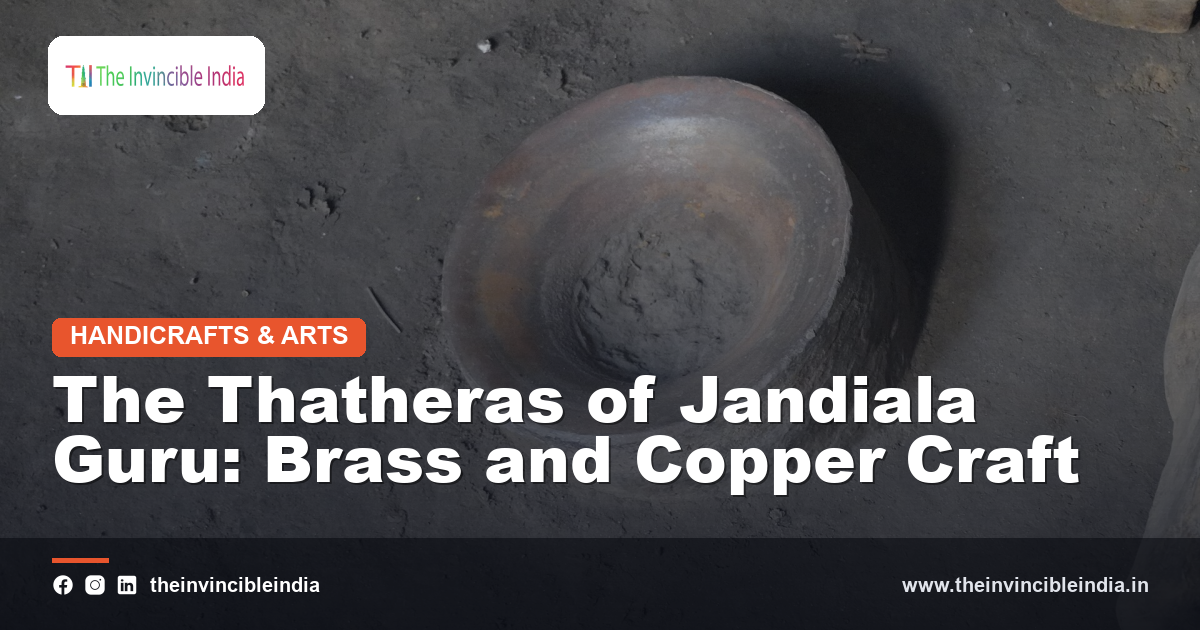
The Thatheras of Jandiala Guru are a community of metalworkers in the Amritsar district of Punjab who make brass and copper utensils by hand-hammering sheets of metal. Their name is also written Thathiars or Thatheras, and their craft has been recognised by UNESCO on the Representative List of the Intangible Cultural Heritage of Humanity. The town of Jandiala Guru, near Amritsar, has long been known for the ringing sound of hammers from its workshops, a sound as characteristic of Punjab as the colourful threads of Phulkari embroidery. Through generations of work, the Thatheras have supplied the kitchens, homes and community meals of the region with durable and beautiful metalware.
Quick answer: The Thatheras of Jandiala Guru are a community of artisans in Punjab, India, who make brass and copper utensils by hammering metal sheets by hand. Their craft, centred on the town of Jandiala Guru near Amritsar, is recognised by UNESCO as intangible cultural heritage. It is valued for producing durable, handmade cookware and vessels for homes and community kitchens.
Key Takeaways
- The Thatheras, also called Thathiars, are traditional metalworkers of Jandiala Guru in the Amritsar district of Punjab.
- They make utensils of brass and copper by heating, hammering and shaping metal sheets entirely by hand.
- UNESCO inscribed the Thatheras craft on its Representative List of the Intangible Cultural Heritage of Humanity.
- Traditional products include cooking pots, plates, bowls, water vessels and large vessels used in community kitchens.
- Copper utensils are often tinned on the inside, a coating process called kalai, to make them safe for cooking.
- Knowledge of the craft is passed from fathers and elders to younger family members through direct practice.
The sections below explain the origins, methods, products and present-day life of this Punjab metal tradition.
Quick Facts
| Detail | Information |
|---|---|
| Community | Thatheras (Thathiars) |
| Place | Jandiala Guru, Amritsar, Punjab |
| Materials | Brass and copper |
| Technique | Hand hammering of heated metal |
| Recognition | UNESCO intangible heritage listing |
| Typical products | Cooking pots, plates, water vessels |
Who Are the Thatheras of Jandiala Guru?
The Thatheras are a traditional community of metalworkers in Jandiala Guru, a town in the Amritsar district of Punjab. They specialise in making utensils from brass and copper by shaping metal sheets with hammers rather than casting or machine stamping. The name is sometimes written Thathiars, and it refers to the trade as much as to the community. Their workshops are typically small, family-run spaces where several members work together, often sitting close to the heat and the anvil. The craft has been passed down through generations, and the community is known for both skill and endurance. Their products have supplied households, gurdwara kitchens and festival events across Punjab. In essence, the Thatheras are the hereditary keepers of a regional metalworking art, and their identity is closely tied to the town in which they live and work.
Where Is Jandiala Guru?
Jandiala Guru is a town in the Amritsar district of Punjab, India, located a short distance from the city of Amritsar. It is known as a centre of traditional metalworking, and the sound of hammering from its lanes has long marked the town’s character. The area lies in the fertile plains of the Majha region of Punjab, a region with a strong tradition of agriculture, community kitchens and festive gatherings, all of which create demand for sturdy utensils. The town is also referred to in connection with its name, Jandiala Guru, which is used to distinguish it from other places of similar name. Its position near Amritsar has made it easy for the Thatheras to supply the region’s markets and religious institutions. Jandiala Guru is therefore both a place and a brand name for traditional Punjab brass and copper craft.
How Did the Thatheras Craft Begin?
According to tradition, the Thatheras of Punjab trace their craft to metalworkers who were encouraged to settle in the region during the rule of Maharaja Ranjit Singh in the early nineteenth century. This account is widely repeated in descriptions of the community, though, like many oral histories, it cannot be confirmed in every detail. What is clear is that the craft took root in Jandiala Guru and grew with the demand for durable metal utensils. The Thatheras organised themselves into family workshops and developed a recognisable style of hammered brass and copper ware. The craft survived changes in power and economy because food vessels remained a daily necessity. Its history is therefore best understood as a continuous local tradition, supported by a living memory of royal patronage and strengthened by the practical needs of Punjabi households.
What Materials Do the Thatheras Use?
The Thatheras use brass and copper as their main materials, along with tin for lining certain vessels and wood or charcoal for fuel. Copper is a naturally reddish metal prized for its heat conduction, while brass is an alloy of copper and zinc that is golden in colour and slightly harder. The metals are bought in sheets or pieces, and in earlier times, scrap metal was also reworked into new vessels. Tin is used in a coating process known as kalai to line the insides of copper and brass pots, forming a barrier between the food and the metal. Other supplies include natural polishing agents and simple cleaning substances. The choice of these metals reflects both practical cooking needs and long cultural preference for metal vessels in Indian homes. The materials are therefore simple, but their handling requires deep knowledge.
What Tools Do the Thatheras Use?
The Thatheras use hammers, anvils, tongs, shears, files, a furnace or heating hearth and polishing tools to shape and finish their metalware. Hammers of different weights and shapes are used for rough shaping, for thinning the metal and for the final fine finish. An anvil or a heavy block gives a firm base for striking the metal. Tongs allow the artisan to hold heated metal safely, and shears or chisels are used to cut sheets to the needed size. The heating hearth provides the high temperature that softens the metal. Many tools are made or adapted by the artisans themselves to fit their own working style. The tool kit is simple and old, and the craft depends far more on the trained arm and eye than on equipment. In this sense, the tools serve the skill, and the skill is what gives the finished vessel its form.
How Do the Thatheras Make a Utensil?
The Thatheras make a utensil by cutting metal, heating it, and hammering it into shape through repeated rounds of striking and reheating. A sheet or piece of metal is first cut to size and heated until it becomes workable. Working in teams, the artisans hammer the metal against an anvil, gradually raising it into a bowl or curved form. Metal hardens as it is hammered, so it must be reheated periodically to keep it soft. When the basic shape is complete, the vessel is trimmed, joined where necessary, and smoothed with finer strokes. Decoration, such as simple lines or patterns, may be added by hammering or engraving. The final stages include cleaning, polishing and, for cooking vessels, lining with tin. The process is physically demanding and requires close coordination, and each utensil carries the evidence of many hundreds of careful blows.
What Is Kalai and Why Is It Used?
Kalai is the traditional process of coating the inside of copper and brass vessels with a thin layer of tin, and it is used to make cooking utensils safe and durable. Copper and brass can react with acidic foods, so a tin lining acts as a protective barrier between the food and the metal. The vessel is cleaned and heated, and molten tin is wiped across the inner surface so that it forms a smooth, silvery layer. Over time, with regular use, the lining wears thin and the vessel needs to be re-tinned by a kalaigar, the specialist who performs this task. The practice is an old and familiar part of Indian kitchens and is closely associated with metalware crafts. Kalai therefore reflects a practical knowledge of food safety, and it shows how traditional craft solves everyday problems with simple materials.
What Products Are Made by the Thatheras?
The Thatheras make a wide range of products, including cooking pots, plates, bowls, water vessels, ladles, jugs and large vessels used for community cooking. Familiar forms include the lota, the handi, the parat, the degchi and the karahi, each with a particular role in the Indian kitchen. Larger pots serve the kitchens of gurdwaras and other community institutions, where food is prepared in great quantities. Smaller items are made for households and for gifting at weddings, where metal utensils have traditionally been part of the bride’s trousseau. In recent years some artisans have also made decorative objects and contemporary tableware in response to new tastes. The range of products shows that the craft is rooted in daily need as much as in art. Each piece is both useful and well made, which is why Thatheras ware has remained valued across generations.
Why Are Brass and Copper Utensils Valued in India?
Brass and copper utensils are valued in India because they are durable, repairable, good conductors of heat and long associated with traditional ideas of healthy cooking and storage. Metal vessels can last for generations when cared for, and they can be re-tinned, repaired or melted down and remade. Many households keep copper vessels for storing drinking water, a practice rooted in tradition and widely believed to benefit health, though such claims are cultural beliefs and not matters of settled science. Brass and copper are also used in religious ceremonies, where their gleaming surfaces have symbolic meaning. Their warm colours add beauty to kitchens and shrines. The demand for such vessels sustains crafts like that of the Thatheras, who supply goods with both practical and ceremonial value. These values explain why the utensils remain important despite competition from steel and plastic.
Why Did UNESCO Recognise the Thatheras Craft?
UNESCO recognised the Thatheras craft because it is a living tradition of knowledge, skill and community practice that has been passed down through generations. The craft was inscribed in 2014 on the Representative List of the Intangible Cultural Heritage of Humanity, under the title relating to traditional brass and copper utensil making among the Thatheras of Jandiala Guru, Punjab. The recognition highlights not just the objects but the knowledge of working metal, the community organisation behind it and the cultural role of the utensils in Punjabi life. It draws national and international attention to a craft that had been under pressure from industrial goods. Such listing also encourages safeguarding efforts, such as documentation and training. The UNESCO inscription therefore serves as both an honour and a call to protect an endangered skill.
How Is Knowledge Passed Down among the Thatheras?
Knowledge among the Thatheras is passed down through direct practice within families, as younger members work alongside experienced elders. A child begins by watching, then helps with simple tasks, and over years learns to judge the heat of the metal, the weight of the hammer and the shape of the vessel by feel. There is no single textbook of the craft; the lessons are carried in habit, in rhythm and in shared work. Group hammering in particular teaches timing and coordination, since several people must strike in sequence. Community workshops and safeguarding programmes now supplement this family teaching. The method is slow but effective, and it ensures that techniques are understood in the body as well as the mind. This chain of teaching is the true heart of the heritage, and its continuity depends on the willingness of each generation to take it up.
What Challenges Do the Thatheras Face?
The Thatheras face challenges from the spread of cheaper stainless steel, aluminium and non-stick cookware, from rising metal prices and from the physical demands of the work. Mass-produced utensils are lighter on the budget and easier to maintain, so many households have moved away from hand-made brass and copper. The craft is also noisy, hot and tiring, which discourages some young people from entering it. Income can be uncertain, and artisans often depend on middlemen or seasonal demand. Recognition by UNESCO and renewed interest in traditional cookware have helped, but support is still needed in the form of fair markets, training and design assistance. These challenges are common to many Indian crafts. Understanding them shows why the preservation of the Thatheras tradition requires active help from buyers, institutions and policy as well as from the artisans.
How Can You Choose and Care for Handmade Metalware?
Handmade metalware should be chosen for even hammering, sturdy joins and, for cooking pots, a clean and smooth tin lining. Buyers can look for the visible marks of the hammer, which are a sign of genuine handwork, and ask about the metal and the lining. For care, wash the vessel with mild soap and a soft cloth, dry it fully and avoid scouring with harsh pads that can scrape away the tin. Brass and copper naturally darken, and traditional cleaning uses lemon, tamarind or ash to restore the shine. Do not leave acidic food standing in unlined copper, and have the lining renewed when it wears thin. Store the vessels in a dry place. With sensible treatment a Thatheras vessel can serve a family for decades, and that durability is part of what makes the craft worth supporting.
The Thatheras of Jandiala Guru Today
The Thatheras of Jandiala Guru today continue to hammer brass and copper in family workshops, even as they adapt to new tastes and new markets. Some artisans have introduced lighter designs, serving ware and decorative pieces alongside traditional pots, while renewed interest in heritage cookware and gifting has widened their customer base. Craft exhibitions, institutional training and the UNESCO inscription keep the tradition in public view. The sound of hammers on metal remains the signature of the town. Readers curious about other Indian metal and surface crafts can compare the gold-embossed art of Bikaner or the silver filigree of Cuttack. The Thatheras thus stand as a vivid example of how Punjab’s everyday objects can be elevated by skill into recognised world heritage, sustained by community and by the demand for things made well.
Sources & Further Reading
- UNESCO Intangible Cultural Heritage (ich.unesco.org).
- Ministry of Culture, Government of India (indiaculture.gov.in).
Frequently Asked Questions
Who are the Thatheras of Jandiala Guru?
The Thatheras are a community of traditional metalworkers in Jandiala Guru, a town in the Amritsar district of Punjab. They make brass and copper utensils by hammering metal sheets by hand.
Where is Jandiala Guru?
Jandiala Guru is a town in the Amritsar district of Punjab, India, close to the city of Amritsar. It is known for its tradition of hand-made brass and copper ware.
Is the Thatheras craft recognised by UNESCO?
Yes, the traditional brass and copper utensil making of the Thatheras of Jandiala Guru is inscribed on UNESCO’s Representative List of the Intangible Cultural Heritage of Humanity. The listing was made in 2014.
What is kalai in metal utensils?
Kalai is the traditional tin coating applied to the inside of copper and brass vessels. It acts as a protective layer between the metal and food, and it needs renewal when it wears thin.
What do the Thatheras make?
The Thatheras make cooking pots, plates, bowls, water vessels, ladles and large vessels used in community kitchens. Some artisans now also make decorative and contemporary tableware.
How should hand-hammered brass and copper be cleaned?
Hand-hammered brass and copper should be washed with mild soap and a soft cloth, dried fully and polished with lemon, tamarind or ash if needed. Harsh scouring should be avoided, as it can remove the tin lining.


