

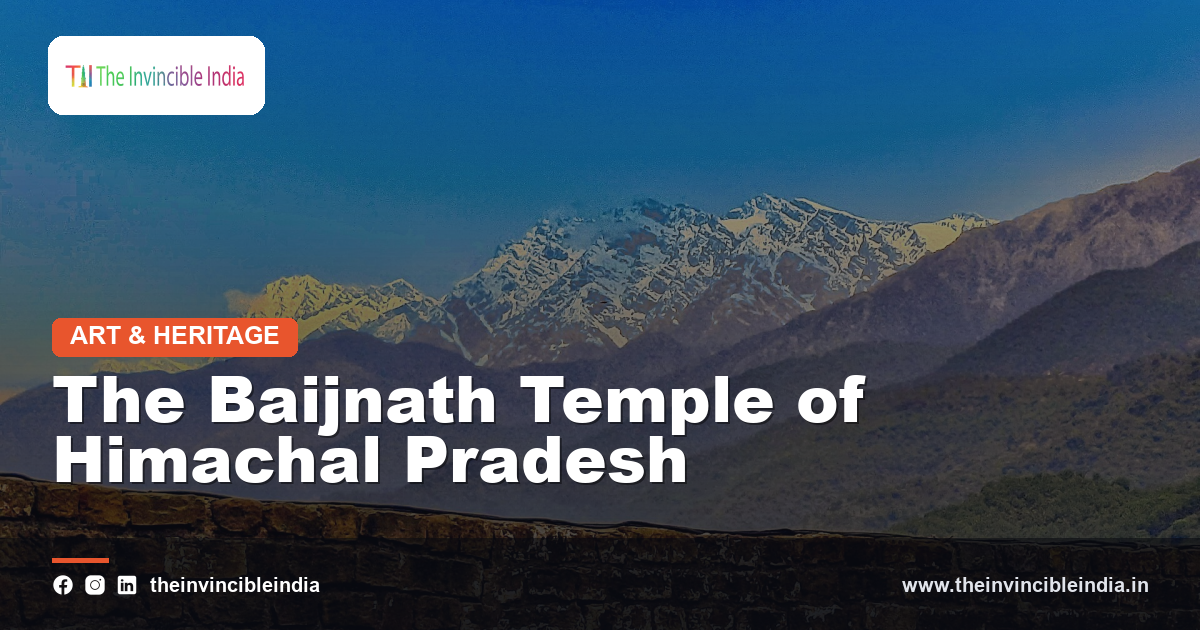
The Baijnath temple, also spelled Vaidyanath or Baidyanath and known in older records as the Kirgrama temple, is a medieval stone temple of Shiva in the Kangra district of Himachal Pradesh. It stands in the town of Baijnath on the road between Palampur and Mandi, with the snow-streaked Dhauladhar range rising behind it. Shiva is worshipped here as Vaidyanath, the lord of physicians, and the temple is one of the finest surviving examples of the northern Nagara style in the western Himalaya. Among the temples of India it is valued for its age, its carving and its inscriptions. This article describes the town, the history, the architecture and the living traditions of the temple.
Quick answer: The Baijnath temple is a Hindu temple dedicated to Shiva as Vaidyanath, the lord of physicians, in Baijnath town, Kangra district, Himachal Pradesh, India. Built in the early thirteenth century in the Nagara style, it is an important monument of the Kangra valley and is protected by the Archaeological Survey of India. It remains an active place of worship, especially during Mahashivaratri.
Key Takeaways
- The Baijnath temple is a stone temple of Shiva as Vaidyanath, located in Kangra district, Himachal Pradesh.
- Inscriptions on the temple record that it was built in the early thirteenth century by two local brothers named Manyuka and Ahuka.
- The temple is a notable example of the Nagara style, with a curved stone tower and a carved entrance porch.
- The ancient name of the town was Kiragrama, and the name Baijnath comes from the title Vaidyanath, meaning lord of physicians.
- A local tradition holds that Ravana worshipped Shiva here, and in many accounts the Dussehra effigy burning is not performed in the town.
- Several places claim to hold the Vaidyanath jyotirlinga, and the question of which is the original is debated.
The sections below explain the history, design and cultural life of the temple.
Quick Facts
| Detail | Information |
|---|---|
| Location | Baijnath, Kangra district, Himachal Pradesh |
| Deity | Shiva as Vaidyanath, lord of physicians |
| Style | Nagara temple architecture |
| Built | Early thirteenth century, according to inscriptions |
| Builders | Brothers Manyuka and Ahuka, as recorded in inscriptions |
| Old name of town | Kiragrama |
| Setting | Binwa river valley below the Dhauladhar range |
| Protection | Monument protected by the Archaeological Survey of India |
What Is the Baijnath Temple?
The Baijnath temple is a stone temple of Shiva that stands as the principal monument of the town of Baijnath in the Kangra valley. It consists of a square sanctum topped by a curved tower, a pillared hall in front and two entrance porches, all enclosed within a walled courtyard. The shrine is dedicated to Shiva in his healing aspect as Vaidyanath, so devotees come here to pray for health and well-being. The temple is built in grey stone and decorated with carvings that cover the walls, doorways and porches. It combines devotional energy with architectural elegance, and it remains one of the oldest continuously worshipped temples in Himachal Pradesh. The temple is therefore both a pilgrimage centre and an outstanding historical monument.
Where Is Baijnath Located?
Baijnath is located in the Kangra district of Himachal Pradesh, on the road that links Palampur with Mandi, in the valley of the Binwa river. The Dhauladhar mountains rise to the north, and their snow-covered peaks frame the temple on clear days. The town sits in a fertile landscape of tea gardens, paddy fields and pine-covered slopes, close to Palampur and a short distance from Dharamshala. This position made it a natural halting place on old trade and pilgrimage routes across the hills. The pleasant climate and the mountain scenery add to the appeal of a visit. Baijnath is easy to reach by road, and its location in the Kangra valley places it among the richest heritage regions of the western Himalaya.
What Does the Name Baijnath Mean?
The name Baijnath is a local form of Vaidyanath, which means the lord of physicians, from the Sanskrit words vaidya, meaning physician, and natha, meaning lord. Shiva is worshipped under this name as a divine healer, and many temples across India carry the same title. The town was known in ancient times as Kiragrama, a name that appears in inscriptions, and it was later renamed after its famous temple. The spelling varies in English as Baijnath, Baidyanath and Vaidyanath. The name tells us what pilgrims have long sought here, which is relief from illness and a sense of peace. It is a title that links this Himalayan shrine with a wider family of Shaiva healing temples.
When Was the Baijnath Temple Built?
The Baijnath temple was built in the early thirteenth century, according to inscriptions carved on its walls. These records, written in Sanskrit and in the Sharada script, are among the most important sources for the temple’s history. They name two brothers, Manyuka and Ahuka, as the builders, and they mention an earlier shrine on the same site. This suggests that the present temple replaced or enlarged an older structure, so worship at the place may be older than the stone building we see today. The inscriptions are valued because they provide a rare combination of builders’ names and a clear period for a medieval temple in the hills. Their evidence makes Baijnath one of the better documented early temples of Himachal Pradesh.
Who Were Manyuka and Ahuka?
Manyuka and Ahuka were two brothers who, according to the inscriptions, built the present temple of Baijnath. They are described as local figures of standing, and tradition remembers them as devout patrons who gave generously to the shrine. Their names appear on the temple walls, so the building preserves the memory of ordinary donors as well as that of royal houses. Such inscriptions remind us that Indian temples were often built by communities and families rather than only by kings. The brothers probably belonged to a class of wealthy residents who could fund a major building, though details of their lives are not fully known. Their record at Baijnath gives the temple a personal and human dimension.
What Is the Nagara Style of Architecture?
The Nagara style is the northern Indian tradition of temple building, marked by a curved tower called a shikhara that rises over the sanctum. A typical Nagara temple stands on a raised platform and consists of a sanctum, one or more halls and a porch, with carved walls divided into projecting and recessed bands. The style developed across northern India from the early centuries and produced many regional variations, from Odisha to Rajasthan and the Himalayan hills. At Baijnath the shikhara is built entirely of stone, with ribbed and layered surfaces that lead the eye upwards. The temple therefore represents a hill variant of a pan-Indian tradition. Understanding the Nagara style helps visitors to read the structure of Baijnath and compare it with temples elsewhere.
What Does the Baijnath Temple Look Like?
The temple presents a handsome composition of a curved tower, a sloping-roofed hall and two projecting porches within a rectangular enclosure. The sanctum is square, and its tower is crowned with a flattened ribbed disc, a typical feature of Nagara temples, topped by a finial. In front of the sanctum is a hall with carved pillars, and the entrance porches are richly decorated. The stone has weathered to a soft grey, which gives the temple a calm and dignified appearance against the green hills. A large Nandi, the bull associated with Shiva, faces the sanctum from a separate small pavilion. The proportions of the temple are balanced, and the carving adds liveliness without crowding the structure.
What Sculptures Decorate the Temple Walls?
The outer walls of the temple are covered with carved images set in niches and panels, representing gods, goddesses and celestial figures. Shiva appears in several forms, and there are images of Ganesha, Durga, Vishnu and other deities that reflect the breadth of Hindu worship. Guardian figures flank the doorways, and floral scrolls and geometric bands frame the main panels. The carving is crisp and confident, with figures that have a graceful and slightly stylised quality typical of medieval northern art. Some images have been worn smooth by weather, yet many details survive. These sculptures belong to the wider story of Indian sculpture and show how temple walls served as a visual scripture for devotees.
What Do the Baijnath Inscriptions Say?
The inscriptions on the temple walls state that the temple was built by Manyuka and Ahuka and describe the dedication of the shrine to Shiva. They are written in Sanskrit verse in the Sharada script, a script used in the north-western Himalaya, and they are among the oldest and best-preserved records of the region. Scholars have studied them to understand the political and religious life of the Kangra valley in the medieval period. The inscriptions praise the god, mention the donors and refer to the earlier history of the site. They help to confirm the age of the temple and its connection with Kiragrama, the old name of the town. As written evidence carved in stone, they give Baijnath a special value for historians and epigraphers.
Why Is Shiva Worshipped Here as Vaidyanath?
Shiva is worshipped at Baijnath as Vaidyanath because Hindu tradition regards him as the divine physician who heals both body and spirit. Pilgrims come to the temple to pray for recovery from illness and for the health of their families. Offerings of water, milk, flowers and leaves are made over the lingam, and special prayers are performed on Mondays and on festival days. The concept of Shiva as a healer connects the shrine with a broad Indian tradition in which temples and medicine were linked. The calm and clean air of the valley also supports the idea of the place as one of rest and restoration. For many families the temple is a trusted source of comfort in difficult times.
What Is the Legend of Ravana at Baijnath?
A local tradition says that Ravana, the learned king of Lanka in the Ramayana, worshipped Shiva at this place and won a boon from him. According to the story, Ravana offered his heads in penance, and Shiva granted his wish and was said to dwell here as a healer. Because of this belief, many accounts report that the people of Baijnath do not hold the burning of Ravana effigies at Dussehra, as is done in most of India. The legend belongs to the realm of tradition and faith, and historians do not treat it as a record of events. Its importance lies in showing how deeply the temple has entered the imagination of the community. The story is part of what makes Baijnath unusual among Indian towns.
Is Baijnath One of the Jyotirlingas?
Baijnath is one of several places that are associated with the Vaidyanath jyotirlinga, a group of twelve sacred Shiva shrines revered across India. The tradition refers to a jyotirlinga called Vaidyanath, and more than one temple claims to be that site, among them places in Jharkhand, Maharashtra and Himachal Pradesh. The question of which is the original is debated, and different traditions and scholars reach different conclusions. This article does not settle the debate, which depends on texts, local belief and devotion. What is clear is that Baijnath enjoys great sanctity and a very long history of worship. Devotees come with faith, and the temple stands on its own merits as a major Shiva shrine of the Himalayan region.
How Is Mahashivaratri Celebrated at Baijnath?
Mahashivaratri is the greatest festival at the Baijnath temple, drawing large crowds from across Himachal Pradesh and neighbouring states. The festival takes place in the late winter and is marked by night-long worship, fasting, chanting and the offering of water and leaves to the lingam. A fair is held in the town, with stalls, folk music, dance and cultural programmes, and the event has been recognised as a major state fair. Devotees often walk long distances to take part, and the temple is lit and decorated for the occasion. Families treat the festival as both a religious duty and a social gathering. The celebration shows how the temple continues to unite the community around shared faith and tradition.
What Is the Setting of the Temple in the Kangra Valley?
The temple stands in the Kangra valley, a region known for its green slopes, tea gardens, rivers and a long artistic history. The valley is also famous for the Kangra school of miniature painting, for old forts and for several important temples, so Baijnath belongs to a rich cultural landscape. The Dhauladhar range forms a dramatic backdrop, and the Binwa river flows nearby. In this setting the grey stone of the temple appears to merge with its mountain surroundings. Seasons change the scene, with misty monsoon days, bright autumn light and occasional winter snow on the peaks. The setting enhances the temple’s atmosphere of calm and makes a visit memorable for reasons beyond architecture alone.
How Can Visitors Plan a Visit to the Baijnath Temple?
Visitors usually reach Baijnath by road from Palampur, Dharamshala or Mandi, and the nearest rail and air connections are in the Kangra region. The best seasons are the cooler months of spring and autumn, when the skies are clear and the mountain views are at their best. The temple is open for worship through the day, and visitors should dress modestly and remove their shoes before entering. The early morning is a good time, when the light is soft and the courtyard is quiet. A visit to Baijnath can be combined with other attractions of the valley, such as Palampur’s tea gardens and the Tibetan centres around Dharamshala. Allowing time for the carvings and inscriptions rewards the curious traveller.
Baijnath Temple Today
The Baijnath temple today is a cherished heritage monument and a busy centre of worship, protected by the Archaeological Survey of India. Pilgrims and travellers arrive throughout the year, and the town has grown around the shrine with markets, guesthouses and small businesses. The challenge for conservators is to balance the needs of a living temple with the protection of centuries-old stone and carving. Cleaning, structural care and visitor management all form part of that effort. For the people of the Kangra valley the temple is a source of identity and pride. Its curved tower, ancient inscriptions and healing associations continue to draw those who seek beauty, history or peace.
Sources & Further Reading
- Archaeological Survey of India (asi.nic.in).
- Ministry of Culture, Government of India (indiaculture.gov.in).
Frequently Asked Questions
Where is the Baijnath temple located?
The Baijnath temple is located in Baijnath town in the Kangra district of Himachal Pradesh, on the road between Palampur and Mandi. It stands in the Binwa river valley below the Dhauladhar mountains. Palampur is the nearest larger town.
Who built the Baijnath temple?
According to inscriptions on its walls, the Baijnath temple was built in the early thirteenth century by two local brothers, Manyuka and Ahuka. The inscriptions also mention an earlier shrine on the site. This makes the temple unusually well documented.
Which deity is worshipped at Baijnath?
Shiva is worshipped at Baijnath as Vaidyanath, the lord of physicians. Devotees pray to him for healing and good health. The temple also contains images of other deities in its carvings.
What architectural style is the Baijnath temple?
The Baijnath temple is built in the Nagara style of northern India, with a curved stone tower over the sanctum and carved porches. It is a hill variant of the style. The temple is regarded as one of the best examples in Himachal Pradesh.
Why is Dussehra not celebrated in Baijnath?
According to a local tradition, Ravana worshipped Shiva at Baijnath, so the people of the town do not burn his effigy at Dussehra. This is a matter of belief rather than recorded history. The custom is widely reported in accounts of the town.
When is the best time to visit the Baijnath temple?
The best time to visit is spring or autumn, when the weather is pleasant and the mountains are clear. Mahashivaratri in late winter is the busiest and most festive time. Visitors should dress modestly and remove their shoes inside the temple.


