

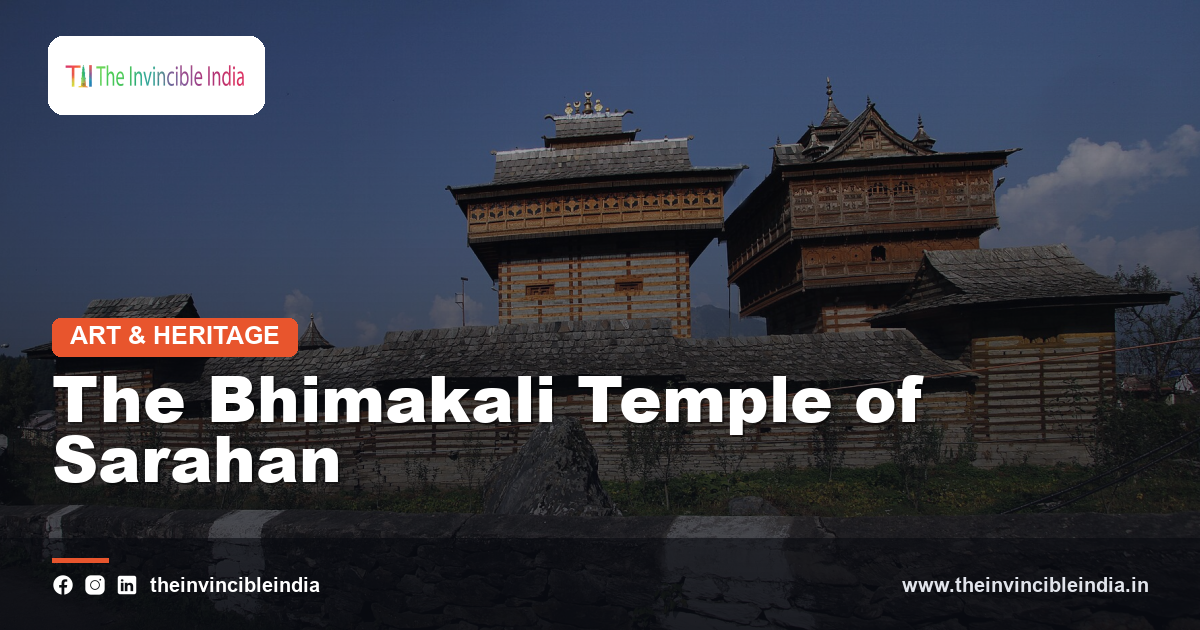
The Bhimakali temple, also spelled Bhima Kali and sometimes called the Sarahan temple, is a Himalayan shrine of the goddess Bhimakali in the village of Sarahan in the Shimla district of Himachal Pradesh. It served for generations as the family temple of the rulers of the former princely state of Bushahr, and it is celebrated for its tiered roofs and its fine combination of timber and stone. The temple stands in a courtyard enclosure with the snow-clad Srikhand peak rising in the distance. Among the temples of India it is a rare example of a hill style in which Hindu and Himalayan building traditions meet. This article describes the village, the goddess, the architecture and the visitor experience.
Quick answer: The Bhimakali temple is a Hindu temple of the goddess Bhimakali at Sarahan in Shimla district, Himachal Pradesh, India. Built in a tiered Himalayan style that combines timber and stone, it was the family temple of the Bushahr rulers and is counted among the sacred Shakti sites of the western Himalaya. It remains an active place of worship and a landmark of the Sutlej valley.
Key Takeaways
- The Bhimakali temple is a goddess temple at Sarahan, in Shimla district of Himachal Pradesh.
- Bhimakali was the family deity of the rulers of the former princely state of Bushahr.
- The temple is built in a tiered Himalayan style with sloping roofs, using timber and stone in layered courses.
- Tradition counts the temple among the sacred Shakti Peethas, although the lists of such sites differ between texts.
- Sarahan lies on the old route to Kinnaur and is often called the gateway to that mountain district.
- The Srikhand Mahadev peak is visible in the distance and forms a dramatic backdrop to the temple.
The sections below describe the place, the goddess, the architecture and the living traditions of the temple.
Quick Facts
| Detail | Information |
|---|---|
| Location | Sarahan, Rampur area, Shimla district, Himachal Pradesh |
| Deity | Goddess Bhimakali, a form of Shakti |
| Role | Family temple (kuldevi shrine) of the Bushahr rulers |
| Style | Tiered Himalayan timber-and-stone architecture |
| Valley | Sutlej river valley |
| Backdrop | Srikhand Mahadev peak |
| Gateway to | Kinnaur district |
| Also spelled | Bhima Kali temple, Sarahan |
What Is the Bhimakali Temple of Sarahan?
The Bhimakali temple is a group of sacred buildings within a walled courtyard at Sarahan, dedicated to the goddess Bhimakali. The goddess is regarded as a powerful form of the divine feminine, worshipped as protector of the Bushahr region and its people. The complex includes an older temple and a newer one built in the same tradition, together with halls, living quarters for priests and subsidiary shrines. The temples rise in tiers, with sloping slate roofs and carved wooden balconies that give the complex a distinctive mountain look. Worship is carried out daily, and devotees come from across Himachal Pradesh. The Bhimakali temple is both an architectural treasure and a living centre of faith in the hills.
Where Is Sarahan Located?
Sarahan is a small village in the Shimla district of Himachal Pradesh, in the Sutlej river valley within the Rampur Bushahr area. It lies on the road that leads from Shimla through Narkanda and Rampur towards Kinnaur and the high Himalaya. The village sits at a considerable altitude on a mountain slope, so the air is cool and the views are broad. Apple orchards, deodar forests and terraced fields surround the settlement, and the snow peak of Srikhand Mahadev rises in the distance. Because of its position, Sarahan is often called the gateway to Kinnaur. A visit to the temple is a natural stop for travellers exploring the upper Sutlej valley and the old Hindustan-Tibet route.
Who Is the Goddess Bhimakali?
Bhimakali is a form of the Hindu goddess Shakti, whose name is usually understood to combine bhima, meaning fearsome or mighty, with kali, a name of the dark and powerful goddess. She is worshipped as a protective deity who guards the region and its rulers, and she is addressed with devotion and awe. Her cult belongs to the wider tradition of mother goddess worship found across the Himalaya, where local goddesses are often merged with the great goddess of the Sanskrit texts. Devotees pray to her for protection, prosperity and relief from fear. The goddess is a presence in the life of the people of Sarahan and the surrounding villages. Her worship illustrates how pan-Indian and local religious traditions meet in the hills.
How Is Bhimakali Linked to the Shakti Peethas?
Tradition links the Bhimakali temple with the Shakti Peethas, the sacred sites associated with the goddess Sati in Hindu mythology. According to the story, parts of the goddess’s body fell at various places across the subcontinent, and each became a holy seat of the divine mother. Different texts give different lists of such sites, and the number and identity of the Peethas vary, so Sarahan’s place in the tradition is a matter of local and devotional belief. Some accounts say that the goddess’s ear fell here, while other accounts speak of a different part. Whatever the exact detail, devotees regard the temple as a seat of great spiritual power. The connection shows how deeply the shrine has entered the sacred geography of India.
What Is the Role of the Bushahr Rulers?
The Bushahr rulers regarded Bhimakali as their family deity and were the chief patrons of the temple for many generations. Bushahr was a hill state in the Sutlej valley, and Sarahan served for a time as a seat of its ruling family, who built a palace near the temple. The rulers supported the priests, funded repairs and presided over the major festivals of the shrine. After India’s independence the princely state was merged into Himachal Pradesh, yet the family continues to be associated with the temple and its rituals. This long royal connection helps to explain the quality of the buildings and the richness of the temple traditions. The history of the temple and the history of Bushahr are closely woven together.
What Does the Temple Complex Look Like?
The complex stands inside a stone-walled courtyard entered through a decorated gateway and divided into inner and outer spaces. The main temples rise in several tiers above a stone base, and their sloping slate roofs are topped with finials and pinnacles. Balconies and railings of carved wood run around the upper levels, and the doors and windows are framed with intricate carving. The older and newer temples stand close together, and the courtyard also holds smaller shrines and priests’ dwellings. Seen against the mountains, the buildings give an impression of lightness and vertical grace. The overall effect is of a harmonious mountain citadel dedicated to the goddess, in which religion, craft and landscape meet.
What Is Himalayan Timber-and-Stone Architecture?
The hill temples of Himachal use a building method in which layers of stone and horizontal timber beams are alternated to form thick, earthquake-resistant walls. This technique, often called kath-kuni in local usage, is well suited to a mountainous region where wood is plentiful and tremors are common. The flexible timber courses help the walls to absorb movement, while the stone gives mass and warmth. Roofs are built in slopes to shed snow and rain, and are covered with slates or wooden shingles. At Sarahan the technique is used on an impressive scale and combined with carved ornament. The result is a type of building that reflects centuries of local experience and adaptation to climate and terrain.
How Does the Temple Show Hindu and Buddhist Influences?
The tiered roofs and carved woodwork of the Bhimakali temple reflect a mixing of Hindu building traditions with styles common in the Himalayan and Tibetan worlds. The multi-storeyed form, with its stacked sloping roofs, resembles the pagoda-like temples found in other mountain regions, while the deity and rituals belong to the Hindu tradition. This blend is natural in a place on the old trade and pilgrimage routes between the plains and Tibet, where ideas and craftsmen travelled freely. Carved motifs on doors and brackets draw on both Hindu iconography and local ornament. The temple is therefore a good example of cultural exchange in the mountains. Its design shows that the Himalaya was never an isolated region but a meeting place of traditions.
What Carvings and Decoration Can Be Seen?
The temple is rich in carved woodwork, with doors, window frames, brackets and balconies decorated with floral patterns, geometric bands and sculpted figures. Metal plaques and repoussé work adorn the main doorway of the sanctum, and images of deities and guardian figures are set into panels. The craftsmanship shows the skill of local carpenters and metalworkers, who passed their art from one generation to the next. Much of the carving is in deodar wood, which is durable and takes fine detail. The decoration is lively but disciplined, giving the complex a warm and welcoming character. These details form part of the wider story of Indian sculpture and craft, in which hill artisans played a distinctive part.
What Role Does the Srikhand Mahadev Peak Play?
The Srikhand Mahadev peak is a snow-covered mountain visible from Sarahan and is regarded as a sacred peak associated with Shiva. Pilgrims undertake a demanding trek to the mountain each year, and the peak is a powerful symbol in local faith. From the courtyard of the Bhimakali temple the peak forms a dramatic backdrop, linking the goddess shrine with the surrounding sacred landscape. Mountains are central to Himalayan religion, and temples are often placed to take advantage of their views. At Sarahan the mountain and the temple seem to speak to each other across the valley. The peak adds a sense of grandeur and spiritual meaning to the visit.
What Festivals Are Celebrated at the Temple?
Several festivals mark the year at the Bhimakali temple, with Navratri and Dussehra among the most important occasions. During these festivals the temple is decorated, special rites are performed and local people gather in large numbers. Processions carry the symbols of the deities, accompanied by drums, horns and traditional music, and villagers dress in festive attire. The Phulaich festival, associated with flowers in the high pastures of Kinnaur and the surrounding hills, is also part of the regional calendar. These events keep customs alive and bind the community together. Visitors who attend a festival see the temple at its liveliest, though they should plan ahead because accommodation fills quickly. The festivals show that the temple remains central to the life of the region.
What Is the Padam Palace and the Wider Sarahan Complex?
Close to the temple stands a former palace of the Bushahr rulers, built in the early twentieth century in a style that combines local timber-and-stone construction with elements of colonial and European taste. The palace reflects the changing world of the hill states under British paramountcy, yet it keeps the familiar hill silhouette. Together the palace and the temple give a picture of the princely court and its religious life. Parts of the complex are occupied by the family and are not open to visitors, so travellers should respect signs and boundaries. Seen in context, the buildings help to explain the role of the temple as both a royal and a public shrine. The wider Sarahan complex adds depth to any visit.
What Else Can Visitors See Around Sarahan?
Sarahan offers more than the temple, since it lies amid beautiful mountain scenery and has other points of interest nearby. A pheasant breeding centre in the village is known for the Himalayan monal, the colourful bird that is the state bird of Himachal Pradesh. Walks through orchards and deodar forest give views of the valley and the high peaks. The towns of Rampur Bushahr and Narkanda are within reach, and the road continues to Kinnaur for those who wish to go further. Local markets sell woollen shawls, caps and dried fruit. A day or two in the area allows a relaxed exploration of the culture and landscape that surround the temple.
How Can Visitors Plan a Visit to the Bhimakali Temple?
Visitors usually reach Sarahan by road from Shimla, a long mountain drive that is best done with an early start. The most comfortable seasons are spring and autumn, while winter can bring snow and cold and the monsoon can cause landslides on mountain roads. Modest clothing is expected, and shoes must be removed before entering the courtyard. Photography may be restricted inside the temple, so it is wise to follow local instructions. A local priest or guide can explain the history and rituals. Because of the altitude and winding roads, visitors should travel with care and allow generous time. A respectful, unhurried visit rewards the traveller with both beauty and insight.
Bhimakali Temple Today
The Bhimakali temple today remains an active centre of worship, a focus of regional pride and one of the best-known landmarks of the Sutlej valley. Pilgrims, scholars and travellers arrive throughout the year, drawn by the combination of faith, architecture and mountain scenery. The challenge for the future is to protect the timber and stone from weather, fire and the pressures of increasing visitors. Local communities and temple trusts play an important part in this care, drawing on traditional skills. In a time of rapid change, the temple continues to link the people of the hills to their goddess, their rulers’ history and their landscape. Sarahan still stands as a place where the sacred and the beautiful meet.
Sources & Further Reading
- Ministry of Culture, Government of India (indiaculture.gov.in).
- Archaeological Survey of India (asi.nic.in).
Frequently Asked Questions
Where is the Bhimakali temple located?
The Bhimakali temple is located in Sarahan village in the Shimla district of Himachal Pradesh, in the Sutlej river valley. It lies on the road from Shimla towards Kinnaur. The Srikhand Mahadev peak is visible in the distance.
Who is worshipped at the Bhimakali temple?
The goddess Bhimakali, a form of Shakti, is worshipped at the temple. She was the family deity of the rulers of the former Bushahr state. Devotees pray to her for protection and prosperity.
What is special about the architecture of the Bhimakali temple?
The temple is built in a tiered Himalayan style that combines timber and stone, with sloping slate roofs and carved wooden balconies. The method is well suited to a region of heavy snow and earthquakes. The design also shows Hindu and Himalayan influences.
Is the Bhimakali temple a Shakti Peetha?
Local tradition counts the Bhimakali temple among the sacred Shakti Peethas, although different texts give different lists of such sites. The identification is therefore a matter of devotion and tradition. Devotees treat it as a seat of great spiritual power.
Why is Sarahan called the gateway to Kinnaur?
Sarahan is called the gateway to Kinnaur because it lies on the road that leads from Shimla and Rampur into the Kinnaur district. Travellers heading into the high Himalaya often stop here. The village therefore serves as a natural halt on the route.
When is the best time to visit Sarahan?
The best time to visit Sarahan is spring or autumn, when the weather is clear and the roads are easier. Winter can bring heavy snow, and the monsoon can cause landslides. Festival seasons such as Navratri and Dussehra are lively but crowded.


