

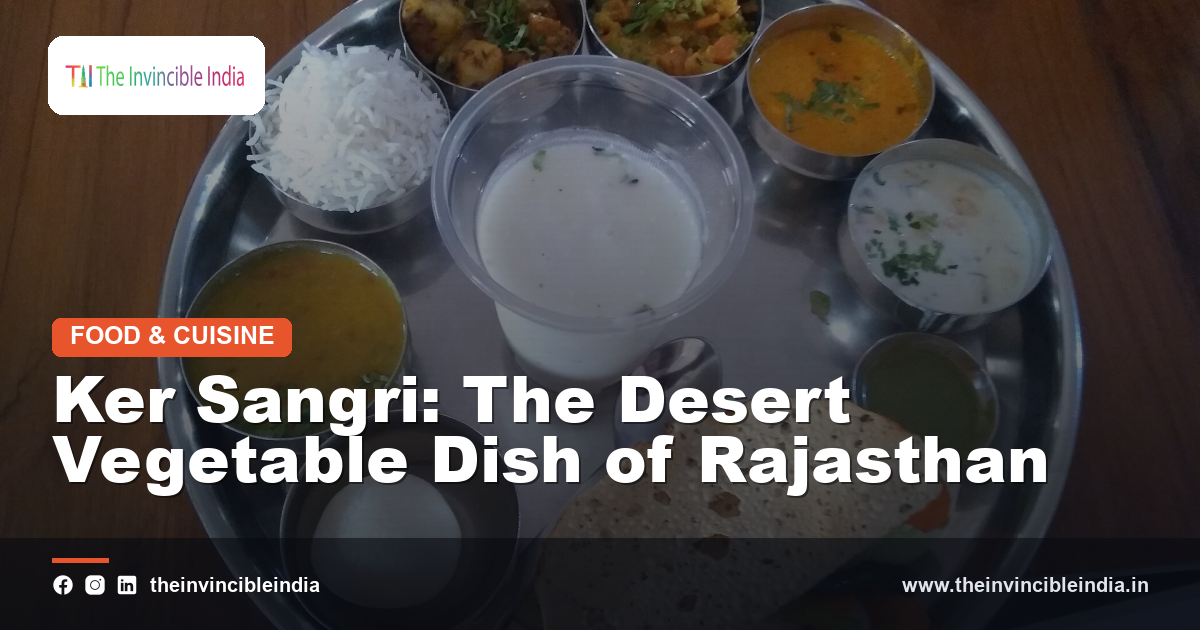
Ker sangri, also spelled kair sangri, ker sangri ki sabzi or khejri sangri, is a traditional dish of Rajasthan made from two desert foods: the dried berries of the ker shrub and the slender pods of the sangri tree. Both grow wild in the arid Thar region and were historically gathered, dried and stored for use through the long, dry months when fresh vegetables were scarce. The dish has a distinctive tangy, slightly bitter and earthy flavour that tastes unlike any ordinary vegetable curry. It is a proud part of Marwari and Rajasthani food culture and a good example of the region’s resourceful cooking. Within the wide range of regional cuisines of India, it stands out as a true food of the desert. This guide explains the ingredients, the method and the heritage of the dish.
Quick answer: Ker sangri is a traditional Rajasthani dish made from ker, the dried berries of the Capparis decidua shrub, and sangri, the dried pods of the khejri tree (Prosopis cineraria). The two desert ingredients are soaked, boiled and then cooked with spices, dried chillies and often yogurt or dried mango powder. Native to the Thar Desert, it is a signature food of Marwar and a classic example of cooking with preserved wild produce.
Key Takeaways
- Ker sangri is a Rajasthani dish made from two wild desert ingredients, ker berries and sangri pods.
- Ker is the small berry of the Capparis decidua shrub, and sangri is the long pod of the khejri tree, Prosopis cineraria.
- The khejri is the state tree of Rajasthan and is widely valued in desert life for its shade, fodder and pods.
- Both ingredients are dried for storage and must be soaked and boiled before cooking to soften them and reduce bitterness.
- The dish is typically flavoured with dried red chillies, spices and a tangy element such as yogurt or dried mango powder.
- Ker sangri is usually served with bajra roti, baati or plain roti, and it often appears at festive and thali meals.
The sections below describe the plants, the preparation, the flavours and the cultural background of this distinctive dish.
Quick Facts
| Detail | Information |
|---|---|
| Dish type | Vegetarian dry or semi-dry vegetable dish |
| Region | Rajasthan, especially the Thar Desert and Marwar |
| Main ingredients | Dried ker berries and sangri pods |
| Source plants | Capparis decidua (ker) and Prosopis cineraria (khejri) |
| Flavour | Tangy, earthy and mildly bitter with chilli spice |
| Usually served with | Bajra roti, baati, plain roti and a thali |
What is ker sangri?
Ker sangri is a Rajasthani vegetable dish prepared from dried desert berries and bean-like pods. Ker, sometimes spelled kair or kerda, refers to the small, round, green-to-red fruit of a thorny desert shrub. Sangri, sometimes written as sangar or sangri-phali, refers to the long pods of the khejri tree. The two are paired because they grow in the same landscape and complement each other in texture and taste, ker being tangy and slightly bitter while sangri is milder and chewy. Together they are cooked in oil or ghee with spices into a dry or semi-dry dish that keeps for several days. Ker sangri belongs to the family of desert foods that people of Rajasthan learned to gather and preserve, and it is regarded as one of the region’s signature dishes.
What is ker, and where does it grow?
Ker is the berry of the Capparis decidua shrub, a hardy, leafless-looking plant that grows wild across the arid parts of north-western India, including the Thar Desert. The shrub is adapted to heat and dryness and bears small flowers followed by round fruits that people harvest in season. The fresh berries are bitter and not eaten raw, so they are traditionally pickled in brine or dried in the sun. In its dried form ker keeps for a long time and is used throughout the year. Ker is also made into pickles, either alone or with other desert ingredients. Because it thrives where cultivated crops struggle, the plant has been an important food source for desert communities, and its berries remain a symbol of the region’s resourcefulness.
What is sangri, and which tree does it come from?
Sangri is the long, slender pod of the khejri tree, known botanically as Prosopis cineraria, a drought-tolerant tree found widely in Rajasthan and neighbouring arid regions. The tree is so important to desert life that it is the state tree of Rajasthan and is often called the lifeline of the desert. Its pods are harvested while tender, boiled briefly and dried for storage. The leaves serve as fodder for livestock, and the tree gives shade and helps enrich the soil. Dried sangri has a mild, bean-like taste and a pleasantly chewy texture. In cooking it absorbs the surrounding spices well and provides body to the dish. The relationship between the tree and the people who depend on it is a recurring theme in Rajasthani culture.
Why is the khejri tree important in Rajasthan?
The khejri tree is important in Rajasthan because it supports human life, animals and soil in one of the driest regions of India. It tolerates heat, drought and poor soil, and it provides shade, fodder, fuel and edible pods. Its roots reach deep for water, and the tree helps keep the soil fertile for crops grown beneath it. The Bishnoi community of Rajasthan is widely known for its traditional commitment to protecting khejri trees and wildlife, and the tree has a place in local ritual and folklore. In the Dussehra season the khejri is worshipped in parts of the state. Sangri is only one of its gifts, yet it shows how closely the cuisine of the region is tied to the natural world. The tree is a cultural symbol as well as a food source.
How are ker and sangri prepared for cooking?
Ker and sangri are prepared by washing the dried ingredients, soaking them in water or buttermilk and then boiling them until tender. Soaking takes several hours or overnight, and it rehydrates the pods and berries and draws out much of their natural bitterness. Many cooks discard the soaking water and boil the ingredients in fresh salted water, sometimes with a little turmeric. Some families soak ker in sour buttermilk to soften its flavour further. After draining, the ingredients are ready to be cooked with spices. The preparation stage matters as much as the cooking, because under-soaked ker stays hard and bitter, while properly prepared ker becomes pleasantly tangy. This patient groundwork is a reminder that dried wild foods require care to be turned into a good meal.
How is ker sangri cooked?
Ker sangri is cooked by tempering oil or ghee with cumin and dried red chillies, adding the boiled ker and sangri, and then stirring them with spices until they are well coated and tender. Many cooks add turmeric, coriander powder, red chilli powder and a pinch of asafoetida. A souring element such as whisked yogurt, dried mango powder or a little tamarind provides the tang that suits the berries. Some versions are quite dry and the pieces are fried until slightly crisp at the edges, while others have a light gravy of yogurt. Cooking is done on moderate heat so the ingredients absorb the seasoning without turning mushy. The finished dish keeps well, which suited households that wanted food that could be eaten over several days.
What does ker sangri taste like?
Ker sangri tastes tangy, earthy and slightly bitter, with a chewy texture and a warmth of red chilli. The ker berries provide the sharper, sour-bitter notes, while the sangri gives a gentle bean-like flavour and a firm bite. Spices and fat round off the edges, and a squeeze of dried mango powder or yogurt adds brightness. The flavour is quite unlike ordinary green vegetables, and first-time eaters often describe it as deep and complex. Some find the bitterness an acquired taste, though careful preparation reduces it considerably. The combination of acidity, spice and chew makes the dish a natural partner for plain breads and rich dishes. This distinct profile is a large part of why ker sangri is treasured as a regional speciality.
Why is ker sangri a dish of the desert?
Ker sangri is a dish of the desert because both its ingredients grow in dry land and can be dried and stored through months without fresh produce. In the Thar, agriculture depends on scant rainfall, and communities historically relied on foods that could survive heat and time. Gathering ker and sangri in season and drying them in the sun provided a vegetable supply for the rest of the year. The dish uses little water in its cooking and often replaces water with buttermilk or yogurt. It reflects an old pattern of living with the landscape instead of fighting it. For this reason, ker sangri is often described as the taste of the desert, and it carries a sense of place that few other Indian dishes can claim.
What is ker sangri served with?
Ker sangri is traditionally served with bajra roti, baati, plain wheat roti or paratha, and it often forms part of a Rajasthani thali. The dry, tangy dish pairs naturally with the earthy sweetness of millet bread and with the ghee-rich baati and its companion dal. A bowl of fresh yogurt, raita, buttermilk or a spoonful of pickle completes the plate. In many households, a festive meal might include ker sangri beside gatte ki sabzi, kadhi and a sweet such as churma. Its shelf life also makes it a handy accompaniment for travel food. Whether served at home or in a restaurant, the dish is usually presented as one part of a balanced meal rather than a standalone course.
Is ker sangri a preserved or pickled food too?
Ker sangri is a preserved food in its raw form, and ker is also made into pickle in Rajasthani homes. Fresh ker berries are bitter, so cooks traditionally brine, dry or pickle them to make them edible and long-lasting. Ker pickle, often prepared with mustard oil, salt and spices, is a well-known condiment, and sangri can be included in mixed pickles as well. The drying and pickling tradition meant that a household could keep both vegetables and relishes ready for months. This habit of preservation is central to desert cooking, where seasonal abundance is brief and must be saved for later. Ker sangri sabzi and ker pickle thus show two different ways of using the same desert harvest, one as a main dish and the other as an accompaniment.
What nutritional value is associated with ker sangri?
Ker sangri is traditionally valued as a nourishing, fibre-rich dish that provided useful food in lean seasons. The sangri pods are a legume-type food and the berries are eaten whole, and both are considered filling and sustaining in traditional dietary belief. Because they are cooked with modest oil and plenty of spice, the dish was seen as suitable for working people in a hot climate. Exact nutritional values depend on the preparation and the amount of fat used, so it is wise not to treat any figure as fixed. The dish also offers variety to a diet otherwise dominated by grains, pulses and dairy. The traditional view of ker sangri as a hearty and wholesome food continues to shape its place on the Rajasthani table.
How is ker sangri linked to festivals and special meals?
Ker sangri is linked to festivals and special meals because it is regarded as a prized regional dish served to guests and at celebrations. In Rajasthani households it often appears at weddings, festival thalis and family gatherings alongside dishes such as dal baati churma and gatte ki sabzi. During the Gangaur season and other regional celebrations, families prepare traditional foods that include local specialities. Its value is partly symbolic, because it represents the foods of the land and the skill of cooks who work with scarce ingredients. Restaurants in Rajasthan often highlight it for visitors who want an authentic taste. In this way a dish that began as survival food has taken on the status of a festive and ceremonial favourite.
What are the common variations of ker sangri?
The common variations of ker sangri differ in the amount of oil, the souring agent and the dryness of the final dish. Some families cook it with plenty of yogurt for a creamy, tangy version, while others prefer a dry preparation with dried mango powder and red chilli. Certain recipes add fennel, fenugreek seeds or dried pomegranate seeds for extra aroma. Jain households prepare versions without onion and garlic, and some cooks include dried red chillies whole for a smoky hit. Restaurant versions may be less bitter and richer in oil to suit wider tastes. These differences show that ker sangri is a living tradition adapted to the household kitchen, yet its central pairing of ker and sangri remains the same wherever it is made.
What are common mistakes when making ker sangri?
The common mistakes in making ker sangri are skipping the soaking stage, using too little acidity and overcooking the berries and pods. Ker that is not soaked long enough remains tough and bitter, which spoils the whole dish. Without a souring element such as yogurt or dried mango powder, the flavour can taste flat and harsh. Cooking for too long after the boiling stage can turn the pods mushy, and too little fat leaves the dish dry and dull. Over-seasoning with chilli can mask the delicate bitterness that gives the dish its character. Reading the dried ingredients carefully, giving them time to soften and balancing the spices produce a better result. Good ker sangri depends on patience in preparation as much as on skill at the stove.
Ker Sangri Today
Ker sangri today remains one of the most distinctive and respected dishes of Rajasthan, enjoyed in homes, restaurants and festive meals. Dried ker and sangri are sold in markets across the state and are increasingly available to people elsewhere in India who wish to cook the dish. Chefs and food writers often cite it as proof that desert cooking can be sophisticated, and cooks continue to experiment with new methods while respecting the core pairing. Awareness of the khejri tree and its role in the desert ecosystem has also added to the dish’s cultural meaning. For anyone who wishes to understand Rajasthani food beyond its famous meat and sweet dishes, ker sangri offers a memorable and honest introduction. It remains a flavour of the Thar that is hard to match.
Sources & Further Reading
- Ministry of Culture, Government of India (indiaculture.gov.in).
- Rajasthan Tourism, Department of Tourism, Government of Rajasthan (tourism.rajasthan.gov.in).
Frequently Asked Questions
What is ker sangri?
Ker sangri is a traditional Rajasthani dish made from dried ker berries and sangri pods. The ingredients are soaked, boiled and cooked with spices into a tangy, earthy dish.
What are ker and sangri?
Ker is the small berry of the Capparis decidua shrub, and sangri is the long pod of the khejri tree, Prosopis cineraria. Both grow wild in the Thar Desert and are dried for use through the year.
Why does ker sangri taste bitter?
Ker sangri tastes slightly bitter because ker berries are naturally bitter. Soaking and boiling the dried berries, sometimes in buttermilk, reduces the bitterness, and tangy ingredients balance what remains.
What is ker sangri eaten with?
Ker sangri is usually eaten with bajra roti, baati or plain roti. It often appears in a Rajasthani thali with yogurt, pickle and other regional dishes.
Is the khejri tree important in Rajasthan?
Yes, the khejri tree is the state tree of Rajasthan and is valued for shade, fodder and edible pods. It supports life in the desert, and sangri is one of its best-known food products.
Is ker sangri vegetarian?
Yes, ker sangri is a fully vegetarian dish. It is made from dried desert berries and pods, with oil or ghee, spices and often yogurt, and can be prepared without onion and garlic.


