

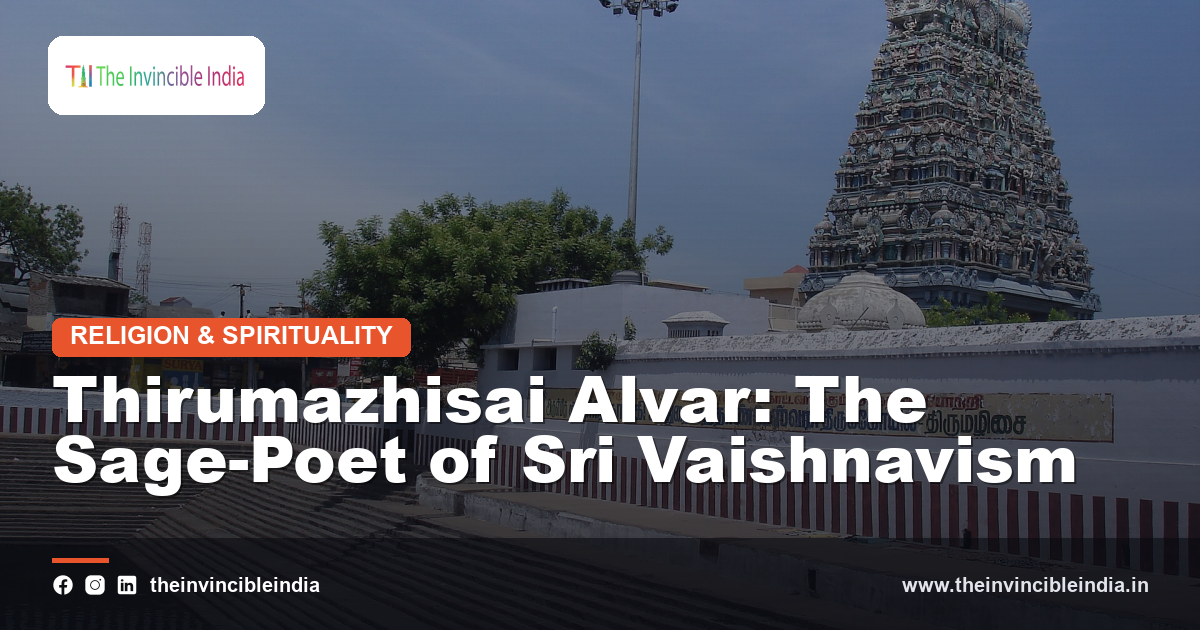
Thirumazhisai Alvar, also spelled Tirumalisai Alvar, Thirumalisai Azhwar or Tirumazhisai Piran and known in tradition as Bhaktisara, is one of the twelve Alvars, the Tamil saint-poets of Vaishnava devotion whose hymns form the Divya Prabandham of Sri Vaishnavism. He is traditionally associated with Thirumazhisai, a village near Chennai, and is remembered for two hymns, Nanmugan Tiruvandadi and Tiruchanda Viruttam, which proclaim the supremacy of Vishnu. His life is told through tradition and is part of the story of Vaishnavism.
Quick answer: Thirumazhisai Alvar is one of the twelve Alvars, the Tamil saint-poets of Vaishnava devotion, and is traditionally associated with the village of Thirumazhisai near Chennai in Tamil Nadu. He composed two hymns in the Divya Prabandham, Nanmugan Tiruvandadi and Tiruchanda Viruttam, which affirm the supremacy of Vishnu. Sri Vaishnava tradition honours him as a sage who tested many paths before settling on devotion to Vishnu.
Key Takeaways
- Thirumazhisai Alvar is one of the twelve Alvars, the Tamil saint-poets whose hymns form the Divya Prabandham of Sri Vaishnavism.
- He is traditionally associated with Thirumazhisai, a village near Chennai in Tamil Nadu, where a temple to Vishnu honours his memory.
- His two hymns in the Divya Prabandham are Nanmugan Tiruvandadi and Tiruchanda Viruttam, composed in Tamil.
- Tradition says that he studied many religious paths before settling on devotion to Vishnu, which gave him the name Bhaktisara.
- Sri Vaishnava tradition regards him as an amsa, or partial manifestation, of Vishnu’s discus, Sudarshana.
- Stories of his life, such as the journey of the Lord with his disciple Kanikannan, are tradition and not documented history.
The sections below explain the life, works, teachings and continuing legacy in more detail.
Quick Facts
| Detail | Information |
|---|---|
| Also known as | Tirumalisai Alvar, Bhaktisara, Tirumazhisai Piran |
| Tradition | Sri Vaishnavism (Alvars) |
| Birthplace (traditional) | Thirumazhisai near Chennai, Tamil Nadu |
| Language | Tamil |
| Hymns | Nanmugan Tiruvandadi and Tiruchanda Viruttam |
| Collection | Nalayira Divya Prabandham |
| Traditional view of origin | Amsa of Vishnu’s discus Sudarshana |
| Era | Early Alvar period (traditional account, dates debated) |
Who Was Thirumazhisai Alvar?
Thirumazhisai Alvar was a Tamil saint-poet and one of the twelve Alvars of Vaishnava tradition, remembered as a sage of deep learning and strong devotion to Vishnu. He is honoured in Sri Vaishnavism as a teacher who explained the supremacy of Vishnu through verse. His hymns are recited in temples across South India.
The accounts of his life come from Sri Vaishnava tradition and devotional biography, and respectful readers treat them as sacred narrative. Scholars debate his dates and many details of his life. What is consistent is the picture of an independent thinker who explored many ideas and then gave himself wholly to the worship of the Lord.
Who Are the Alvars?
The Alvars are twelve Tamil saint-poets of Vaishnava devotion who lived in South India in the early and medieval centuries, and their hymns are gathered in the Nalayira Divya Prabandham. The word Alvar means one who is immersed in God. They include Poigai, Bhutam, Pey, Thirumazhisai, Nammalvar, Madhurakavi, Kulashekhara, Periyalvar, Andal, Thondaradippodi, Tiruppan and Tirumangai.
Their songs express love for Vishnu in the Tamil language and celebrate temples across the land, which are known as the Divya Desams. The Alvars came from many walks of life, and their poetry is a pillar of Sri Vaishnava worship. Thirumazhisai Alvar holds a respected place among them as one of the earlier voices.
Where Is Thirumazhisai and Why Is It Important?
Thirumazhisai is a village near Chennai, in the Tiruvallur region of Tamil Nadu, and is traditionally regarded as the birthplace of Thirumazhisai Alvar. A temple dedicated to Vishnu, known as the Jagannatha Perumal temple, stands there and is counted among the Divya Desams praised in the Alvar hymns. The village takes its name from the saint, or he from it, according to tradition.
The place is important because it ties the saint to a living centre of worship. Pilgrims visit to honour both the deity and the Alvar, and festivals recall his memory. The village is a quiet but meaningful stop on the pilgrim routes of Tamil Nadu and shows how sacred geography keeps saints close to ordinary people.
What Do Traditions Say About His Birth and Upbringing?
Tradition says that Thirumazhisai Alvar was born in unusual circumstances to a sage and was raised by a humble foster family, and that he showed great spiritual gifts from childhood. The stories speak of a child who grew up in simple surroundings but became a sage of wide learning. They stress that holiness is not limited by birth.
These accounts are told as tradition and are not documented in historical records. Different versions give different details, and respectful readers take them as devotional narrative that explains the saint’s character. The theme of an unexpected and humble background fits many stories of Indian saints, who often rise from simple homes.
Why Is He Called Bhaktisara?
Thirumazhisai Alvar is called Bhaktisara, meaning the essence of devotion, because tradition says that he tested many religious paths and found devotion to Vishnu to be their finest fruit. The name also reflects the idea that his hymns distil devotion into a few strong verses. It is a title of honour used by followers.
Accounts say that he studied various philosophies and faiths before turning to Vishnu, and this journey is part of his reputation as a thoughtful seeker. The story is told as tradition. It gives the saint a special place as one who reached devotion by inquiry and not by habit alone, and it appeals to readers who value reflection.
Which Hymns Did Thirumazhisai Alvar Compose?
Thirumazhisai Alvar composed two hymns in the Divya Prabandham, Nanmugan Tiruvandadi and Tiruchanda Viruttam, and they are counted among the most philosophical works of the Alvar corpus. Nanmugan Tiruvandadi is traditionally counted at ninety-six verses and Tiruchanda Viruttam at one hundred and twenty. Both are written in Tamil and in demanding poetic forms.
These hymns are recited by devotees and studied by scholars of Sri Vaishnavism. They speak of the supremacy of Vishnu over other deities and of the way of devotion. Their depth makes them a rich source for understanding early Vaishnava thought, and they show the strong intellectual side of the Alvar movement.
What Is Nanmugan Tiruvandadi?
Nanmugan Tiruvandadi is a Tamil hymn of Thirumazhisai Alvar in the antadi form, in which the last word of each verse begins the next. The name refers to Nanmugan, the four-faced Brahma, and the hymn argues that even Brahma and the other great deities owe their position to Vishnu. It is a compact statement of faith.
The antadi form links the verses like a chain, which makes the hymn easy to recite and remember. The poet uses it to present reasoned praise of Vishnu. The work is admired for its clarity and its concentrated meaning, and many verses are quoted in later commentaries and in temple recitation.
What Is Tiruchanda Viruttam?
Tiruchanda Viruttam is a Tamil hymn of Thirumazhisai Alvar composed in a variety of metres, and it presents deep devotion and philosophical reflection on the nature of the Lord. The word chanda refers to metre, and the title suggests a sacred poem in many rhythms. The work uses rich sound and imagery.
Scholars value it for the skill with which the poet handles difficult Tamil forms. The verses praise the many acts and forms of Vishnu and reflect on how the soul may reach him. Like Nanmugan Tiruvandadi, it is a mark of the intellectual strength of the Alvar poet and is cherished in Sri Vaishnava recitation.
What Is the Divya Prabandham?
The Divya Prabandham, or Nalayira Divya Prabandham, is the collection of about four thousand Tamil verses by the Alvars and is held in great reverence in Sri Vaishnavism. It is often called the Tamil Veda because of the honour given to it in worship. The collection was gathered by Nathamuni, according to tradition.
The verses are recited in temples, especially in festivals such as Adhyayana Utsavam at Srirangam, and they are part of daily worship in many homes. The work places the hymns of Thirumazhisai Alvar beside those of his fellow saints. Together they form one of the great devotional anthologies of India.
What Is the Story of Kanikannan and the Lord of Kanchipuram?
The best-known story about Thirumazhisai Alvar tells of his disciple Kanikannan, who was asked to leave Kanchipuram by the king, and of the Lord who is said to have rolled up his serpent bed and followed them out of the city. Tradition says that when the king relented and the disciple was invited back, the Lord returned as well. The deity at Kanchipuram is known as Yathokthakari, meaning one who acts as told.
The story is a tradition and not a documented event, and it is told with great affection. It shows the Lord as devoted to his devotees, as they are to him. Its meaning is that sincere service has the power to move the divine, and it is among the most cherished accounts of the Alvar.
What Is the Link Between Thirumazhisai Alvar and Sudarshana?
Sri Vaishnava tradition regards Thirumazhisai Alvar as an amsa, or partial manifestation, of Sudarshana, the discus held by Vishnu. This belief is part of the way the tradition understands the Alvars, each of whom is linked in devotion with an emblem or attendant of the Lord. It is a statement of reverence.
The idea is a matter of faith and not of history. It reflects the high honour in which the saint is held. The discus is a symbol of the protection and the power of Vishnu, and associating the Alvar with it expresses the force and clarity of his hymns, which cut through confusion like the discus through darkness.
How Is Thirumazhisai Alvar Remembered in Worship?
Thirumazhisai Alvar is remembered through the annual celebration of his birth star, which tradition places in the Tamil month of Thai under the Magha star, and through the recitation of his hymns in Vaishnava temples. Special rites take place at Thirumazhisai and at other Vishnu temples where Alvars are honoured.
Devotees offer prayers, sing his verses and take part in processions. Images of the Alvar are kept in many temples, usually in a standing pose with folded hands. These practices keep his memory close to the daily and seasonal life of the community and show how saints are woven into temple culture.
How Do the Traditions Describe His End?
Tradition associates the final part of the life of Thirumazhisai Alvar with Kumbakonam, where he is said to have addressed the Lord reclining at the temple there, and Sri Vaishnavism holds that he attained the Lord’s abode after a long life. These details are told as sacred tradition and not as recorded history.
Many devotees mention that the saint is believed to have lived to a very great age, which is a way of expressing the depth of his spiritual attainment. The accounts are treated with reverence, and the focus is on his devotion and teaching. His memory in Kumbakonam adds to the sacred landscape of the Kaveri delta.
Why Is Thirumazhisai Alvar Important in Indian Culture?
Thirumazhisai Alvar is important in Indian culture because his hymns enrich Tamil literature and give early expression to the philosophical side of Vaishnava devotion. As one of the twelve Alvars, he is part of a tradition that shaped temple worship, music and festival life in South India. His verses are studied by scholars of Tamil and of religion.
His story also shows the depth of the Tamil language as a vehicle of sacred thought. The Alvars helped make Tamil a language of worship, alongside Sanskrit. Their legacy remains visible in the temples, the songs and the learning of Tamil Nadu, and Thirumazhisai Alvar is a respected part of that heritage.
Thirumazhisai Alvar Today
Thirumazhisai Alvar today is remembered as one of the great saint-poets of Sri Vaishnavism, honoured at Thirumazhisai, at Kumbakonam and in Vishnu temples across South India. His hymns are recited in worship and studied in scholarly circles, and his story is told on festival days. Pilgrims who travel to the village near Chennai often remember him in their prayers.
For students of Indian religion, he is an important example of the thoughtful and philosophical side of the Alvar tradition. The accounts of his life are traditional, and respectful readers treat them as sacred narrative that carries real devotional meaning. His verses remain a living part of Tamil spiritual culture.
Sources & Further Reading
- Ministry of Culture, Government of India (indiaculture.gov.in).
- Archaeological Survey of India (asi.nic.in).
Frequently Asked Questions
Who was Thirumazhisai Alvar?
Thirumazhisai Alvar was one of the twelve Alvars, the Tamil saint-poets of Vaishnava devotion, traditionally associated with Thirumazhisai near Chennai. He composed two hymns in the Divya Prabandham and is honoured in Sri Vaishnavism.
Which hymns did Thirumazhisai Alvar write?
Thirumazhisai Alvar wrote Nanmugan Tiruvandadi and Tiruchanda Viruttam, both in the Tamil language and both part of the Nalayira Divya Prabandham. They proclaim the supremacy of Vishnu and describe the way of devotion.
Why is he called Bhaktisara?
He is called Bhaktisara, meaning the essence of devotion, because tradition says he explored many religious paths before settling on devotion to Vishnu. It is a title of honour used by followers.
Where is Thirumazhisai?
Thirumazhisai is a village near Chennai in the Tiruvallur region of Tamil Nadu. It is traditionally regarded as the birthplace of the Alvar and has a temple of Vishnu known as the Jagannatha Perumal temple.
What is the story of Kanikannan and Yathokthakari?
Tradition says that when the disciple Kanikannan was asked to leave Kanchipuram, the Lord there rolled up his serpent bed and followed them, and returned when the disciple was recalled. It is a traditional story and not documented history, and it expresses the closeness between the Lord and his devotees.
What is the Divya Prabandham?
The Divya Prabandham, or Nalayira Divya Prabandham, is the collection of about four thousand Tamil verses by the twelve Alvars. It is revered in Sri Vaishnavism and is sometimes called the Tamil Veda.


