

The Gaekwad dynasty, also spelled Gaikwad or Gaekwar, was a Maratha ruling house that governed the princely state of Baroda, now Vadodara in Gujarat, from the eighteenth century until Indian independence. Beginning as military commanders of the Maratha confederacy, the Gaekwads established an independent base in Gujarat and later became subsidiary allies of the British. The dynasty is especially remembered for Maharaja Sayajirao Gaekwad III, a reformer who promoted education, libraries, social change and the arts, and for monuments such as the Laxmi Vilas Palace. Their rule forms a distinctive chapter alongside the Maratha Empire from which they emerged and the princely India that followed.
Quick answer: The Gaekwad dynasty, also spelled Gaikwad or Gaekwar, was a Maratha ruling house that governed the princely state of Baroda, now Vadodara in Gujarat, from the eighteenth century until 1949. Rising from the Maratha confederacy, the family became allies of the British and is best known for Sayajirao Gaekwad III, whose reforms in education and the arts and the Laxmi Vilas Palace define its legacy.
Key Takeaways
- The Gaekwads, also spelled Gaikwad or Gaekwar, were a Maratha dynasty that ruled the princely state of Baroda in Gujarat until 1949.
- Pilaji Rao Gaekwad, a Maratha commander active in Gujarat in the early eighteenth century, is regarded as the founder of the dynasty.
- Sayajirao Gaekwad III promoted free primary education, libraries, social reform and the arts, and is the best-known ruler of the line.
- The Laxmi Vilas Palace in Vadodara, built in the late nineteenth century in the Indo-Saracenic style, is the grand residence of the family.
- Sayajirao III supported B. R. Ambedkar with a scholarship to study in the United States, and the Maharaja Sayajirao University honours his memory.
- Baroda joined the Indian Union in the late 1940s and later became part of Gujarat when the state was formed in 1960.
Quick Facts
| Detail | Information |
|---|---|
| Dynasty | Gaekwad (Gaikwad, Gaekwar) of Baroda |
| Capital | Baroda, now Vadodara, Gujarat |
| Origin | Maratha commanders within the Maratha confederacy |
| Founder | Pilaji Rao Gaekwad |
| Best-known ruler | Sayajirao Gaekwad III |
| End of rule | State merged with independent India in 1949 |
Who were the Gaekwads of Baroda?
The Gaekwads of Baroda were a Maratha dynasty that ruled a large princely state in Gujarat from their capital at Baroda. They rose from the military service of the Maratha confederacy in the eighteenth century and became one of its principal houses, alongside the Peshwas, Holkars, Scindias and Bhonsles. Over time they built a stable kingdom that outlasted the confederacy itself, and they adapted to British paramountcy while keeping control over internal affairs. The dynasty produced rulers of varied character, but the family is above all remembered for an unusually progressive record in education and public life. The Gaekwads thus stand out among Indian princely houses for the lasting institutions they founded, and their name remains tied to the city of Vadodara.
What does the name Gaekwad mean?
The name Gaekwad is a Marathi family name that is traditionally explained as meaning protector or keeper of cows, derived from words for cow and for guard or door. The surname appears in several spellings, including Gaikwad and Gaekwar, and the British often used the last form in official documents. Like many Maratha clan names, it reflects an agrarian and pastoral background, and the family’s early members were soldiers and local chiefs from the Deccan. The title Sena Khas Khel, meaning commander of the special troops, was given to the family head by the Maratha rulers. This title appears frequently in treaties and chronicles. The name therefore connects the dynasty to both its rural Maratha roots and its military service.
How did the Gaekwad dynasty begin?
The Gaekwad dynasty began with the rise of Pilaji Rao Gaekwad, a Maratha commander who served under the Dabhade family and then the Peshwas in the early eighteenth century. He campaigned in Gujarat on behalf of the Maratha state, collecting revenue shares and building a following among local officers. Over time he established a power base in the region, with a fort at Songadh and later at other centres. His successors, especially Damaji Rao, strengthened the family’s claim and expanded their territories. Historians note that the exact stages of the dynasty’s early rise are described differently in different accounts, but the broad outline is secure. From these beginnings, the Gaekwads grew into rulers of a stable kingdom.
How did Baroda become the Gaekwad capital?
Baroda became the Gaekwad capital when the dynasty took the city in the eighteenth century and gradually made it the centre of their government. The city, known in the older tradition as Vadodara, already had a long history, and it lay on important routes between northern India, Gujarat and the western coast. The Gaekwads strengthened its defences and developed its administration, and they made it the seat of a court that attracted soldiers, officials and artists. By the nineteenth century the city had grown into a flourishing capital with palaces, gardens and public buildings. Its fertile surroundings and strategic position helped the Gaekwads maintain a reliable revenue base and a stable political centre in western India.
How did the Gaekwads relate to the Maratha confederacy?
The Gaekwads were one of the leading houses of the Maratha confederacy and owed nominal allegiance to the Peshwas while governing Gujarat largely on their own. They gathered revenue through a share known as chauth from Gujarat, and they provided troops when the Peshwa required them. As the confederacy weakened after the late eighteenth century, the Gaekwads found themselves increasingly independent and increasingly exposed to British influence. Disputes with the Peshwa over revenue and succession complicated the relationship. Historians describe the confederacy as a loose structure of powerful houses rather than a centralised state, and the Gaekwads illustrate that pattern clearly. Their relationship with the confederacy shaped both their rise and their eventual turn towards the British.
How did the Gaekwads deal with the British?
The Gaekwads dealt with the British by negotiating a treaty of alliance in the early nineteenth century that accepted British protection in exchange for retaining internal rule. As the Maratha confederacy weakened, Baroda’s rulers sought security through the subsidiary arrangement, which brought a British Resident to the court and committed the state to maintaining a British-supported force. The alliance allowed the Gaekwads to preserve their dynasty through the nineteenth century, though it limited their independence in foreign affairs. Relations were sometimes tense, and one ruler was deposed in the later nineteenth century after disputes with the British authorities. Despite these tensions, the state remained one of the most important princely states in western India and kept a high rank in ceremonial matters.
Who was Sayajirao Gaekwad III?
Sayajirao Gaekwad III was the most celebrated ruler of the dynasty, reigning from the later nineteenth century into the first part of the twentieth. He was chosen as a boy from a collateral branch of the family after the deposition of his predecessor, and he received a careful education in preparation for rule. Once he took charge, he governed with energy and became known as one of the most reform-minded princes of his time. His interests ranged across education, law, industry, agriculture, religion and the arts, and he travelled widely to study other countries. Sayajirao is often called one of the makers of modern Baroda, and many institutions of the city still reflect his vision and his sustained attention to public welfare.
What reforms did Sayajirao III introduce?
Sayajirao III introduced reforms that touched education, social life, law and administration, and these made Baroda a model for other princely states. He promoted free and compulsory primary education within his state at a time when few other rulers did so, supported schools for girls and for communities that had been denied access to learning, and encouraged the growth of libraries. His government passed measures to curb child marriage and to support widow remarriage, and it worked to reduce social discrimination. He also supported the development of industry, agriculture and railways in the state. The details of individual measures are recorded in official histories, but their general direction is well known. His reforms remain the central reason for the dynasty’s high reputation.
How did the Gaekwads support education and libraries?
The Gaekwads supported education and libraries by founding schools, colleges and a public library network that reached many villages. Under Sayajirao III, the state created a central library and encouraged the spread of local libraries, which became a model for later library movements in India. Baroda College, which later became the foundation of the Maharaja Sayajirao University, trained generations of students. The ruler also funded scholarships for promising students, including those from disadvantaged communities, enabling some to study abroad. These efforts helped create a literate and skilled population in the state. The emphasis on learning made Baroda unusual among princely states and left a lasting educational culture in the city of Vadodara.
How did the Gaekwads support B. R. Ambedkar and other scholars?
The Gaekwads supported B. R. Ambedkar and other scholars by offering scholarships, employment and a place at court at important moments in their careers. Sayajirao III awarded Ambedkar a scholarship to study in the United States, and the support allowed the future constitutional leader to pursue higher education abroad. Other scholars and reformers also found a welcome in Baroda, and the state employed individuals who later became notable in public life, including the nationalist Sri Aurobindo, who worked in Baroda service for a time, and Dadabhai Naoroji, who served briefly as a minister. This pattern of patronage showed the ruler’s belief in talent and merit. It also strengthened Baroda’s reputation as an open and forward-looking state.
What is Laxmi Vilas Palace?
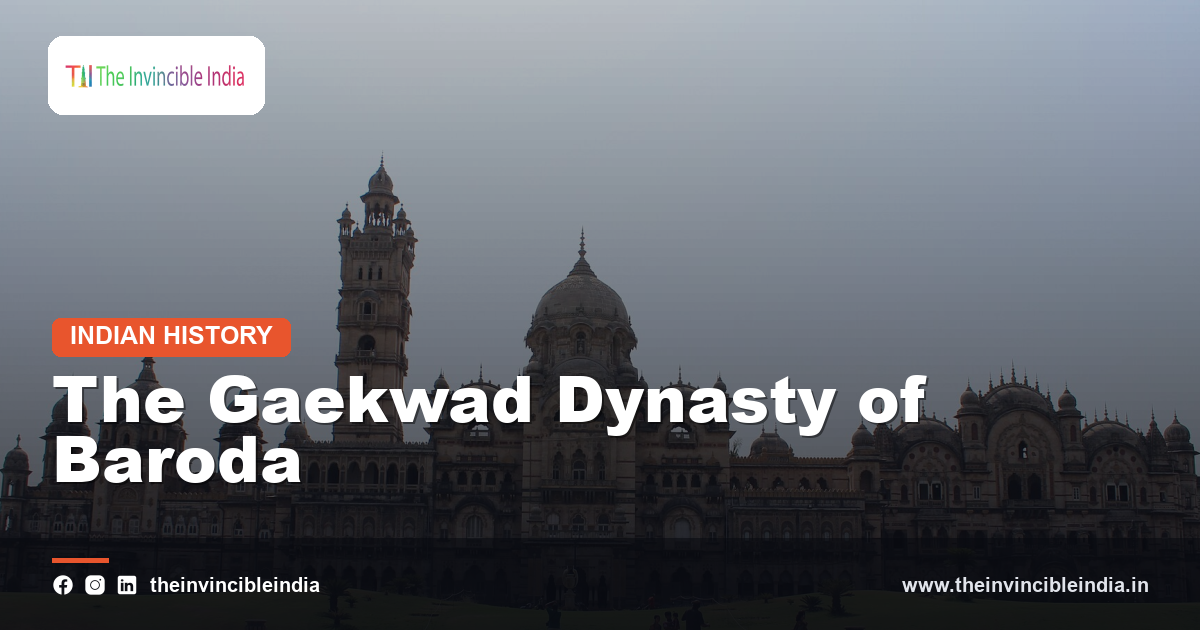
Laxmi Vilas Palace is the grand residence of the Gaekwad family in Vadodara, built in the late nineteenth century in the Indo-Saracenic style. Designed by the British architect Major Charles Mant, with later changes by others, it combines Indian, Islamic and European elements in a large complex of domes, arches, towers and gardens. The interiors held decorative arts, marble work and mosaics, and the palace housed an important collection of paintings, including works by Raja Ravi Varma. The palace is still associated with the Gaekwad family and is among the most famous residences in India. It remains a symbol of the city and of the wealth and artistic ambition of the dynasty.
How did the Gaekwads patronise art and architecture?
The Gaekwads patronised art and architecture by commissioning palaces, museums, gardens and public buildings, and by supporting painters, sculptors and musicians. The painter Raja Ravi Varma worked for the court and produced large canvases that now hang in the Laxmi Vilas Palace. Other buildings include the Nyay Mandir, the Kirti Mandir, the Baroda Museum and Picture Gallery and the Sursagar Lake with its central statue. The court also supported classical music and welcomed leading performers, which strengthened the musical culture of Gujarat. Later, the Faculty of Fine Arts at the Maharaja Sayajirao University grew into a major centre for modern Indian art, building on the tradition of patronage set by the dynasty.
What was Baroda like as a princely state?
Baroda as a princely state was a large and relatively wealthy territory in Gujarat with its own administration, courts, police, railways and revenue system, ruled by the Gaekwad maharaja under British paramountcy. It held a high rank among Indian princely states and was entitled to a large number of ceremonial gun salutes. Its administration was often cited as efficient and progressive, with notable achievements in education and public works. The state also contributed to industry through textile mills and chemical works and to agriculture through irrigation and land management. In international terms Baroda was a recognised princely state, whose rulers travelled abroad, received visitors and took part in imperial ceremonies, while internal governance remained in Gaekwad hands.
What happened to Baroda after independence?
After Indian independence, Baroda joined the Indian Union and was merged into the new administrative structure in the late 1940s. Maharaja Pratapsinhrao Gaekwad, the last ruling prince, agreed to accession, and the state was integrated, first into the Bombay State and later into Gujarat when that state was formed in 1960. The Maharaja Sayajirao University was founded in the same period as a memorial to Sayajirao III, carrying forward the educational tradition of Baroda. The royal family kept its private estates and titles in a personal capacity and continued to take part in public and cultural life. The integration of Baroda was part of the wider process by which hundreds of princely states became part of the republic of India.
Why is the Gaekwad dynasty important?
The Gaekwad dynasty is important because it shows how a princely house could use power to promote public good, learning and culture. Sayajirao III’s reforms influenced debates on education and social change across India, and his support for scholars and artists left a lasting mark on the cultural life of Gujarat. The dynasty also illustrates the transformation of Maratha military families into regional rulers in the age of British expansion, and it offers a case study of how princely states managed the relationship with the British Raj. Historians therefore consider Baroda a significant example of a reform-minded state. The institutions and buildings of Vadodara remain tangible evidence of this record.
The Gaekwad Dynasty Today
The Gaekwad dynasty lives on today through the institutions and monuments it left in Vadodara, including the Laxmi Vilas Palace, the Maharaja Sayajirao University, the museum and the public libraries. The royal family remains active in cultural and charitable life, and the palace is a prominent landmark that draws visitors from across India and abroad. The memory of Sayajirao III is kept alive in education, in public statues and in the history taught in schools, and his legacy of reform continues to inspire discussion. Vadodara is often described as the cultural capital of Gujarat, a reputation that owes much to the patronage of the Gaekwads. Their heritage forms a lasting part of the history of western India.
Sources & Further Reading
- Ministry of Culture, Government of India (indiaculture.gov.in).
- Archaeological Survey of India (asi.nic.in).
Frequently Asked Questions
Who were the Gaekwads of Baroda?
The Gaekwads were a Maratha dynasty that ruled the princely state of Baroda, now Vadodara in Gujarat, from the eighteenth century until 1949. They began as commanders in the Maratha confederacy and later became allies of the British.
Who founded the Gaekwad dynasty?
Pilaji Rao Gaekwad is regarded as the founder of the Gaekwad dynasty. He was a Maratha commander who campaigned in Gujarat in the early eighteenth century and built a power base that his successors expanded.
Who was Sayajirao Gaekwad III?
Sayajirao Gaekwad III was the most famous Gaekwad ruler, who reigned from the later nineteenth century into the early twentieth century. He is known for reforms in education, libraries, law and social life, and for patronage of the arts.
What is Laxmi Vilas Palace?
Laxmi Vilas Palace is the Gaekwad family’s grand residence in Vadodara, built in the late nineteenth century in the Indo-Saracenic style. It was designed by Major Charles Mant and holds notable art, including works by Raja Ravi Varma.
How did Sayajirao III help B. R. Ambedkar?
Sayajirao III supported B. R. Ambedkar with a scholarship that allowed him to study in the United States. The assistance was an important step in Ambedkar’s education and later career.
When did Baroda join India?
Baroda joined the Indian Union in the late 1940s, when its last ruling prince, Pratapsinhrao Gaekwad, agreed to accession. The state was merged into Bombay State and later became part of Gujarat in 1960.


