

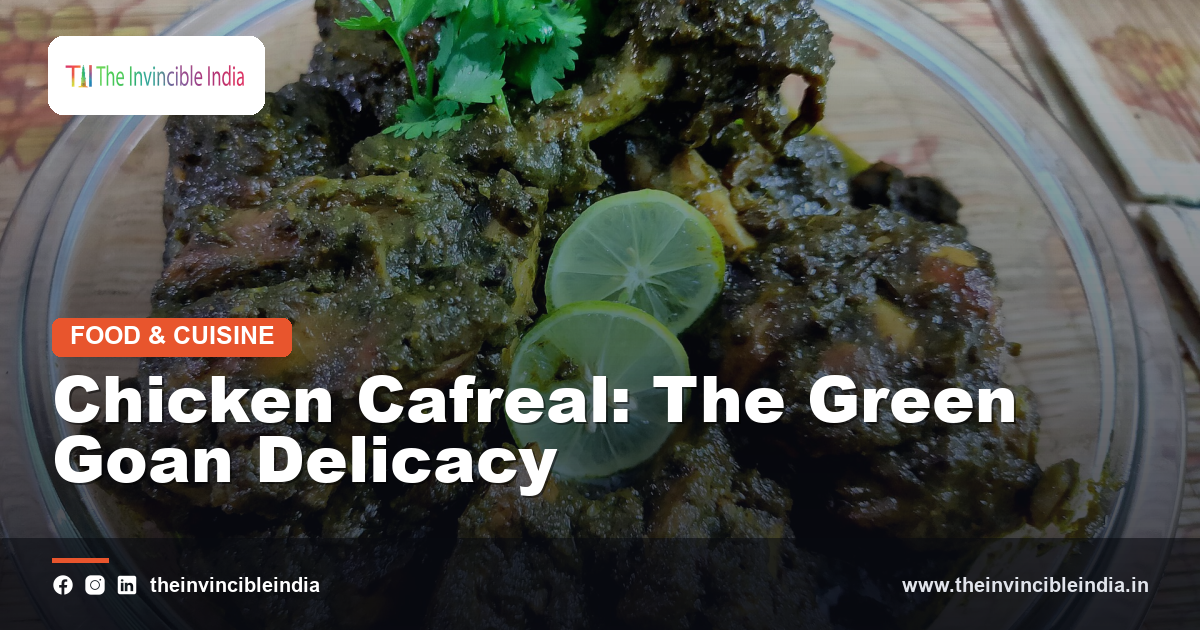
Chicken cafreal, also spelled cafriel or caffrael and often described as Goan green chicken, is a celebrated dish of the coastal state of Goa in western India. The chicken is marinated in a vivid green paste of fresh coriander, green chillies, ginger, garlic, spices and vinegar or lime, and then grilled, roasted or shallow fried until the edges char and the flavour deepens. The dish reflects Goa’s long Portuguese era, which left a lasting mark on the region’s food, and it is a staple of Goan restaurants, beach shacks and home kitchens. Alongside the great regional cuisines of India, Goan cooking is distinctive for its use of vinegar, chillies and coconut, and cafreal shows that heritage clearly. This guide explains what it is, where it comes from and how it is prepared and served.
Quick answer: Chicken cafreal is a Goan dish of chicken marinated in a green paste of coriander, green chillies, ginger, garlic, spices and vinegar or lime, then grilled or fried. It is associated with Goa’s Portuguese-influenced cuisine, and its origins are linked by many accounts to Portuguese contacts with Africa. It is usually served with onion rings, lime, fries or bread.
Key Takeaways
- Chicken cafreal is a Goan dish of chicken coated in a bright green coriander and chilli masala.
- The marinade combines fresh coriander, green chillies, ginger, garlic, spices such as cloves, cinnamon and pepper, and an acid such as vinegar or lime.
- The dish is linked to Goa’s Portuguese era, and the name is often connected to African influences, though its exact origin is debated.
- Cafreal is usually grilled, roasted or shallow fried rather than cooked in a gravy, so the masala clings to the meat as a dry coating.
- It is typically served with sliced onion, lime wedges, French fries, salad or Goan bread.
- The same masala is also used for fish, prawns and other meats in Goan kitchens.
The sections below describe the dish, its history, its masala, its cooking methods and the way it is served in Goa.
Quick Facts
| Detail | Information |
|---|---|
| Dish type | Non-vegetarian grilled or fried chicken dish |
| Region | Goa, on the western coast of India |
| Main ingredient | Chicken marinated in a green coriander and chilli paste |
| Signature flavour | Fresh coriander, green chilli, ginger, garlic and vinegar |
| Cooking style | Marinated, then grilled, roasted or shallow fried |
| Usually served with | Onion rings, lime, fries, salad or Goan bread |
What is chicken cafreal?
Chicken cafreal is a Goan dish in which pieces of chicken are coated in a bright green spice paste and then grilled, roasted or shallow fried until browned. The paste is built around fresh coriander and green chillies, with ginger, garlic, whole spices and a sour element such as vinegar or lime. The green colour is the dish’s visual signature, and the flavour is herbal, sharp, hot and aromatic. Unlike many Indian chicken dishes, cafreal is not cooked in a thick gravy, so the masala clings to the meat as a dry, fragrant coating. The charred edges add a smoky note, and the sourness of vinegar or lime lifts the whole dish. Chicken cafreal is therefore best understood as a vivid, tangy and fiery preparation, one of the most recognised flavours of Goan cooking.
Where does cafreal come from?
Cafreal comes from Goa, a small coastal state on the Konkan coast of western India, and it belongs to Goan cuisine as a whole rather than to any single community. Goa was under Portuguese rule for several centuries, until 1961, and during that period its food absorbed new ingredients and techniques from Europe, Africa and the wider Portuguese trading world. The dish is found in Goan Catholic kitchens and in many restaurants frequented by Goans of all communities. Today it is eaten across the state and has spread to Goan restaurants in other Indian cities and overseas. Exact dates and the identity of the first cook are not recorded, so the origin is best described as a Goan adaptation shaped by colonial era exchange. Its place in Goan food culture is firmly established.
What is the history of cafreal in Goa?
The history of cafreal in Goa is tied to the Portuguese era and to the movement of people, ingredients and cooking ideas across the Portuguese empire. Many accounts say that the dish is a Goan adaptation of a style of grilled, spiced chicken that Portuguese traders and soldiers knew from their contacts in Africa, and that local cooks recreated it using Indian ingredients. Chillies themselves, now central to Indian cooking, are generally understood to have reached India through Portuguese traders. The Goan version replaced African peppers with local chillies, coriander, ginger and garlic, producing a dish with a character of its own. Because written records of any single recipe are scarce, the story is best treated as a well-supported tradition rather than a verified chain of events. The history shows Goa’s role as a meeting point of cultures.
Why is it called cafreal?
The name cafreal is generally traced to a word used in Portuguese for people of African origin who served in Portuguese forces in Asia, and the dish is therefore linked in popular accounts with African soldiers and sailors. According to this explanation, such communities in Goa and other Portuguese settlements prepared a style of spiced grilled chicken, which Goans came to know as cafreal. The term is now considered outdated and sometimes offensive in other contexts, but it survives as the traditional name of the dish and is used without such meaning in Goan cooking. The name’s exact origin remains debated among food writers, and alternative theories exist. What is not in doubt is that the word has become the established label for the green Goan chicken. It is also sometimes spelled cafriel or caffrael, and menus use all of these forms.
What goes into the cafreal masala?
The cafreal masala is made by grinding fresh coriander, green chillies, ginger and garlic with whole spices, vinegar or lime juice and a little salt. The usual whole spices are cloves, cinnamon, black peppercorns and cumin, and some cooks add turmeric, a pinch of nutmeg or fresh mint to adjust the balance. The vinegar is typically the Goan palm or coconut vinegar, which adds a distinctive sourness and also helps the marinade penetrate the meat. The paste should be fine and bright green, with enough moisture to coat the chicken but not so much that it becomes a sauce. Because the masala depends on fresh herbs, it is best made shortly before use. The combination of herbal freshness, heat and tang is what gives cafreal its character and distinguishes it from the red masalas common in other regions.
Why is fresh coriander so important in cafreal?
Fresh coriander is important in cafreal because it provides the green colour and the clean herbal fragrance that define the dish. A generous quantity is used, often more than all the other ingredients combined, and both leaves and tender stems go into the paste. Coriander has a bright, slightly citrus flavour that balances the heat of green chillies and the pungency of garlic and ginger. It also keeps the marinade fresh tasting even after the chicken is charred. Cooks prefer coriander that is young and fragrant, and some pound it by hand in a mortar to release the oils. If the coriander is overcooked the green colour darkens and the flavour dulls, so the masala is usually applied raw and cooked only briefly with the meat. This careful handling explains why fresh herbs are treated as the heart of the dish.
How is the chicken marinated for cafreal?
The chicken for cafreal is marinated by coating whole legs, drumsticks or cut pieces thoroughly in the green paste and leaving them to rest, usually for several hours or overnight. Cooks often make small cuts in the meat so that the marinade can reach deeper layers, and they rub the paste under the skin where possible. The vinegar or lime in the paste acts as a mild tenderiser and adds sourness, while the spices and herbs infuse the meat. Longer marination gives a deeper flavour and a more even green colour, though very long contact with acid can make the meat soft in texture. The marinated chicken is kept cool until cooking. A good marinade is patient and generous, and it is the central step in the dish, because the cooking method that follows is simple and relies on the marinade for nearly all of its flavour.
How is cafreal cooked?
Cafreal is cooked by grilling, roasting or shallow frying the marinated chicken until it is cooked through and lightly charred at the edges. In Goan homes the usual method is to shallow fry the pieces in a little oil on a heavy pan, turning them until the masala forms a fragrant crust. Restaurants and beach shacks often grill the chicken over charcoal or bake it in an oven or tandoor, which gives a smokier flavour. Some cooks add a small splash of water or vinegar to the pan to keep the masala from burning. The aim is to cook the chicken thoroughly while keeping the coating green and fragrant rather than dark brown. A little of the leftover paste may be spooned over the finished dish for extra flavour. The method is straightforward, but timing and heat control matter a great deal.
What is served with chicken cafreal?
Chicken cafreal is usually served with sliced raw onion, lime wedges, a simple salad and either French fries or Goan bread. Goan bread, called pao, is a soft, round loaf that is often used to mop up the masala. Some restaurants serve it with Goan sausage fried rice or plain steamed rice, and a side of fresh cucumber and tomato adds coolness. Cafreal also appears on mixed grill platters and is a common accompaniment to drinks in beach shacks. In more formal meals it may be one of several dishes, alongside fish curry rice or other Goan preparations. The sharp acidity of lime and the freshness of raw onion are traditional ways of balancing the heat and richness. These simple accompaniments keep the focus on the green marinade and its bold, herbal character.
How does cafreal fit into Goan cuisine?
Cafreal fits into Goan cuisine as one of several dishes that show the region’s mixture of Indian and Portuguese influences, alongside vindaloo, sorpotel, xacuti and fish curry rice. Goan cooking is known for its use of vinegar, coconut, kokum, red and green chillies, and for a love of seafood, pork and chicken. The cuisine differs between Hindu and Catholic households, with Catholic kitchens traditionally using more meat, vinegar and bread, and Hindu kitchens favouring coconut and vegetarian dishes. Cafreal is most closely associated with the former but is now eaten by almost everyone. Where vindaloo and xacuti are rich, dark and gravy-based, cafreal is green, dry and tangy, which makes it a distinct and recognisable member of the Goan repertoire. It is a good example of how a colonial exchange became a local tradition.
Is cafreal the same as other green chicken dishes?
Cafreal is not exactly the same as other green chicken dishes, although it shares features with several of them. Hariyali chicken from north India is also marinated in a green paste of coriander, mint and green chillies, but it usually relies on yogurt and is cooked in a tandoor. Cafreal uses vinegar or lime instead of yogurt, includes whole spices such as cloves, cinnamon and pepper, and has a sharper and tangier profile. Piri piri chicken, associated with Portuguese and African traditions, is based on red chillies rather than green. Each of these dishes reflects its own regional tastes and techniques. The overlap shows how marinated grilled chicken appears in many cuisines, while the particular mix of ingredients identifies the origin of each version. Cafreal, in its Goan form, is clearly distinguishable by its fresh, vinegary heat.
Can cafreal be made with fish, prawns or other meats?
Cafreal masala can be used with fish, prawns, pork, mutton and even vegetables, and Goan cooks regularly apply it to a variety of ingredients. Pomfret, mackerel and kingfish are popular choices for cafreal fish, which is usually pan fried or grilled with the green paste. Prawns take well to the marinade because of their quick cooking time, and the result is a fragrant, lightly charred seafood dish. Pork and mutton versions exist but are less common than chicken. Some modern cooks use the masala on paneer, mushrooms or cauliflower to create vegetarian dishes. The adaptability of the paste is one reason it is so well loved in Goa, where seafood is central to daily eating. Chicken remains the best-known version, but the same herbal and tangy marinade clearly works across many kinds of food.
What are common variations of chicken cafreal?
Common variations of chicken cafreal include different balances of spice, the addition of fresh mint or curry leaves and differences in cooking style. Some cooks add green capsicum or a little raw green mango for extra tang, while others emphasise black pepper for a warmer taste. Restaurants may serve the chicken as boneless pieces, as whole legs or as a half bird roasted in an oven. A gravy version, in which the marinade is simmered with a little water or coconut milk, also appears occasionally, although purists prefer the dry style. The heat of the green chillies can be adjusted to suit different tastes, and modern kitchens may use an air fryer or oven for a lighter dish. These variations reflect individual taste and available equipment, but the green colour, the herbal flavour and the tang of vinegar or lime always identify a cafreal.
How is chicken cafreal made at home?
Chicken cafreal can be made at home by grinding a fresh green masala, marinating the chicken for several hours and then pan frying or roasting it until cooked through and lightly charred. The cook first blends coriander, green chillies, ginger, garlic, cloves, cinnamon, pepper, cumin and vinegar or lime into a smooth paste. The chicken is cut or scored and coated thoroughly, then rested in a cool place. It is cooked in a heavy pan with a little oil over a steady medium heat, covered for part of the time so that it cooks through, and then uncovered to crisp the surface. Home cooks often serve it with onion rings and lime. The recipe is forgiving, but it rewards the use of fresh ingredients and careful heat control, which keep the green colour bright.
What is the cultural place of cafreal in Goa?
Cafreal holds a respected place in Goan culture as a dish of everyday pleasure and festive hospitality. It appears at family lunches, at celebrations such as Christmas and weddings, and in the beach shacks that serve both locals and visitors. Goan food writers regard it as part of the state’s shared culinary heritage, reflecting centuries of contact with different peoples. For many Goans living in other cities or countries, cafreal is also a dish of nostalgia, prepared to recall the flavours of home. Its presence on restaurant menus across India has made it a kind of ambassador for Goan cooking. The dish has therefore moved from a local favourite to a widely recognised symbol of a distinctive coastal culture. It continues to serve both as a daily meal and as a marker of regional identity.
Chicken Cafreal Today
Chicken cafreal today remains one of the most popular Goan dishes and is served in restaurants, hotels and homes across Goa and in Goan kitchens around the world. Visitors to the state commonly list it among the dishes they most want to try, and it appears on menus from simple beach shacks to elegant hotel restaurants. Cooks continue to refine the masala, experiment with grilling methods and adapt the dish for lighter or vegetarian versions, while the traditional green paste of coriander, chilli, ginger, garlic and vinegar remains the core. Bottled cafreal masalas and ready marinades now make it easy to prepare outside Goa, although many people still prefer to grind the paste fresh. The dish endures because it combines a bright look, a bold flavour and a story of cultural exchange. Chicken cafreal remains a green emblem of Goa’s culinary identity.
Sources & Further Reading
- Ministry of Culture, Government of India (indiaculture.gov.in).
- Goa Tourism, Government of Goa (goatourism.gov.in).
Frequently Asked Questions
What is chicken cafreal?
Chicken cafreal is a Goan dish of chicken marinated in a green paste of coriander, green chillies, ginger, garlic, spices and vinegar or lime, then grilled or shallow fried. It is dry rather than gravy-based. It is one of Goa’s best-known chicken dishes.
Which state is cafreal from?
Cafreal is from Goa, on the western coast of India. It reflects the Portuguese-era influences on Goan cuisine and is eaten across the state.
Why is chicken cafreal green?
Chicken cafreal is green because the marinade is made mostly of fresh coriander and green chillies. These herbs and chillies are ground into a paste that coats the chicken and gives the dish its colour and fragrance.
What is cafreal served with?
Cafreal is usually served with sliced onion, lime wedges, salad, French fries or Goan bread (pao). It may also be eaten with rice or as part of a mixed grill platter.
Is cafreal spicy?
Yes, cafreal is usually moderately to very spicy because of the green chillies in the masala, though the heat can be adjusted. The vinegar and fresh coriander add tang and freshness that balance the chilli.
How is cafreal different from hariyali chicken?
Cafreal uses vinegar or lime and whole spices such as cloves, cinnamon and pepper, while hariyali chicken is usually based on yogurt, mint and coriander and is cooked in a tandoor. Cafreal is tangier and sharper, whereas hariyali is creamier and milder.


