

The Press Council of India (PCI) is a statutory, quasi-judicial body set up under the Press Council Act, 1978 to preserve the freedom of the press and to maintain and improve the standards of newspapers and news agencies in India. It acts as a watchdog over the print media, hearing complaints against the press and complaints by the press about interference, and it can warn, admonish or censure, but it has no power to punish.
The Council is headed by a chairman who is, by established convention, a retired judge of the Supreme Court of India, and it has members drawn from journalism, newspaper management, Parliament and cultural bodies. Its limited powers, and the question of whether it should cover television and digital media, have made it a recurring subject in discussions on media regulation. This explainer covers its history, composition, functions, procedures and the debate around its authority.
| Attribute | Detail |
|---|---|
| Legal basis | Press Council Act, 1978 |
| First Press Council | Established on 4 July 1966 under the Press Council Act, 1965 |
| Present Council | Constituted in 1979 after the 1978 Act |
| Nature | Statutory, autonomous, quasi-judicial body |
| Chairman | Usually a retired Judge of the Supreme Court |
| Strength | Chairman and 28 members |
| Term of members | Three years |
| Powers | Warn, admonish, censure or disapprove; no power to fine or imprison |
| Headquarters | New Delhi |
| Jurisdiction | Newspapers, news agencies, editors and journalists (print media) |
Key Takeaways
- The Press Council of India is a statutory quasi-judicial body established under the Press Council Act, 1978 to preserve press freedom and maintain journalistic standards.
- The first Press Council in India was set up on 4 July 1966, and the present Council was constituted under the 1978 Act after the earlier body was abolished in 1975.
- The Press Council of India consists of a chairman, who is conventionally a retired Supreme Court judge, and 28 other members.
- The Press Council of India can warn, admonish or censure a newspaper, news agency, editor or journalist, but it cannot impose fines, imprisonment or other punishment.
- The Press Council of India has jurisdiction over the print media only, and television and radio are not covered by its statute.
- The Press Council of India publishes Norms of Journalistic Conduct, a set of ethical guidelines used to decide complaints against the press.
What is the Press Council of India?
The Press Council of India is an independent statutory authority whose job is to protect the press from outside interference and to hold the press to professional standards. It has two sides to its work, defending press freedom and also policing press conduct.
The Council works as a quasi-judicial body, which means it hears evidence, examines complaints and issues reasoned decisions, though it is not a court. The Press Council Act confers on it certain powers of a civil court, such as summoning witnesses and requiring the production of documents. Its adjudications are published and serve as a body of precedent on questions of journalistic ethics.
The Council also acts as a bridge between different parts of the newspaper industry, because its membership includes working journalists, editors, owners and publishers as well as public representatives. It reports to Parliament through an annual report.
How did the Press Council of India come into being?
The Press Council of India came into being after the first Press Commission recommended a statutory council in 1954, and the first Council was set up under the Press Council Act, 1965 and started work on 4 July 1966. Since then, the institution has been abolished and restored once.
| Year | Event |
|---|---|
| 1952-54 | The First Press Commission examines the state of the press and recommends an independent Press Council |
| 1965 | Parliament passes the Press Council Act |
| 1966 | The first Press Council is established on 4 July, with Justice J. R. Mudholkar as its first chairman |
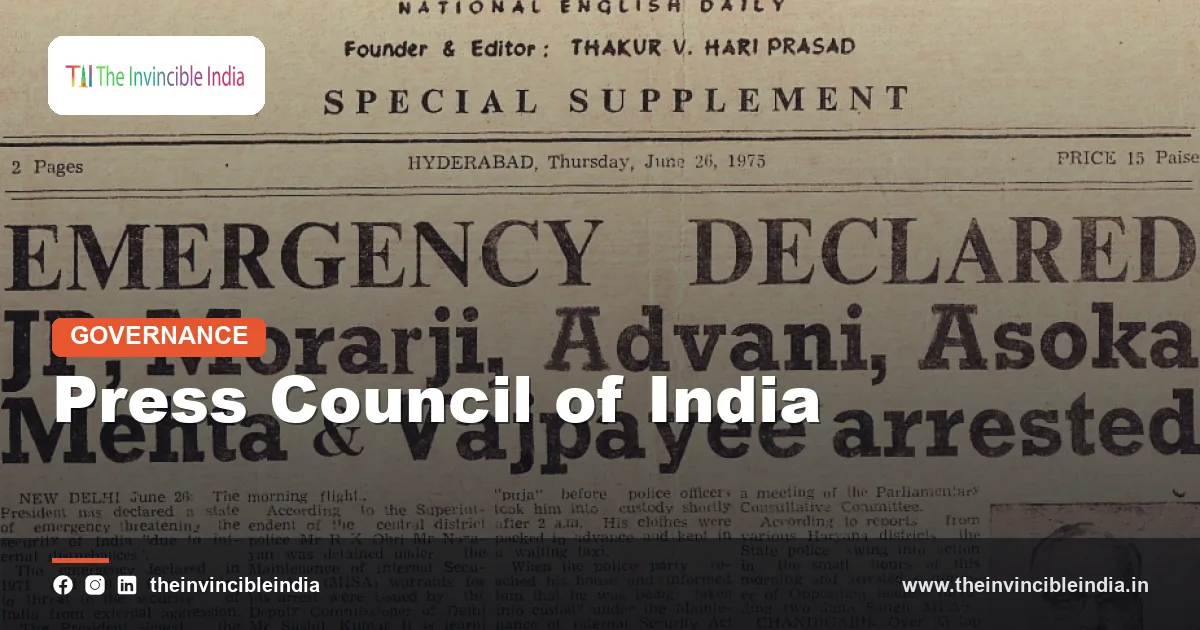
| 1975 | The Council is abolished during the Emergency by a repeal law |
| 1978 | The Second Press Commission is formed and a new Press Council Act is enacted |
| 1979 | The present Council starts functioning under the 1978 Act |
The First Press Commission of 1952-54, headed by Justice G. S. Rajadhyaksha, had argued that an independent body was needed to uphold standards and defend press freedom without the need for state control. The Council that resulted was India’s first statutory body of this kind and has continued, with one break, ever since.
Who sits on the Press Council of India?
The Press Council of India has a chairman and 28 members, with a majority drawn from the press itself. The structure is meant to give the Council both professional credibility and a link to public life.
- Chairman: Chosen by a three-member committee made up of the Speaker of the Lok Sabha, the Chairman of the Rajya Sabha and a person elected by the members of the Council. By convention the chairman is a retired judge of the Supreme Court.
- Working journalists (13): Six editors of newspapers and seven working journalists other than editors.
- Newspaper owners (6): Persons who own or manage newspapers, including those running small and medium publications.
- News agencies (1): One person managing a news agency.
- Parliament (5): Three members of the Lok Sabha and two members of the Rajya Sabha.
- Cultural, literary and legal fields (3): One nominee each from the University Grants Commission, the Sahitya Akademi and the Bar Council of India.
Members serve for a term of three years. The press members are nominated by recognised press organisations, while the Parliament members are nominated by the Speaker and the Chairman of the Rajya Sabha respectively.
What are the functions of the Press Council of India?
The functions of the Press Council of India, set out in the Press Council Act, 1978, are to help newspapers and news agencies maintain their independence, to build up a code of conduct and to keep standards high. The Act lists a range of specific objects, which can be grouped as follows.
- Helping newspapers and news agencies to maintain their independence and uphold the freedom of the press.
- Building a code of conduct for newspapers, news agencies and journalists in accordance with high professional standards.
- Ensuring on the part of newspapers, news agencies and journalists the maintenance of high standards of public taste and fostering a due sense of both the rights and responsibilities of citizenship.
- Encouraging the growth of a sense of responsibility and public service among all those engaged in the profession of journalism.
- Keeping under review any development likely to restrict the supply and dissemination of news of public interest and importance.
- Reviewing cases of undue interference with the freedom of the press and the concentration of ownership of newspapers.
- Undertaking studies and research on matters relating to the press and publishing reports.
The Council’s role is therefore broader than complaint handling. It speaks for the independence of the press as well as for its accountability.
What powers does the Press Council of India have?
The Press Council of India has the power to hold inquiries on complaints, to summon witnesses and to issue warnings, admonitions or censures, but it does not have power to impose penalties. This is the central feature that defines its authority.
Powers of inquiry
After receiving a complaint or on its own initiative, the Council may call for information from the newspaper, editor, journalist or any other person concerned. It has powers of a civil court under the Code of Civil Procedure in respect of summoning and examining witnesses, requiring discovery and production of documents, receiving evidence on affidavit and issuing commissions.
Powers of decision
If, after the inquiry, the Council finds that a newspaper or journalist has violated journalistic ethics or that an editor or journalist has committed professional misconduct, it may warn, admonish or censure the party, or disapprove of the conduct. It may also require the newspaper concerned to publish the Council’s decision, including a contradiction or a correction.
What the Council cannot do
The Council cannot impose a fine, suspend a licence, order imprisonment or award compensation. It also has no power to enforce its decisions against a publication that refuses to comply. Its authority rests on moral weight and on the standing of its members. In practice, failure to comply is recorded in the Council’s reports, and the Council has asked successive governments for stronger enforcement powers.
How does the Press Council of India handle complaints?
The Press Council of India handles complaints by receiving a written complaint, seeking a response from the other side, holding a hearing through an inquiry committee and then adjudicating through a reasoned decision. The process is designed to be accessible to ordinary readers as well as to professionals.
- A person or organisation files a written complaint against a newspaper, news agency, editor or journalist, usually after first raising the matter with the editor concerned.
- The Council seeks comments from the party complained against.
- The complaint is considered by an inquiry committee of members, which may hear both parties.
- The full Council adjudicates and issues its decision, which may be a warning, admonition, censure or a finding that no violation occurred.
- The decision is communicated to the parties and published in the Council’s records.
The Council can also take up a matter on its own initiative, a procedure known as suo motu cognizance. It also receives complaints made by the press, for example when a journalist alleges harassment or a newspaper alleges that the government has interfered with its freedom, and it can make recommendations to the government or others in such cases.
What are the Norms of Journalistic Conduct?
The Norms of Journalistic Conduct are a published set of ethical guidelines issued by the Press Council of India, which the Council uses as the yardstick for deciding complaints. They cover the principles of accuracy, fairness and responsibility that newspapers and journalists are expected to follow.
The guidelines address matters such as the following:
- Accuracy and fairness in reporting, and the duty to correct errors.
- The right of reply and the publication of rejoinders.
- Respect for privacy and caution in reporting on private individuals.
- Care in reporting on communal matters, caste issues and crime, including avoidance of sensationalism.
- Rules on the coverage of victims of sexual offences, minors and the identity of persons involved in sensitive cases.
- The separation of advertisements from news, including the practice known as paid news.
The Norms are revised from time to time to address new issues. They are not a statute and do not have independent legal force, but they are widely cited in the media and in discussions of professional ethics.
Does the Press Council of India cover television and digital media?
No, the Press Council of India does not have jurisdiction over television, radio or digital news platforms, because the Press Council Act refers only to newspapers and news agencies. This is one of the major gaps cited in debates about media regulation.
| Medium | Main regulatory or self-regulatory arrangement |
|---|---|
| Newspapers and news agencies | Press Council of India under the Press Council Act, 1978 |
| Television news channels | Programme Code under the Cable Television Networks (Regulation) Act, 1995, and industry self-regulation through the News Broadcasting and Digital Standards Authority (NBDSA) |
| Digital news publishers | Information Technology (Intermediary Guidelines and Digital Media Ethics Code) Rules, 2021 |
| Advertising across media | Self-regulation by the Advertising Standards Council of India (ASCI) |
Different sections of the media have therefore developed separate frameworks. Some of the Council’s chairpersons have called for a single regulator or for the extension of the Council’s remit to cover electronic and online news, while others in the industry prefer separate bodies and voluntary self-regulation.
What is the debate about the powers of the Press Council of India?
The debate about the Press Council of India is whether a body that can only censure should be given real enforcement powers, or whether its moral authority is the right model for a free press. Both views are held within and outside the profession.
The case for stronger powers
Those who want stronger powers argue that the Council’s decisions are sometimes ignored, that censure carries little weight against a determined publication and that the Council is described as a “toothless” body. They suggest powers such as fines, directions to publish apologies or the ability to recommend action in cases of repeated violations. They also want its jurisdiction extended to broadcast and digital news.
The case for self-regulation
Those who defend the existing model argue that punitive powers in a body linked to the state could be used to pressure the press, and that an ethical regime works best when it rests on professional consent. They note that the Council includes working journalists and publishers, and that its role is as much to defend press freedom as to discipline it. Article 19(1)(a) of the Constitution protects freedom of speech and expression, from which press freedom is derived, subject to reasonable restrictions.
The Council is funded by fees levied on newspapers and by a grant from the Union government, which some observers believe affects perceptions of independence. The Act, however, provides for the Council to operate as an autonomous body.
Why does the Press Council of India matter?
The Press Council of India matters because it provides a low-cost, accessible forum for settling disputes between the public and the press, and because it records standards of ethical journalism in a written form. A reader who believes that a newspaper has made a false or harmful claim can approach the Council without going to a court.
The Council’s adjudications also build a body of reasoning on press ethics, privacy and the balance between freedom and responsibility. Its existence signals that the press, which has a central role in a democracy, is expected to be both free and accountable. The effectiveness of the Council depends on the willingness of the industry, the government and the public to treat its findings seriously.
Bottom Line
The Press Council of India is India’s statutory press watchdog, created in its current form by the Press Council Act, 1978. It can warn, admonish and censure but cannot punish, and its jurisdiction is limited to print media, which keeps the debate on its powers and scope active.
Frequently Asked Questions
What is the Press Council of India?
The Press Council of India is a statutory quasi-judicial body set up under the Press Council Act, 1978 to preserve the freedom of the press and maintain standards of journalism. It hears complaints against newspapers and journalists, and complaints by the press about interference.
Who is the chairman of the Press Council of India?
The chairman of the Press Council of India is, by convention, a retired judge of the Supreme Court of India. The chairman is chosen by a committee consisting of the Speaker of the Lok Sabha, the Chairman of the Rajya Sabha and a person elected by the members of the Council.
Can the Press Council of India punish a newspaper?
No, the Press Council of India cannot fine, imprison or otherwise punish a newspaper or journalist. It can warn, admonish or censure, disapprove of conduct and require its decision to be published, but it has no direct power to enforce these decisions.
When was the Press Council of India established?
The first Press Council of India was established on 4 July 1966 under the Press Council Act, 1965. It was abolished in 1975 during the Emergency and was revived under the Press Council Act, 1978, with the present Council functioning from 1979.
Does the Press Council of India regulate television and online news?
No, the Press Council of India’s jurisdiction covers newspapers, news agencies, editors and journalists in the print media only. Television news is covered by other frameworks, including the News Broadcasting and Digital Standards Authority, and digital news publishers fall under the IT Rules, 2021.
How many members does the Press Council of India have?
The Press Council of India has a chairman and 28 other members. These include working journalists and editors, newspaper owners, a news agency representative, five Members of Parliament and three nominees from cultural, literary and legal bodies, each serving a three-year term.
{“@context”:”https://schema.org”,”@graph”:[{“@type”:”FAQPage”,”mainEntity”:[{“@type”:”Question”,”name”:”What is the Press Council of India?”,”acceptedAnswer”:{“@type”:”Answer”,”text”:”The Press Council of India is a statutory quasi-judicial body set up under the Press Council Act, 1978 to preserve the freedom of the press and maintain standards of journalism. It hears complaints against newspapers and journalists, and complaints by the press about interference.”}},{“@type”:”Question”,”name”:”Who is the chairman of the Press Council of India?”,”acceptedAnswer”:{“@type”:”Answer”,”text”:”The chairman of the Press Council of India is, by convention, a retired judge of the Supreme Court of India. The chairman is chosen by a committee consisting of the Speaker of the Lok Sabha, the Chairman of the Rajya Sabha and a person elected by the members of the Council.”}},{“@type”:”Question”,”name”:”Can the Press Council of India punish a newspaper?”,”acceptedAnswer”:{“@type”:”Answer”,”text”:”No, the Press Council of India cannot fine, imprison or otherwise punish a newspaper or journalist. It can warn, admonish or censure, disapprove of conduct and require its decision to be published, but it has no direct power to enforce these decisions.”}},{“@type”:”Question”,”name”:”When was the Press Council of India established?”,”acceptedAnswer”:{“@type”:”Answer”,”text”:”The first Press Council of India was established on 4 July 1966 under the Press Council Act, 1965. It was abolished in 1975 during the Emergency and was revived under the Press Council Act, 1978, with the present Council functioning from 1979.”}},{“@type”:”Question”,”name”:”Does the Press Council of India regulate television and online news?”,”acceptedAnswer”:{“@type”:”Answer”,”text”:”No, the Press Council of India’s jurisdiction covers newspapers, news agencies, editors and journalists in the print media only. Television news is covered by other frameworks, including the News Broadcasting and Digital Standards Authority, and digital news publishers fall under the IT Rules, 2021.”}},{“@type”:”Question”,”name”:”How many members does the Press Council of India have?”,”acceptedAnswer”:{“@type”:”Answer”,”text”:”The Press Council of India has a chairman and 28 other members. These include working journalists and editors, newspaper owners, a news agency representative, five Members of Parliament and three nominees from cultural, literary and legal bodies, each serving a three-year term.”}}]}]}


