

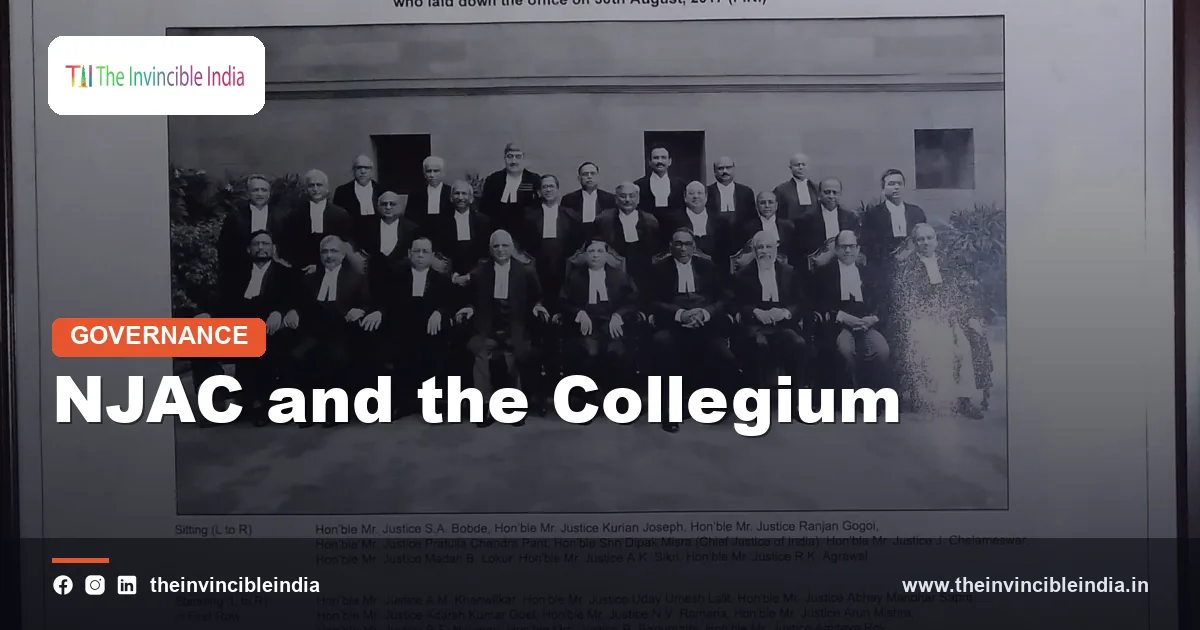
The National Judicial Appointments Commission (NJAC) was a constitutional body created in 2014 to select and recommend judges for the Supreme Court and the High Courts of India in place of the collegium system, but the Supreme Court struck down the law that created it in October 2015. The Commission was established through the Constitution (Ninety-ninth Amendment) Act, 2014 and the National Judicial Appointments Commission Act, 2014, and it was meant to give the executive and eminent citizens a formal voice alongside senior judges in choosing the judiciary.
The National Judicial Appointments Commission never began recommending judges, because the Supreme Court declared both the Amendment and the Act unconstitutional in the Fourth Judges case. The decision restored the collegium system, and the question of how judges should be appointed in India continues to be debated by lawyers, legislators and scholars.
| Attribute | Details |
|---|---|
| Full name | National Judicial Appointments Commission (NJAC) |
| Created by | Constitution (Ninety-ninth Amendment) Act, 2014 and the NJAC Act, 2014 |
| Constitutional provisions inserted | Articles 124A, 124B and 124C |
| Came into force | 13 April 2015 |
| Struck down | 16 October 2015, by a Constitution Bench of the Supreme Court |
| Case name | Supreme Court Advocates-on-Record Association v. Union of India (Fourth Judges case) |
| Bench decision | Four judges to one in favour of striking down |
| Members of the Commission | Six: the Chief Justice of India, two senior judges, the Law Minister and two eminent persons |
| System that continued | The collegium system of judicial appointments |
Key Takeaways
- The National Judicial Appointments Commission was a six-member body, headed by the Chief Justice of India, that was designed to recommend appointments and transfers of judges to the Supreme Court and High Courts.
- The National Judicial Appointments Commission was created by the Constitution (Ninety-ninth Amendment) Act, 2014 and the National Judicial Appointments Commission Act, 2014, and it came into force on 13 April 2015.
- On 16 October 2015, a five-judge Constitution Bench of the Supreme Court struck down the Ninety-ninth Amendment and the NJAC Act by a four-to-one majority.
- The Supreme Court held that the independence of the judiciary is part of the basic structure of the Constitution and that the NJAC composition diluted the primacy of the judiciary in appointments.
- The collegium system, evolved through the First, Second and Third Judges cases, was restored after the NJAC judgment and still governs judicial appointments in the higher judiciary.
- The debate on judicial appointments remains open, with arguments about transparency and accountability on one side and judicial independence on the other.
What is the National Judicial Appointments Commission (NJAC)?
The National Judicial Appointments Commission (NJAC) was a proposed constitutional body that would have selected judges for the Supreme Court and the High Courts, and also recommended transfers of High Court Chief Justices and judges. It was intended to replace the collegium, in which the Chief Justice of India and the senior-most judges decide appointments.
The National Judicial Appointments Commission was enacted by Parliament in 2014 with wide political support, and the amendment was ratified by the required number of State legislatures. Its supporters argued that a commission with members from outside the judiciary would make selection more transparent and accountable. Its opponents argued that any executive role in choosing judges threatens independence.
How were judges appointed before the NJAC?
Before the NJAC, judges were appointed by the President of India under Articles 124 and 217, after consultation with the Chief Justice of India and others, and the interpretation of the word “consultation” evolved through a series of Supreme Court judgments. The Constitution does not mention a collegium; the system grew from judicial interpretation.
The Judges cases
- First Judges case (S.P. Gupta, 1981): The Supreme Court held that “consultation” did not mean “concurrence”, which gave the executive the upper hand in appointments.
- Second Judges case (1993): A nine-judge Bench overruled the earlier position and held that the Chief Justice of India’s opinion, formed collectively with senior judges, has primacy. This created the collegium.
- Third Judges case (1998): In an opinion on a Presidential Reference under Article 143, the Court expanded the Supreme Court collegium to the Chief Justice of India and the four senior-most judges.
- Fourth Judges case (2015): The Court struck down the NJAC and restored the collegium.
Under the collegium system, the Chief Justice of India and four senior-most judges recommend names for the Supreme Court, while a High Court collegium of the Chief Justice and two senior-most judges recommends names for that High Court. The Government can raise objections or seek reconsideration, but when the collegium reiterates a recommendation, it is generally binding on the Government.
Why was the NJAC created?
The NJAC was created because many policymakers believed the collegium system lacked transparency, was not accountable to any outside body and placed appointments solely in judicial hands. Critics of the collegium pointed to the absence of written criteria, minimal public information and a perception of favouritism.
Earlier reform proposals had suggested a broader-based commission. The Law Commission of India, various committees and political leaders had in different years discussed alternative mechanisms involving members from the judiciary, executive and civil society. The 2014 law was the first such proposal to actually be passed by Parliament.
The reformers argued that appointments to a pillar of democracy should not be the exclusive domain of one institution, and that checks and balances would make the process more credible.
Who were the members of the NJAC?
The National Judicial Appointments Commission was to consist of six members under Article 124A: the Chief Justice of India as chairperson, two other senior judges of the Supreme Court, the Union Minister in charge of Law and Justice, and two eminent persons. Judges formed half of the Commission and non-judges formed the other half.
| Member | Source |
|---|---|
| Chief Justice of India (Chairperson) | Ex officio |
| Two senior-most Supreme Court judges | Next after the Chief Justice of India, ex officio |
| Union Minister of Law and Justice | Ex officio |
| Two eminent persons | Nominated by a committee of the Prime Minister, the Chief Justice of India and the Leader of the Opposition in the Lok Sabha (or the leader of the largest opposition party) |
One of the two eminent persons had to belong to the Scheduled Castes, the Scheduled Tribes, Other Backward Classes, minorities or be a woman. The eminent persons served a three-year term and could not be nominated again.
What did the NJAC Act, 2014 provide?
The NJAC Act, 2014 laid down the procedure for the Commission’s work, including criteria for selection and the manner of making recommendations. It specified that the Commission would recommend persons for appointment as Chief Justice of India, judges of the Supreme Court, Chief Justices of High Courts and High Court judges, and that it would recommend transfers of Chief Justices and judges of High Courts.
The Act required the Commission to consider ability, integrity and other criteria for suitability, and it contained rules on seniority-based appointment of the Chief Justice of India. A key provision was that the Commission could not recommend a person if any two of its members did not agree. This meant that the two eminent persons, or one eminent person and the Law Minister, could effectively veto a candidate favoured by the judges.
That veto provision proved central to the constitutional challenge, because the three judges held only half of the six seats, and any two non-judicial members acting together could block a name the judges favoured.
Why did the Supreme Court strike down the NJAC?
The Supreme Court struck down the NJAC because the majority concluded that the Ninety-ninth Amendment violated the basic structure of the Constitution by compromising the independence of the judiciary. The judgment was delivered on 16 October 2015 by a five-judge Constitution Bench in the Fourth Judges case, with four judges forming the majority and one dissenting.
Reasoning of the majority
- Independence of the judiciary and separation of powers are part of the basic structure of the Constitution, which Parliament cannot amend away.
- The primacy of the judiciary in the appointment process is an essential feature of judicial independence.
- The composition of the Commission, with only three judges among six members, did not give the judiciary sufficient weight.
- The inclusion of the Law Minister gave the executive a direct role, and the veto held by any two members could allow non-judicial members to block judicial choices.
- The vague term “eminent person” and the lack of clear criteria for choosing such persons raised concerns about arbitrariness.
- Placing the composition in a statute, rather than in the Constitution itself, left it open to change by ordinary legislation.
The Court also noted that the process of appointing eminent persons through a committee that included the Chief Justice of India did not cure the imbalance. As a result, Article 124A and the NJAC Act were held unconstitutional, and the older Articles in their pre-amendment form were revived.
What did the dissenting judge say?
The dissenting judge in the Fourth Judges case upheld the NJAC and the Ninety-ninth Amendment, taking the view that the collegium system had weaknesses and that Parliament could legitimately create a new method. Justice J. Chelameswar, who dissented, argued that a lack of transparency in the collegium was a real concern and that the proposed commission could be a reasonable reform.
His opinion also observed that the secrecy of collegium proceedings was hard to defend in a democracy, and that transparency in selection was a legitimate public interest. The majority and the dissent therefore agreed that the collegium was not perfect, but disagreed on whether the NJAC was a constitutionally permitted remedy.
What happened after the NJAC judgment?
After the NJAC judgment, the Supreme Court restored the collegium system and invited suggestions to improve its working, particularly on transparency, eligibility criteria and a secretariat. The Court listed these matters for further hearing, and the Memorandum of Procedure, which governs appointment processes, became the subject of discussion between the judiciary and the Government.
The restored collegium continues to make recommendations, while the Government processes them, raises queries and conveys appointments. Disagreements have periodically surfaced publicly over timing, the return of names and the acceptance of particular candidates. Courts have addressed related issues, including time limits for the Government to act on reiterated names, in later proceedings.
Calls for a fresh legislative approach have also been raised in Parliament and by successive law ministers, though no new statute has replaced the collegium.
What are the arguments for and against the collegium and the NJAC?
The collegium and the NJAC each have supporters, and the core argument is a trade-off between judicial independence and democratic accountability. The table below summarises the commonly stated positions in a neutral way.
| Aspect | Arguments for the collegium | Arguments for a commission like the NJAC |
|---|---|---|
| Independence | Insulates appointments from political influence | Can be designed to preserve a judicial majority |
| Transparency | Can publish reasons and resolutions | Open criteria and wider participation are possible |
| Accountability | Judges know the performance of candidates from the Bar and bench | Outside members can bring public accountability |
| Representation | Consultation with colleagues and High Court views | Includes civil society and diverse voices |
| Practical concerns | Limited records and absence of a formal secretariat have been questioned | Risk of executive influence or deadlock through a veto |
Many scholars suggest a middle path, such as a statutory commission with a clear judicial majority, published criteria and a permanent secretariat.
How does the NJAC compare with judicial appointment systems elsewhere?
The NJAC resembled judicial appointment commissions in other jurisdictions, but India’s collegium is unusual because judges choose judges with only limited executive input. Many democracies use mixed bodies or executive nomination with legislative or independent review.
- In the United Kingdom, an independent Judicial Appointments Commission selects candidates for most judicial offices.
- In the United States, federal judges are nominated by the President and confirmed by the Senate.
- In South Africa, a Judicial Service Commission interviews candidates and advises the President.
These comparisons show that no single international model exists, and each system tries to balance independence, competence and accountability according to its own constitutional design.
Bottom Line
The National Judicial Appointments Commission was Parliament’s attempt to broaden the process of choosing India’s higher judges, but the Supreme Court struck it down in 2015 to protect judicial independence as part of the basic structure. The collegium remains in place, and the search for a more transparent yet independent method of appointment continues.
Frequently Asked Questions
What is the NJAC in India?
The NJAC, or National Judicial Appointments Commission, was a body created by the Ninety-ninth Constitutional Amendment of 2014 to appoint judges to the Supreme Court and High Courts. It was to replace the collegium system. The Supreme Court struck it down in 2015 before it made any recommendations.
Who were the members of the NJAC?
The NJAC had six members: the Chief Justice of India, the two next senior-most Supreme Court judges, the Union Law Minister and two eminent persons. A committee of the Prime Minister, the Chief Justice of India and the Leader of the Opposition nominated the eminent persons. One of them had to be from a Scheduled Caste, Scheduled Tribe, Other Backward Class, minority or be a woman.
Why did the Supreme Court strike down the NJAC?
The Supreme Court struck down the NJAC because it held that the Commission undermined the independence of the judiciary, which is part of the basic structure of the Constitution. The majority in the Fourth Judges case found that the Commission gave too little weight to the judiciary and allowed non-judicial members to block judicial choices. The decision came on 16 October 2015 by a four-to-one majority.
What is the difference between the collegium and the NJAC?
The collegium consists only of the Chief Justice of India and senior judges, while the NJAC would have included the Law Minister and two eminent persons as well. The collegium evolved through court judgments and is not mentioned in the Constitution. The NJAC was created by a constitutional amendment and an Act of Parliament.
Is the NJAC still in force?
No, the NJAC is not in force because the Supreme Court declared the Ninety-ninth Amendment and the NJAC Act unconstitutional in 2015. The collegium system was revived and continues to govern appointments to the higher judiciary. No new law has replaced it so far.
Which articles did the Ninety-ninth Amendment add to the Constitution?
The Ninety-ninth Amendment added Articles 124A, 124B and 124C to the Constitution. Article 124A set up the Commission and its composition, Article 124B described its functions, and Article 124C empowered Parliament to regulate the procedure by law. The amendment also changed Articles 127, 128, 217, 222, 224, 224A and 231 to align them with the new system.
{“@context”:”https://schema.org”,”@graph”:[{“@type”:”FAQPage”,”mainEntity”:[{“@type”:”Question”,”name”:”What is the NJAC in India?”,”acceptedAnswer”:{“@type”:”Answer”,”text”:”The NJAC, or National Judicial Appointments Commission, was a body created by the Ninety-ninth Constitutional Amendment of 2014 to appoint judges to the Supreme Court and High Courts. It was to replace the collegium system. The Supreme Court struck it down in 2015 before it made any recommendations.”}},{“@type”:”Question”,”name”:”Who were the members of the NJAC?”,”acceptedAnswer”:{“@type”:”Answer”,”text”:”The NJAC had six members: the Chief Justice of India, the two next senior-most Supreme Court judges, the Union Law Minister and two eminent persons. A committee of the Prime Minister, the Chief Justice of India and the Leader of the Opposition nominated the eminent persons. One of them had to be from a Scheduled Caste, Scheduled Tribe, Other Backward Class, minority or be a woman.”}},{“@type”:”Question”,”name”:”Why did the Supreme Court strike down the NJAC?”,”acceptedAnswer”:{“@type”:”Answer”,”text”:”The Supreme Court struck down the NJAC because it held that the Commission undermined the independence of the judiciary, which is part of the basic structure of the Constitution. The majority in the Fourth Judges case found that the Commission gave too little weight to the judiciary and allowed non-judicial members to block judicial choices. The decision came on 16 October 2015 by a four-to-one majority.”}},{“@type”:”Question”,”name”:”What is the difference between the collegium and the NJAC?”,”acceptedAnswer”:{“@type”:”Answer”,”text”:”The collegium consists only of the Chief Justice of India and senior judges, while the NJAC would have included the Law Minister and two eminent persons as well. The collegium evolved through court judgments and is not mentioned in the Constitution. The NJAC was created by a constitutional amendment and an Act of Parliament.”}},{“@type”:”Question”,”name”:”Is the NJAC still in force?”,”acceptedAnswer”:{“@type”:”Answer”,”text”:”No, the NJAC is not in force because the Supreme Court declared the Ninety-ninth Amendment and the NJAC Act unconstitutional in 2015. The collegium system was revived and continues to govern appointments to the higher judiciary. No new law has replaced it so far.”}},{“@type”:”Question”,”name”:”Which articles did the Ninety-ninth Amendment add to the Constitution?”,”acceptedAnswer”:{“@type”:”Answer”,”text”:”The Ninety-ninth Amendment added Articles 124A, 124B and 124C to the Constitution. Article 124A set up the Commission and its composition, Article 124B described its functions, and Article 124C empowered Parliament to regulate the procedure by law. The amendment also changed Articles 127, 128, 217, 222, 224, 224A and 231 to align them with the new system.”}}]}]}


