

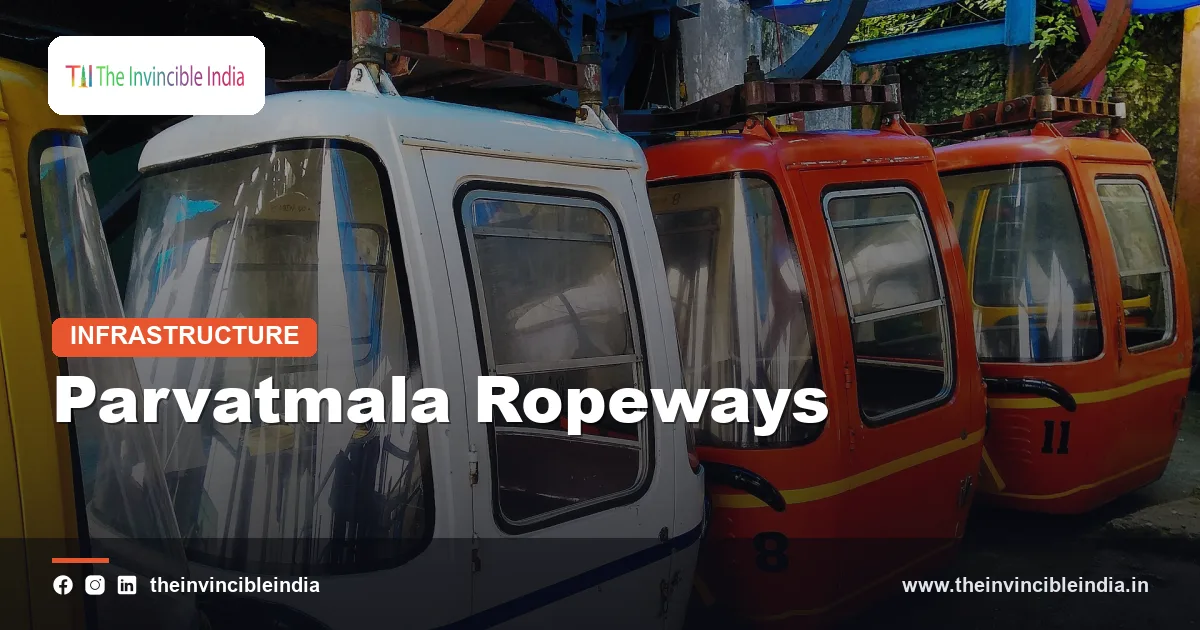
Parvatmala is India’s National Ropeways Development Programme, a government initiative announced in the Union Budget 2022-23 to build ropeways, which are aerial cable-car systems, in hilly and congested urban areas for tourism, pilgrimage and last-mile connectivity. The programme is led by the Ministry of Road Transport and Highways (MoRTH), and it is implemented mainly through National Highways Logistics Management Limited (NHLML), a company set up under the National Highways Authority of India (NHAI).
The name Parvatmala means “a chain of mountains”, and the programme aims to give steep, remote and crowded places an alternative to roads that are costly or impossible to build. Parvatmala projects are generally developed through public-private partnership on a design, build, finance, operate and transfer (DBFOT) basis, with a hybrid annuity-style support structure used in some cases. 15 October 2026
Quick Facts
| Attribute | Details |
|---|---|
| Programme | Parvatmala, the National Ropeways Development Programme |
| Announced | Union Budget 2022-23 (February 2022) |
| Nodal ministry | Ministry of Road Transport and Highways (MoRTH) |
| Implementing agency | National Highways Logistics Management Limited (NHLML), under the National Highways Authority of India (NHAI) |
| Purpose | Ropeways for tourism, pilgrimage, urban congestion relief and connectivity in hill areas |
| Preferred model | Public-private partnership; design, build, finance, operate and transfer (DBFOT), with some hybrid annuity-style support |
| Typical technology | Monocable and tricable detachable gondola systems (3S), aerial tramways |
| Example corridors | Sonprayag to Kedarnath, Govindghat to Hemkund Sahib, Varanasi urban ropeway, and others in the pipeline |
Key Takeaways
- Parvatmala is the National Ropeways Development Programme that the Government of India announced in the Union Budget 2022-23 to build ropeways in hilly and urban areas.
- Parvatmala is led by the Ministry of Road Transport and Highways and executed through National Highways Logistics Management Limited (NHLML), a special-purpose company under the National Highways Authority of India.
- Parvatmala ropeways are meant to serve tourism, pilgrimage routes, remote hill communities and congested city corridors where roads are hard to build.
- Parvatmala projects are usually developed on a design, build, finance, operate and transfer (DBFOT) basis through public-private partnership, which shifts construction and operating risk to a private concessionaire.
- Parvatmala has identified major corridors such as the routes to Kedarnath and Hemkund Sahib in Uttarakhand and an urban ropeway in Varanasi.
- Parvatmala ropeways can cut a multi-hour trek or road journey to a short ride while using little land and causing relatively low direct emissions.
What is Parvatmala?
Parvatmala is a national programme to plan, finance and build ropeway projects across India, with a focus on mountainous regions and crowded urban areas. It was announced by the Union Finance Minister in the Union Budget 2022-23 as part of a wider push to expand modern transport options.
The idea behind Parvatmala is simple. Roads in steep terrain require extensive cutting, retaining walls and tunnelling, and these works are expensive, slow and environmentally disruptive. A ropeway, by contrast, needs only a small number of support towers and two terminal stations, and it can cross slopes, gorges and rivers in a straight line.
The programme was designed to create a pipeline of ropeway projects, standardise how they are bid and built, and bring in private investment. It sits next to other national infrastructure programmes such as Bharatmala for highways, Sagarmala for ports and the PM Gati Shakti master plan for integrated planning.
What does the term “ropeway” mean?
A ropeway is a transport system in which cabins or chairs are carried along steel cables that are suspended between towers and terminals, and it is also known as an aerial cable car or aerial tramway. The cabins are pulled by a motor at a station, and the cables are held by towers that can be set at wide intervals.
Ropeways are used for passengers, for freight, or for both. They are common in mountain countries and in cities, and in India they are already familiar at places such as Gulmarg in Jammu and Kashmir, Auli in Uttarakhand and several temple towns where pilgrims ride to hilltop shrines.
Types of ropeway systems
- Monocable detachable gondola (MDG): Cabins grip a single moving cable and detach at stations to load passengers slowly and then speed up on the line.
- Tricable detachable gondola (3S): Cabins run on fixed support cables and are pulled by a separate haul cable, which gives stability in wind and permits long spans and high capacity.
- Aerial tramway (reversible ropeway): Large cabins shuttle back and forth along fixed cables, which suits steep, short or very long lines.
- Funicular: Cars run on rails on a slope and are pulled by a cable, and this is not a true aerial system but is sometimes grouped with ropeways.
Why did India launch the National Ropeways Development Programme?
India launched the National Ropeways Development Programme to improve access in difficult terrain where roads are impractical, to reduce congestion in crowded cities and to support tourism and pilgrimage in a cleaner and safer way. A large share of India’s pilgrimage sites and tourist destinations lie in the Himalayas and other hill regions.
These destinations often depend on narrow roads, long treks or ponies and palanquins, and their capacity is limited. Landslides, bad weather and heavy seasonal crowds make the situation worse. A ropeway can offer a faster and safer option while also providing a regulated way to manage visitor numbers.
There is also a broader policy logic. Hill and border regions have fewer economic opportunities, and better access supports local business, jobs and services. Better connectivity can also improve emergency response and bring health care closer to remote communities.
Who implements Parvatmala?
Parvatmala is implemented by the Ministry of Road Transport and Highways through National Highways Logistics Management Limited (NHLML), which is a special-purpose vehicle (SPV) created under the National Highways Authority of India (NHAI). NHAI is the statutory body that builds and maintains India’s national highways.
NHLML was established to handle logistics-oriented infrastructure, including multimodal logistics parks and ropeways. For Parvatmala, it prepares feasibility studies, invites bids and manages the contracts with concessionaires. State governments take part by providing land, clearances and coordination, because many of the sites fall in state-managed hill areas, forests or religious precincts.
Key roles in a typical Parvatmala project are shown below.
| Party | Role |
|---|---|
| MoRTH | Policy lead and overall nodal ministry |
| NHLML (under NHAI) | Project development, bidding and contract management |
| State government | Land, local permissions, forest and environmental coordination |
| Private concessionaire | Design, construction, financing, operation and maintenance during the concession |
| Regulators and safety authorities | Technical standards, inspections and safety certification |
How are Parvatmala projects financed?
Parvatmala projects are financed mainly through public-private partnership, and the preferred model is DBFOT, which stands for design, build, finance, operate and transfer. Under DBFOT, a private concessionaire designs and builds the ropeway, raises the money, operates it for a fixed concession period, earns revenue from fares and other sources, and then hands it back to the public authority.
Some projects may use a hybrid annuity-style approach, in which the government supports part of the capital cost during construction and the rest is recovered by the concessionaire from operations. The mix is chosen according to how commercially viable a route is, since busy pilgrimage routes can attract investors more easily than remote, low-traffic ones.
Why the model matters
- Risk sharing: The private partner carries construction and operating risks, while the government carries risks such as land and clearances.
- Technical expertise: Ropeways need specialised design, equipment and maintenance that private operators can bring.
- Fiscal discipline: The model reduces the burden on public budgets for large capital projects.
- Revenue links: Fares, advertising, retail and other station income can help repay the investment.
Which corridors are included in Parvatmala?
Parvatmala includes ropeway projects in Uttarakhand, Himachal Pradesh, Jammu and Kashmir, the Northeast and some urban centres, and the best-known examples are the proposed ropeways to Kedarnath and Hemkund Sahib. The pipeline has evolved since 2022 as feasibility studies were completed and clearances progressed, so the list is best treated as indicative.
| Corridor | State | Purpose |
|---|---|---|
| Sonprayag to Kedarnath | Uttarakhand | Pilgrim access to the Kedarnath temple, replacing a long and demanding trek of roughly 16 km from Gaurikund |
| Govindghat to Hemkund Sahib | Uttarakhand | Access to the high-altitude Sikh shrine and the Valley of Flowers area |
| Varanasi urban ropeway | Uttar Pradesh | Congestion relief in the dense old city between the railway station area and the ghats |
| Other hill and tourist routes | Himachal Pradesh, Jammu and Kashmir, the Northeast and others | Tourism, border-area access and last-mile links |
The Union Cabinet gave approval to the Kedarnath and Hemkund Sahib ropeways in 2025, each a project of around 12 to 13 kilometres. Such projects are intended to be among the longest ropeways in the country and to carry large numbers of passengers per hour.
How does a ropeway help pilgrims and tourists?
A ropeway helps pilgrims and tourists by turning a long, tiring and sometimes risky trek into a short ride of a few tens of minutes. For elderly pilgrims, children and persons with disabilities, this can mean the difference between being able to visit a shrine or not.
The Kedarnath route is a good illustration. The traditional approach from Gaurikund is a mountain trek of around sixteen kilometres that can take most of a day, and the path is subject to landslides and extreme weather. A ropeway on the corridor is intended to reduce the journey to roughly half an hour, although the final time depends on the design.
Ropeways also help manage crowds. A scheduled system with ticketing and fixed capacity gives authorities better control over numbers and safety than an unregulated flow of pedestrians, ponies and vehicles on narrow paths.
What is the economic and environmental case for ropeways?
The economic case for ropeways is that they open up remote areas, support tourism income and local jobs, and cost less to build than equivalent roads in steep terrain, while the environmental case is that they need less land and cause less landscape damage. A road in the mountains often needs extensive slope cutting, which can trigger landslides and destroy vegetation.
A ropeway needs only isolated tower footings and station sites. Because the cabins are electric, they produce no direct exhaust emissions on the line, and they can help reduce vehicle traffic and diesel use in sensitive areas. Where the electricity comes from renewable sources, the footprint is smaller still.
Several benefits are usually cited:
- Smaller land footprint: Only towers and terminals touch the ground.
- Lower direct emissions: Electric drives avoid fuel burned by road traffic.
- Disaster resilience: A ropeway can bypass landslide-prone sections of a road, though it has its own wind and weather limits.
- Local jobs: Operations, maintenance, tourism services and retail create employment.
- Safer access: Properly regulated systems have good safety records worldwide.
How are ropeways kept safe?
Ropeways are kept safe through strict design standards, regular inspection, trained operators and well-rehearsed rescue plans, and the same principles apply to Parvatmala projects. Modern gondola systems have multiple braking systems, backup power supplies and sensors that stop the line automatically in strong winds or when a fault is detected.
Operators carry out daily checks of cables, grips, cabins and towers, and periodic non-destructive testing of steel ropes to find wear that cannot be seen with the naked eye. In an emergency, cabins can be brought to the nearest station by an auxiliary drive, or passengers can be lowered to the ground by trained rescue crews using standard evacuation equipment.
Safety also depends on regulation. Ropeways in India follow technical codes and are subject to inspection by the competent state or central authorities before they are allowed to carry the public. For high-altitude projects, designers add extra margins for wind, snow and ice load.
What challenges do Parvatmala projects face?
Parvatmala projects face challenges of land acquisition, environmental and forest clearances, technical safety, financing viability and community concerns, and these have slowed the pace of some proposals. Many sites lie inside or near protected forests, religious precincts and ecologically fragile areas, so approvals are complex.
Communities that currently earn a living from pilgrims and tourists, such as porters, pony operators and palanquin carriers, may worry about their livelihoods when a ropeway is introduced. Planners often discuss rehabilitation and skill programmes to address this, and the ability to handle it fairly affects the acceptance of a project.
There are also engineering and operating questions. Ropeways must be designed for high winds, snow, heavy rainfall and seismic activity, and they need regular inspection and trained staff. Rescue arrangements for stranded passengers are a mandatory part of the safety plan.
How does Parvatmala fit into India’s wider infrastructure plans?
Parvatmala fits into India’s wider infrastructure plans as the programme for hill and urban aerial transport, complementing highways, railways, ports and waterways. Under the PM Gati Shakti National Master Plan, ropeway corridors are meant to be planned in coordination with roads, tourist circuits and settlements so that stations connect properly with other modes.
The programme also links to the government’s goals for tourism, pilgrimage circuits and border-area development. Better last-mile access to high-altitude destinations supports local economies and encourages people to stay in remote regions.
Bottom Line
Parvatmala is India’s national effort to bring ropeways into the mainstream of public transport, with a focus on hills, pilgrimage routes and crowded cities. If projects are well planned, fairly handled and safely run, they can offer faster access with a smaller environmental footprint than roads in steep terrain.
Frequently Asked Questions
What is Parvatmala?
Parvatmala is India’s National Ropeways Development Programme, announced in the Union Budget 2022-23. It aims to build ropeways in hilly and congested urban areas for tourism, pilgrimage and last-mile connectivity. The Ministry of Road Transport and Highways leads it, and National Highways Logistics Management Limited implements it.
Who implements Parvatmala ropeway projects?
National Highways Logistics Management Limited (NHLML), a special-purpose company under the National Highways Authority of India, implements Parvatmala projects for the Ministry of Road Transport and Highways. NHLML prepares studies, invites bids and manages contracts. State governments assist with land and local clearances.
What is the financing model of Parvatmala?
Parvatmala projects are mainly financed through public-private partnership using the DBFOT model, which means design, build, finance, operate and transfer. A private concessionaire builds and runs the ropeway for a fixed period before handing it over. Some projects may use hybrid annuity-style government support when a route is not fully viable on revenues alone.
Which are the main Parvatmala projects?
The best-known Parvatmala projects are the ropeways proposed from Sonprayag to Kedarnath and from Govindghat to Hemkund Sahib in Uttarakhand, along with an urban ropeway in Varanasi. Other proposals cover hill and tourist routes in Himachal Pradesh, Jammu and Kashmir and the Northeast. The pipeline changes as studies and approvals progress.
Why are ropeways better than roads in the mountains?
Ropeways are often better in steep terrain because they need much less land and far less slope cutting than roads. They also avoid landslide-prone road sections and produce no direct exhaust on the line. They do have limits, such as wind and weather, and they need strict safety systems.
Will Parvatmala affect local livelihoods?
Parvatmala can affect livelihoods of porters, pony operators and palanquin carriers who serve pilgrim routes, and this is a recognised concern. Planners often propose rehabilitation measures, training and new jobs in operations and tourism services. How fairly this is handled influences public acceptance of each project.
{“@context”:”https://schema.org”,”@graph”:[{“@type”:”FAQPage”,”mainEntity”:[{“@type”:”Question”,”name”:”What is Parvatmala?”,”acceptedAnswer”:{“@type”:”Answer”,”text”:”Parvatmala is India’s National Ropeways Development Programme, announced in the Union Budget 2022-23. It aims to build ropeways in hilly and congested urban areas for tourism, pilgrimage and last-mile connectivity. The Ministry of Road Transport and Highways leads it, and National Highways Logistics Management Limited implements it.”}},{“@type”:”Question”,”name”:”Who implements Parvatmala ropeway projects?”,”acceptedAnswer”:{“@type”:”Answer”,”text”:”National Highways Logistics Management Limited (NHLML), a special-purpose company under the National Highways Authority of India, implements Parvatmala projects for the Ministry of Road Transport and Highways. NHLML prepares studies, invites bids and manages contracts. State governments assist with land and local clearances.”}},{“@type”:”Question”,”name”:”What is the financing model of Parvatmala?”,”acceptedAnswer”:{“@type”:”Answer”,”text”:”Parvatmala projects are mainly financed through public-private partnership using the DBFOT model, which means design, build, finance, operate and transfer. A private concessionaire builds and runs the ropeway for a fixed period before handing it over. Some projects may use hybrid annuity-style government support when a route is not fully viable on revenues alone.”}},{“@type”:”Question”,”name”:”Which are the main Parvatmala projects?”,”acceptedAnswer”:{“@type”:”Answer”,”text”:”The best-known Parvatmala projects are the ropeways proposed from Sonprayag to Kedarnath and from Govindghat to Hemkund Sahib in Uttarakhand, along with an urban ropeway in Varanasi. Other proposals cover hill and tourist routes in Himachal Pradesh, Jammu and Kashmir and the Northeast. The pipeline changes as studies and approvals progress.”}},{“@type”:”Question”,”name”:”Why are ropeways better than roads in the mountains?”,”acceptedAnswer”:{“@type”:”Answer”,”text”:”Ropeways are often better in steep terrain because they need much less land and far less slope cutting than roads. They also avoid landslide-prone road sections and produce no direct exhaust on the line. They do have limits, such as wind and weather, and they need strict safety systems.”}},{“@type”:”Question”,”name”:”Will Parvatmala affect local livelihoods?”,”acceptedAnswer”:{“@type”:”Answer”,”text”:”Parvatmala can affect livelihoods of porters, pony operators and palanquin carriers who serve pilgrim routes, and this is a recognised concern. Planners often propose rehabilitation measures, training and new jobs in operations and tourism services. How fairly this is handled influences public acceptance of each project.”}}]}]}


