

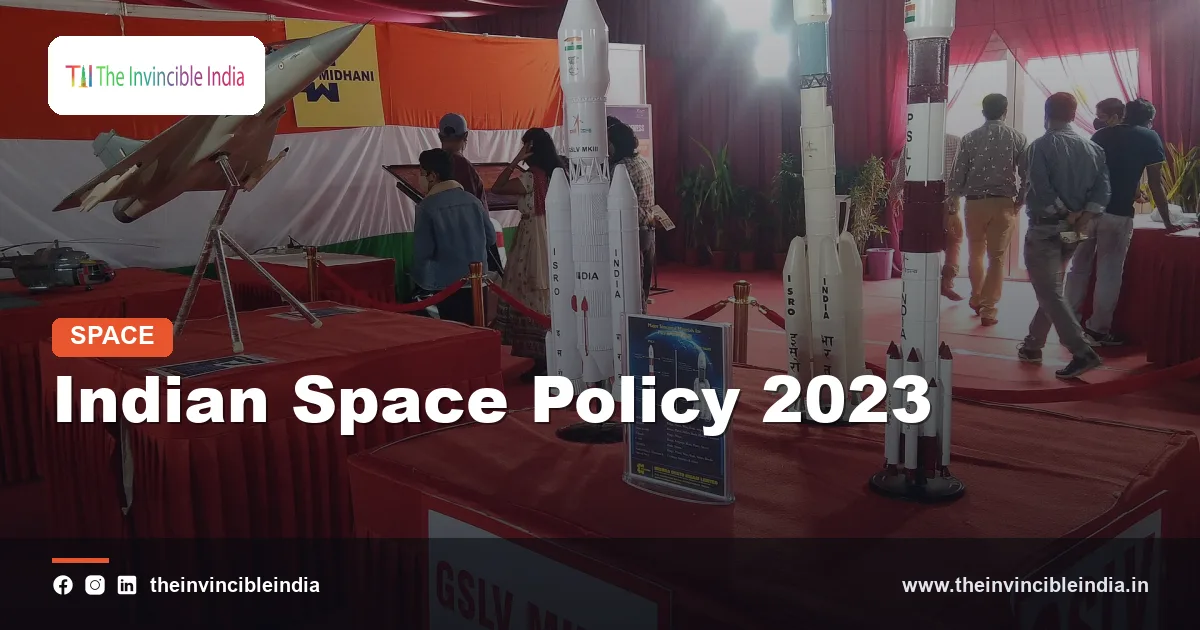
The Indian Space Policy 2023 is the Government of India’s framework, approved in April 2023, that opens the country’s space sector to private companies and sets out the roles of ISRO, IN-SPACe, NSIL and the Department of Space. It aims to let non-government entities carry out end-to-end space activities, from building satellites and launch vehicles to offering space-based services.
Under the policy, the Indian Space Research Organisation (ISRO) concentrates on research and advanced technology, the Indian National Space Promotion and Authorisation Centre (IN-SPACe) promotes and authorises private activity, and NewSpace India Limited (NSIL) handles commercial operations. This explainer covers the policy’s background, objectives, institutional roles and effects on the space economy and startups. It was last reviewed on 15 October 2026.
Quick Facts
| Attribute | Detail |
|---|---|
| Name | Indian Space Policy 2023 |
| Approved | April 2023, by the Union Cabinet |
| Nodal department | Department of Space, Government of India |
| Policy objective | Enable, encourage and regulate private participation across the space sector |
| Role of ISRO | Research and development, advanced technologies and missions; moves routine operations to industry |
| Role of IN-SPACe | Single-window promoter, enabler and authoriser for non-government entities |
| Role of NSIL | Commercial arm of the Department of Space; demand-driven operations and services |
| Predecessor reforms | Space sector reforms announced in 2020; creation of IN-SPACe in 2020 and NSIL in 2019 |
| Policy type | Overarching policy framework, supported by detailed guidelines |
Key Takeaways
- The Indian Space Policy 2023 was approved in April 2023 and lets non-government entities undertake end-to-end space activities in India.
- Under the Indian Space Policy 2023, the Indian Space Research Organisation (ISRO) is to focus on research, advanced technologies and exploration, rather than routine operational services.
- The Indian National Space Promotion and Authorisation Centre (IN-SPACe) is the single-window agency that promotes, authorises and supervises private space activities.
- NewSpace India Limited (NSIL), a public sector company under the Department of Space, is the commercial arm that takes over operational space systems from ISRO.
- The Department of Space, which reports to the Prime Minister, is the nodal department responsible for the overall space policy.
- The policy complements the 2020 space reforms and aims to expand the space economy, attract investment and nurture space startups.
What is the Indian Space Policy 2023?
The Indian Space Policy 2023 is a national policy document that defines how India’s space activities will be organised, who may carry them out, and which agency will do what. It replaces a situation in which most space work was done by ISRO and a small set of public sector firms and suppliers.
The policy states a vision of augmenting space capabilities, enabling a thriving commercial presence in space and using space as a driver of technology development. It also spells out that all space-related activities by non-government entities (NGEs) will need authorisation, so that safety, security and international obligations are protected.
The policy is not a law. It is a framework approved by the Union Cabinet, and its implementation relies on the detailed norms, guidelines and procedures issued by the Department of Space and IN-SPACe, with a proposed space activities law to give it statutory support.
Why did India need a new space policy?
India needed a new space policy because the space economy was growing rapidly, ISRO could not meet all demand alone, and private companies lacked a clear legal route to build and launch their own systems. Earlier policies covered narrow areas such as satellite communications and remote sensing data.
The older framework included the Satellite Communication Policy of 2000 and the Remote Sensing Data Policy, first issued in 2001 and revised later. These documents regulated particular activities, but none gave a full picture of the sector or allowed private firms to run launches and other core activities.
Several forces made change urgent:
- A fast-growing global commercial space industry with falling launch costs and many small satellites.
- Rising domestic demand for communications, earth observation, navigation and data services.
- ISRO’s wish to focus on frontier missions such as human spaceflight and planetary exploration instead of routine production.
- A growing number of Indian space startups seeking access to facilities and clear rules.
What is the background to the 2023 policy?
The background to the 2023 policy is a series of reforms between 2019 and 2022 that restructured the Indian space sector. These reforms prepared the institutional ground, and the policy then consolidated them into one framework.
| Year | Milestone |
|---|---|
| 1969 | Indian Space Research Organisation (ISRO) is formed |
| 1972 | Department of Space and the Space Commission are set up |
| 1992 | Antrix Corporation is established as ISRO’s commercial arm |
| 2019 | NewSpace India Limited (NSIL) is established as a public sector company |
| 2020 | Government announces opening of the space sector to private participation; IN-SPACe is created |
| 2022 | First privately developed Indian rocket, Vikram-S by Skyroot Aerospace, is launched from Sriharikota |
| 2023 | Indian Space Policy 2023 is approved |
The 2020 reforms were announced as part of the broader self-reliance push. They included a plan to allow private players to use ISRO facilities and to take part in missions and services. IN-SPACe was set up as an autonomous body inside the Department of Space to carry out this task.
What are the main objectives of the Indian Space Policy 2023?
The main objectives of the Indian Space Policy 2023 are to enhance India’s space capabilities, enable private participation across the whole value chain, promote space-based applications, and build a strong industrial base. The policy states these goals in broad terms and leaves details to later rules.
- Capability building: Strengthen national capabilities in space technologies, infrastructure and applications.
- Private participation: Allow non-government entities to own space assets, launch satellites and provide services.
- Industry growth: Support a vibrant industry ecosystem and raise India’s share in the global space economy.
- Technology development: Use space activities as a driver of innovation and as a catalyst for other sectors.
- International cooperation: Support collaboration with other countries and compliance with international treaties such as the Outer Space Treaty.
- Safe and sustainable space: Encourage responsible use of orbits and the control of space debris.
What is the role of ISRO under the policy?
The role of ISRO under the Indian Space Policy 2023 is to concentrate on research and development, new technologies, exploration and strategic missions, while gradually moving mature operational activities to industry. ISRO remains India’s national space agency.
The policy says that ISRO will focus on next-generation technologies, space science, planetary exploration and human spaceflight. Systems that have reached operational maturity, such as the Polar Satellite Launch Vehicle (PSLV) and the Small Satellite Launch Vehicle (SSLV), are to be transferred to industry for production and operation, with NSIL playing a coordinating role.
ISRO will also share its technologies, products, processes and best practices with non-government entities, and it will open some of its facilities and data to them on a fee-based or agreed basis. The agency will continue to build and operate missions of national importance.
What does IN-SPACe do?
IN-SPACe, the Indian National Space Promotion and Authorisation Centre, is the single-window agency that promotes, handholds and authorises space activities by non-government entities in India. It is headquartered in Ahmedabad and operates as an autonomous body within the Department of Space.
The policy gives IN-SPACe three broad functions:
- Promotion and handholding: Help private companies, startups and academic institutions access ISRO facilities, expertise and data.
- Authorisation: Issue permissions for launch vehicles, satellites, ground stations and other space activities by non-government entities.
- Regulation and oversight: Monitor compliance with safety, security and international obligations, and set standards for space activities.
IN-SPACe also acts as a bridge between industry and government, collecting demand from users and matching it to capabilities. A technical directorate supports the work of evaluating proposals.
What is the role of NSIL and the Department of Space?
NewSpace India Limited (NSIL) is the commercial arm of the Department of Space that serves as the interface between ISRO’s technologies and the market, while the Department of Space remains the nodal body for policy. NSIL was incorporated in 2019 as a central public sector enterprise based in Bengaluru.
Under the policy, NSIL is to take ownership of operational space assets, offer launch and satellite services on a demand-driven basis, and work with industry to manufacture launch vehicles such as the PSLV and SSLV. NSIL also looks after commercial agreements, including satellite capacity and launch contracts with domestic and foreign customers.
The Department of Space, which reports to the Prime Minister, is the policy authority. It provides strategic direction, sets national priorities and ensures that the space programme aligns with national security and development goals.
| Body | Primary function under the policy |
|---|---|
| Department of Space (DoS) | Overall policy, strategic direction and coordination |
| ISRO | Research, development, advanced technology and missions |
| IN-SPACe | Promotion, authorisation and supervision of non-government entities |
| NSIL | Commercial operations, services and technology transfer to industry |
| Non-government entities (NGEs) | End-to-end activities including satellites, launches and services |
What can private companies now do in India’s space sector?
Private companies can now take part in every stage of space activity in India, including building and launching satellites and rockets, running ground stations, offering communication and data services, and developing their own space infrastructure, subject to authorisation by IN-SPACe. The policy states that non-government entities may undertake end-to-end activities.
The allowed areas include:
- Building and operating satellites for communications, earth observation and navigation.
- Building launch vehicles and launching from Indian territory or abroad.
- Setting up ground stations and data processing infrastructure.
- Offering space-based services such as broadband, imagery and analytics.
- Seeking to commercialise space-based data and carrying out experiments in orbit.
Private firms can also use ISRO’s testing and launch facilities at agreed charges, and they can bring in investment, including foreign investment under the rules that the government specifies for each activity.
How does the policy affect the space economy and startups?
The Indian Space Policy 2023 affects the space economy and startups by providing regulatory clarity, easier access to government facilities and a framework for investment, which together encourage new companies to enter the sector. India’s space startups have grown from a handful to a significantly larger community since the 2020 reforms.
Startups working on small launch vehicles, satellite constellations, earth observation analytics, propulsion systems and ground infrastructure have drawn interest from investors. Skyroot Aerospace’s Vikram-S launch in 2022 and the tests of Agnikul Cosmos’s launch systems were early milestones of this new ecosystem.
The policy has several likely economic effects:
- A larger domestic supply chain for components, materials and electronics.
- Greater export potential for satellites, launch services and space data.
- More skilled jobs in engineering, software and data science.
- New uses of space data in agriculture, urban planning, disaster management and logistics.
The government has also supported the sector through reforms in foreign investment rules and by proposing dedicated funding for space ventures. Because such measures are updated frequently, readers should check current notices for the latest details.
What are the challenges in implementing the policy?
The main challenges in implementing the Indian Space Policy 2023 are the absence of a comprehensive space law, the need for clear liability and insurance rules, access to long-term capital and the task of building enough trained manpower. The policy sets direction, but execution depends on detailed procedures.
- Legal framework: A dedicated space activities law is still needed to give statutory force to authorisation, liability and dispute resolution.
- Capital: Space ventures need patient capital with long development cycles and uncertain returns.
- Infrastructure: Launch sites, test facilities and range capacity must grow to serve many new users.
- Coordination: Clear boundaries between ISRO, NSIL and IN-SPACe are needed to avoid duplication.
- Security and sustainability: The policy must balance openness with national security and responsible orbital use, including debris management.
Bottom Line
The Indian Space Policy 2023 redraws the roles of India’s space institutions so that ISRO can pursue frontier science while private companies, supported by IN-SPACe and NSIL, build and run commercial space services. Its success will depend on stable regulation, a supportive legal framework and a steady flow of investment and talent.
Frequently Asked Questions
What is the Indian Space Policy 2023?
The Indian Space Policy 2023 is a Government of India framework, approved in April 2023, that opens the space sector to private companies. It defines the roles of ISRO, IN-SPACe, NSIL and the Department of Space. Its goal is to build a stronger space economy with wide private participation.
What is the role of IN-SPACe in the Indian space sector?
IN-SPACe is the single-window agency that promotes, authorises and supervises space activities by non-government entities. It also helps private firms access ISRO facilities and expertise. It is headquartered in Ahmedabad and works as an autonomous body within the Department of Space.
What will ISRO do under the new space policy?
ISRO will concentrate on research, advanced technologies, space science, exploration and human spaceflight. It will transfer mature operational systems, such as the PSLV and SSLV, to industry through NSIL. ISRO will also share technologies and facilities with private companies.
What is NSIL and how does it differ from IN-SPACe?
NewSpace India Limited (NSIL) is the commercial arm of the Department of Space that provides operational space services and technology transfer, while IN-SPACe is the authorising and promoting agency for private players. NSIL deals with business and contracts, whereas IN-SPACe handles permissions and oversight. Both work under the Department of Space.
Can private companies launch rockets and satellites in India now?
Private companies can build and launch satellites and rockets in India with authorisation from IN-SPACe. The policy permits non-government entities to take part in end-to-end space activities. Companies such as Skyroot Aerospace and Agnikul Cosmos have already carried out launch tests.
Is the Indian Space Policy 2023 a law?
The Indian Space Policy 2023 is a policy framework approved by the Union Cabinet and is not an Act of Parliament. It is implemented through detailed guidelines issued by the Department of Space and IN-SPACe. A separate space activities law has been proposed to provide statutory backing.
{“@context”:”https://schema.org”,”@graph”:[{“@type”:”FAQPage”,”mainEntity”:[{“@type”:”Question”,”name”:”What is the Indian Space Policy 2023?”,”acceptedAnswer”:{“@type”:”Answer”,”text”:”The Indian Space Policy 2023 is a Government of India framework, approved in April 2023, that opens the space sector to private companies. It defines the roles of ISRO, IN-SPACe, NSIL and the Department of Space. Its goal is to build a stronger space economy with wide private participation.”}},{“@type”:”Question”,”name”:”What is the role of IN-SPACe in the Indian space sector?”,”acceptedAnswer”:{“@type”:”Answer”,”text”:”IN-SPACe is the single-window agency that promotes, authorises and supervises space activities by non-government entities. It also helps private firms access ISRO facilities and expertise. It is headquartered in Ahmedabad and works as an autonomous body within the Department of Space.”}},{“@type”:”Question”,”name”:”What will ISRO do under the new space policy?”,”acceptedAnswer”:{“@type”:”Answer”,”text”:”ISRO will concentrate on research, advanced technologies, space science, exploration and human spaceflight. It will transfer mature operational systems, such as the PSLV and SSLV, to industry through NSIL. ISRO will also share technologies and facilities with private companies.”}},{“@type”:”Question”,”name”:”What is NSIL and how does it differ from IN-SPACe?”,”acceptedAnswer”:{“@type”:”Answer”,”text”:”NewSpace India Limited (NSIL) is the commercial arm of the Department of Space that provides operational space services and technology transfer, while IN-SPACe is the authorising and promoting agency for private players. NSIL deals with business and contracts, whereas IN-SPACe handles permissions and oversight. Both work under the Department of Space.”}},{“@type”:”Question”,”name”:”Can private companies launch rockets and satellites in India now?”,”acceptedAnswer”:{“@type”:”Answer”,”text”:”Private companies can build and launch satellites and rockets in India with authorisation from IN-SPACe. The policy permits non-government entities to take part in end-to-end space activities. Companies such as Skyroot Aerospace and Agnikul Cosmos have already carried out launch tests.”}},{“@type”:”Question”,”name”:”Is the Indian Space Policy 2023 a law?”,”acceptedAnswer”:{“@type”:”Answer”,”text”:”The Indian Space Policy 2023 is a policy framework approved by the Union Cabinet and is not an Act of Parliament. It is implemented through detailed guidelines issued by the Department of Space and IN-SPACe. A separate space activities law has been proposed to provide statutory backing.”}}]}]}


