

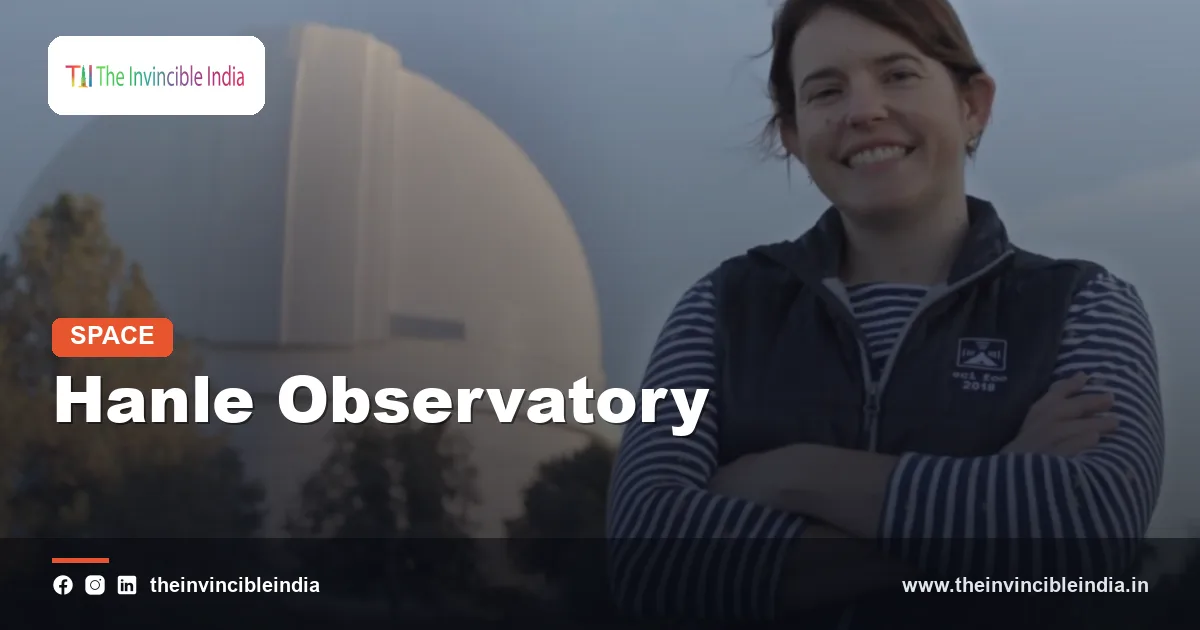
The Hanle Observatory, formally the Indian Astronomical Observatory (IAO), is a high-altitude astronomical facility at Hanle in Ladakh, run by the Indian Institute of Astrophysics (IIA), and it is among the highest optical observatories in the world. Its cold, dry, cloud-free skies at about 4,500 metres above sea level make it one of the best sites for astronomy in Asia.
The area around the observatory has also been declared India’s first Dark Sky Reserve, a protected zone that limits artificial light and promotes astro-tourism. This explainer covers where Hanle is, why the site is special, which telescopes operate there, what the Dark Sky Reserve means and what visitors should know. It was last reviewed on 15 October 2026.
Quick Facts
| Attribute | Detail |
|---|---|
| Official name | Indian Astronomical Observatory (IAO), Hanle |
| Location | Hanle, Changthang region, Leh district, Ladakh |
| Altitude | About 4,500 metres above sea level |
| Operated by | Indian Institute of Astrophysics (IIA), Bengaluru |
| Funding department | Department of Science and Technology, Government of India |
| Main optical telescope | 2-metre Himalayan Chandra Telescope (HCT) |
| Other instruments | HAGAR and MACE gamma-ray telescopes, GROWTH-India telescope |
| Remote control | Operated through a satellite link from the Centre for Research and Education in Science and Technology (CREST), Hosakote, near Bengaluru |
| Dark Sky Reserve | India’s first, centred on the Hanle region in Changthang |
Key Takeaways
- The Hanle Observatory, also called the Indian Astronomical Observatory, is located at about 4,500 metres in the Changthang cold desert of Ladakh.
- The Indian Institute of Astrophysics (IIA), Bengaluru, operates the Hanle Observatory under the Department of Science and Technology.
- The Himalayan Chandra Telescope (HCT) at Hanle is a 2-metre optical and infrared telescope named after the astrophysicist Subrahmanyan Chandrasekhar.
- Telescopes at Hanle are operated remotely from Hosakote in Karnataka through a satellite link because of the harsh conditions at the site.
- Hanle hosts gamma-ray telescopes, including the HAGAR array and the Major Atmospheric Cherenkov Experiment (MACE), in addition to optical instruments.
- The area around the observatory forms India’s first Dark Sky Reserve, created to protect the night sky and promote astro-tourism.
Where is the Hanle Observatory located?
The Hanle Observatory is located near the village of Hanle in the Changthang region of eastern Ladakh, within the Leh district, at an altitude of about 4,500 metres. The telescopes sit on a mountain peak known locally as Mount Saraswati, overlooking the Hanle valley.
The region lies in a high-altitude cold desert on the Tibetan plateau’s western fringe. Hanle is a remote settlement, many hours by road from Leh, and the nearby landscape includes grasslands, lakes and the historic Hanle Monastery, a Buddhist monastery of the Drukpa lineage. Winter temperatures drop far below freezing, and the air is thin.
The village has a very small population, and the sparse settlement is a key reason why the night skies are so dark. There are few towns, factories or roads nearby to cause light pollution.
Why was Hanle chosen for an astronomical observatory?
Hanle was chosen because site surveys showed that it has an unusually large number of clear nights, very low atmospheric water vapour, high altitude and minimal light pollution. These factors are the main ingredients of a good observatory site.
In the 1990s, the Indian Institute of Astrophysics carried out a long search for a better site than its existing observatories in the plains and lower hills. Satellite data, weather records and on-site measurements pointed to the Hanle area as outstanding. The site offered the following advantages:
- Clear skies: Hanle lies in the rain shadow of the Himalayas, so the monsoon barely reaches it. Cloud-free nights are plentiful through much of the year.
- Dry air: Low humidity and low water vapour improve observations in the infrared and sub-millimetre bands.
- Altitude: At about 4,500 metres, the telescopes sit above a large fraction of the atmosphere, reducing atmospheric distortion and absorption.
- Dark surroundings: The nearest large towns are far away, so artificial light is minimal.
- Longitude: India’s position fills a gap in the global network of observatories between Europe and East Asia, so Hanle can cover objects when other major sites are in daylight.
The observatory was established at the start of the 2000s, and the first major telescope began operations in 2000-2001.
Who runs the Hanle Observatory?
The Indian Institute of Astrophysics (IIA) runs the Hanle Observatory. The IIA is an autonomous research institute headquartered in Bengaluru and is funded by the Department of Science and Technology of the Government of India.
The IIA traces its roots to the Madras Observatory, founded in the eighteenth century, and has a long history of solar and stellar research. Besides Hanle, it operates observatories at Kodaikanal in Tamil Nadu, Kavalur in Tamil Nadu and Gauribidanur in Karnataka, and it uses a large site at Devasthal in Uttarakhand through a partner institution. The IIA also runs the Centre for Research and Education in Science and Technology (CREST) at Hosakote, which serves as the remote control centre for Hanle.
Researchers from universities across India can propose observations at Hanle, and a telescope time allocation committee reviews proposals. Observations are also made available to international collaborators in some projects.
What is the Himalayan Chandra Telescope?
The Himalayan Chandra Telescope (HCT) is a 2-metre-class optical and infrared telescope at the Hanle Observatory, named in honour of the Nobel Prize-winning astrophysicist Subrahmanyan Chandrasekhar. It is the principal instrument at the site and was commissioned around the year 2000.
The HCT is a Ritchey-Chretien reflector. Its main mirror has a diameter of about two metres and is controlled by an active support system that keeps the mirror’s shape accurate as the telescope moves. Instruments attached to the telescope allow imaging and spectroscopy in optical and near-infrared wavelengths.
Because Hanle is so remote, the HCT is controlled over a satellite communications link from CREST at Hosakote, near Bengaluru. Astronomers can therefore observe from the plains without travelling to Ladakh. This remote operation was a pioneering effort in India and was developed with the help of the Indian Space Research Organisation’s satellite facilities.
Which other telescopes operate at Hanle?
Besides the Himalayan Chandra Telescope, Hanle hosts gamma-ray telescopes, a robotic telescope for transient events and other instruments. Together they make the site a multi-purpose observatory.
| Instrument | Type | What it studies |
|---|---|---|
| Himalayan Chandra Telescope (HCT) | 2-metre optical and infrared telescope | Stars, galaxies, supernovae, exoplanet hosts and transient objects |
| HAGAR (High Altitude Gamma Ray) array | Atmospheric Cherenkov telescope array | Very high-energy gamma rays from cosmic sources |
| MACE (Major Atmospheric Cherenkov Experiment) | Large Cherenkov telescope, about 21 metres across | Very high-energy gamma rays; among the highest such telescopes in the world |
| GROWTH-India Telescope | Robotic optical telescope, about 0.7 metre | Rapid follow-up of transient events such as supernovae and gravitational wave counterparts |
| Other small and site-testing instruments | Photometers, weather and sky-quality monitors | Atmospheric conditions and night-sky brightness |
The Cherenkov telescopes detect the faint flashes of blue light produced when high-energy gamma rays strike the atmosphere. The height of the site improves sensitivity, as there is less air above the detector to absorb the light.
What is the Hanle Dark Sky Reserve?
The Hanle Dark Sky Reserve is India’s first Dark Sky Reserve, a protected area around the Hanle Observatory where artificial lighting is regulated to preserve the natural night sky. It was established by the Union Territory administration of Ladakh with scientific support from the Indian Institute of Astrophysics.
A dark sky reserve is a conservation area with an exceptional starry night and a management plan that limits light pollution. The idea comes from the international dark-sky movement, which treats the night sky as a natural and cultural resource. The Hanle reserve lies within the Changthang Cold Desert Wildlife Sanctuary area, which covers a large part of the surrounding region.
The key measures typically include:
- Rules on outdoor lighting, such as shielded fixtures, warm-coloured bulbs and curfews on bright lights.
- Training and guidelines for homestays and tourism operators.
- Public awareness about the value of dark skies for science, wildlife and local culture.
- Cooperation between the Ladakh administration, the Ladakh Autonomous Hill Development Council and the IIA.
The reserve was announced in the early 2020s. Hanle was an obvious choice because it already hosted a scientific observatory and had some of the darkest skies in the country.
How does the Dark Sky Reserve promote astro-tourism?
The Dark Sky Reserve promotes astro-tourism by attracting visitors who want to see the Milky Way, planets and star clusters in an unspoiled sky and by creating local jobs in homestays, guiding and equipment services. The aim is to turn the dark sky into a sustainable livelihood for residents of Changthang.
Astro-tourism activities include stargazing sessions with small telescopes, night-sky photography, guided talks by astronomers and visits to the observatory when permitted. Several homestays in and around Hanle have been trained for visitors, and some local residents have received training in basic astronomy to act as guides.
Visitors should plan carefully, because Hanle is remote and the climate is harsh. Altitude sickness is a genuine risk, nights are extremely cold even in summer, and facilities are limited. Travel to some border-adjacent areas of Ladakh requires permits, so visitors should check the current rules with the Ladakh authorities before travelling. The best period for stargazing is generally the clear, dry months, and the new-moon nights give the darkest skies.
Why does the Hanle Observatory matter for Indian science?
The Hanle Observatory matters because it gives Indian astronomers a world-class, high-altitude site within the country, so they can study the universe in optical, infrared and gamma-ray wavelengths without depending only on foreign facilities. Its location also fills a geographic gap in the global network of telescopes.
The observatory contributes to research on supernovae, active galactic nuclei, star formation, exoplanets and high-energy sources such as blazars and pulsars. It also has a role in time-domain astronomy, in which telescopes quickly observe sudden events such as gamma-ray bursts or the optical counterparts of gravitational wave signals.
The site has supported training for generations of students and researchers, and it has strengthened India’s engineering skills in building and operating instruments at extreme altitude and in remote conditions.
What are the challenges of running an observatory at Hanle?
The main challenges of running an observatory at Hanle are the extreme cold, thin air, remote location, limited power and communication, and the need to balance science with the needs of local communities and the environment. These factors raise costs and complicate maintenance.
- Cold and wind: Winter temperatures fall far below freezing, so equipment must be designed to work reliably in extreme cold.
- Thin air: Oxygen is scarce at 4,500 metres, which limits how long staff can work at the site and requires acclimatisation.
- Power and connectivity: Electricity relies heavily on solar and backup generation, and data links depend on satellite communication.
- Access: Roads can be closed by snow, and supplies must travel long distances.
- Light pollution risk: Increased tourism and local development could brighten the sky unless lighting is managed through the Dark Sky Reserve rules.
Remote operation of the telescopes reduces the need for observers to stay at the site, which helps with many of these issues.
Bottom Line
The Hanle Observatory combines one of the world’s highest optical observatories with India’s first Dark Sky Reserve, linking serious science to sustainable tourism. Its protection will depend on keeping the sky dark while allowing the local community to benefit from the attention the site receives.
Frequently Asked Questions
Where is the Hanle Observatory?
The Hanle Observatory is in the village of Hanle in the Changthang region of Ladakh, in the Leh district. It stands at about 4,500 metres above sea level. It is formally called the Indian Astronomical Observatory and is run by the Indian Institute of Astrophysics.
What is the Himalayan Chandra Telescope?
The Himalayan Chandra Telescope (HCT) is a 2-metre optical and infrared telescope at Hanle, named after Subrahmanyan Chandrasekhar. It is the main instrument at the Indian Astronomical Observatory. Astronomers operate it remotely from Hosakote near Bengaluru through a satellite link.
Who operates the Indian Astronomical Observatory at Hanle?
The Indian Institute of Astrophysics (IIA), an autonomous institute in Bengaluru, operates the Indian Astronomical Observatory at Hanle. The IIA is funded by the Department of Science and Technology. It uses a remote control centre at Hosakote to run the telescopes.
What is India’s first Dark Sky Reserve?
India’s first Dark Sky Reserve is the Hanle Dark Sky Reserve in Ladakh, created around the Hanle Observatory. It limits artificial light to protect the natural night sky. It was set up by the Ladakh administration with scientific support from the Indian Institute of Astrophysics, and it also promotes astro-tourism.
Why is Hanle good for astronomy?
Hanle is good for astronomy because it has high altitude, dry air, many clear nights and very little light pollution. It lies in the rain shadow of the Himalayas, so cloud cover is low. These conditions improve both optical and infrared observations.
Can tourists visit the Hanle Observatory and stargaze there?
Tourists can visit Hanle and enjoy stargazing in the Dark Sky Reserve, but access to the observatory facilities is controlled and may require permission. Visitors should check permit rules, acclimatise to the altitude and plan for very cold nights. Homestays and local guides help organise stargazing sessions.
{“@context”:”https://schema.org”,”@graph”:[{“@type”:”FAQPage”,”mainEntity”:[{“@type”:”Question”,”name”:”Where is the Hanle Observatory?”,”acceptedAnswer”:{“@type”:”Answer”,”text”:”The Hanle Observatory is in the village of Hanle in the Changthang region of Ladakh, in the Leh district. It stands at about 4,500 metres above sea level. It is formally called the Indian Astronomical Observatory and is run by the Indian Institute of Astrophysics.”}},{“@type”:”Question”,”name”:”What is the Himalayan Chandra Telescope?”,”acceptedAnswer”:{“@type”:”Answer”,”text”:”The Himalayan Chandra Telescope (HCT) is a 2-metre optical and infrared telescope at Hanle, named after Subrahmanyan Chandrasekhar. It is the main instrument at the Indian Astronomical Observatory. Astronomers operate it remotely from Hosakote near Bengaluru through a satellite link.”}},{“@type”:”Question”,”name”:”Who operates the Indian Astronomical Observatory at Hanle?”,”acceptedAnswer”:{“@type”:”Answer”,”text”:”The Indian Institute of Astrophysics (IIA), an autonomous institute in Bengaluru, operates the Indian Astronomical Observatory at Hanle. The IIA is funded by the Department of Science and Technology. It uses a remote control centre at Hosakote to run the telescopes.”}},{“@type”:”Question”,”name”:”What is India’s first Dark Sky Reserve?”,”acceptedAnswer”:{“@type”:”Answer”,”text”:”India’s first Dark Sky Reserve is the Hanle Dark Sky Reserve in Ladakh, created around the Hanle Observatory. It limits artificial light to protect the natural night sky. It was set up by the Ladakh administration with scientific support from the Indian Institute of Astrophysics, and it also promotes astro-tourism.”}},{“@type”:”Question”,”name”:”Why is Hanle good for astronomy?”,”acceptedAnswer”:{“@type”:”Answer”,”text”:”Hanle is good for astronomy because it has high altitude, dry air, many clear nights and very little light pollution. It lies in the rain shadow of the Himalayas, so cloud cover is low. These conditions improve both optical and infrared observations.”}},{“@type”:”Question”,”name”:”Can tourists visit the Hanle Observatory and stargaze there?”,”acceptedAnswer”:{“@type”:”Answer”,”text”:”Tourists can visit Hanle and enjoy stargazing in the Dark Sky Reserve, but access to the observatory facilities is controlled and may require permission. Visitors should check permit rules, acclimatise to the altitude and plan for very cold nights. Homestays and local guides help organise stargazing sessions.”}}]}]}


