

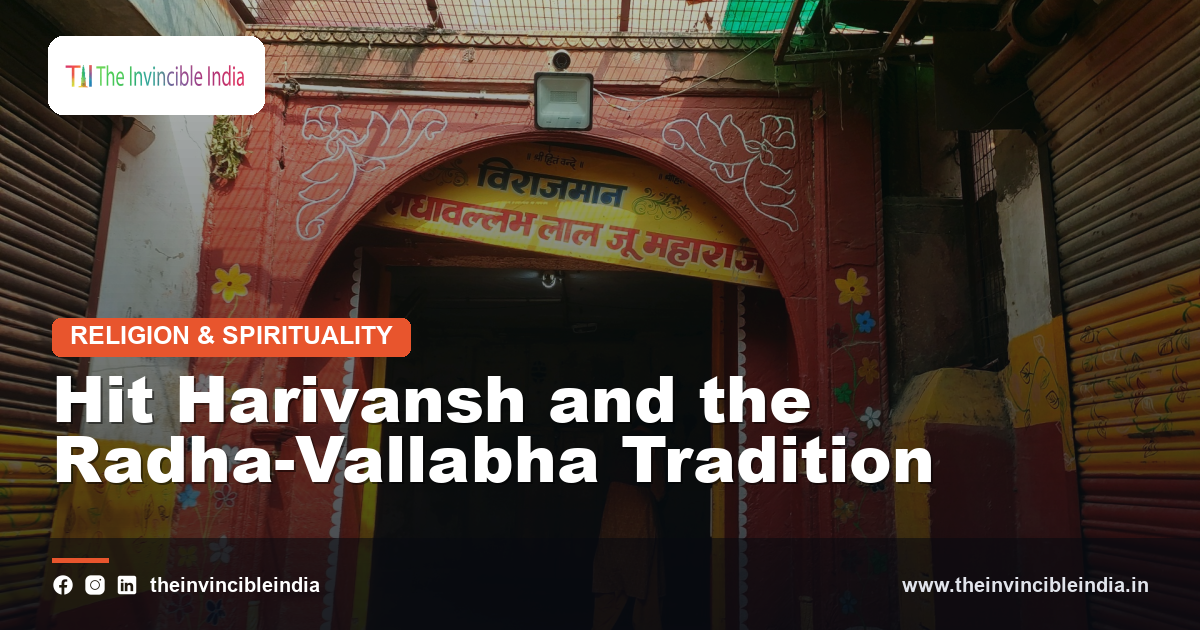
Hit Harivansh, also called Hit Harivansh Mahaprabhu, Sri Hita Harivamsa or Hith Harivansh, is the saint remembered as the founder of the Radha-Vallabha tradition, also known as the Radha Vallabh Sampradaya, centred in Vrindavan in the Braj region of Uttar Pradesh. His devotion places Radha at the heart of worship, and his Braj Bhasha poem Hit Chaurasi is the best-known text of the community. He is placed in the sixteenth century, and many details of his life come from tradition. His path belongs to the wider stream of love-centred worship described in the guide to Vaishnavism.
Quick answer: Hit Harivansh is a sixteenth-century devotional saint of Vrindavan who is regarded as the founder of the Radha-Vallabha tradition, a Vaishnava community that places Radha at the centre of devotion to Krishna. His best-known work is Hit Chaurasi, a collection of eighty-four devotional verses in Braj Bhasha. The tradition is still active today around the Radha Vallabh temple and the Vrindavan Dham.
Key Takeaways
- Hit Harivansh is the saint traditionally regarded as the founder of the Radha-Vallabha Sampradaya of Vrindavan.
- His best-known work is Hit Chaurasi, a collection of eighty-four verses in Braj Bhasha that praise Radha and Krishna.
- The word Vallabha means beloved, and the tradition honours Krishna as the beloved of Radha, with Radha placed first in worship.
- Worship in the community is built on loving service, song, the divine pastimes of Radha and Krishna and the sacred land of Vrindavan.
- The Radha Vallabh temple in Vrindavan is the main centre of the tradition and is known for its distinctive way of worship.
- Details of his birth, family and miracles come largely from tradition, and respectful writers mark them as tradition, not documented history.
The sections below explain the life, works, teachings and continuing legacy in more detail.
Quick Facts
| Detail | Information |
|---|---|
| Also known as | Hit Harivansh Mahaprabhu, Sri Hita Harivamsa |
| Tradition | Radha Vallabh Sampradaya (Vaishnava) |
| Main centre | Vrindavan, Braj region, Uttar Pradesh |
| Era | Sixteenth century, by tradition |
| Best-known text | Hit Chaurasi, eighty-four verses in Braj Bhasha |
| Language | Braj Bhasha, with some Sanskrit works attributed |
| Central idea | Radha as the supreme beloved and centre of devotion |
| Key temple | Radha Vallabh temple, Vrindavan |
Who Was Hit Harivansh?
Hit Harivansh was a devotional saint and poet who is regarded as the founder of the Radha-Vallabha tradition in Vrindavan. He is remembered as a teacher who placed the love of Radha and Krishna above all other paths and who settled in the sacred land of Braj to live a life of song and worship. His followers honour him with the title Mahaprabhu.
Most of what is told about his life comes from the community’s own tradition, which preserves stories of his childhood, his devotion and his arrival in Vrindavan. Careful writers therefore describe him as a saint of tradition and speak about his importance in general terms. His real and lasting presence lies in the verses and the living worship that bear his name.
What Do His Names and Titles Mean?
The name Hit Harivansh combines Hit, meaning love, welfare or kindly affection, with Harivansh, a name connected with Hari, a title of Vishnu and Krishna. In writing it also appears as Hita Harivamsa, Hith Harivansh or Hit Harivans, depending on the transliteration. The title Mahaprabhu means great master and is used by devotees as a mark of respect.
Followers also address him with the affectionate forms used in Braj, where saints are often called by tender names. The word Hit is important because it names the central quality of the path, a selfless love that wishes only the happiness of the beloved. In this way the name itself holds a short statement of the teaching.
When and Where Did He Live?
Hit Harivansh is placed by tradition in the sixteenth century, and his life is linked with the Braj region around Mathura and Vrindavan in Uttar Pradesh. The community teaches that he was born near Mathura and later made his home in Vrindavan, which became the heart of the tradition he founded. These statements rest on the community’s own accounts.
Braj was already a centre of Krishna devotion in his time, and several other saints and traditions flourished in the same land. Exact dates for individual events are not firmly fixed in documents, so general language is best. What is certain is that the tradition he inspired has been alive in Vrindavan for centuries and continues to gather devotees today.
What Does Tradition Say About His Early Life?
Tradition describes Hit Harivansh as a child of a devout family who showed early signs of deep devotion and a gift for song and verse. Accounts say that he was drawn from youth to the stories of Radha and Krishna, and that he grew into a learned and gentle householder before turning fully to the life of devotion in Vrindavan.
These accounts are part of sacred biography, and they differ in detail between texts and tellings. They should be read as tradition, not as proven history. Their purpose is to show that the path of love is natural to a pure heart and that the founder lived by the ideals he later taught. The stories give the community a warm picture of its first teacher.
Why Did He Settle in Vrindavan?
Hit Harivansh settled in Vrindavan because the community regards it as the eternal playground of Radha and Krishna, the place where divine love is most fully present. By tradition, he journeyed to the sacred forest and made it his home, and his devotion was shaped by the groves, the river and the seasonal rhythms of the land.
Vrindavan is more than a place of pilgrimage for the tradition. It is understood as a living realm in which every tree and bird takes part in the divine pastimes. Settling there meant entering that world as a servant and singer. The choice of Vrindavan still defines the identity of the community, whose temples and gatherings remain rooted in the town.
What Is the Radha-Vallabha Tradition?
The Radha-Vallabha tradition is a Vaishnava devotional community that honours Radha as the supreme beloved and Krishna as her Vallabha, her beloved. Its teaching makes Radha the centre of worship, and Krishna is loved in the form that delights her. The community is also called the Radha Vallabh Sampradaya or the Hit Sampradaya after its founder.
The path is a form of bhakti, the devotion described in the Bhakti movement across India, but it has a distinct emphasis. Instead of seeking liberation or power, the devotee aims to share in the joy of the divine couple. This focus on pure love, offered without demand, gives the tradition its quiet and tender character.
What Is Hit Chaurasi?
Hit Chaurasi is a collection of eighty-four devotional verses in Braj Bhasha, attributed to Hit Harivansh, and it is the most important text of the Radha-Vallabha tradition. The word chaurasi means eighty-four in Hindi, and the verses are often called pads, short lyrical songs that are meant to be sung. They describe Radha and Krishna in their bowers and groves.
The poems are filled with delicate images of love, nature and music. They are not argument or doctrine in a formal sense but song offered to the divine couple. Devotees sing them in temple worship and in gatherings, treating the act of singing as a form of service. The text holds the heart of the community’s spiritual outlook in poetic form.
Why Is Radha Placed First in This Tradition?
Radha is placed first in the tradition because she is regarded as the highest embodiment of devotion and the source of delight for Krishna. In worship the devotee does not approach Krishna alone but through Radha, whose love is the model of perfect surrender. This is why the community greets one another with her name.
The idea does not lower Krishna but raises love itself to the highest place. By honouring Radha first, the tradition teaches that the divine is best known through the heart. The point is a matter of devotional emphasis within Vaishnava thought and is held with deep reverence by the followers. It gives their worship a distinct tone of gentleness and joy.
What Are the Main Teachings of the Path?
The main teaching of the path is that pure, selfless love for Radha and Krishna is the highest goal of life, and that this love is best cultivated through song, remembrance and loving service. The devotee is encouraged to live humbly, to avoid conflict and to see the divine couple in the beauty of Vrindavan.
The tradition values a gentle and inclusive spirit. It gives little weight to rivalry or display and prefers quiet devotion. Daily life is meant to be shaped by this love, so that work, speech and thought are turned toward service. The teaching is simple in form and deep in meaning, which has helped it endure through changing times.
How Is Worship Conducted in the Tradition?
Worship in the tradition is centred on seva, loving service to the deity, offered through music, offerings, decoration and daily ritual in the temple. The day is divided into periods of worship in which the deity is awakened, adorned, offered food, entertained with song and finally put to rest, much like the care given to a beloved guest.
Singing has a special place. Group singing of devotional verses, often called samaj gayan, is a hallmark of the community and is performed with great feeling. The worship does not stress elaborate philosophy but the tender relationship between devotee and deity. Through this daily service the followers keep the founder’s vision alive in an unbroken practice.
What Is the Radha Vallabh Temple in Vrindavan?
The Radha Vallabh temple in Vrindavan is the principal temple of the tradition and is known for a distinctive form of worship in which the presence of Radha is honoured in a special way beside Krishna. It is a place of daily song and ritual and a centre for followers who gather from many parts of India.
By tradition the deity worshipped there was given to the founder and has been served by generations of devotees. The present building belongs to a later period than the founder, and the history of the temple includes times of change. For visitors, it offers a quiet example of the intimate and musical devotion that defines the Radha-Vallabha path.
Who Are the Sevaits and Goswamis?
The sevaits are the families and servants who perform the daily service of the deity, and the Goswamis are the hereditary teachers connected with the tradition. They carry the responsibility of worship, teaching and care of the temple, handing down their duties through the generations by long-standing custom.
The community also reveres early followers and poets who spread the founder’s teaching in Braj Bhasha verse. Their songs and commentaries helped the tradition take root and grow. The structure of service and teaching shows how a devotional path can be held by families and disciples together, keeping both ritual and poetry alive within the same sacred setting.
How Does the Tradition Relate to Other Vaishnava Paths?
The Radha-Vallabha tradition is one of several Vaishnava paths that flourished in Braj and across India, and it shares with them the love of Krishna, the use of regional language and the importance of song. At the same time it keeps its own character through the strong centrality of Radha.
Other communities, such as those following Chaitanya or Vallabhacharya, also worship Radha and Krishna in Braj, each with its own emphasis and lineage. The wider background of Vishnu worship is described in the wider Vaishnava tradition. Respectful writers avoid ranking these paths, since each offers its own approach to the same shared love of the divine.
How Does Vrindavan Shape the Tradition?
Vrindavan shapes the tradition by giving it a setting, a calendar and an imagination. The groves, riverbank and lanes of the town are seen as the stage of the divine pastimes, and the community’s festivals follow the seasons that appear in its verses, such as spring, the monsoon and autumn nights.
The land of Braj is also honoured through pilgrimage routes and shared memory. Many followers live in or near the town and spend their days in temple service and song. The bond between the saint, the verse and the place is so close that it is hard to imagine the tradition anywhere else. Place and devotion are woven into a single whole.
What Festivals Are Observed?
The tradition observes the major festivals of Radha and Krishna, including Janmashtami, Radhashtami and Holi, with songs, decoration and special offerings in the temple. These days draw large crowds and are marked by music that expresses the joy of the divine couple and the closeness of the devotee to them.
The anniversary of the founder is also honoured by the community with gatherings and the singing of his verses. Festival worship follows long-standing local custom, and the details vary by temple and household. What stays constant is the spirit of celebration through song, which turns each festival into an act of shared devotion and remembrance.
Why Does Hit Harivansh Matter in Indian Culture?
Hit Harivansh matters because he gave India a tradition in which love, music and poetry are the road to the divine, and because his verses enriched Braj Bhasha literature. The tradition adds to the cultural life of Vrindavan and to the wider story of devotion in North India.
His influence is felt in temple music, in the poetic tradition of Braj and in the sense that sacred places can be experienced through song. Scholars of religion and literature study the community as an example of how regional devotion shaped language and art. The tradition therefore belongs not only to its followers but to the shared heritage of Indian spiritual culture.
Hit Harivansh Today
Hit Harivansh today is remembered through a living community that continues the worship, singing and teaching of the Radha-Vallabha tradition in Vrindavan and in other parts of India. The Radha Vallabh temple remains the main centre, and Hit Chaurasi is still sung by devotees with the same devotion that shaped it.
For visitors and readers, the tradition offers a quiet and musical view of Indian spirituality, built on the idea that love is the highest path. The details of the founder’s life are best honoured as tradition, while his verses and the worship they inspire stand as clear and lasting evidence of his gift to the culture of Braj.
Sources & Further Reading
- Ministry of Culture, Government of India (indiaculture.gov.in).
- Uttar Pradesh Tourism, Government of Uttar Pradesh (uptourism.gov.in).
Frequently Asked Questions
Who was Hit Harivansh?
Hit Harivansh was a sixteenth-century devotional saint of Vrindavan who is regarded as the founder of the Radha-Vallabha tradition. Details of his life come largely from the community’s own tradition.
What is the Radha-Vallabha tradition?
The Radha-Vallabha tradition is a Vaishnava devotional community that places Radha at the centre of worship and honours Krishna as her beloved. It is based in Vrindavan and is also called the Radha Vallabh Sampradaya.
What is Hit Chaurasi?
Hit Chaurasi is a collection of eighty-four devotional verses in Braj Bhasha attributed to Hit Harivansh. It is the central text of the tradition and is sung in worship.
What does the word Vallabha mean in Radha Vallabh?
Vallabha means beloved or dear one. In the name Radha Vallabh it refers to Krishna as the beloved of Radha.
Where is the Radha Vallabh temple?
The Radha Vallabh temple is in Vrindavan in the Braj region of Uttar Pradesh. It is the main centre of the tradition and is known for its devotional music.
Is the life story of Hit Harivansh historical fact?
Much of it is tradition and sacred biography, and exact dates and events are not firmly documented. Respectful readers value the verses and living worship and treat the stories as tradition.


