

The Faruqi dynasty, also called the Faruqis of Khandesh or the Sultanate of Khandesh, was a Muslim ruling house that governed the Tapti valley between Malwa and the Deccan from the late fourteenth century until the Mughal conquest at the turn of the seventeenth. Its founder, Malik Raja Faruqi, began as a noble of the Delhi Sultanate and ended as an independent ruler. The kingdom was small compared with its neighbours, yet it held a vital gateway between north and south India, with the hill fort of Asirgarh and the city of Burhanpur as its great landmarks. Its story intersects with the Mughal Empire, which finally absorbed it. This guide offers a general account and flags debated points.
Quick answer: The Faruqi dynasty was a Muslim ruling house that governed the Sultanate of Khandesh, a region of the Tapti valley between Malwa and the Deccan, from the late fourteenth century until the Mughals annexed it around the turn of the seventeenth century. Founded by Malik Raja Faruqi, a former noble of the Delhi Sultanate, the dynasty held the hill fort of Asirgarh and the city of Burhanpur.
Key Takeaways
- The Faruqi dynasty, also called the Sultanate of Khandesh, ruled the Tapti valley from the late fourteenth century.
- Malik Raja Faruqi, a noble under Firuz Shah Tughlaq, founded the dynasty and rose to independent rule as Delhi weakened.
- Burhanpur, named after the Sufi saint Burhanuddin, grew into the main city of Khandesh.
- Asirgarh Fort was called the key to the Deccan because it commanded the pass between north and south India.
- The Faruqis claimed descent from the caliph Umar al-Faruq, a lineage that is traditional and unverified.
- The Mughal emperor Akbar annexed Khandesh after a long siege of Asirgarh around the turn of the seventeenth century.
Quick Facts
| Detail | Information |
|---|---|
| Name | Faruqi dynasty (Faruqis of Khandesh, Sultanate of Khandesh) |
| Region | Khandesh, the Tapti valley, in present Maharashtra and Madhya Pradesh |
| Founder | Malik Raja Faruqi, a former Delhi Sultanate noble |
| Capitals | Thalner at first, then Burhanpur |
| Key fortress | Asirgarh, called the key to the Deccan |
| End of the dynasty | Annexed by the Mughal emperor Akbar around the turn of the seventeenth century |
What was the Faruqi dynasty of Khandesh?
The Faruqi dynasty was a line of sultans who ruled the region of Khandesh in the Tapti river valley from the late fourteenth century until the Mughal annexation. Its rulers began as governors under the Delhi Sultanate and gradually became independent monarchs as Delhi’s authority weakened. Khandesh lay between Gujarat and Malwa to the north-west and north, and the Deccan sultanates to the south, which gave it strategic value out of proportion to its size. The dynasty is counted among the regional sultanates that arose across India in the late medieval period. It left monuments, trading towns and a distinctive local culture, and it served as a buffer and a bridge between northern and southern powers during roughly two centuries of existence.
Where is Khandesh and why was it strategic?
Khandesh is a historical region in the Tapti river valley, now divided between north-western Maharashtra and the neighbouring parts of Madhya Pradesh. It was strategic because it stood on the main route linking the plains of Hindustan with the Deccan plateau. Armies, merchants and pilgrims travelling between north and south passed through the Satpura gaps and the fertile Tapti basin. The region’s black cotton soils produced valuable crops and its towns lay on trade routes. Control of the passes and of the fort of Asirgarh meant control of movement between the two great regions of the subcontinent. For this reason Khandesh was repeatedly courted, pressured and contested by Gujarat, Malwa, the Bahmani successors and later the Mughals.
Who was Malik Raja Faruqi?
Malik Raja Faruqi was the founder of the dynasty, a noble who served the Delhi Sultanate in the time of Firuz Shah Tughlaq and received lands in the Khandesh region. Tradition says Firuz Shah granted him the territory of Thalner and Karwand as an estate, in return for service. Over time, especially as the Tughlaq state weakened and later suffered Timur’s invasion, Malik Raja behaved as a ruler in his own right. The exact date of his full independence is debated, and historians usually place it in the closing years of the fourteenth century. He was careful in diplomacy, accepting a form of nominal deference to powerful neighbours when necessary. His long rule laid the foundation of a state that endured for generations.
Why is the dynasty called Faruqi?
The dynasty is called Faruqi because its members claimed descent from Umar ibn al-Khattab, the second caliph of Islam, whose title was al-Faruq, meaning the one who distinguishes truth from falsehood. Such claims of prestigious Arab ancestry were common among Muslim ruling families in medieval India, and they helped establish legitimacy and religious standing. Historians accept that the family used this lineage, but the genealogy cannot be fully verified and is treated as traditional. The name Faruqi itself nonetheless became the standard label for the house, appearing in chronicles and inscriptions. It illustrates how ancestry, real or claimed, served as a tool of political identity, and how a dynasty could present itself within the wider Islamic world while ruling a regional Indian kingdom.
How did Khandesh become independent?
Khandesh became independent as the authority of the Delhi Sultanate collapsed in the late fourteenth century. Governors across the empire started acting as sovereigns, and the invasion of Timur at the end of the century gave a decisive blow to Delhi. Malik Raja, already established at Thalner, took on the position of an independent ruler while keeping careful relations with Gujarat and Malwa, the stronger neighbouring sultanates. For a time Khandesh accepted a form of deference to Gujarat, which helped protect it. The process was gradual rather than sudden, and sources do not always agree on exact moments. In summary, independence arose from circumstance, local strength and diplomatic skill, as it did for several other provincial states of the era.
What was Khandesh's relationship with Gujarat and Malwa?
Khandesh’s relationship with Gujarat and Malwa was a mix of dependence, marriage alliance and rivalry. Gujarat was the strongest neighbour in the west and often acted as a protector, receiving formal acknowledgment of its overlordship in return for support. Malwa, to the north, sometimes threatened Khandesh and at other times served as a partner against common rivals. Khandesh rulers married into neighbouring families and tried to keep a balance rather than rely on a single patron. This policy allowed a small state to survive among larger ones. The arrangement shows how medieval Indian politics worked through networks of kinship and shifting allegiance, and it helps explain why the Faruqi rulers lasted much longer than their size alone might suggest.
How did the Bahmani successors affect Khandesh?
The Bahmani successors, especially Ahmednagar, affected Khandesh as a southern neighbour that sometimes cooperated and sometimes clashed with it. After the Bahmani Sultanate broke up into five states in the late fifteenth century, the Nizam Shahi rulers of Ahmednagar became the nearest Deccan power. Khandesh and Ahmednagar fought over border districts and intervened in each other’s succession disputes, while also joining forces when a greater danger appeared. Marriage ties again softened the relationship at times. Historians note that Khandesh served as a buffer between the Deccan sultanates and the northern powers, and that this position kept it involved in nearly every major conflict of the region. The result was an uneasy middle-ground status that lasted until the Mughals approached.
Why was Asirgarh called the key to the Deccan?
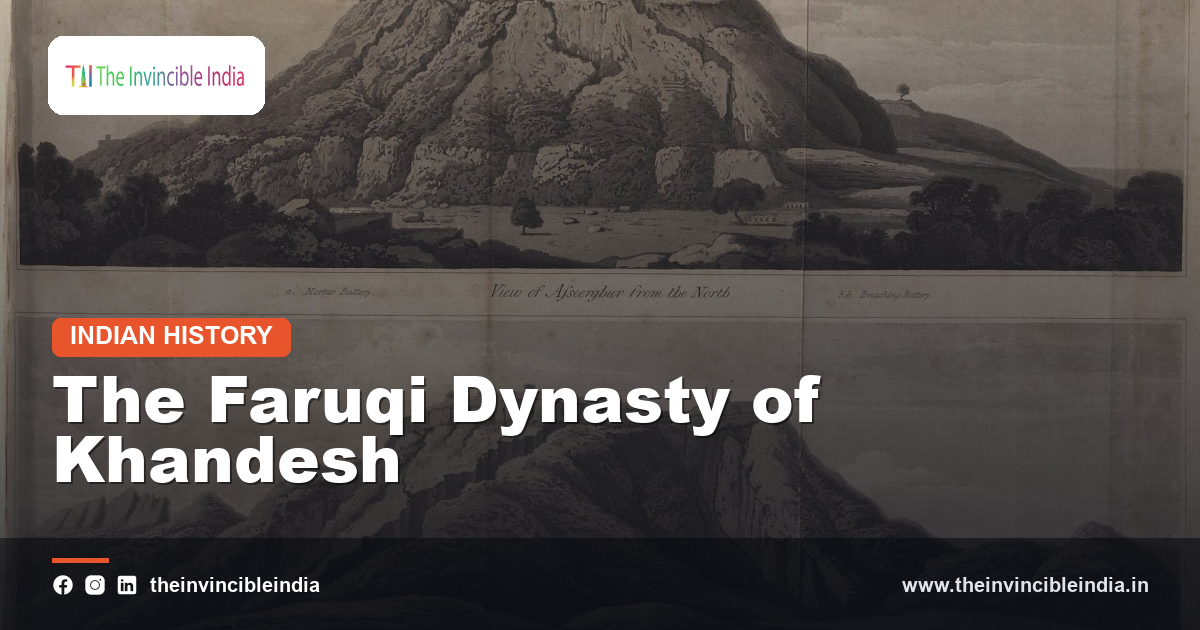
Asirgarh was called the key to the Deccan because the fort commanded the main pass between northern India and the south, and no army could safely move through the region without dealing with it. Perched on a spur of the Satpura range, the fortress has strong walls, deep tanks and natural cliffs, and it was long considered nearly impregnable. Tradition links the original fort to a chieftain called Asa Ahir, from whom it gets its name, though the story cannot be confirmed. The Faruqi sultans acquired and strengthened it, and it became their main stronghold and treasury. Its reputation was so formidable that even the Mughals needed a long siege to take it, which underlines why this one fort carried such outsized strategic weight.
Who founded Burhanpur and why is it important?
Burhanpur was founded by a Faruqi ruler, traditionally Nasir Khan, around the turn of the fifteenth century and named in honour of the Sufi saint Burhanuddin. It grew into the principal city of Khandesh and a major crossing point between north and south. Located on the Tapti river, it developed as a centre of trade, textiles and craftsmanship, and its markets were known for fine cloth. The city later became a key base for the Mughals, who used it as the gateway to their Deccan campaigns. Its importance therefore outlasted the Faruqi dynasty itself. Burhanpur remains the best-known legacy of the Faruqis, and many of its mosques, tombs and old quarters preserve traces of the dynasty that first made it a capital.
What did the Faruqis build at Burhanpur?
The Faruqis built mosques, tombs and civic buildings at Burhanpur, and their architecture blends the Islamic tradition with local Deccan and Malwa styles. The Jami Masjid, traditionally attributed to a Faruqi ruler of the late sixteenth century, is a prominent example, with its tall minarets and large prayer hall. Another notable building is the Bibi ki Masjid, and Faruqi tombs stand in several parts of the city. Craftsmen used local stone and, in some places, delicate carving and tilework. The style is generally restrained but graceful, reflecting the dynasty’s moderate resources. Later Mughal additions at Burhanpur, including the water system and palace buildings, sit beside Faruqi work, so the city shows two successive layers of rule within one urban landscape.
What were the economy and trade of Khandesh like?
The economy of Khandesh rested on agriculture, textiles and trade along the north-south corridor. The fertile Tapti valley produced cotton, grains and other crops, and Burhanpur became a centre of weaving and dyeing. Fine cotton cloth, including muslin and brocade, was traded to wider markets, and merchants moved between the ports of Gujarat and the Deccan. Revenue from land and from customs duties supported the court and the army. The state’s position on a major trade route gave it prosperity beyond what its small territory might suggest. Textile traditions in the region continue in modern times, and they offer a living link to the commercial life of the sultanate, which was built on practical and well-connected economic foundations.
How did religion and culture shape Faruqi Khandesh?
Religion and culture in Faruqi Khandesh were shaped by Sufi orders, Islamic scholarship and the older traditions of the Tapti valley. Sufi saints, including those associated with the Chishti tradition from the nearby Deccan, were revered, and the city of Burhanpur took its name from one of them. The court patronised scholars, poets and religious teachers, and Persian served as the language of administration. Local Hindu communities, including merchants, farmers and artisans, remained a large and essential part of the population, and local customs and languages continued alongside the court culture. The result was a layered society. Khandesh therefore reflects the pattern of many regional sultanates, in which Persianate court life and local tradition lived side by side and gradually influenced each other.
How did the Mughals annex Khandesh?
The Mughals annexed Khandesh in the reign of Akbar, after a campaign that ended with the surrender of Asirgarh around the turn of the seventeenth century. Akbar’s armies moved south in the 1590s as part of his plan to extend imperial authority into the Deccan. Burhanpur came under Mughal pressure first, and the Faruqi ruler eventually retreated to Asirgarh. A prolonged siege followed, and the fort fell after months of blockade, ending the line of independent Faruqi sultans. Accounts of the final surrender differ in detail, and historians debate how much was due to force and how much to negotiation. The territory became a Mughal province, and Burhanpur served as the staging point for Mughal operations in the Deccan for generations afterwards.
Who were the last Faruqi rulers?
The last Faruqi rulers faced the full weight of Mughal expansion and could not resist it. Raja Ali Khan, a ruler of the late sixteenth century, followed a policy of cooperation with the Mughals and accepted imperial authority, and he is said to have died in the course of Mughal service. His successor, Bahadur Shah, tried a more independent course and held out in Asirgarh, but he eventually surrendered. After the fall, he was taken into imperial custody, and the dynasty ceased to rule. Details about the later lives of Faruqi family members are limited. The end of the line shows how smaller sultanates could not survive once a larger centralised empire turned toward them, a fate shared by several other regional states in the same period.
Why does Khandesh matter in Deccan history?
Khandesh matters in Deccan history because it shows how a small border state could survive for two centuries between powerful neighbours and then become a gateway for imperial expansion. The Faruqis balanced alliances with Gujarat, Malwa and the Deccan sultanates, and their capital Burhanpur became one of the key cities in the later Mughal advance south. The kingdom is also a useful reminder that medieval India contained many regional courts, each with its own culture, trade and diplomacy. Studying Khandesh helps to correct the idea that history was made only by large empires. It also illustrates, in a compact form, the connected political world of the Deccan, in which marriage, trade and war linked kingdoms across wide distances.
The Faruqi Dynasty of Khandesh Today
The Faruqi dynasty of Khandesh today is remembered mainly through Burhanpur and Asirgarh, which both draw visitors interested in medieval heritage. Burhanpur’s mosques, tombs and old market lanes keep the memory of the sultanate alive, and its textile tradition remains a link to the past. Asirgarh stands as a ruined but impressive hill fortress, protected as a monument. Historians continue to study chronicles and inscriptions to clarify the sequence of rulers and the details of their relations with neighbours. The Faruqi story shows that regional dynasties, even short-lived ones, shaped the geography and culture of central India. Their legacy survives in the place names, monuments and trade routes that still define the Tapti valley today.
Sources & Further Reading
- Archaeological Survey of India (asi.nic.in).
- Ministry of Culture, Government of India (indiaculture.gov.in).
Frequently Asked Questions
Who were the Faruqis of Khandesh?
The Faruqis were a Muslim ruling dynasty that governed Khandesh in the Tapti valley from the late fourteenth century until the Mughal annexation around the turn of the seventeenth century. They began as nobles of the Delhi Sultanate and became independent sultans.
Who founded the Faruqi dynasty?
The Faruqi dynasty was founded by Malik Raja Faruqi, a noble in the service of Firuz Shah Tughlaq who received the Khandesh region as an estate. He later acted as an independent ruler as Delhi’s power declined.
What is Asirgarh Fort known for?
Asirgarh is a hill fort in the Satpura range known as the key to the Deccan because it commanded the pass between north and south India. It was the main stronghold of the Faruqi sultans and fell to the Mughals after a long siege.
Why is the dynasty called Faruqi?
The dynasty is called Faruqi because its rulers claimed descent from Umar ibn al-Khattab, the second caliph, whose title was al-Faruq. The claim is traditional and cannot be fully verified.
How did the Faruqi dynasty end?
The dynasty ended when Akbar’s Mughal forces besieged Asirgarh and the last Faruqi ruler, Bahadur Shah, surrendered around the turn of the seventeenth century. Khandesh then became a Mughal province.
What is Burhanpur famous for?
Burhanpur is famous as the Faruqi capital on the Tapti river, named after the Sufi saint Burhanuddin, and as the Mughal gateway to the Deccan. It is also known for its historic mosques and its textile tradition.


