

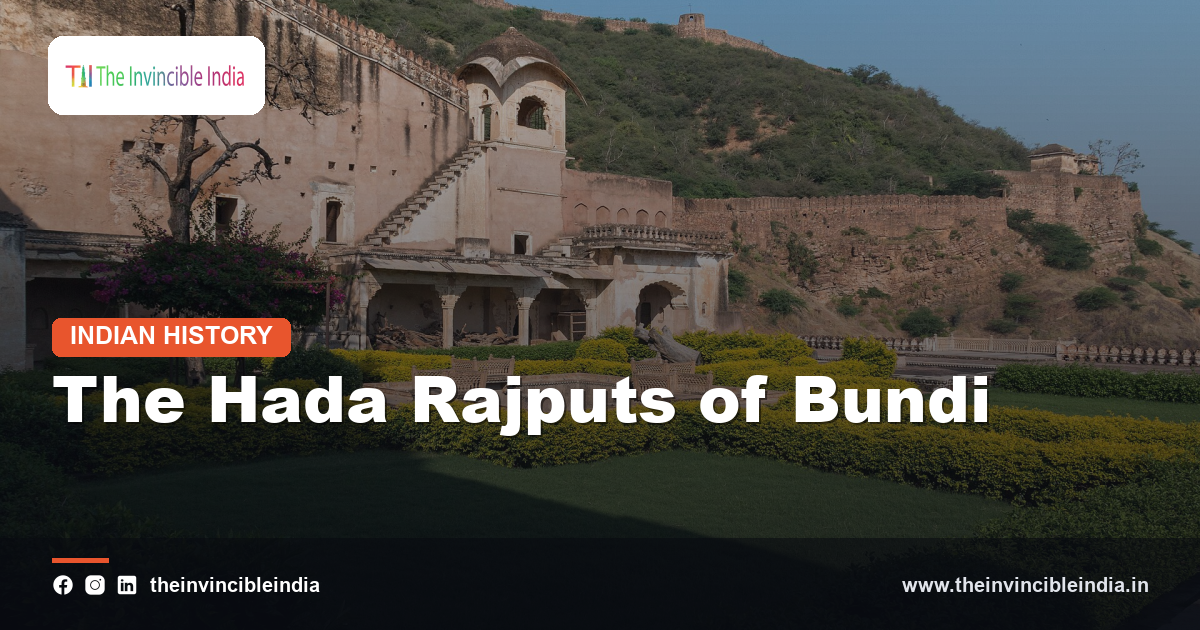
The Hada Rajputs, also written Hara or Hada Chauhans, were a branch of the Chauhan clan who ruled the princely state of Bundi in the Hadauti region of south-eastern Rajasthan. Their name gave the region its own, Hadauti, which later also included the sister state of Kota. From the hill fort of Taragarh and the Garh Palace below it, the Hada rulers governed a small but culturally rich kingdom through the medieval and early modern periods. Like the Rajput clans of Rajasthan generally, they combined martial pride with patronage of art and architecture. This guide describes Bundi’s rulers in general terms and notes where tradition and documented history diverge.
Quick answer: The Hada Rajputs, also called the Hara Chauhans, were a branch of the Chauhan clan who ruled the princely state of Bundi in the Hadauti region of south-eastern Rajasthan from the medieval period until Indian independence. They are remembered for Taragarh Fort, the Garh Palace and its murals, a large number of stepwells and the Bundi school of miniature painting.
Key Takeaways
- The Hada Rajputs, also called Hara Chauhans, were a branch of the Chauhan clan who ruled Bundi in Rajasthan.
- Bundi lies in the Hadauti region of south-eastern Rajasthan, which takes its name from the Hadas.
- Taragarh Fort, the Garh Palace and the Chitrashala are the leading monuments of Hada Bundi.
- The Bundi school of miniature painting is a celebrated regional style of Rajput art that grew under Hada patronage.
- Kota separated from Bundi in the early seventeenth century as a second Hada state.
- Bundi merged into the Union of Rajasthan in the late 1940s after Indian independence.
Quick Facts
| Detail | Information |
|---|---|
| Name | Hada Rajputs (Hara Chauhans) of Bundi |
| Region | Bundi, in the Hadauti region of south-eastern Rajasthan |
| Clan | A branch of the Chauhan Rajputs |
| Traditional founder | Rao Deva, said to have taken Bundi from local chiefs |
| Main monuments | Taragarh Fort, Garh Palace, Chitrashala and Raniji ki Baori |
| Known for | Bundi school of miniature painting and a large number of stepwells |
Who were the Hada Rajputs of Bundi?
The Hada Rajputs were the ruling family of Bundi, a branch of the Chauhan clan that held the Hadauti region of Rajasthan for many centuries. They belonged to the wider world of Rajput clans that dominated Rajasthan in the medieval period and developed a shared culture of kingship, honour and patronage. The Hadas ruled a relatively small state, yet they played a visible part in the politics of northern India, serving the Mughal emperors and later the British while retaining their own court. Their capital, Bundi, grew into a town of forts, lakes, temples and stepwells set in a narrow valley between the Aravalli hills. The family is remembered both for its courage in war and for its refined taste in painting and building, a combination that defines Hada heritage.
How are the Hadas linked to the Chauhans?
The Hadas are linked to the Chauhans as a cadet branch, meaning a younger line that separated from the main clan and formed its own ruling house. The Chauhans, also called Chahamanas, are known from the kingdom of Shakambhari and from famous rulers such as Prithviraj Chauhan. After the main line suffered defeat in the late twelfth century, surviving branches spread across Rajasthan and beyond. Tradition connects the Hadas with the Chauhans of Ranthambore and with a founder who moved south-east. The exact genealogy, as often in Rajput history, combines remembered tradition with bardic chronicles, and scholars do not accept every link without question. What is certain is that the Hadas identified strongly as Chauhans, and that identity shaped their sense of honour and lineage.
How did Bundi get its name?
Bundi is traditionally said to take its name from a local chieftain called Bunda or Bundu, a leader of the Meena community who held the area before the Hadas. According to this tradition the place was first known as Bunda-ka-nal, meaning the pass or channel of Bunda, and the name later shortened to Bundi. The story, like many founding legends, cannot be confirmed from contemporary records, and other explanations have been proposed. Nonetheless it reflects an important truth, which is that the area had earlier inhabitants and that the Hadas established their rule over a landscape already shaped by local communities. The name continues to define the town, and the legend remains part of the heritage shared with visitors and local residents alike.
Who founded the Hada state of Bundi?
The Hada state of Bundi is traditionally credited to Rao Deva, a Hada Chauhan chief who is said to have taken the area from local Meena rulers around the thirteenth century. The exact date and the circumstances are uncertain, since the main sources are bardic chronicles written later. Some accounts describe a conquest by force, others speak of a gradual takeover. Whatever the truth, the founder established a line that would hold Bundi for centuries and give the region its enduring name, Hadauti. Early Hada history is therefore a mixture of legend and fragmentary evidence, and historians generally prefer to speak of the dynasty taking shape across the medieval period rather than fix one precise founding date. The dynasty’s continuity from that period is itself the clearest historical fact.
Why is Taragarh Fort called the Star Fort?
Taragarh Fort is called the Star Fort because its name combines the Hindi word tara, meaning star, with garh, meaning fort, and tradition says it resembles a star set upon the hill. It crowns a steep ridge above Bundi and is surrounded by walls that follow the contours of the rock. Inside are water tanks, bastions, ruined palaces and a large cannon-like gun mounted on a rampart, as visitors usually note. The fort served as the military heart of the Hada state and a refuge in times of danger. Its steep approach and high walls made it hard to attack. Though parts are in ruins, Taragarh remains a striking symbol of Hada power and a magnet for visitors who climb to its summit for the view over the town.
What is the Garh Palace of Bundi?
The Garh Palace is the royal palace of Bundi, built on the slope below Taragarh Fort and expanded over several generations of Hada rulers. It is admired for its stone courtyards, balconies, pavilions and rooms decorated with wall paintings. Rudyard Kipling, the English writer, is traditionally said to have found the palace unforgettable, and the nearby Sukh Mahal is associated with his visit. Different portions of the palace belong to different reigns, so it shows how architectural taste evolved from earlier Rajput fortress style to a lighter, more decorative mode. Many rooms preserve murals that rank among the finest in Rajasthan. The palace therefore serves as both a royal residence and a gallery of Bundi art, offering a compact view of Hada court life across several centuries.
What is the Chitrashala and why is it famous?
The Chitrashala is a small painted gallery within the Garh Palace, famous for its richly coloured wall paintings in the Bundi style. Its name means picture hall, and its walls and ceilings carry scenes of Krishna, court processions, hunting, festivals and the Hindu cycle of seasons, all painted with fine detail. Tradition links its decoration to the patronage of a Hada ruler in the eighteenth century. The palette includes deep blues, greens and reds, and the compositions show the characteristic Bundi love of flowing landscape and lively movement. Because the paintings are in a relatively sheltered setting, they have survived well. The Chitrashala is often called one of the loveliest rooms in Rajasthan and is a major reason that art lovers travel to Bundi from India and abroad.
What is the Bundi school of miniature painting?
The Bundi school of miniature painting is a regional style of Rajput painting known for lush landscapes, vivid colour and graceful, animated figures. Developing under the patronage of Hada rulers from around the seventeenth century, it blended influences from earlier Rajput traditions and from Mughal court painting. Typical subjects include scenes from the life of Krishna, ragamala musical themes, royal portraits, hunts and courtly gatherings. A distinctive feature is the rich depiction of forests, clouds, birds and water, painted with a sense of rhythm. The school is closely related to the Kota school of painting, since Kota was once part of Bundi, and the two are often discussed together. The Bundi school remains one of the most admired schools of Indian miniature art and influences present-day artists in the region.
Why is Bundi called the city of stepwells?
Bundi is called the city of stepwells because it contains a large number of baoris, or stepped water reservoirs, built by its rulers and nobles for public use. In a dry region, storing water was essential, and stepwells provided a cool and dependable supply while also serving as gathering places. Many in Bundi are richly carved, with arches, pillars and sculpted panels. The most famous is Raniji ki Baori, built in the late seventeenth century by a queen of the Hada house, traditionally named Nathavati. Its deep flights of steps, ornate gateway and carved elephants attract many visitors. Local people often say there were once dozens of such wells, though no exact number should be assumed. They remain a distinctive part of Bundi’s heritage and show water management as an art form.
How did the Hadas deal with the Mughals?
The Hadas dealt with the Mughals through alliance and service, a path taken by many Rajput houses in the sixteenth century. Tradition credits Rao Surjan Hada with surrendering the fort of Ranthambore to Emperor Akbar and then entering imperial service, receiving honours and wider authority. In return, Hada rulers and princes served as commanders in Mughal campaigns across the empire. This relationship protected Bundi and enriched its court, and it also brought artistic influences from the Mughal capital. Later, relations varied from reign to reign, and succession quarrels sometimes drew in imperial officers. The Hadas are therefore typical of Rajput states that kept internal rule while serving a larger empire. Their history shows how cooperation, not only resistance, shaped the Rajput role in Mughal India.
How did Kota separate from Bundi?
Kota separated from Bundi in the early seventeenth century when the Mughal emperor Shah Jahan recognised a younger Hada prince as ruler of a distinct state. Tradition names this prince as Madho Singh, a son of Bundi’s ruler who had served the empire with distinction. The division created two Hada kingdoms, Bundi and Kota, which shared ancestry yet sometimes competed for land and favour. Over time Kota became the larger and more powerful of the two, but Bundi preserved a strong sense of seniority within the clan. The two states together make up the historical Hadauti region. The split is a good example of how imperial grants could reshape local politics, and it explains why the Hada heritage appears in both Bundi and Kota today.
What is the legend of the Hada Rani?
The legend of the Hada Rani is a famous folk tale about a Hada princess who showed extraordinary sacrifice on the eve of her husband’s battle. In tradition, she was a newly married queen whose husband, a Rajput chief, was called to war just after the wedding. Fearing that thoughts of his bride might weaken him, she is said to have sent him a token of her devotion that proved her loyalty beyond doubt. The tale is told in many versions across Rajasthan and in ballads, and its details vary. Historians regard it as a legend rather than documented fact. Even so, it holds an important place in popular culture, where it expresses ideals of courage and devotion associated with Rajput women, and it keeps the Hada name alive in memory.
How did the Marathas and the British affect Bundi?
The Marathas and the British affected Bundi by reducing its independence in the eighteenth and early nineteenth centuries. As Mughal power faded, Maratha armies raided and collected tribute across Rajasthan, and Bundi suffered from this pressure along with succession quarrels at court. Rulers sought help where they could, and in the early nineteenth century Bundi signed a treaty with the British East India Company, accepting its protection and paramountcy. Under this arrangement the Hada rulers kept their title and internal administration, while the Company controlled foreign affairs. The era brought stability but also loss of political independence. Bundi continued as a princely state until after Indian independence, and its rulers kept up palace life, ceremony and patronage of art during these changing times.
How did Bundi join independent India?
Bundi joined independent India when its ruler agreed to merge the state into the new Union of Rajasthan in the late 1940s. After independence, hundreds of princely states had to choose accession to India, and the rulers of Rajasthan’s many small states were brought together in stages into a single large state. Bundi was among the states merged during the formation of Rajasthan, and the royal house gave up sovereign rule while retaining private property and social standing. The process was peaceful, though it ended centuries of independent Hada governance. Today the former royal family remains part of local life and its heritage properties are important parts of the town. Bundi’s accession is a small chapter within the larger story of India’s political integration after 1947.
How do the Hadas of Bundi compare with other Rajput houses?
The Hadas of Bundi compare with other Rajput houses as a smaller state with a strong artistic identity. Mewar, Marwar and Amber were larger kingdoms with more famous rulers, and they often overshadow Bundi in general histories. But Bundi stands out for its murals, its miniature painting and its stepwells, which are among the best surviving examples of Rajput court culture. The Hadas shared with other clans the ideals of martial honour, lineage pride and temple patronage, and they navigated Mughal and British overlordship with similar pragmatism. A comparison therefore shows both common patterns and local difference. Bundi’s quiet, small-town character helped preserve its monuments, so that the Hada legacy survives in unusually good condition and offers a lively view of Rajasthan’s past.
The Hada Rajputs of Bundi Today
The Hada Rajputs of Bundi today are remembered through the fort, palaces, stepwells and paintings that continue to define the town. Taragarh and the Garh Palace are protected heritage sites, and conservation work aims to stabilise the murals and masonry. Bundi has become a favoured destination for travellers seeking a quieter alternative to Rajasthan’s larger tourist cities. Artists and craftspeople keep alive the Bundi painting tradition, and local festivals draw on the region’s folk heritage. The former royal family remains part of civic life, and its members have supported efforts to preserve the town. For readers of Indian history, Bundi shows how a modest Rajput state left a legacy that is cultural and artistic as much as political and military.
Sources & Further Reading
- Archaeological Survey of India (asi.nic.in).
- Ministry of Culture, Government of India (indiaculture.gov.in).
Frequently Asked Questions
Who were the Hada Rajputs?
The Hada Rajputs were a branch of the Chauhan clan who ruled the state of Bundi in the Hadauti region of Rajasthan for many centuries. They are also called Hara or Hada Chauhans, and they gave the region its name.
Where is Bundi and what is it known for?
Bundi is a town in south-eastern Rajasthan, in the Hadauti region. It is known for Taragarh Fort, the Garh Palace with its murals, the Bundi school of miniature painting and its many stepwells.
Who founded Bundi?
Bundi is traditionally said to have been taken by a Hada chief called Rao Deva, who displaced local Meena rulers around the thirteenth century. The exact date and details are uncertain, since the main sources are later chronicles.
What is Raniji ki Baori?
Raniji ki Baori is a famous stepwell in Bundi built in the late seventeenth century by a queen of the Hada house, traditionally named Nathavati. It is celebrated for its deep steps, carved pillars and ornate gateway.
How are Bundi and Kota connected?
Kota began as part of Bundi and became a separate Hada state in the early seventeenth century when the Mughal emperor recognised a younger prince as its ruler. Together the two make up the historical Hadauti region.
What is the Bundi school of painting?
The Bundi school is a style of Rajput miniature painting known for lush landscapes, bright colour and lively figures. It developed under Hada patronage from around the seventeenth century and is closely related to the Kota school.


