

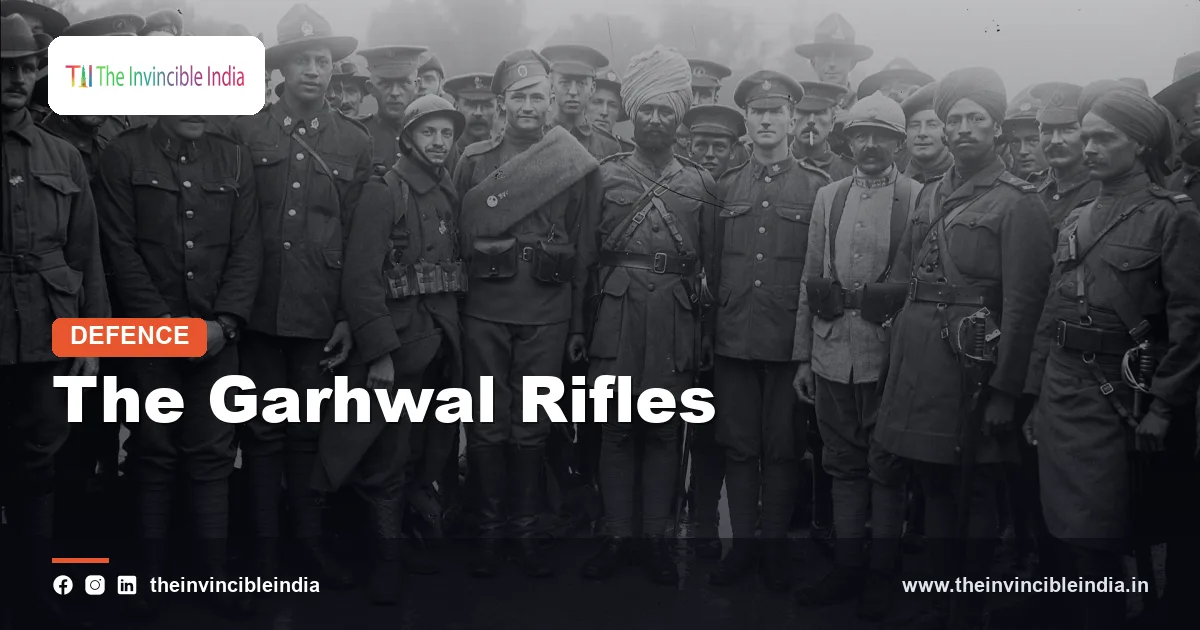
The Garhwal Rifles is an infantry regiment of the Indian Army raised in 1887 from the Garhwal region of the Himalayas, in present-day Uttarakhand, and headquartered at its Regimental Centre in Lansdowne. The regiment is remembered for two Victoria Crosses won in the First World War, by Naik Darwan Singh Negi and Rifleman Gabar Singh Negi, and for the legendary stand of Rifleman Jaswant Singh Rawat at Nuranang in 1962.
Few regiments of comparable size have such a strong link to a single mountain district. This explainer describes how the Garhwal Rifles was formed, why its soldiers are known for resilience in cold and rough terrain, what its war cry and traditions mean, and how a few frequently repeated claims about its decorations should be read with care.
Quick Facts: Garhwal Rifles
| Attribute | Detail |
|---|---|
| Type | Rifle regiment (infantry) of the Indian Army |
| Raised | 1887, at Almora, from Garhwali recruits |
| Regimental Centre | Lansdowne, Pauri Garhwal district, Uttarakhand |
| Recruiting region | Garhwal division of Uttarakhand |
| War cry | Badri Vishal Lal Ki Jai |
| Regimental motto | Yudhaya Krit Nishchaya (commonly rendered “Fight with determination”) |
| Victoria Cross recipients | Naik Darwan Singh Negi (1914) and Rifleman Gabar Singh Negi (1915) |
| Royal title | Granted in 1921 as the Royal Garhwal Rifles; dropped after independence |
Key Takeaways
- The Garhwal Rifles was raised in 1887 at Almora from recruits of the Garhwal hills, which lie in the present-day Indian state of Uttarakhand.
- The Regimental Centre of the Garhwal Rifles is at Lansdowne, a hill cantonment in the Pauri Garhwal district named after a Viceroy of India.
- Two soldiers of the Garhwal Rifles, Naik Darwan Singh Negi and Rifleman Gabar Singh Negi, were awarded the Victoria Cross in 1914 and 1915 on the Western Front in France.
- Rifleman Jaswant Singh Rawat of 4 Garhwal Rifles was posthumously awarded the Maha Vir Chakra, not the Param Vir Chakra, for his role in the Battle of Nuranang in November 1962.
- The war cry of the Garhwal Rifles, “Badri Vishal Lal Ki Jai”, honours Lord Badrinath, the presiding deity of the Badrinath temple in the Garhwal Himalaya.
- The Garhwal Rifles became the Royal Garhwal Rifles in 1921 in recognition of its First World War record and reverted to its present name after independence.
What is the Garhwal Rifles?
The Garhwal Rifles is a regular infantry regiment of the Indian Army that recruits its soldiers from the Garhwal region of Uttarakhand and fights in the manner of a rifle regiment. It is one of the oldest hill regiments of the Army and one of the few that has kept a single regional identity for well over a century.
As a “rifle” regiment, the Garhwal Rifles follows a tradition that dates back to light infantry in the British Army, with dark green uniform colours, a quick marching pace and a rifle-green ceremonial style. The designation has little to do with a different weapon, since all modern infantry use rifles, but it shapes parade conduct, music and customs.
The regiment is made up of numbered battalions that are posted across India under different brigades. Each battalion has its own history and honours, while the Regimental Centre at Lansdowne is the shared base for training, records and veterans’ welfare.
Who are the Garhwalis and why are they known as soldiers?
The Garhwalis are the people of the Garhwal hills of Uttarakhand, who speak Garhwali and related dialects and have a strong tradition of military service going back to the British period. The region is steep, cold and lightly populated, so many families have long supplemented farming income with army pay.
The Garhwal division includes districts such as Pauri Garhwal, Chamoli, Tehri Garhwal, Rudraprayag, Uttarkashi, Dehradun and Haridwar. The mountain terrain, which includes the sources of the Ganga and the shrines of Badrinath and Kedarnath, shaped people accustomed to marching and carrying loads at altitude.
That background helped the regiment adapt to mountain and cold-weather war. Local culture also prizes service to the nation, and a considerable number of villages have a long list of serving soldiers and veterans, which has been a feature of the area for generations.
When and how was the Garhwal Rifles raised?
The Garhwal Rifles was raised on 5 May 1887 at Almora, when Garhwali companies of the 3rd Gurkha Rifles were formed into a separate battalion, under Lieutenant Colonel Edward Mainwaring. The new unit moved to Kaludanda in the Garhwal hills a few years later, and the post was renamed Lansdowne in 1890 after the Viceroy, Lord Lansdowne.
Before 1887, Garhwalis had been recruited into Gurkha regiments, where they served beside Nepalese Gurkhas. The decision to give the Garhwalis their own battalion reflected both the growing recognition of their qualities and the view that they should have their own regimental identity.
A second battalion followed in 1901, and by the First World War the Garhwal Rifles was a two-battalion regiment, renumbered several times in the colonial list. In 1921, in recognition of the First World War record, the regiment was awarded the title “Royal Garhwal Rifles”, and the Royal title was dropped after India became a republic.
| Year | Event |
|---|---|
| 1887 | Garhwali battalion raised at Almora |
| 1890 | Cantonment at Kaludanda renamed Lansdowne |
| 1914-1915 | Two Victoria Crosses won in France |
| 1921 | Royal title granted |
| 1930 | The Peshawar incident involving Garhwali troops |
| 1939-1945 | Service in the Second World War, including Burma |
| 1962 | Battle of Nuranang in the north-east frontier |
| 1965 and 1971 | Service in wars against Pakistan |
What are the Victoria Cross awards of the Garhwal Rifles?
The Garhwal Rifles produced two Victoria Crosses in the First World War, awarded to Naik Darwan Singh Negi and Rifleman Gabar Singh Negi, and both men are central to the regiment’s heritage. The Victoria Cross was then the highest gallantry award for British and imperial soldiers, and Indian soldiers had only become eligible in 1911.
Naik Darwan Singh Negi of the 1st Battalion won the award for action near Festubert in France on the night of 23 and 24 November 1914. He was among the first Indian soldiers to receive the Victoria Cross, after Khudadad Khan, and is reported to have continued fighting despite serious wounds when his unit was holding a trench.
Rifleman Gabar Singh Negi of the 2nd Battalion earned the award, posthumously, for his bravery in the Battle of Neuve Chapelle on 10 March 1915. He joined a bayonet assault on a German trench and was killed in the attack, and his courage is commemorated at an annual fair in his home district of Tehri Garhwal.
Who was Jaswant Singh Rawat and what happened at Nuranang?
Rifleman Jaswant Singh Rawat was a soldier of the 4th Battalion of the Garhwal Rifles who became a folk hero for his part in the Battle of Nuranang, fought in November 1962 in the Tawang sector of Arunachal Pradesh. He was posthumously awarded the Maha Vir Chakra, India’s second-highest wartime gallantry award, and is widely remembered as the “hero of Nuranang”.
The Battle of Nuranang took place on 17 November 1962, when Chinese forces attacked Indian positions as part of the wider India-China conflict. According to regimental accounts, Rawat and two comrades held back advancing troops while the rest of the battalion withdrew, and he is said to have continued to fight after his colleagues were killed or wounded.
Popular tradition adds stories of local Monpa women who helped him, and of a protracted three-day stand. Historians treat some of these details with caution, as the oral tradition has grown with time. What is well established is his Maha Vir Chakra, the Army’s decision to commemorate him, and the Jaswant Garh memorial near Nuranang, where his memory is honoured to this day.
Did a Garhwal Rifles soldier win the Param Vir Chakra?
No soldier of the Garhwal Rifles appears among the 21 recipients of the Param Vir Chakra, so Jaswant Singh Rawat’s award is the Maha Vir Chakra and not the Param Vir Chakra. The error is common in social media posts and even in some news reports, which merge his legend with the highest award.
The distinction does not reduce his standing, because the Maha Vir Chakra is itself a rare honour, but it helps keep records accurate. Readers who encounter claims of a Garhwal Rifles Param Vir Chakra should check the official list maintained by the Government of India.
The regiment’s gallantry record includes two Victoria Crosses, numerous Military Crosses and Indian Distinguished Service Medals in the colonial period, and after independence many Maha Vir Chakras, Vir Chakras, Kirti Chakras and Shaurya Chakras, though counts differ among sources.
What is the Peshawar incident of 1930?
The Peshawar incident of April 1930 was an episode in which two platoons of the 2nd Battalion of the Royal Garhwal Rifles were reported to have refused an order to fire on unarmed protesters in Peshawar during the civil disobedience movement. Hawaldar Chandra Singh Garhwali is the name most often associated with the event.
The soldiers were arrested and tried, and several received harsh sentences, including imprisonment. The incident is cited in Indian historical writing as a sign of how nationalist feeling reached the ranks of colonial troops, though British accounts and Indian accounts differ in their emphasis and details.
The event is a sensitive and debated topic and is presented here as a historical episode with varied interpretations rather than as a settled narrative. It is nevertheless part of the wider story of the regiment.
What is the war cry of the Garhwal Rifles?
The war cry of the Garhwal Rifles is “Badri Vishal Lal Ki Jai”, which means “Victory to Lord Badri Vishal”, a title of Lord Badrinath, the form of Vishnu worshipped at the Badrinath temple in Chamoli district. Soldiers use the phrase on parade and at the start of an attack.
The choice of Badrinath, one of the four Char Dham shrines and a symbol of Garhwali religious life, links the regiment to its home region. The regimental motto, “Yudhaya Krit Nishchaya”, is usually translated as “Fight with determination”, and expresses a similar spirit of resolve.
Where is the Garhwal Rifles Regimental Centre?
The Garhwal Rifles Regimental Centre is located at Lansdowne, a small hill cantonment in the Pauri Garhwal district of Uttarakhand at an altitude of about 1,700 metres. It trains recruits, preserves regimental records and runs a museum dedicated to the history of the regiment.
Lansdowne is named after Lord Lansdowne, who was Viceroy of India from 1888 to 1894. The cantonment is a rare example of a military station that remained closely tied to the same regiment from its beginnings, and the Regimental Centre is a major institution in the local community.
Features of the Regimental Centre
- Recruit training and passing-out parades
- A regimental museum with exhibits on the Victoria Cross winners and later campaigns
- Records, welfare and pension offices for veterans and families
- Memorials and annual commemorations of key battles
How has the Garhwal Rifles fought since independence?
The Garhwal Rifles has fought in all the major wars of independent India, including the Jammu and Kashmir operations of 1947-48, the Sino-Indian conflict of 1962, and the wars with Pakistan in 1965 and 1971. Its battalions have also served in the Siachen area, in counter-insurgency operations and on peacekeeping missions.
The 1962 Battle of Nuranang remains the best known of these episodes, but other actions in the Tawang sector and elsewhere also matter. In 1971, Garhwal battalions took part in operations on both western and eastern fronts, and the regiment received battle honours for those campaigns.
Over the decades, the Garhwal Rifles has expanded to a larger number of battalions than it had in 1947. Some of these battalions have specialised roles, such as mountain operations and counter-insurgency, which reflect the demands of border security in the Himalayas.
Why does the Garhwal Rifles matter?
The Garhwal Rifles matters because it is a rare case of a regiment that is almost inseparable from one region’s identity and because its battlefield record spans from the Western Front of 1914 to the Himalayan borders of 1962 and after. It shows how a community’s military habits and a state’s institutions can reinforce each other.
The regiment also has a role in the culture and economy of Uttarakhand, where army service is a significant source of income and prestige. Memorials, fairs and village traditions keep the stories of Darwan Singh Negi, Gabar Singh Negi and Jaswant Singh Rawat in public memory.
For readers, the Garhwal Rifles also teaches an important lesson about sources. Names, dates and awards are often repeated with errors, so consulting official records and published regimental histories is the sound way to verify claims. This explainer was last updated on 16 October 2026.
Bottom Line
The Garhwal Rifles is a Garhwal-based Indian Army rifle regiment raised in 1887, centred at Lansdowne and known for two First World War Victoria Crosses and the Nuranang legend of 1962. Jaswant Singh Rawat’s honour is the Maha Vir Chakra, and no Param Vir Chakra belongs to the regiment.
Frequently Asked Questions
What is the Garhwal Rifles?
The Garhwal Rifles is an infantry regiment of the Indian Army recruited from the Garhwal region of Uttarakhand. It was raised in 1887 and has its Regimental Centre at Lansdowne.
When was the Garhwal Rifles raised?
The Garhwal Rifles was raised in 1887 at Almora, when Garhwali companies were formed into a separate battalion. It was named the Royal Garhwal Rifles in 1921, and the Royal title was dropped after independence.
Who won the Victoria Cross in the Garhwal Rifles?
Naik Darwan Singh Negi and Rifleman Gabar Singh Negi won the Victoria Cross in the Garhwal Rifles. Darwan Singh Negi earned his in November 1914 at Festubert, and Gabar Singh Negi earned his posthumously at Neuve Chapelle in March 1915.
Did Jaswant Singh Rawat receive the Param Vir Chakra?
No, Jaswant Singh Rawat was posthumously awarded the Maha Vir Chakra, not the Param Vir Chakra. He served in 4 Garhwal Rifles and became a legend for his part in the Battle of Nuranang in November 1962.
What is the war cry of the Garhwal Rifles?
The war cry of the Garhwal Rifles is “Badri Vishal Lal Ki Jai”, meaning victory to Lord Badri Vishal. It refers to the deity of the Badrinath temple, an important shrine in the Garhwal Himalaya.
Where is the Garhwal Rifles Regimental Centre?
The Garhwal Rifles Regimental Centre is at Lansdowne in the Pauri Garhwal district of Uttarakhand. The cantonment was named in 1890 after the Viceroy, Lord Lansdowne, and it remains the home of recruit training for the regiment.
{“@context”:”https://schema.org”,”@graph”:[{“@type”:”FAQPage”,”mainEntity”:[{“@type”:”Question”,”name”:”What is the Garhwal Rifles?”,”acceptedAnswer”:{“@type”:”Answer”,”text”:”The Garhwal Rifles is an infantry regiment of the Indian Army recruited from the Garhwal region of Uttarakhand. It was raised in 1887 and has its Regimental Centre at Lansdowne.”}},{“@type”:”Question”,”name”:”When was the Garhwal Rifles raised?”,”acceptedAnswer”:{“@type”:”Answer”,”text”:”The Garhwal Rifles was raised in 1887 at Almora, when Garhwali companies were formed into a separate battalion. It was named the Royal Garhwal Rifles in 1921, and the Royal title was dropped after independence.”}},{“@type”:”Question”,”name”:”Who won the Victoria Cross in the Garhwal Rifles?”,”acceptedAnswer”:{“@type”:”Answer”,”text”:”Naik Darwan Singh Negi and Rifleman Gabar Singh Negi won the Victoria Cross in the Garhwal Rifles. Darwan Singh Negi earned his in November 1914 at Festubert, and Gabar Singh Negi earned his posthumously at Neuve Chapelle in March 1915.”}},{“@type”:”Question”,”name”:”Did Jaswant Singh Rawat receive the Param Vir Chakra?”,”acceptedAnswer”:{“@type”:”Answer”,”text”:”No, Jaswant Singh Rawat was posthumously awarded the Maha Vir Chakra, not the Param Vir Chakra. He served in 4 Garhwal Rifles and became a legend for his part in the Battle of Nuranang in November 1962.”}},{“@type”:”Question”,”name”:”What is the war cry of the Garhwal Rifles?”,”acceptedAnswer”:{“@type”:”Answer”,”text”:”The war cry of the Garhwal Rifles is “Badri Vishal Lal Ki Jai”, meaning victory to Lord Badri Vishal. It refers to the deity of the Badrinath temple, an important shrine in the Garhwal Himalaya.”}},{“@type”:”Question”,”name”:”Where is the Garhwal Rifles Regimental Centre?”,”acceptedAnswer”:{“@type”:”Answer”,”text”:”The Garhwal Rifles Regimental Centre is at Lansdowne in the Pauri Garhwal district of Uttarakhand. The cantonment was named in 1890 after the Viceroy, Lord Lansdowne, and it remains the home of recruit training for the regiment.”}}]}]}


