

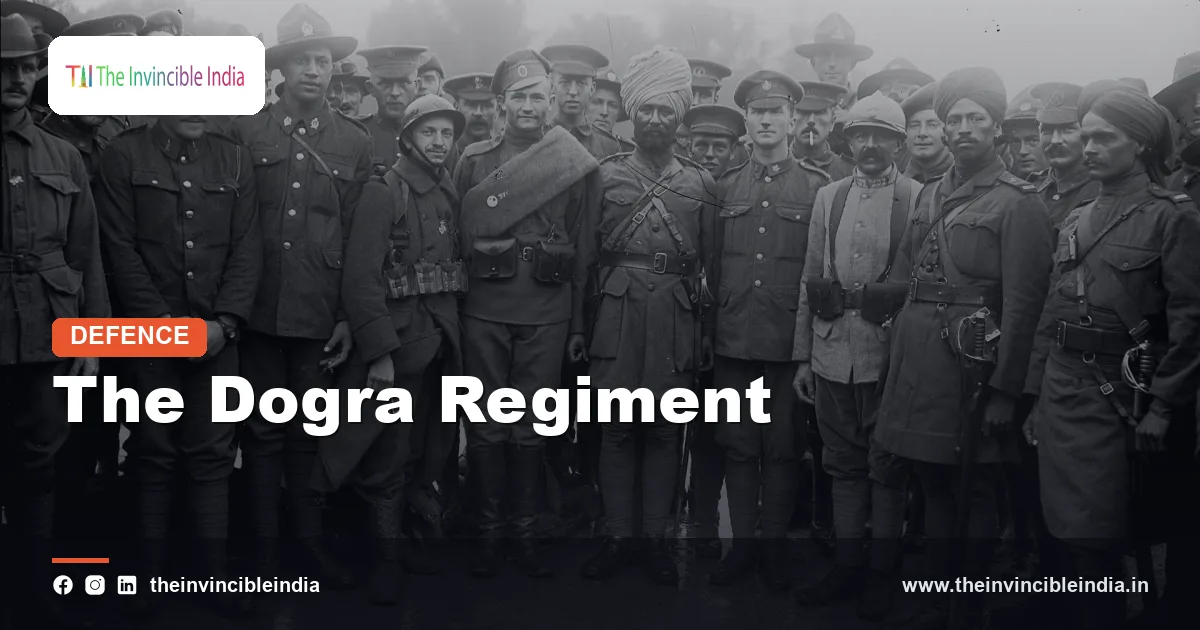
The Dogra Regiment is an infantry regiment of the Indian Army recruited mainly from the Dogra community of the Jammu region, Himachal Pradesh and the Punjab hills, with its Regimental Centre at Faizabad in Uttar Pradesh. The regiment’s soldiers shout the war cry “Jwala Mata Ki Jai”, invoking the goddess whose shrine at Jwalamukhi in Himachal Pradesh is deeply tied to Dogra faith and identity.
Formally constituted in the early twentieth century and reorganised several times since, the Dogra Regiment has served in both World Wars, in the Jammu and Kashmir operations that began in 1947, and in later wars and internal security campaigns. This guide explains who the Dogras are, how the regiment evolved, what its customs mean and how its record should be read accurately.
Quick Facts: Dogra Regiment
| Attribute | Detail |
|---|---|
| Type | Infantry regiment of the Indian Army |
| Origins | Dogra companies and battalions in British Indian service from the late nineteenth century; Dogra regiments consolidated in the early twentieth century |
| Designation history | Numbered Dogra regiments of the 1900s-1920s, grouped as the 17th Dogra Regiment in 1922, later the Dogra Regiment |
| Regimental Centre | Faizabad, Uttar Pradesh |
| Principal recruiting region | Jammu region, Himachal Pradesh (Kangra, Hamirpur, Una, Chamba) and the Punjab hills |
| War cry | Jwala Mata Ki Jai (Bharat Mata Ki Jai is also used) |
| Parent organisation | Indian Army, Ministry of Defence, Government of India |
| Wartime service | First World War, Second World War, Jammu and Kashmir 1947-48, 1965, 1971 and later operations |
Key Takeaways
- The Dogra Regiment is an Indian Army infantry regiment whose soldiers come chiefly from the Dogra hill communities of Jammu, Himachal Pradesh and the Punjab foothills.
- The Regimental Centre of the Dogra Regiment is at Faizabad in Uttar Pradesh, where recruits are trained and the regimental museum and records are kept.
- The principal war cry of the Dogra Regiment is “Jwala Mata Ki Jai”, a tribute to the goddess worshipped at Jwalamukhi in the Kangra valley.
- The Dogra martial reputation draws on the nineteenth-century army of Maharaja Gulab Singh of Jammu and Kashmir, whose general Zorawar Singh led campaigns into Ladakh and western Tibet.
- The Dogra Regiment fought in the First World War, the Second World War and every major conflict of independent India, earning battle honours and many gallantry awards.
- The roll of the 21 Param Vir Chakra recipients does not list a soldier of the Dogra Regiment, so the regiment’s distinction rests on a large record of other gallantry awards.
What is the Dogra Regiment?
The Dogra Regiment is a regular infantry regiment of the Indian Army that takes its name and much of its character from the Dogra people of the lower Himalayan region. It consists of numbered battalions that share a Regimental Centre, a cap badge, a war cry and a set of ceremonial traditions.
In practice, the regiment is an administrative family. Its battalions are posted in different parts of the country and can be placed under any brigade or division, which means that a Dogra battalion may serve beside units from many other regiments in the same operation. The regiment maintains links between serving battalions, veterans and war widows through its Regimental Centre.
The Dogra Regiment is distinct from the Jammu and Kashmir Rifles and the Jammu and Kashmir Light Infantry, which grew out of the old state forces of the princely state of Jammu and Kashmir. Although all three draw on soldiers from overlapping hill regions, they are separate regiments with their own histories and centres.
Who are the Dogras?
The Dogras are a Hindu-majority community of the hill and foothill region that stretches from the Jammu plains to Kangra and Chamba, and they speak Dogri, a language recognised in the Eighth Schedule of the Constitution of India. Rajputs form an important section of the community, but Brahmins, Khatris and other castes also identify as Dogra.
The region’s martial image is partly the legacy of Maharaja Gulab Singh, the Dogra ruler who established the princely state of Jammu and Kashmir in 1846 under the Treaty of Amritsar. His general, Zorawar Singh Kahluria, led armies into Ladakh in the 1830s and 1840s and made a famous but ultimately fatal expedition into western Tibet in 1841.
Dogra identity rests on a common language, shared fortresses and temples, and local customs. The Jwala Devi temple at Jwalamukhi and the Vaishno Devi shrine in the Trikuta hills are widely revered, and their goddesses appear in the community’s prayers and in the regimental war cry.
When was the Dogra Regiment raised?
The Dogra Regiment was formed in the early twentieth century when the British Indian Army created regiments specifically for Dogra recruits, and it took its present form through the reorganisation of 1922 and later changes. Exact dates for individual battalions vary between sources and should be confirmed from official records.
Dogra soldiers had been enlisted in British service from the nineteenth century, often in mixed units and in regiments that were later converted. Around the turn of the twentieth century, some existing battalions were redesignated as Dogra units, and by the First World War Dogra infantry formed a recognisable group within the army.
In 1922, the army adopted a system of larger regiments with a number and a class or regional name. The Dogra battalions were grouped as the 17th Dogra Regiment, and after independence in 1947 the numerical prefix was dropped, leaving the Dogra Regiment of today.
Key stages in the regiment’s evolution
- Nineteenth century: Dogra recruits enlisted in British Indian regiments
- Early 1900s: Dogra class battalions established as separate numbered units
- 1922: Reorganisation into the 17th Dogra Regiment
- 1947 onwards: The regiment continues as the Dogra Regiment of the Indian Army
What is the war cry of the Dogra Regiment?
The war cry of the Dogra Regiment is “Jwala Mata Ki Jai”, meaning “Victory to Mother Jwala”, and soldiers also call out “Bharat Mata Ki Jai” in a national context. The first cry is a direct reference to the goddess Jwala Devi, whose flame shrine at Jwalamukhi in Kangra district is a major pilgrimage centre.
A regimental war cry has both operational and cultural uses. In an assault, it is a short signal that carries across noise and helps groups move together, and in peacetime it is part of every parade, passing-out ceremony and regimental reunion.
The use of a hill goddess in the war cry ties the regiment to the home region of its soldiers. Many Dogra families visit Jwalamukhi before sending a son to the army, and serving soldiers often return to the shrine on leave.
Where is the Dogra Regimental Centre?
The Dogra Regimental Centre is located at Faizabad in Uttar Pradesh, within the Ayodhya region, and it is the training and administrative home of the regiment. Recruits complete their basic military training there before they are posted to a battalion.
The Centre looks after more than recruit training. It manages promotion cadres for non-commissioned officers, welfare of ex-servicemen, and the upkeep of a regimental museum that holds flags, uniforms, photographs and relics from campaigns.
The location of Regimental Centres often reflects colonial-era decisions about land, railways and climate rather than the home region of the regiment. Faizabad is therefore at some distance from the Dogra hills, although a number of ceremonial links to Jammu and Himachal Pradesh remain.
What battle honours has the Dogra Regiment earned?
The Dogra Regiment and its predecessor battalions have earned battle honours in the First World War in Mesopotamia and Palestine, in the Second World War in Burma and other theatres, and in post-independence operations in Jammu and Kashmir. The exact list differs among battalions.
In the First World War, Dogra battalions served in the Middle East, where Indian infantry played a large role in the Mesopotamia campaign. In the Second World War, Dogra units fought in the Burma campaign, where they faced the Japanese army in difficult jungle terrain, and some served in the Middle East and elsewhere.
After 1947, the regiment’s battalions were committed to the defence of Jammu and Kashmir, and they took part in later wars in 1965 and 1971. Their honours and awards from these wars include Maha Vir Chakra, Vir Chakra, Kirti Chakra, Shaurya Chakra and Sena Medal decorations, though the details differ by battalion and by source.
| Period | Area of service | Note |
|---|---|---|
| 1914-1918 | Mesopotamia, Palestine and other Middle East theatres | Indian infantry in the Allied campaign against the Ottoman Empire |
| 1939-1945 | Burma and other theatres | Jungle warfare against Japanese forces |
| 1947-1948 | Jammu and Kashmir | Defence of the state after the tribal and Pakistani incursions |
| 1962 | Northern borders | Service during the India-China conflict |
| 1965 and 1971 | Western front and other sectors | Participation in the Indo-Pakistani wars |
| 1980s onwards | Kashmir, the north-east and high altitude | Counter-insurgency and border security |
How is the Dogra Regiment connected to Jammu and Kashmir?
The Dogra Regiment is closely connected to Jammu and Kashmir because many of its soldiers come from the Jammu region and because its battalions have served in the state in most phases since 1947. The regiment’s history and the history of the Dogra dynasty are separate but overlapping.
The Dogra rulers of Jammu and Kashmir maintained their own state army, which later formed the basis of the Jammu and Kashmir Rifles and related units. The Dogra Regiment, by contrast, belongs to the national army and originated from British Indian recruitment, so it should not be confused with the former state forces.
During the 1947-48 war, battalions from several regiments were flown or moved into the state, and Dogra soldiers served in the operations that followed. In the decades since, the regiment’s battalions have been regularly deployed along the Line of Control and in counter-insurgency tasks, and many veterans of the regiment live in the same region.
Has the Dogra Regiment won the Param Vir Chakra?
The Dogra Regiment does not appear on the roll of the 21 recipients of the Param Vir Chakra, India’s highest wartime gallantry award, but its soldiers have earned many other decorations. The absence of a Param Vir Chakra says little about the regiment’s wider record, since the award has been given only a small number of times to the whole army.
Some Param Vir Chakra recipients came from the same hill regions that supply Dogra recruits but served in other regiments. Subedar Bana Singh of the Jammu and Kashmir Light Infantry, for example, won the award for the capture of a post on the Siachen Glacier in 1987, and Captain Vikram Batra of the Jammu and Kashmir Rifles won it for his actions in the Kargil conflict.
It is therefore important to separate regional or community origin from regimental affiliation. Writers often credit a hill regiment with a famous gallantry award merely because the soldier was born in the region, which leads to repeated errors in popular summaries.
What is the class composition of the Dogra Regiment?
The Dogra Regiment is historically a class regiment drawn largely from Dogra communities, with Dogra Rajputs, Brahmins and other hill groups at its core. Before 1947 some Dogra companies also included Muslim Dogras and Punjabi Mussalmans, who moved to Pakistan at Partition.
Class composition in the Indian Army has changed since independence, and many regiments now recruit more widely than they did under the British. The Dogra Regiment still keeps a strong hill identity, but entrance rules, quotas and reservations are reviewed by the government and the Army, so current details must be checked from official notices.
Typical features of Dogra recruitment
- Strong family tradition, with several generations serving in one regiment
- Recruiting concentrated in the Jammu region, Kangra, Hamirpur, Una and parts of the Punjab hills
- Training at the Faizabad Regimental Centre after selection
- Entry mainly through national recruitment rallies and, since 2022, the Agnipath scheme
How does the Dogra Regiment differ from other hill regiments?
The Dogra Regiment differs from other hill-based regiments in its recruiting area, its war cry and its history of Dogra-class organisation. Comparing it with neighbouring regiments helps readers avoid confusing similar names.
| Regiment | Origin or recruiting area | Regimental Centre | War cry |
|---|---|---|---|
| Dogra Regiment | Dogras of Jammu, Himachal Pradesh and the Punjab hills | Faizabad, Uttar Pradesh | Jwala Mata Ki Jai |
| Garhwal Rifles | Garhwal region of Uttarakhand | Lansdowne, Uttarakhand | Badri Vishal Lal Ki Jai |
| Kumaon Regiment | Kumaon hills of Uttarakhand | Ranikhet, Uttarakhand | Kalika Mata Ki Jai |
| Jammu and Kashmir Rifles | Jammu and Kashmir, from former state forces | Jabalpur, Madhya Pradesh | Durga Mata Ki Jai |
The Dogra Regiment’s closest cultural neighbours are the Garhwal and Kumaon regiments to the east and the Jammu and Kashmir regiments to the north. Each recruits from a different slice of the Himalayan foothills and keeps its own history.
Why does the Dogra Regiment matter?
The Dogra Regiment matters because it links the military heritage of the western Himalayan foothills to the modern Indian Army and keeps alive traditions that go back to the Dogra dynasty and the British Indian era. Its battalions continue to serve in some of the country’s most demanding terrain.
The regiment also illustrates the role of regional identity in Indian military organisation. Language, faith, local geography and family histories all contribute to a feeling of belonging, which the Army uses to build cohesion at the battalion level.
For readers and researchers, the Dogra Regiment is a useful example of how names, regions and units can be confused. A careful reading of official histories, rather than reliance on a single popular narrative, is the best protection against error. This page was last reviewed on 16 October 2026.
Bottom Line
The Dogra Regiment is an Indian Army infantry regiment drawing on the Dogra hill communities, based at Faizabad and led into battle with the cry “Jwala Mata Ki Jai”. Its reputation is built on service in the World Wars and in Jammu and Kashmir, supported by many gallantry awards but not by any Param Vir Chakra.
Frequently Asked Questions
What is the Dogra Regiment?
The Dogra Regiment is an infantry regiment of the Indian Army recruited mainly from Dogra communities in Jammu, Himachal Pradesh and the Punjab hills. It has a Regimental Centre at Faizabad and a history that runs from British Indian service to modern operations.
What is the war cry of the Dogra Regiment?
The war cry of the Dogra Regiment is “Jwala Mata Ki Jai”, which means victory to Mother Jwala. The cry refers to the goddess whose temple at Jwalamukhi in Kangra district is revered by many Dogra families, and “Bharat Mata Ki Jai” is also used.
Where is the Dogra Regimental Centre?
The Dogra Regimental Centre is at Faizabad in Uttar Pradesh. It trains recruits, holds the regimental museum and looks after the welfare of serving soldiers, veterans and families.
When was the Dogra Regiment formed?
The Dogra Regiment took shape in the early twentieth century and was grouped as the 17th Dogra Regiment in the army reorganisation of 1922. The numerical prefix was dropped after independence, though exact raising dates of individual battalions vary between sources.
Has the Dogra Regiment won a Param Vir Chakra?
No, the Dogra Regiment is not among the units of the 21 Param Vir Chakra recipients. Its soldiers have won many other gallantry awards, including the Maha Vir Chakra, Vir Chakra, Kirti Chakra and Shaurya Chakra.
Is the Dogra Regiment the same as the Jammu and Kashmir Rifles?
No, the Dogra Regiment and the Jammu and Kashmir Rifles are separate regiments. The Dogra Regiment grew out of British Indian recruitment of Dogra soldiers, while the Jammu and Kashmir Rifles descend from the former state forces of the Dogra rulers of Jammu and Kashmir.
{“@context”:”https://schema.org”,”@graph”:[{“@type”:”FAQPage”,”mainEntity”:[{“@type”:”Question”,”name”:”What is the Dogra Regiment?”,”acceptedAnswer”:{“@type”:”Answer”,”text”:”The Dogra Regiment is an infantry regiment of the Indian Army recruited mainly from Dogra communities in Jammu, Himachal Pradesh and the Punjab hills. It has a Regimental Centre at Faizabad and a history that runs from British Indian service to modern operations.”}},{“@type”:”Question”,”name”:”What is the war cry of the Dogra Regiment?”,”acceptedAnswer”:{“@type”:”Answer”,”text”:”The war cry of the Dogra Regiment is “Jwala Mata Ki Jai”, which means victory to Mother Jwala. The cry refers to the goddess whose temple at Jwalamukhi in Kangra district is revered by many Dogra families, and “Bharat Mata Ki Jai” is also used.”}},{“@type”:”Question”,”name”:”Where is the Dogra Regimental Centre?”,”acceptedAnswer”:{“@type”:”Answer”,”text”:”The Dogra Regimental Centre is at Faizabad in Uttar Pradesh. It trains recruits, holds the regimental museum and looks after the welfare of serving soldiers, veterans and families.”}},{“@type”:”Question”,”name”:”When was the Dogra Regiment formed?”,”acceptedAnswer”:{“@type”:”Answer”,”text”:”The Dogra Regiment took shape in the early twentieth century and was grouped as the 17th Dogra Regiment in the army reorganisation of 1922. The numerical prefix was dropped after independence, though exact raising dates of individual battalions vary between sources.”}},{“@type”:”Question”,”name”:”Has the Dogra Regiment won a Param Vir Chakra?”,”acceptedAnswer”:{“@type”:”Answer”,”text”:”No, the Dogra Regiment is not among the units of the 21 Param Vir Chakra recipients. Its soldiers have won many other gallantry awards, including the Maha Vir Chakra, Vir Chakra, Kirti Chakra and Shaurya Chakra.”}},{“@type”:”Question”,”name”:”Is the Dogra Regiment the same as the Jammu and Kashmir Rifles?”,”acceptedAnswer”:{“@type”:”Answer”,”text”:”No, the Dogra Regiment and the Jammu and Kashmir Rifles are separate regiments. The Dogra Regiment grew out of British Indian recruitment of Dogra soldiers, while the Jammu and Kashmir Rifles descend from the former state forces of the Dogra rulers of Jammu and Kashmir.”}}]}]}


