

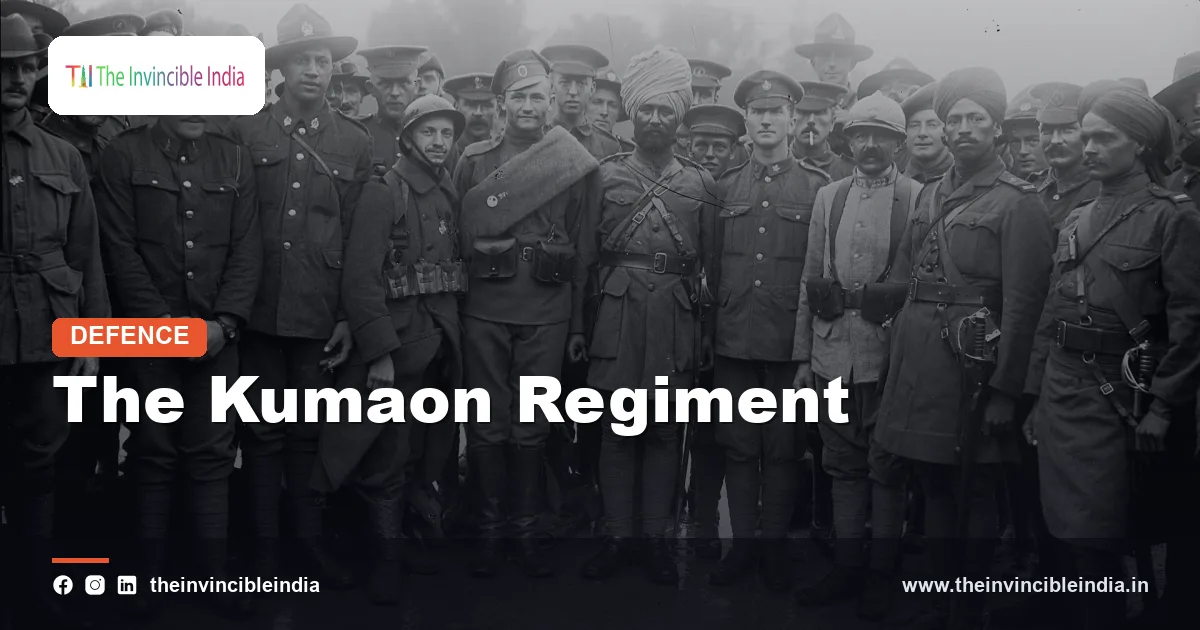
The Kumaon Regiment is an infantry regiment of the Indian Army that recruits chiefly from the Kumaon hills of Uttarakhand and from the Ahir community, with a lineage that runs back to the Hyderabad Contingent of the early nineteenth century and a Regimental Centre at Ranikhet. The regiment owns two of India’s 21 Param Vir Chakras, won by Major Somnath Sharma in 1947 and Major Shaitan Singh in 1962.
Its best-known battle is the last stand of Charlie Company, 13 Kumaon, at Rezang La in Ladakh in November 1962. This guide explains how the Kumaon Regiment came to bear its name, what its war cry and organisation signify, who its famous soldiers and generals were, and why Rezang La looms so large in Indian memory.
Quick Facts: Kumaon Regiment
| Attribute | Detail |
|---|---|
| Type | Infantry regiment of the Indian Army |
| Lineage | Hyderabad Contingent units of 1813, later the Hyderabad Regiment |
| Present name | Redesignated as the Kumaon Regiment in 1945 and retained after independence |
| Regimental Centre | Ranikhet, Almora district, Uttarakhand |
| Principal recruits | Kumaonis, Ahirs (Yadavs) and other groups, with Naga troops in earlier decades |
| War cry | Kalika Mata Ki Jai (Bajrang Bali Ki Jai is also used) |
| Param Vir Chakra recipients | Major Somnath Sharma (1947) and Major Shaitan Singh (1962) |
| Best-known action | Rezang La, Ladakh, 18 November 1962 |
Key Takeaways
- The Kumaon Regiment is an Indian Army infantry regiment with a Regimental Centre at Ranikhet in the Kumaon hills of Uttarakhand.
- The Kumaon Regiment descends from the Hyderabad Contingent and the Hyderabad Regiment, and it took its present name in 1945.
- Major Somnath Sharma of 4 Kumaon, who died defending the Srinagar airfield near Badgam in November 1947, was the first recipient of the Param Vir Chakra.
- Major Shaitan Singh of 13 Kumaon received the Param Vir Chakra for leading Charlie Company at Rezang La in Ladakh on 18 November 1962.
- The war cry of the Kumaon Regiment, “Kalika Mata Ki Jai”, honours the goddess Kali, who is widely worshipped in the Kumaon hills.
- The Kumaon Regiment has produced senior army leaders, including General S. M. Shrinagesh and General K. S. Thimayya, both of whom later served as Chief of the Army Staff.
What is the Kumaon Regiment?
The Kumaon Regiment is a regular infantry regiment of the Indian Army, built around battalions drawn mostly from the Kumaonis of the central Himalayas and the Ahirs of the northern plains. It is one of the oldest regiments in the Army and is often counted among the most decorated for its size.
Unlike regiments named after a single ethnic group, the Kumaon Regiment joined units of mixed origin under a regional name. Its early battalions were raised elsewhere in India, and Kumaoni soldiers became numerous only after the regiment’s reorganisation in the 1940s, which gave the name its present meaning.
The regiment’s battalions are posted across the country and have taken part in major campaigns in Jammu and Kashmir, Ladakh, the north-east, and the plains of Punjab. The Regimental Centre at Ranikhet, a cantonment town in Uttarakhand, is the focal point for recruits, veterans and ceremonial life.
Where did the Kumaon Regiment come from?
The Kumaon Regiment came from the Hyderabad Contingent, a force raised in the early nineteenth century to serve the Nizam of Hyderabad under British supervision, and the oldest battalion traces its beginnings to 1813. These units were later absorbed into the regular Indian Army as the Hyderabad Regiment.
In 1922, the army’s numbered reorganisation placed the Hyderabad battalions together as the 19th Hyderabad Regiment. The regiment then became the 19th Kumaon Regiment in 1945, a change prompted by the growing share of Kumaoni and related hill recruits, and the numerical prefix was dropped after independence.
The history of such redesignations makes exact dates uncertain. Writers often cite slightly different years for battalion raising dates, so official regimental histories should be preferred when precision is required.
| Stage | Name or event |
|---|---|
| 1813 | Earliest Hyderabad Contingent unit raised |
| Nineteenth century | Hyderabad Contingent serves in Indian campaigns |
| 1922 | 19th Hyderabad Regiment formed in the army reorganisation |
| 1945 | Renamed 19th Kumaon Regiment |
| 1947-1948 | Kashmir operations and the first Param Vir Chakra |
| 1962 | Rezang La and Walong |
| 1965, 1971, 1984 and later | Wars, Siachen and counter-insurgency |
Who recruits into the Kumaon Regiment?
The Kumaon Regiment recruits mainly from the Kumaon division of Uttarakhand and from the Ahir community of Haryana, Rajasthan and Uttar Pradesh. Historically some Naga troops also served in Kumaon battalions before a separate Naga Regiment was raised in 1970.
Kumaonis come from the districts of Almora, Bageshwar, Pithoragarh, Champawat, Nainital and Udham Singh Nagar, where military service has long been a major career option. The Ahir battalions, particularly 13 Kumaon, drew heavily on the Ahirwal belt of southern Haryana.
Exact class composition has changed over time, and the Army’s present policy on recruitment has been revised in recent years. Anyone who needs current figures should consult official Indian Army notices, since many regiments now take recruits through national rallies and the Agnipath scheme.
Regions linked with the regiment
- Kumaon hills of Uttarakhand, including Almora and Pithoragarh
- Ahirwal belt of Haryana, including Rewari and Mahendragarh
- Parts of Rajasthan and western Uttar Pradesh
- The north-eastern hills, in the case of Naga recruits in earlier decades
What is the war cry of the Kumaon Regiment?
The war cry of the Kumaon Regiment is “Kalika Mata Ki Jai”, which means “Victory to Mother Kali”, and soldiers also cry “Bajrang Bali Ki Jai” in the name of Lord Hanuman. The invocation of Kali reflects the importance of the goddess in the folk religion of the Kumaon hills.
The regiment uses the cry in parades, ceremonies and moments of attack. Like the war cries of other regiments, it unites soldiers behind a shared symbol and gives the unit a distinct voice on the battlefield.
Where is the Kumaon Regimental Centre?
The Kumaon Regimental Centre is at Ranikhet in the Almora district of Uttarakhand, a hill station and cantonment at an altitude of about 1,800 metres. The Centre trains recruits, keeps regimental records and runs the Kumaon Regimental Museum.
Ranikhet is a wooded station known for its views of the Himalayan peaks. The Centre has a close relationship with local communities and with the many veterans who retire to the surrounding villages.
The museum at Ranikhet displays captured weapons, flags, photographs and relics, and it has a section on the Param Vir Chakra recipients. The Centre also holds annual events on important regimental days, including commemoration of the fallen of Rezang La.
Who was Major Somnath Sharma?
Major Somnath Sharma was an officer of the 4th Battalion of the Kumaon Regiment who became the first recipient of the Param Vir Chakra after he was killed defending Srinagar airfield on 3 November 1947. India’s highest wartime gallantry award was instituted in 1950, and Sharma’s was the first on the list, awarded posthumously.
His company was flown to Srinagar in the early weeks of the 1947-48 war, when tribal raiders and Pakistani forces threatened the capital of Jammu and Kashmir. On 3 November, he commanded a company at Badgam, a few miles from the airfield, and held his position against a much larger force even after being wounded.
Sharma and most of his men were killed, but the delay gave time for reinforcements to arrive and kept the Srinagar airfield and the city secure. He came from a family with a strong tradition of Army service.
What happened at Rezang La in 1962?
Rezang La was a battle fought on 18 November 1962, when Charlie Company of 13 Kumaon, commanded by Major Shaitan Singh, held a high-altitude pass in the Chushul sector of Ladakh against a far larger Chinese force. The company, made up mostly of Ahir soldiers from southern Haryana, fought almost to the last man.
Charlie Company had about 120 soldiers, and accounts put Indian deaths at around 114, with a handful of survivors, while Chinese casualties are reported by Indian sources to have been far higher. The pass lay at around 5,000 metres, in intense cold, and the Indian soldiers fought with limited artillery support.
Major Shaitan Singh, who moved between posts under fire, was wounded and later died, and he received the Param Vir Chakra. A memorial at Chushul and a memorial at Rewari in Haryana, known as the Ahir Dham, honour the men of Charlie Company, and the battle is regularly cited in Indian military education.
Why is Rezang La remembered?
- The company held its ground at high altitude against heavy odds
- The Indian defence helped protect the Chushul airfield approaches
- The casualties were concentrated in one community, so memory is strong in the Ahirwal region
- Major Shaitan Singh received the Param Vir Chakra and other soldiers of the company also received gallantry awards
How many Param Vir Chakras has the Kumaon Regiment won?
The Kumaon Regiment has won two Param Vir Chakras, which are those of Major Somnath Sharma in 1947 and Major Shaitan Singh in 1962. Of the 21 awards made to date, this gives the regiment one of the highest tallies among Indian infantry regiments.
Both awards were made posthumously, and both relate to defensive stands in the first and second decades of independence. The regiment has also earned many Maha Vir Chakras, Vir Chakras, Kirti Chakras, Shaurya Chakras and Sena Medals, though counts differ by source and by date.
How has the Kumaon Regiment fought in other wars?
The Kumaon Regiment has fought in the Second World War, the Jammu and Kashmir operations of 1947-48, the Sino-Indian conflict of 1962, the wars of 1965 and 1971, and later operations such as Siachen and counter-insurgency. Each period has brought additional battle honours.
In the Second World War, battalions of the predecessor regiments served in Burma and in other theatres, and they earned honours for the hard jungle fighting against Japanese forces. In 1962, besides Rezang La, the regiment’s 6th Battalion fought at Walong in the Lohit valley of Arunachal Pradesh, one of the more stubborn Indian defences on the north-east frontier.
Later, Kumaon battalions took part in high-altitude operations on the Siachen Glacier from the mid-1980s and in internal security work in Jammu and Kashmir and the north-east. The regiment’s soldiers also serve in United Nations missions.
Which army chiefs came from the Kumaon Regiment?
The Kumaon Regiment has produced at least two Chiefs of the Army Staff, General S. M. Shrinagesh and General K. S. Thimayya, both of whom began their careers in the units that became the Kumaon Regiment. General Thimayya is also known for chairing the Neutral Nations Repatriation Commission in Korea in 1953.
Many readers ask about the first Indian head of the Army. The first Indian Commander-in-Chief of the Indian Army, General K. M. Cariappa, who took the post in 1949, belonged to the Rajput Regiment and not to the Kumaon Regiment, so he is sometimes mentioned with it in error.
The regiment’s association with senior leadership shows that it has contributed not only fighting soldiers but also officers who rose to the top of the service. Details of individual careers are best checked in official biographies.
How does the Kumaon Regiment compare with the Garhwal Rifles?
The Kumaon Regiment and the Garhwal Rifles are both Uttarakhand hill regiments, but they differ in their origins, their recruiting areas and their decorations. The Kumaon Regiment descends from the Hyderabad Contingent, while the Garhwal Rifles was raised in 1887 from Garhwali recruits.
| Feature | Kumaon Regiment | Garhwal Rifles |
|---|---|---|
| Regimental Centre | Ranikhet | Lansdowne |
| Region | Kumaon hills, plus Ahirs | Garhwal hills |
| Origin | Hyderabad Contingent, 1813 lineage | Raised 1887 at Almora |
| War cry | Kalika Mata Ki Jai | Badri Vishal Lal Ki Jai |
| Param Vir Chakras | Two (1947 and 1962) | None |
Why does the Kumaon Regiment matter?
The Kumaon Regiment matters because its two Param Vir Chakras and its role in the defence of Srinagar and Ladakh tie it directly to the survival of India’s borders in the early years of independence. Its story links the Kumaon hills, the Ahirwal plains and the old Hyderabad forces in a single institution.
The regiment also stands as a reminder of how community identity and military service can reinforce each other. Memorials, annual commemorations and family traditions keep memories of Badgam and Rezang La alive across generations.
As with many regimental histories, details of casualties, ranks and dates are sometimes reported differently. Readers who need exact figures should consult official sources, and this page was last updated on 16 October 2026.
Bottom Line
The Kumaon Regiment is an Indian Army infantry regiment with a Hyderabad Contingent lineage, a Regimental Centre at Ranikhet and the war cry “Kalika Mata Ki Jai”. Its two Param Vir Chakras, from Badgam in 1947 and Rezang La in 1962, make it one of the best-known regiments in the country.
Frequently Asked Questions
What is the Kumaon Regiment?
The Kumaon Regiment is an infantry regiment of the Indian Army recruited mainly from the Kumaon hills of Uttarakhand and from the Ahir community. Its Regimental Centre is at Ranikhet, and its lineage goes back to the Hyderabad Contingent of 1813.
What happened at Rezang La?
At Rezang La on 18 November 1962, Charlie Company of 13 Kumaon, led by Major Shaitan Singh, held a high-altitude pass in Ladakh against a much larger Chinese force. Most of the company’s roughly 120 soldiers died, and Major Shaitan Singh received the Param Vir Chakra.
How many Param Vir Chakras does the Kumaon Regiment have?
The Kumaon Regiment has two Param Vir Chakras. They were awarded to Major Somnath Sharma in 1947 for the defence of Srinagar airfield and to Major Shaitan Singh in 1962 for Rezang La.
What is the war cry of the Kumaon Regiment?
The war cry of the Kumaon Regiment is “Kalika Mata Ki Jai”, meaning victory to Mother Kali. Soldiers also use “Bajrang Bali Ki Jai” in honour of Lord Hanuman.
Where is the Kumaon Regimental Centre?
The Kumaon Regimental Centre is at Ranikhet in the Almora district of Uttarakhand. It trains recruits, houses the regimental museum and supports veterans and families.
Was the first Indian Army chief from the Kumaon Regiment?
No, the first Indian head of the Army, General K. M. Cariappa, belonged to the Rajput Regiment. The Kumaon Regiment’s chiefs include General S. M. Shrinagesh and General K. S. Thimayya, who led the Army later in the 1950s.
{“@context”:”https://schema.org”,”@graph”:[{“@type”:”FAQPage”,”mainEntity”:[{“@type”:”Question”,”name”:”What is the Kumaon Regiment?”,”acceptedAnswer”:{“@type”:”Answer”,”text”:”The Kumaon Regiment is an infantry regiment of the Indian Army recruited mainly from the Kumaon hills of Uttarakhand and from the Ahir community. Its Regimental Centre is at Ranikhet, and its lineage goes back to the Hyderabad Contingent of 1813.”}},{“@type”:”Question”,”name”:”What happened at Rezang La?”,”acceptedAnswer”:{“@type”:”Answer”,”text”:”At Rezang La on 18 November 1962, Charlie Company of 13 Kumaon, led by Major Shaitan Singh, held a high-altitude pass in Ladakh against a much larger Chinese force. Most of the company’s roughly 120 soldiers died, and Major Shaitan Singh received the Param Vir Chakra.”}},{“@type”:”Question”,”name”:”How many Param Vir Chakras does the Kumaon Regiment have?”,”acceptedAnswer”:{“@type”:”Answer”,”text”:”The Kumaon Regiment has two Param Vir Chakras. They were awarded to Major Somnath Sharma in 1947 for the defence of Srinagar airfield and to Major Shaitan Singh in 1962 for Rezang La.”}},{“@type”:”Question”,”name”:”What is the war cry of the Kumaon Regiment?”,”acceptedAnswer”:{“@type”:”Answer”,”text”:”The war cry of the Kumaon Regiment is “Kalika Mata Ki Jai”, meaning victory to Mother Kali. Soldiers also use “Bajrang Bali Ki Jai” in honour of Lord Hanuman.”}},{“@type”:”Question”,”name”:”Where is the Kumaon Regimental Centre?”,”acceptedAnswer”:{“@type”:”Answer”,”text”:”The Kumaon Regimental Centre is at Ranikhet in the Almora district of Uttarakhand. It trains recruits, houses the regimental museum and supports veterans and families.”}},{“@type”:”Question”,”name”:”Was the first Indian Army chief from the Kumaon Regiment?”,”acceptedAnswer”:{“@type”:”Answer”,”text”:”No, the first Indian head of the Army, General K. M. Cariappa, belonged to the Rajput Regiment. The Kumaon Regiment’s chiefs include General S. M. Shrinagesh and General K. S. Thimayya, who led the Army later in the 1950s.”}}]}]}


