

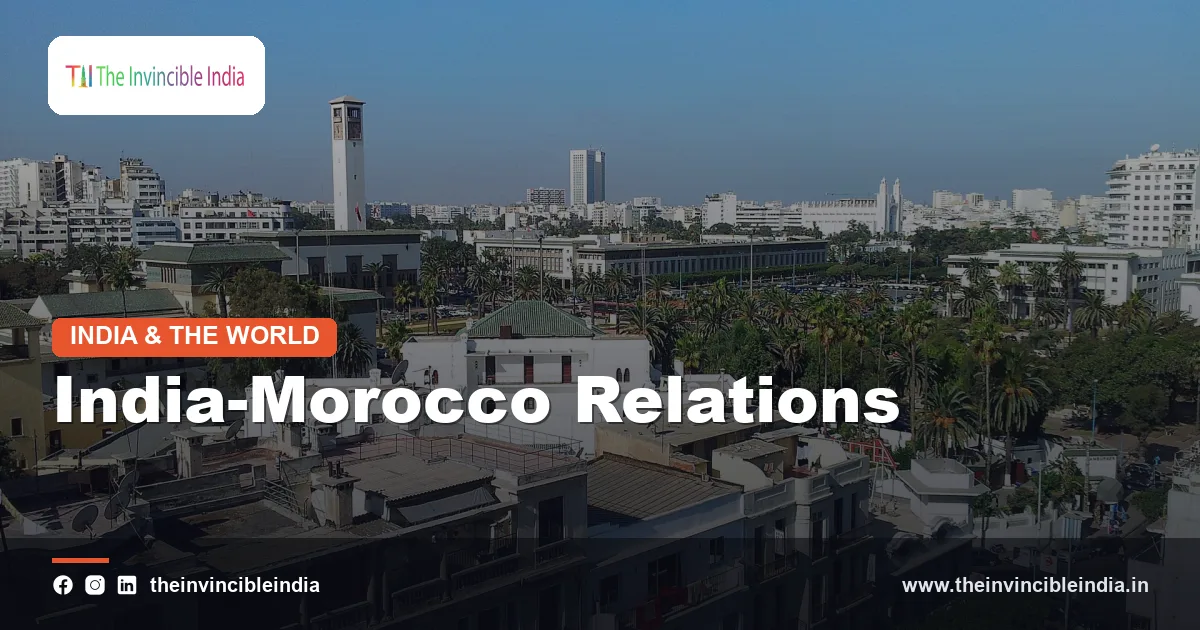
India-Morocco relations are the bilateral ties between the Republic of India and the Kingdom of Morocco, a North African partnership anchored in fertiliser supply, growing trade, defence-industrial cooperation and shared interests in the Global South. Diplomatic relations date to the late 1950s, soon after Morocco regained independence in 1956, and the two countries have since kept consistently cordial, low-friction ties.
The strongest pillar of India-Morocco relations is phosphate: Morocco holds a very large share of the world’s phosphate rock reserves, and India is one of the world’s biggest importers of phosphate-based fertilisers and inputs. Newer areas such as automobiles, defence manufacturing, digital payments and tourism are broadening the partnership.
| Attribute | Details |
|---|---|
| Countries | Republic of India and Kingdom of Morocco |
| Morocco’s independence | 1956, ending the French and Spanish protectorates |
| Diplomatic ties | Established in the late 1950s; embassies in Rabat and New Delhi |
| Key economic link | Phosphate rock, phosphoric acid and fertilisers supplied by Morocco’s OCP Group to India |
| Flagship joint venture | IMACID (Indo Maroc Phosphore S.A.) at Jorf Lasfar, set up in the late 1990s with Indian fertiliser companies |
| Indian exports to Morocco | Vehicles and auto components, machinery, textiles, chemicals, pharmaceuticals, electronics |
| Defence-industrial link | Tata Advanced Systems wheeled armoured vehicle plant near Casablanca, reported in 2025 |
| Shared forums | United Nations, Non-Aligned Movement legacy, G77, International Solar Alliance |
Key Takeaways
- India-Morocco relations are built mainly on phosphate: Morocco’s OCP Group is among India’s most important suppliers of phosphate rock, phosphoric acid and fertilisers.
- The IMACID joint venture at Jorf Lasfar, Morocco, is the best-known example of Indian industrial investment in Morocco.
- Indian companies such as Tata have established manufacturing and defence-related operations in Morocco, linking India’s vehicle industry to Morocco’s export-oriented economy.
- Bilateral trade is counted in the low billions of US dollars, and the totals shift with fertiliser prices, so published figures are approximate.
- Tourism, Bollywood, yoga and a small Indian-origin community give India-Morocco relations a cultural dimension.
- India has kept a cautious, UN-oriented stance on Morocco’s regional disputes, which has helped preserve the cordial character of the relationship.
What is the history of India-Morocco relations?
The history of India-Morocco relations begins with Morocco’s independence in 1956 and the establishment of diplomatic ties soon afterwards, during the period when newly independent Asian and African states were building solidarity. India had been a vocal supporter of decolonisation at the United Nations, and Morocco’s nationalist movement under King Mohammed V received sympathy in Indian public life.
Both countries took part in the wider Afro-Asian political conversation that followed the Bandung Conference of 1955. Morocco was associated with the grouping of progressive African states in the early 1960s and later took part in non-aligned diplomacy, while India was a founding leader of the Non-Aligned Movement.
Key milestones
- 1956: Morocco regains independence from France and Spain.
- Late 1950s: India and Morocco establish diplomatic relations and open missions.
- Late 1990s: The IMACID phosphoric acid joint venture starts at Jorf Lasfar.
- 2000s onward: Regular joint commission meetings, business forums and growing trade volumes.
- 2020s: Expanding cooperation in defence manufacturing, digital payments, energy and fertilisers.
Why is phosphate central to India-Morocco relations?
Phosphate is central to India-Morocco relations because phosphorus is an essential crop nutrient, India’s soils depend on imported phosphate inputs, and Morocco controls roughly three-quarters of the world’s known phosphate rock reserves according to commonly cited estimates. India produces only limited quantities of phosphate rock domestically and imports large volumes of rock, phosphoric acid and finished fertilisers such as diammonium phosphate (DAP).
Morocco’s state-owned OCP Group, headquartered in Casablanca, is one of the largest phosphate producers and exporters in the world. For India, secure supply from OCP helps stabilise fertiliser availability for farmers and supports food-security planning. For Morocco, India is among the largest and most reliable buyers for its phosphate products.
Price changes matter greatly. When global fertiliser prices surged in 2021 and 2022, India’s subsidy bill rose sharply and supply agreements with Morocco became a policy priority. Long-term contracts are therefore a regular feature of the relationship.
What is IMACID and why does it matter?
IMACID, short for Indo Maroc Phosphore S.A., is a joint venture in Morocco between OCP and Indian fertiliser companies, including Chambal Fertilisers and Chemicals and Tata Chemicals, to manufacture phosphoric acid at the Jorf Lasfar industrial complex. The venture began operations in the late 1990s and has produced phosphoric acid mostly for delivery to its Indian shareholders.
IMACID matters because it was an early example of Indian industry securing raw-material supply through direct overseas investment rather than only through spot purchases. It also showed that Morocco was open to value-added partnerships rather than simply exporting unprocessed rock. Over time the venture has expanded capacity, and it is regularly cited as a model of India-Morocco industrial partnership.
The exact shareholding percentages and capacity figures have changed over time, so readers who need precise numbers should consult the companies’ latest annual reports.
How large is trade between India and Morocco?
Trade between India and Morocco is worth a few billion US dollars a year at its highest, with a large Indian import component in fertiliser inputs and a growing Indian export basket of vehicles and manufactured goods. The balance tends to favour Morocco in years of high fertiliser prices and to narrow when prices fall.
What does India import from Morocco?
India imports phosphate rock, phosphoric acid, DAP and other fertilisers, along with sulphur-related products, certain chemicals, cotton, fresh and processed seafood and some agricultural items from Morocco. Fertiliser and phosphate products make up the bulk of the value.
What does India export to Morocco?
India exports automobiles and auto components, two-wheelers, machinery, electrical items, pharmaceuticals, cotton and synthetic textiles, organic chemicals, iron and steel products and food items such as sugar, tea, rice and spices to Morocco. Morocco’s growing automobile and assembly sector has also created demand for Indian components and engineering services.
| Direction | Main product groups | Remarks |
|---|---|---|
| Morocco to India | Phosphate rock, phosphoric acid, DAP and other fertilisers, chemicals | Largest share of trade value; sensitive to global fertiliser prices |
| India to Morocco | Vehicles, auto parts, machinery, textiles, pharmaceuticals, chemicals, food items | Diversifying as Indian manufacturers use Morocco as a gateway to Europe and Africa |
| Investment | IMACID, Tata operations, pharmaceutical and IT firms | Indian firms use Morocco’s free-trade agreements with the EU, the US and African markets |
What is the defence and vehicle connection between India and Morocco?
The defence and vehicle connection between India and Morocco consists mainly of Indian-made vehicles and a manufacturing plant that Tata Advanced Systems has established in Morocco for wheeled armoured platforms. Tata has long sold commercial vehicles in Morocco, and the extension into defence production marks a step beyond conventional trade.
Reports from 2025 indicated that Tata Advanced Systems inaugurated a facility near Casablanca to build armoured vehicles for the Royal Moroccan Armed Forces, described as one of the first Indian private-sector defence manufacturing facilities in Africa. India and Morocco have also held defence consultations and signed arrangements for cooperation in training and the defence industry in recent years.
For India, such partnerships support the goal of expanding defence exports and showing Indian-designed equipment in overseas markets. For Morocco, local assembly fits its strategy of building industrial capacity at home.
How do India and Morocco cooperate in other sectors?
India and Morocco cooperate in other sectors that include digital payments, renewable energy, pharmaceuticals, agriculture, space and education. These sectors reflect the complementary strengths of an Indian economy with scale in technology and services, and a Moroccan economy with strong logistics, ports and renewable-energy ambitions.
- Digital payments: Indian authorities have promoted interoperability of the Unified Payments Interface (UPI) with partner countries, including several in Africa, and fintech cooperation with Morocco is a plausible area of growth.
- Renewable energy: Morocco is known for large solar plants such as the Noor Ouarzazate complex, and both countries are members of the International Solar Alliance.
- Pharmaceuticals: Indian generic medicines are widely used in North Africa, and Moroccan regulators have approved many Indian products.
- Agriculture and food: Cooperation in fertiliser use, soil health and agricultural technology complements the phosphate trade.
- Education and training: Moroccan students and professionals take part in Indian Technical and Economic Cooperation (ITEC) courses and in academic programmes at Indian institutions.
What role do tourism and culture play in India-Morocco relations?
Tourism and culture play a supportive but growing role in India-Morocco relations, led by Bollywood, Indian travellers visiting Moroccan cities and Morocco’s interest in Indian wellness traditions. Cities such as Marrakech, Fez, Chefchaouen and Casablanca appeal to Indian tourists, and Moroccan locations have appeared in Indian films and television productions.
Yoga is practised in Moroccan cities, and the International Day of Yoga is observed in Rabat and other places with the support of the Indian Embassy. A small Indian-origin community, including long-settled Sindhi trading families in Casablanca, adds a human link. The Indian Council for Cultural Relations (ICCR) and Moroccan cultural institutions occasionally organise exchanges.
Direct connectivity remains limited, with most travel routed through Gulf or European hubs. Easier visas and direct flights would increase tourist numbers further.
How do India and Morocco coordinate in international forums?
India and Morocco coordinate in international forums on development issues, climate action, food security and reform of global institutions, and they generally vote in sympathy on matters of concern to developing countries. Both belong to the United Nations and the Group of 77, and both support multilateral approaches to terrorism and climate financing.
Morocco’s regional position on Western Sahara is a sensitive subject in the wider region. India has generally taken a cautious approach, favouring a peaceful, UN-supported political process, and the topic has not been a source of friction with Rabat. In turn, Morocco has expressed understanding for India’s concerns on terrorism. This balanced diplomacy allows India to maintain good relations with Morocco and other North African states.
What challenges and opportunities lie ahead for India-Morocco relations?
The main challenge ahead for India-Morocco relations is diversification beyond fertilisers, and the main opportunity is using Morocco as a manufacturing and export base for Europe and Africa. Fertiliser trade is large but price-sensitive, and the relationship will be more resilient if other sectors grow in proportion.
Challenges
- Dependence of trade value on global phosphate and fertiliser prices.
- Limited direct flights and shipping connections.
- Competition from European, Turkish and Chinese suppliers in Moroccan markets.
- Limited mutual awareness among small and medium-sized businesses.
Opportunities
- Morocco’s free-trade agreements with the European Union, the United States and several African countries make it an attractive base for Indian manufacturers.
- Growth of Moroccan automotive and aerospace clusters offers openings for Indian component makers.
- Green hydrogen, solar energy and green ammonia projects in Morocco could connect with India’s own energy transition goals.
- Defence manufacturing partnerships and digital payment links could deepen the strategic content of the relationship.
Bottom Line
India-Morocco relations are practical, stable and economically grounded, with phosphate and fertilisers forming the backbone and defence manufacturing, digital finance and tourism adding newer layers. The partnership has no major disputes and has room to grow if both countries diversify trade and improve connectivity.
Frequently Asked Questions
Why is Morocco important to India?
Morocco is important to India because it supplies phosphate rock, phosphoric acid and fertilisers that Indian agriculture depends on. Morocco holds a very large share of the world’s phosphate reserves, and its OCP Group is one of the largest exporters. Morocco is also a useful gateway to European and African markets.
What is IMACID?
IMACID, or Indo Maroc Phosphore S.A., is a joint venture between OCP of Morocco and Indian fertiliser firms including Chambal Fertilisers and Tata Chemicals. It produces phosphoric acid at Jorf Lasfar in Morocco, mostly for supply to its Indian partners. It began operating in the late 1990s and is a flagship of the relationship.
What does India export to Morocco?
India exports vehicles, auto components, machinery, textiles, pharmaceuticals, chemicals and food items to Morocco. Tata and other Indian brands sell commercial vehicles there. The product range has widened as Indian firms look to Morocco as a base for wider African and European markets.
Is there defence cooperation between India and Morocco?
Yes, India and Morocco have developed defence cooperation that includes training exchanges and industrial collaboration. Tata Advanced Systems was reported in 2025 to have opened a plant near Casablanca to produce armoured vehicles. The cooperation is commercial and capacity-building in nature rather than a formal military alliance.
What is India’s position on Western Sahara?
India has taken a cautious position on Western Sahara, generally supporting a peaceful political solution through the United Nations. India has avoided actions that would damage its ties with Morocco. The issue has not been a significant irritant in bilateral relations.
How large is India-Morocco trade?
India-Morocco trade is worth a few billion US dollars a year in recent years, though the figure moves with global fertiliser prices. Most of India’s imports are phosphate-related products. India’s exports are more diverse and include vehicles, machinery, textiles and pharmaceuticals.
{“@context”:”https://schema.org”,”@graph”:[{“@type”:”FAQPage”,”mainEntity”:[{“@type”:”Question”,”name”:”Why is Morocco important to India?”,”acceptedAnswer”:{“@type”:”Answer”,”text”:”Morocco is important to India because it supplies phosphate rock, phosphoric acid and fertilisers that Indian agriculture depends on. Morocco holds a very large share of the world’s phosphate reserves, and its OCP Group is one of the largest exporters. Morocco is also a useful gateway to European and African markets.”}},{“@type”:”Question”,”name”:”What is IMACID?”,”acceptedAnswer”:{“@type”:”Answer”,”text”:”IMACID, or Indo Maroc Phosphore S.A., is a joint venture between OCP of Morocco and Indian fertiliser firms including Chambal Fertilisers and Tata Chemicals. It produces phosphoric acid at Jorf Lasfar in Morocco, mostly for supply to its Indian partners. It began operating in the late 1990s and is a flagship of the relationship.”}},{“@type”:”Question”,”name”:”What does India export to Morocco?”,”acceptedAnswer”:{“@type”:”Answer”,”text”:”India exports vehicles, auto components, machinery, textiles, pharmaceuticals, chemicals and food items to Morocco. Tata and other Indian brands sell commercial vehicles there. The product range has widened as Indian firms look to Morocco as a base for wider African and European markets.”}},{“@type”:”Question”,”name”:”Is there defence cooperation between India and Morocco?”,”acceptedAnswer”:{“@type”:”Answer”,”text”:”Yes, India and Morocco have developed defence cooperation that includes training exchanges and industrial collaboration. Tata Advanced Systems was reported in 2025 to have opened a plant near Casablanca to produce armoured vehicles. The cooperation is commercial and capacity-building in nature rather than a formal military alliance.”}},{“@type”:”Question”,”name”:”What is India’s position on Western Sahara?”,”acceptedAnswer”:{“@type”:”Answer”,”text”:”India has taken a cautious position on Western Sahara, generally supporting a peaceful political solution through the United Nations. India has avoided actions that would damage its ties with Morocco. The issue has not been a significant irritant in bilateral relations.”}},{“@type”:”Question”,”name”:”How large is India-Morocco trade?”,”acceptedAnswer”:{“@type”:”Answer”,”text”:”India-Morocco trade is worth a few billion US dollars a year in recent years, though the figure moves with global fertiliser prices. Most of India’s imports are phosphate-related products. India’s exports are more diverse and include vehicles, machinery, textiles and pharmaceuticals.”}}]}]}


