

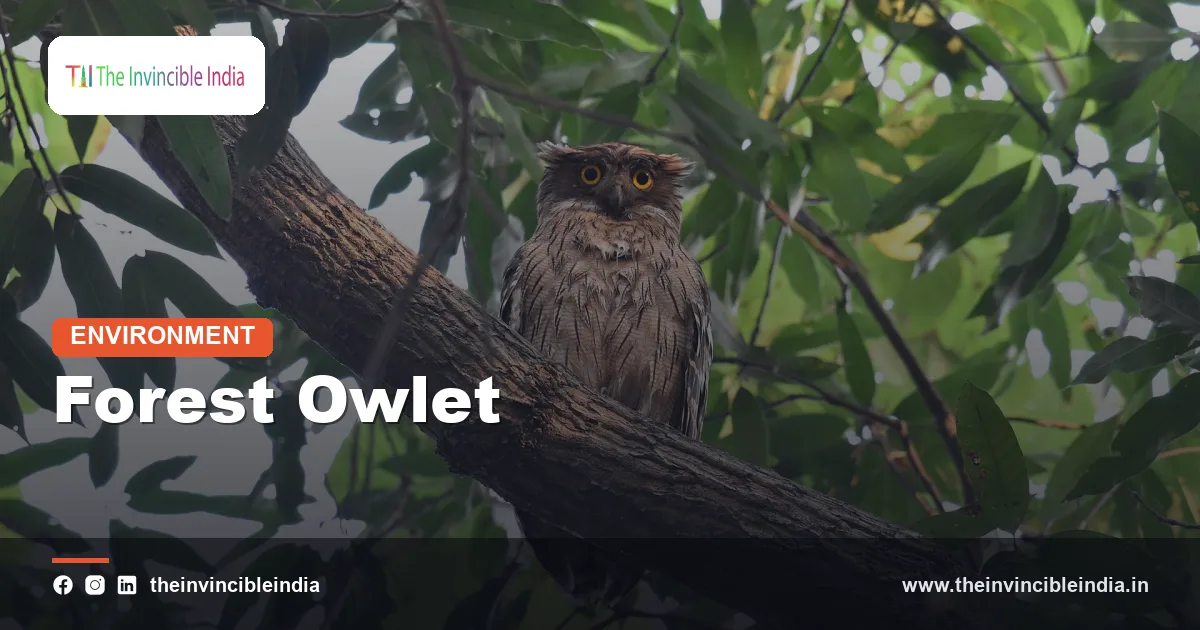
The forest owlet (Athene blewitti, now often placed in the genus Heteroglaux) is a small, endangered owl found only in the dry deciduous forests of central India, and it is famous because ornithologists believed it was extinct for roughly 113 years before it was rediscovered in Maharashtra in 1997. It is a stocky, daytime-active owl, and its conservation depends on protecting a small number of scattered forest patches in the Satpura region and nearby areas.
The story of the forest owlet is one of the most celebrated “lost and found” episodes in Indian ornithology. Today, the bird is protected by law, is the focus of research and community programmes, and remains one of the rarest owls in Asia.
| Attribute | Details |
|---|---|
| Scientific name | Athene blewitti (also treated as Heteroglaux blewitti) |
| Common name | Forest owlet |
| Described by | Allan Octavian Hume, in 1873, from a specimen collected in central India |
| Rediscovery | 1997, in Maharashtra, after about 113 years without a confirmed sighting |
| Endemic to | India (central India, in dry deciduous forest) |
| Key region | Satpura range and nearby forests across Maharashtra, Madhya Pradesh and neighbouring states |
| Size | Small owl, roughly 23 cm long |
| IUCN status | Endangered |
| Legal protection in India | Highest level of protection under the Wildlife (Protection) Act, 1972 |
Key Takeaways
- The forest owlet (Athene blewitti) is a small owl that occurs only in India and lives in the dry deciduous forests of the central Indian hills.
- The forest owlet was considered extinct for about 113 years before it was rediscovered in 1997 in the Shahada region of Maharashtra.
- The forest owlet is active during the day, which is unusual for an owl, and it often perches in the open on bare branches.
- The forest owlet is classified as Endangered by the IUCN, and its population is small and divided among scattered forest patches.
- The main threats to the forest owlet are loss of nesting trees, degradation of dry forest, human disturbance and hunting driven by superstition.
- The forest owlet receives the highest level of protection under India’s Wildlife (Protection) Act, 1972, and is conserved through sanctuaries, research and community involvement.
What is the forest owlet?
The forest owlet is a small, round-headed owl of the family Strigidae that lives in central Indian dry forests and is distinguished by its barred wings and tail, white-spotted brown upperparts, and dark-barred chest. A pale facial disc and bright yellow eyes give it a fierce, alert expression.
The bird measures only about 23 centimetres from head to tail and has a stocky build. Its upper body is brown with small white spots, the crown is dark with pale streaks, and the white underparts carry dark bars on the sides of the breast. The wings and tail are crossed with strong bars, which help in identification.
The species resembles the spotted owlet, a very common Indian bird, but it is heavier and more thickset, and it has a larger, rounder head and a different colour pattern. Birdwatchers separate the two by looking at the bars on the tail and the colouring of the wings.
Why was the forest owlet thought to be extinct?
The forest owlet was thought to be extinct because no confirmed sighting was recorded for about 113 years after the last well-documented record in the nineteenth century. The bird was first described in 1873 by the British naturalist Allan Octavian Hume, and it was named in honour of the collector Blewitt, who obtained the first specimen in central India.
After a few more specimens were collected, the species faded from the records. Several expeditions looked for it without success, and ornithologists feared it had been lost to forest clearance. With so few records and no recent sightings, doubt grew about whether the owl still lived at all. The exact count of years depends on which record is treated as the last reliable one, which is why the figure is commonly given as around a century.
The case became a textbook example of how a rare, inconspicuous species can vanish from view without having gone extinct.
How was the forest owlet rediscovered in 1997?
The forest owlet was rediscovered in 1997 by ornithologists Pamela Rasmussen and Ben King, who found the bird in forest near Shahada in the Nandurbar district of Maharashtra. They had set out to search for it, retracing the old collecting localities and looking in suitable dry forest.
The rediscovery was announced as a major conservation event, and it triggered a fresh round of surveys across central India. Researchers soon located the owlet in a few other sites, including parts of the Satpura belt in Maharashtra and Madhya Pradesh. Studies have since measured its calls, diet, nesting and range, and have shown that it is a habitat specialist with a very patchy distribution.
The rediscovery also had a practical effect. Because the species was now known to exist, authorities and conservation groups could plan protection, and forest departments added the bird to their management priorities.
Where does the forest owlet live?
The forest owlet lives in the dry deciduous forests of central India, mainly in the Satpura hill region and nearby forest patches in Maharashtra, Madhya Pradesh and adjoining states. Teak and mixed deciduous woodland, with fairly open canopy and scattered large trees, is its preferred habitat.
The bird depends on mature trees with natural cavities for nesting and roosting. It is usually found in forest with a mix of teak, other deciduous species and clearings, often on lower hill slopes and near agricultural edges. The species does not occur in dense evergreen forest or in treeless country.
Regions linked to the forest owlet
- The Satpura range in Maharashtra and Madhya Pradesh.
- Forest blocks in the Nandurbar and Jalgaon districts of north-western Maharashtra, where the 1997 rediscovery took place.
- Forests in and around tiger reserves and sanctuaries in the Melghat and Satpura landscapes.
- Scattered records from neighbouring parts of central India, including Chhattisgarh, which hosts historical locations.
Because the exact range is still being clarified through surveys, this list should be read as indicative rather than final.
What makes the forest owlet behave differently from other owls?
The forest owlet is largely diurnal, meaning it hunts and calls in the daytime, unlike most owls, which are nocturnal. It frequently perches on exposed branches in early morning and late afternoon, where it watches for prey.
The species hunts lizards, small rodents, birds and large insects. It drops from a perch to seize prey on the ground, and it may also pursue smaller birds. It is bold in the open, and a person can sometimes observe it for several minutes before it flies. Pairs call to each other with a series of harsh, repeated notes that carry through the forest.
Behaviour at a glance
- Active: mainly in early morning and late afternoon, with a rest during midday heat.
- Diet: lizards, rodents, small birds and insects.
- Territory: pairs defend a home range around their nest cavity.
- Nesting: in tree holes, usually in the cooler, drier months of the year.
Daytime activity makes the species easier to observe than many owls, yet its low numbers and shy habits still make it difficult to find.
How many forest owlets are left?
The forest owlet has a very small and fragmented population, estimated at only a few hundred birds in total, spread across scattered forest patches. Estimates have varied as surveys have improved, so the number should be taken as a rough guide and not a fixed count.
The International Union for Conservation of Nature (IUCN) classifies the species as Endangered. It was previously listed in the more severe Critically Endangered category, and the change reflects the discovery of additional populations, not a clear recovery. Even so, the population is small, individual sub-populations are isolated from each other, and many areas support only a few pairs.
Small and isolated groups face higher risks from local disturbance, inbreeding and chance events, which is why conservationists take the owlet’s long-term outlook seriously despite the improved status.
What are the main threats to the forest owlet?
The main threats to the forest owlet are loss and degradation of dry deciduous forest, felling of large cavity-bearing trees, human disturbance, and hunting or capture linked to superstition. Because the bird needs old trees with natural holes, the removal of mature timber directly cuts its nesting options.
| Threat | How it affects the forest owlet |
|---|---|
| Habitat loss and fragmentation | Forest is cleared for farming, settlements and infrastructure, leaving small and isolated patches |
| Felling of mature trees | Removes the cavities needed for nesting and roosting |
| Forest degradation | Grazing, fuelwood collection and fire reduce prey and cover |
| Superstition and hunting | Owls are sometimes associated with ill omens or black magic, leading to capture or killing |
| Human disturbance | Activity near nests can cause breeding failure |
| Small population size | Isolated groups are vulnerable to local extinction |
Owls in general suffer from negative cultural beliefs in parts of India, and educational work with local communities is therefore as important as habitat protection.
How is the forest owlet protected in India?
The forest owlet is protected in India under the Wildlife (Protection) Act, 1972, which gives it the highest level of legal protection and prohibits hunting, capture and trade. State forest departments enforce the law, with the Ministry of Environment, Forest and Climate Change (MoEFCC) providing national policy.
Several of the places where the owlet occurs lie within protected areas, including wildlife sanctuaries and tiger reserves in the Satpura landscape. Beyond legal protection, conservation groups, universities and forest departments have carried out surveys, tracked nests, run awareness drives and trained local volunteers. Community involvement is considered essential because many owlet sites lie in forests used by villagers.
The species is also on international conservation lists as an Endangered bird, which draws research attention and funding.
What conservation measures help the forest owlet?
Conservation measures that help the forest owlet include protecting known nesting forests, retaining old cavity trees, monitoring populations, and working with local communities. These steps are built around the bird’s need for a few key habitat features rather than for large areas of wilderness.
- Mapping and monitoring: surveys using call playback and nest searches to find new populations and track trends.
- Protecting nest trees: marking and preserving trees with cavities, and avoiding logging in nesting areas.
- Habitat management: reducing fire, controlling grazing and maintaining a mosaic of open and wooded land.
- Community outreach: sharing information in villages to replace fear of owls with pride in a rare local bird.
- Research: studying breeding success, diet and movement to inform long-term plans.
- Landscape connectivity: keeping forest corridors between populations where possible.
Birdwatching tourism, if carefully managed, can also give villagers an income linked to the bird and offer a reason to protect it.
Why does the forest owlet matter?
The forest owlet matters because it is an endemic bird found nowhere else in the world, an indicator of the health of dry deciduous forests, and a symbol of the value of searching for lost species. Its survival shows that conservation can succeed even after long periods of uncertainty.
Dry deciduous forests receive less attention than evergreen rainforests, yet they support many specialised species. Protecting the habitat of the forest owlet helps conserve other animals that depend on large old trees, including other cavity-nesting birds and small mammals. The owlet is also a useful reminder that biodiversity in India extends beyond well-known species such as the tiger.
Bottom Line
The forest owlet is a rare, daytime-active owl restricted to the dry forests of central India, rediscovered in 1997 after being presumed lost for over a century. Its future depends on protecting old cavity-bearing trees and scattered forest patches, backed by legal protection and community support. Information is current as of 17 October 2026.
Frequently Asked Questions
What is the scientific name of the forest owlet?
The scientific name of the forest owlet is Athene blewitti, and some authorities place it in the genus Heteroglaux as Heteroglaux blewitti. It was described by Allan Octavian Hume in 1873 and is found only in India.
When was the forest owlet rediscovered?
The forest owlet was rediscovered in 1997 by ornithologists Pamela Rasmussen and Ben King in the Nandurbar region of Maharashtra. The bird had not been confirmed for about 113 years and had been thought to be extinct.
Where is the forest owlet found?
The forest owlet is found in the dry deciduous forests of central India, mainly in the Satpura hill region and nearby forest patches in Maharashtra and Madhya Pradesh. It prefers teak and mixed deciduous forest with large trees that have nesting cavities.
Is the forest owlet active in the day?
Yes, the forest owlet is mostly active during the day, which is unusual among owls. It often perches openly on branches in the morning and late afternoon and hunts lizards, rodents, small birds and large insects.
Is the forest owlet endangered?
Yes, the forest owlet is classified as Endangered by the IUCN. Its population is small and fragmented, and it faces threats from forest loss, felling of nesting trees and superstitious hunting.
How is the forest owlet protected in India?
The forest owlet is protected under India’s Wildlife (Protection) Act, 1972, which gives it the highest level of legal protection and bans hunting and trade. Protection is also provided through sanctuaries, tiger reserves, scientific monitoring and community awareness programmes.
{“@context”:”https://schema.org”,”@graph”:[{“@type”:”FAQPage”,”mainEntity”:[{“@type”:”Question”,”name”:”What is the scientific name of the forest owlet?”,”acceptedAnswer”:{“@type”:”Answer”,”text”:”The scientific name of the forest owlet is Athene blewitti, and some authorities place it in the genus Heteroglaux as Heteroglaux blewitti. It was described by Allan Octavian Hume in 1873 and is found only in India.”}},{“@type”:”Question”,”name”:”When was the forest owlet rediscovered?”,”acceptedAnswer”:{“@type”:”Answer”,”text”:”The forest owlet was rediscovered in 1997 by ornithologists Pamela Rasmussen and Ben King in the Nandurbar region of Maharashtra. The bird had not been confirmed for about 113 years and had been thought to be extinct.”}},{“@type”:”Question”,”name”:”Where is the forest owlet found?”,”acceptedAnswer”:{“@type”:”Answer”,”text”:”The forest owlet is found in the dry deciduous forests of central India, mainly in the Satpura hill region and nearby forest patches in Maharashtra and Madhya Pradesh. It prefers teak and mixed deciduous forest with large trees that have nesting cavities.”}},{“@type”:”Question”,”name”:”Is the forest owlet active in the day?”,”acceptedAnswer”:{“@type”:”Answer”,”text”:”Yes, the forest owlet is mostly active during the day, which is unusual among owls. It often perches openly on branches in the morning and late afternoon and hunts lizards, rodents, small birds and large insects.”}},{“@type”:”Question”,”name”:”Is the forest owlet endangered?”,”acceptedAnswer”:{“@type”:”Answer”,”text”:”Yes, the forest owlet is classified as Endangered by the IUCN. Its population is small and fragmented, and it faces threats from forest loss, felling of nesting trees and superstitious hunting.”}},{“@type”:”Question”,”name”:”How is the forest owlet protected in India?”,”acceptedAnswer”:{“@type”:”Answer”,”text”:”The forest owlet is protected under India’s Wildlife (Protection) Act, 1972, which gives it the highest level of legal protection and bans hunting and trade. Protection is also provided through sanctuaries, tiger reserves, scientific monitoring and community awareness programmes.”}}]}]}


