

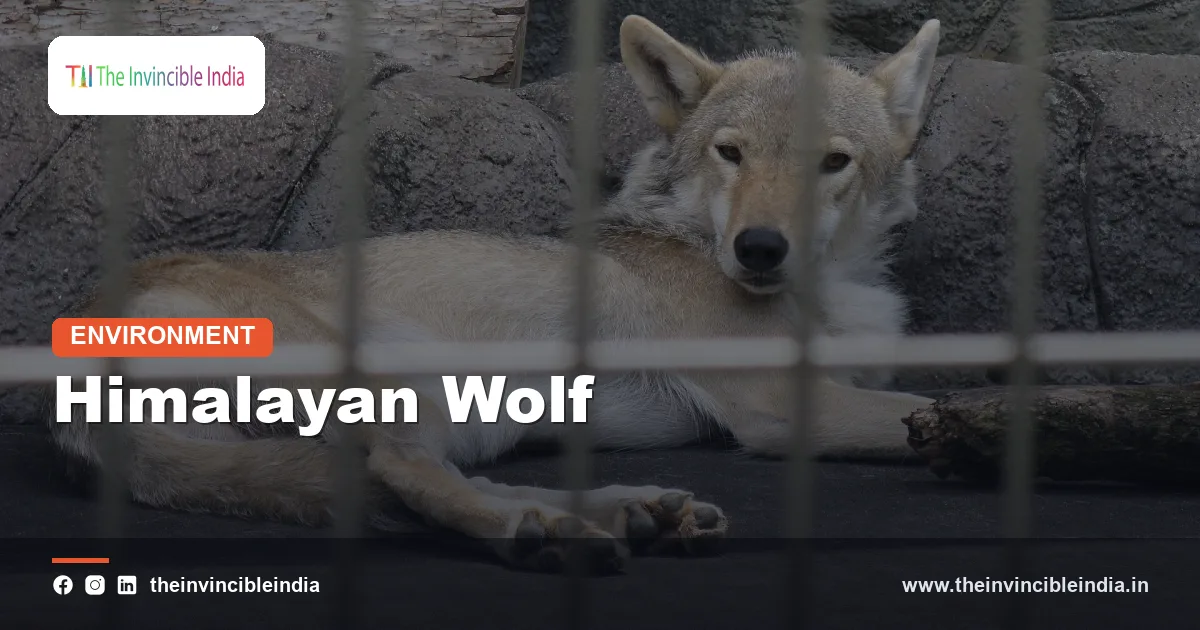
The Himalayan wolf (Canis lupus chanco, often treated together with the Tibetan wolf) is a high-altitude wolf lineage of the Himalayas and the Tibetan plateau that genetic studies suggest separated from other wolves hundreds of thousands of years ago and is adapted to life in thin, oxygen-poor air. In India it survives mainly in the cold deserts of Ladakh, Lahaul and Spiti, where it hunts wild mountain ungulates and, at times, preys on the livestock of herding communities.
Himalayan wolf conservation matters because this animal may represent a distinct evolutionary lineage rather than a common wolf at a high elevation, and because its future depends on how pastoralists, wildlife managers and scientists find ways to share rangelands. This explainer covers its biology, range, taxonomy, threats and legal protection.
| Attribute | Detail |
|---|---|
| Common names | Himalayan wolf, Tibetan wolf (taxonomy debated) |
| Scientific name | Canis lupus chanco; some researchers have proposed treating it as a separate species or lineage |
| Evolutionary history | Genetic studies estimate separation from other wolf lineages roughly 0.7 million years ago (an approximate, research-based figure) |
| Range in India | Ladakh (including Changthang), Lahaul and Spiti in Himachal Pradesh, and adjoining high-altitude regions |
| Typical elevation | Commonly above about 3,000 m and up to more than 5,000 m |
| Main prey | Blue sheep (bharal), Tibetan gazelle, ibex, argali, Tibetan wild ass foals, marmots and hares |
| Legal protection in India | Protected under the Wildlife (Protection) Act, 1972 (wolves are generally listed in the highest protection schedule; check current text) |
| Population | No reliable national count; thought to be small and scattered |
Key Takeaways
- The Himalayan wolf is a high-altitude wolf lineage that genetic research suggests diverged from other wolves roughly 0.7 million years ago, making it one of the oldest wolf lineages known.
- Himalayan wolves in India are found mainly in Ladakh and in Lahaul and Spiti, at elevations that commonly exceed 3,000 metres.
- The Himalayan wolf hunts wild herbivores such as blue sheep and Tibetan gazelle, but also kills livestock, which brings it into conflict with herders.
- Researchers have identified genetic adaptations in Himalayan wolves that appear to help them cope with low-oxygen conditions at altitude.
- Retaliatory killing, stone-pit traps, free-ranging dogs and loss of wild prey are the major threats to Himalayan wolves in India.
- Community-based measures such as predator-proof corrals and compensation or insurance schemes are the main tools used to reduce conflict with the Himalayan wolf.
What is the Himalayan wolf?
The Himalayan wolf is a medium-sized wolf with a thick, pale to greyish-brown coat, found in the high mountains and plateaus of the Himalayas and the Tibetan region. It is generally smaller and lighter-bodied than the wolves of northern forests and tundra, which fits life in sparse, open, cold landscapes.
The animal is usually linked in the scientific literature with the subspecies Canis lupus chanco, sometimes called the Tibetan wolf or Mongolian wolf. Studies of mitochondrial and nuclear DNA from wolves in the Himalayan region, including work associated with the Himalayan Wolf Project, found that these animals carry a lineage that differs from the Holarctic grey wolf and from the Indian wolf of the peninsula. Some researchers argue the lineage deserves recognition as a distinct species, sometimes named Canis himalayensis, but this view is debated and not universally accepted.
The Himalayan wolf is therefore best described as an ancient high-altitude wolf lineage whose precise taxonomic rank is still under scientific discussion. For conservation, the key point is the same either way: the animal is evolutionarily distinct and ecologically important.
Where does the Himalayan wolf live in India?
The Himalayan wolf lives in India’s high-altitude cold deserts and alpine rangelands, especially in Ladakh and in the Lahaul and Spiti region of Himachal Pradesh. It occupies open terrain with scattered shrubs and grass, steep slopes and river valleys, where wild ungulates graze.
Important areas where Himalayan wolves have been recorded or are expected include:
- Changthang Cold Desert Wildlife Sanctuary and the wider Changthang plateau in Ladakh.
- Hanle and surrounding high-altitude grasslands in eastern Ladakh.
- Spiti Valley, including the Pin Valley National Park and the Kibber Wildlife Sanctuary area.
- Other high-altitude pastures in Ladakh and neighbouring Himalayan states, where records are patchy.
Beyond India, the lineage extends to Nepal, Tibet and parts of western China and Bhutan. Exact boundaries of the range, and the number of animals in each region, remain uncertain because the terrain is remote and surveys are costly and difficult.
The wolf generally moves seasonally, following prey and avoiding the deepest snow, and individuals can travel long distances across ridges and valleys.
How is the Himalayan wolf adapted to high altitude?
The Himalayan wolf is adapted to high altitude through a combination of physical features and genetic changes that help it use oxygen efficiently in thin air. Compared with lowland wolves, it is thought to have evolved mechanisms for coping with chronic low oxygen, intense cold and strong ultraviolet radiation.
Research on the genome of Himalayan and Tibetan wolves has pointed to changes in genes linked to oxygen transport and cardiovascular function, including genes such as EPAS1 that are also associated with high-altitude adaptation in humans and other mountain animals. These findings are from published scientific studies, though details and their interpretation continue to be refined.
Observable adaptations include:
- A dense double coat that insulates against sub-zero winter temperatures.
- A compact build and strong legs for moving over steep, rocky ground.
- Efficient oxygen use that supports hunting and travelling above 4,000 metres.
- Pale or grey colouring that blends into rocky, dry landscapes.
These traits make the Himalayan wolf a rare example of a large carnivore that thrives in one of the planet’s harshest environments, and they add to the scientific value of its conservation.
What does the Himalayan wolf eat?
The Himalayan wolf eats mainly wild mountain ungulates and small mammals, with livestock forming a variable share of its diet depending on how many wild prey remain. In remote areas with healthy wild prey, wolves tend to rely on natural food, but where wild herbivores are scarce, sheep, goats and young horses become attractive targets.
Prey commonly reported in studies from the Indian Himalaya and nearby regions includes:
- Blue sheep (bharal), a key prey species for both wolves and snow leopards.
- Tibetan gazelle and other gazelle-like species on the Changthang plateau.
- Ibex and argali (the Tibetan argali) in rugged terrain.
- Marmots, pikas, hares and other small mammals, which are especially important in summer.
- Foals of the kiang (Tibetan wild ass) and other young animals.
- Domestic sheep, goats, yaks and horses grazing on common pastures.
Wolves hunt in small packs, often of two to six animals, using stamina over long distances. They are generally less specialised than snow leopards in cliff hunting but are better at pursuing prey across open terrain.
Why does the Himalayan wolf matter to mountain ecosystems?
The Himalayan wolf matters because, as a top predator of the high-altitude cold desert, it regulates wild herbivore numbers and shares the food web with the snow leopard. Its presence signals a functioning high-altitude ecosystem with intact prey populations.
Key ecological roles include:
- Prey regulation: wolves limit populations of wild grazers, which helps prevent overgrazing of fragile pastures.
- Carrion supply: leftover kills feed foxes, ravens, lammergeiers and other scavengers in sparse landscapes.
- Selective pressure: hunting by wolves tends to remove weak or old animals, supporting healthier herds.
- Genetic heritage: the lineage preserves evolutionary diversity that would be lost if the animal disappeared.
Because the Himalayan wolf and snow leopard share prey and rangelands, conservation programmes that protect one often benefit the other. In practice, though, wolves are rarely given the same attention as snow leopards, even though they may be more directly persecuted.
What is the conflict between the Himalayan wolf and herders?
The conflict arises because Himalayan wolves sometimes kill livestock, which are the main source of income and food for pastoral communities such as the Changpa herders of Ladakh and farming households in Spiti. A single night’s loss in an unguarded corral can represent a significant part of a family’s wealth.
Livestock losses tend to occur when:
- Animals graze unguarded in remote pastures or are left overnight in poorly built enclosures.
- Wild prey populations have declined because of competition with livestock or past hunting.
- Winter conditions push wolves to seek easier prey near villages.
Herders in some areas have traditionally responded by killing wolves, including through stone-pit traps that have been documented in parts of the Himalaya. Such retaliatory killing is illegal but difficult to monitor in remote terrain.
Conservation groups, including local community organisations and research bodies, have promoted practical solutions:
- Predator-proof corrals with strong walls and roofs, which protect livestock overnight.
- Livestock insurance and community-managed compensation funds.
- Better herding practices, including use of guard dogs and daytime supervision.
- Income from wildlife tourism and homestays linked to conservation.
What are the main threats to the Himalayan wolf?
The main threats to the Himalayan wolf are retaliatory killing, trapping, hybridisation and competition with free-ranging dogs, depletion of wild prey and disturbance from development. These pressures act on small, scattered populations, so even a handful of deaths can matter.
Retaliatory killing and trapping
Wolves are killed by herders protecting livestock, sometimes through poisoning, shooting or pit traps. In some places, killing is a long-established practice that has persisted despite legal protection.
Free-ranging dogs
Dogs associated with settlements, army camps, tourism and herding camps can spread diseases to wolves, compete with them for food and, in some cases, breed with them. Scientists are concerned about the possible genetic dilution of the wolf lineage, though the extent is not well documented.
Loss of wild prey
Overgrazing by livestock and past hunting have reduced wild herbivores in parts of the range, which pushes wolves towards domestic animals.
Development and climate change
Roads, infrastructure, mining and increased tourism fragment habitat and increase disturbance. Climate change is altering snow cover, vegetation and water availability in the Himalaya, which could affect both wolves and their prey in ways that are still being studied.
What is the legal status of the Himalayan wolf in India?
The Himalayan wolf is protected in India under the Wildlife (Protection) Act, 1972, which prohibits hunting, trapping and trade in wolves and their parts. Wolves in India are generally placed in the highest protection category, Schedule I, but the Act has been amended over the years, so readers should check the current text for the exact listing.
At the global level, the grey wolf as a whole is classified by the IUCN as Least Concern, but this assessment covers the wide-ranging species and does not reflect the situation of the small, distinct Himalayan population. Some researchers have argued that a separate assessment of the Himalayan lineage is needed, since its numbers are low and its range restricted.
Protected areas that shelter Himalayan wolves include Changthang Cold Desert Wildlife Sanctuary, Pin Valley National Park and Kibber Wildlife Sanctuary, among others. However, many wolves range outside these areas on community pastures, where enforcement depends on local cooperation.
How does the Himalayan wolf compare with the Indian wolf?
The Himalayan wolf differs from the Indian wolf in habitat, genetics and prey: it lives in cold high-altitude regions, whereas the Indian wolf lives in warm semi-arid plains and scrub of peninsular India. Both are separate lineages from the Holarctic grey wolf, and both are threatened by conflict and habitat change.
| Feature | Himalayan wolf | Indian wolf |
|---|---|---|
| Scientific name | Canis lupus chanco (lineage, rank debated) | Canis lupus pallipes |
| Habitat | High-altitude cold deserts and alpine pastures | Semi-arid grasslands, scrub and agricultural land |
| Main region in India | Ladakh, Lahaul and Spiti | Gujarat, Rajasthan, Maharashtra, Karnataka, Madhya Pradesh and others |
| Typical prey | Blue sheep, gazelle, ibex, marmots | Blackbuck, chinkara, hares, livestock |
| Key adaptation | Low-oxygen tolerance and thick coat | Heat tolerance and open-country hunting |
| Main conflict | Livestock depredation with pastoralists | Livestock loss and, rarely, attacks on children |
Comparing the two shows that wolves in India are not a single uniform population; they are distinct lineages with different needs, and conservation plans must reflect that diversity.
How many Himalayan wolves are there?
No reliable, recent count of Himalayan wolves exists, and the population in India is believed to be small, scattered and difficult to survey. Researchers working in the region have suggested that the global population of the Himalayan lineage may be only in the hundreds, although such estimates are uncertain and should be treated as approximate.
Estimating numbers is difficult because:
- The terrain is steep, remote and snowbound for much of the year.
- Wolves occur at low densities and range over very large areas.
- Scat, tracks and camera-trap images are hard to distinguish from those of dogs without genetic testing.
Genetic analysis of scat samples has therefore become a key tool, because it allows scientists to confirm the species and lineage, estimate individual numbers and detect any hybridisation. Continued monitoring is essential for deciding whether the lineage needs a formal conservation status of its own.
How can the Himalayan wolf be conserved?
The Himalayan wolf can be conserved by combining community-based conflict reduction, protection of wild prey, genetic monitoring and stronger enforcement against killing. Because wolves roam over large unprotected pastures, the people who live there must be partners in conservation.
Priority actions include:
- Livestock protection: build and maintain predator-proof corrals, and support insurance or compensation schemes that are paid promptly.
- Prey recovery: manage grazing so that wild herbivores such as blue sheep and gazelle can recover.
- Dog management: vaccinate and control free-ranging dogs near wolf habitat to reduce disease and hybridisation.
- Research and monitoring: expand genetic surveys to clarify taxonomy, range and numbers.
- Responsible tourism: channel wildlife tourism income to herding families and limit disturbance.
- Policy attention: consider whether the Himalayan lineage deserves a separate conservation status.
Such measures are most effective when designed with herding communities, whose traditional knowledge and consent are central to success.
Bottom Line
The Himalayan wolf is an ancient, high-altitude wolf lineage whose survival in India depends on coexistence with herders. Protecting prey, securing livestock and monitoring the population genetically are the most practical steps. Last updated: 17 October 2026.
Frequently Asked Questions
Is the Himalayan wolf a separate species?
The Himalayan wolf is treated by many sources as a subspecies of the grey wolf, Canis lupus chanco, but some researchers argue it is a distinct species. Genetic studies show it is a very old lineage that separated from other wolves roughly 0.7 million years ago. The scientific debate is ongoing, so classification varies between authorities.
Where can the Himalayan wolf be found in India?
The Himalayan wolf is found mainly in Ladakh and in Lahaul and Spiti, in high-altitude cold desert and alpine pastures. Areas such as Changthang, Hanle and the Spiti Valley are important. Sightings are rare because the animals are shy and the terrain is remote.
What does the Himalayan wolf eat?
The Himalayan wolf eats wild ungulates such as blue sheep, Tibetan gazelle and ibex, along with marmots, hares and other small mammals. When wild prey is scarce, it may also kill domestic sheep, goats and horses. The mix depends on local prey availability.
Is the Himalayan wolf endangered?
The Himalayan wolf does not have a separate IUCN assessment, and the grey wolf species as a whole is rated Least Concern. However, the Himalayan population is believed to be small and scattered, so many scientists consider it to be at risk. A dedicated assessment would help clarify its status.
Is the Himalayan wolf protected in India?
Yes, wolves are protected under the Wildlife (Protection) Act, 1972, which bans hunting and trade. They are generally placed in the highest protection schedule, but readers should check the current text because schedules have been amended. Enforcement is difficult in remote pastures.
How is the Himalayan wolf different from the Indian wolf?
The Himalayan wolf lives in cold, high-altitude regions and is adapted to thin air, whereas the Indian wolf lives in warm plains and scrub. They are also genetically distinct lineages and hunt different prey. Both face threats from conflict and habitat change.
{“@context”:”https://schema.org”,”@graph”:[{“@type”:”FAQPage”,”mainEntity”:[{“@type”:”Question”,”name”:”Is the Himalayan wolf a separate species?”,”acceptedAnswer”:{“@type”:”Answer”,”text”:”The Himalayan wolf is treated by many sources as a subspecies of the grey wolf, Canis lupus chanco, but some researchers argue it is a distinct species. Genetic studies show it is a very old lineage that separated from other wolves roughly 0.7 million years ago. The scientific debate is ongoing, so classification varies between authorities.”}},{“@type”:”Question”,”name”:”Where can the Himalayan wolf be found in India?”,”acceptedAnswer”:{“@type”:”Answer”,”text”:”The Himalayan wolf is found mainly in Ladakh and in Lahaul and Spiti, in high-altitude cold desert and alpine pastures. Areas such as Changthang, Hanle and the Spiti Valley are important. Sightings are rare because the animals are shy and the terrain is remote.”}},{“@type”:”Question”,”name”:”What does the Himalayan wolf eat?”,”acceptedAnswer”:{“@type”:”Answer”,”text”:”The Himalayan wolf eats wild ungulates such as blue sheep, Tibetan gazelle and ibex, along with marmots, hares and other small mammals. When wild prey is scarce, it may also kill domestic sheep, goats and horses. The mix depends on local prey availability.”}},{“@type”:”Question”,”name”:”Is the Himalayan wolf endangered?”,”acceptedAnswer”:{“@type”:”Answer”,”text”:”The Himalayan wolf does not have a separate IUCN assessment, and the grey wolf species as a whole is rated Least Concern. However, the Himalayan population is believed to be small and scattered, so many scientists consider it to be at risk. A dedicated assessment would help clarify its status.”}},{“@type”:”Question”,”name”:”Is the Himalayan wolf protected in India?”,”acceptedAnswer”:{“@type”:”Answer”,”text”:”Yes, wolves are protected under the Wildlife (Protection) Act, 1972, which bans hunting and trade. They are generally placed in the highest protection schedule, but readers should check the current text because schedules have been amended. Enforcement is difficult in remote pastures.”}},{“@type”:”Question”,”name”:”How is the Himalayan wolf different from the Indian wolf?”,”acceptedAnswer”:{“@type”:”Answer”,”text”:”The Himalayan wolf lives in cold, high-altitude regions and is adapted to thin air, whereas the Indian wolf lives in warm plains and scrub. They are also genetically distinct lineages and hunt different prey. Both face threats from conflict and habitat change.”}}]}]}


