

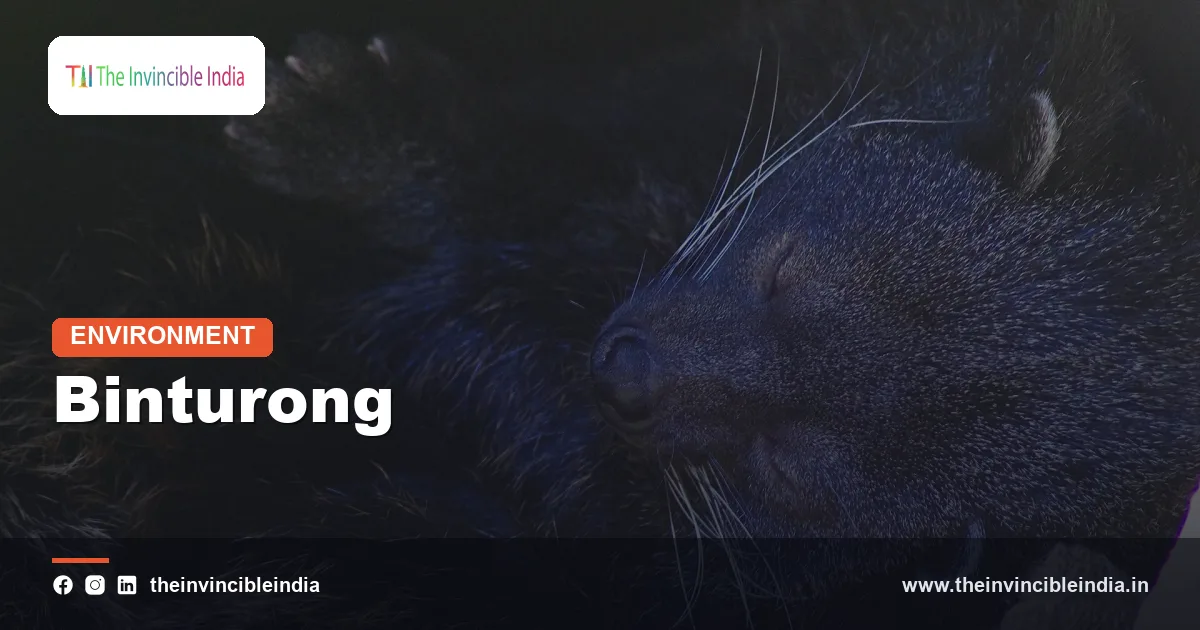
The binturong (Arctictis binturong), also known as the bearcat, is a shaggy, tree-dwelling carnivore of the civet family that lives in the forests of Northeast India and Southeast Asia and is classified as Vulnerable by the International Union for Conservation of Nature (IUCN). It is best known for its strong, muscular prehensile tail and for a smell often compared with buttered popcorn, and it plays a quiet but real part in dispersing the seeds of forest fruit trees.
Binturong conservation in India focuses on protecting the evergreen and semi-evergreen forests of the northeastern states and northern West Bengal, where the animal is rarely seen and poorly studied. This explainer covers what the binturong is, where it lives, how it behaves, why it matters to forest ecology, the threats it faces, and how Indian law protects it.
| Attribute | Detail |
|---|---|
| Common names | Binturong, bearcat |
| Scientific name | Arctictis binturong (family Viverridae, the civets and their relatives) |
| Global IUCN status | Vulnerable, with a declining population trend |
| Range in India | Northeast India and adjoining forests, including Arunachal Pradesh, Assam, Meghalaya and North Bengal; records elsewhere are uncertain |
| Typical body weight | Roughly 9 to 20 kg, with females generally larger than males |
| Distinctive features | Prehensile tail, long black coarse fur, tufted ears and a popcorn-like scent |
| Diet | Mainly fruit (especially figs), with small animals, birds, eggs and insects |
| Legal protection in India | Protected under the Wildlife (Protection) Act, 1972 (generally cited in the highest protection schedule; verify current text) |
Key Takeaways
- The binturong is a large, arboreal member of the civet family Viverridae and is not related to bears or cats despite the common name bearcat.
- The binturong is one of the very few carnivorans in the Old World with a fully prehensile tail, which it uses like a fifth limb when climbing.
- The characteristic buttered-popcorn smell of the binturong has been linked by chemists to a compound called 2-acetyl-1-pyrroline in its scent marks.
- The binturong feeds mostly on fruit, especially figs, which makes it an important seed disperser in tropical and subtropical forests.
- Habitat loss, hunting for meat and traditional use, and the pet trade are the main threats to the binturong, which is rated Vulnerable by the IUCN.
- In India, the binturong is a legally protected species, but little population data exists, which makes planning difficult.
What is a binturong?
A binturong is a stocky, long-haired, nocturnal mammal about the size of a medium dog, with coarse black fur, tufted ears, long whiskers and a thick tail that can grip branches. It belongs to the family Viverridae, which also includes civets, genets and linsangs, and it is the only living member of the genus Arctictis.
The nickname bearcat comes from its bear-like walk and cat-like face, but this is a misnomer. The binturong is closer to civets than to either bears or cats. Its body is heavy and its limbs are short, which gives it a slow, deliberate movement on the ground, but in trees it is surprisingly agile.
Notable physical features include:
- Shaggy black or dark brown fur, often with a grizzled grey tinge on the head and shoulders.
- White-tipped whiskers and ear tufts that give the face a distinctive look.
- A long, thick, muscular tail, almost as long as the body, that can curl around branches.
- Rotating hind ankles that allow it to climb down trees head first.
Females are usually a little larger than males, which is unusual among carnivorans.
Where is the binturong found in India?
The binturong is found in India mainly in the dense evergreen and semi-evergreen forests of the northeastern states and in adjoining forested parts of North Bengal. It occurs in parts of Arunachal Pradesh, Assam, Meghalaya and neighbouring areas, but exact distribution within India is poorly documented.
Beyond India, the species ranges through Nepal, Bhutan, Bangladesh, Myanmar, Thailand, Laos, Cambodia, Vietnam, peninsular Malaysia, Sumatra, Borneo, Java and Palawan, though some of these populations are patchy. This broad range hides the fact that in most countries the animal is declining, as forests are cleared.
In India, sightings and camera-trap records are mostly from:
- Protected areas and community forests in the Eastern Himalaya, such as in Arunachal Pradesh.
- Forest tracts in the Garo Hills and other parts of Meghalaya and Assam.
- Foothill forests of North Bengal, such as those near the Buxa landscape.
The species is considered a rare and elusive animal in these regions. Because it lives high in the canopy, it is easily missed in standard ground-level wildlife surveys.
Why does the binturong have a prehensile tail?
The binturong has a prehensile tail because it spends most of its life in the forest canopy, and the tail acts as a fifth limb that supports its heavy body while it climbs and feeds. The muscular tail can wrap around branches, and the underside near the tip has a patch that improves grip.
This ability is rare among carnivorans. Within the order Carnivora, the binturong is generally regarded as the only Old World member with a fully prehensile tail, and the other well-known example is the kinkajou, a New World relative of raccoons.
The tail allows the binturong to:
- Hang securely while reaching for fruit at the ends of thin branches.
- Climb slowly but safely, keeping three limbs and the tail in contact with a branch.
- Descend tree trunks head first, using its flexible hind ankles together with the tail for stability.
- Rest and sleep in the canopy without falling.
The binturong cannot leap well, so it moves in a measured way, testing each branch before shifting its weight.
Why does the binturong smell like popcorn?
The binturong smells like popcorn because its scent marks contain a volatile chemical compound, 2-acetyl-1-pyrroline, which is also responsible for the aroma of cooked popcorn and some varieties of fragrant rice. Many people compare the smell to buttered popcorn or warm corn tortillas.
The animal produces scent from glands near the base of its tail and also from urine. It rubs the secretion on branches and tree trunks to mark territory and to advertise its presence to other binturongs. A study of captive animals by researchers in the 2010s identified the chemical, and the finding drew wide attention because it showed how a familiar food smell can arise in an unrelated animal.
This scent has some practical value for field research, since the smell can sometimes alert observers to the animal’s presence. Even so, the marking behaviour is mainly part of the binturong’s social communication.
What does the binturong eat?
The binturong eats mostly fruit, with figs being a favoured food, along with leaves, shoots, small vertebrates, eggs, insects and carrion when the opportunity arises. This varied diet makes it an omnivore with a strong lean towards plant food.
The typical diet includes:
- Figs and other ripe forest fruits, which form the staple in many regions.
- Small mammals, birds and their eggs, taken opportunistically.
- Fish, frogs, earthworms and insects found near streams.
- Shoots and leaves, eaten in small amounts.
The binturong forages mainly at night and at dusk, spending daylight hours asleep in the canopy. It is a solitary animal in most situations, though pairs or mothers with young may stay together.
Breeding takes place throughout much of the year in captivity, and wild patterns are poorly known. After a gestation of about three months, a female typically gives birth to one to three young in a tree hollow or nest. The young cling to their mother and develop slowly, and the species is known to live for more than twenty years in captivity.
What role does the binturong play in forest ecology?
The binturong plays the role of a seed disperser, carrying and depositing the seeds of fruiting trees, and thus helps forests regenerate. Its ecological importance is greatest for large-seeded fruits, which small birds and bats cannot move far.
Research on binturongs, including studies from Southeast Asia, has shown that seeds of strangler figs that pass through the animal’s gut can germinate more readily than seeds that have not been processed. Strangler figs are keystone plants in tropical forests, because they bear fruit throughout the year and feed many animals.
The ecological benefits of the binturong include:
- Seed dispersal: seeds are spread across the forest in droppings, often far from the parent tree.
- Forest regeneration: dispersal helps new trees establish in gaps and degraded areas.
- Food web link: the binturong feeds on small prey and may itself be hunted by large predators such as leopards and pythons when young.
- Indicator of forest health: its presence suggests that connected, fruit-rich canopy forest remains.
When canopy frugivores such as the binturong disappear, forests may lose the ability to regenerate, even if the trees themselves still stand. This phenomenon is sometimes called an “empty forest”.
What are the main threats to the binturong?
The main threats to the binturong are loss of forest habitat, hunting for meat and traditional uses, capture for the pet trade and road accidents. The IUCN classifies the species as Vulnerable, based on an estimated decline over recent generations across its range.
Habitat loss
Forest in the northeast and across Southeast Asia has been cleared or degraded by logging, shifting cultivation, plantations, mining, roads and infrastructure. Because the binturong needs continuous tall canopy to travel and feed, fragmentation can isolate populations.
Hunting
The animal is hunted for meat in parts of its range, and its body parts have been used in folk practices. In some regions, it is killed incidentally in traps laid for other animals.
Pet and wildlife trade
Young binturongs have been captured for the exotic pet trade, particularly in Southeast Asia. Poaching for trade removes breeding animals and is a serious concern in range countries.
Limited knowledge
Perhaps the largest threat in India is the lack of information. Without reliable data on where the binturong lives, how many remain and what threatens it locally, protective action is hard to design.
What is the legal status of the binturong in India?
The binturong is protected in India under the Wildlife (Protection) Act, 1972, which prohibits hunting, capture and trade in the species and its parts. It is generally cited as a Schedule I species, which carries the strongest protection, but the schedules have been amended, so the latest official text should be consulted.
The species is also subject to international trade regulation under the Convention on International Trade in Endangered Species of Wild Fauna and Flora (CITES). Its appendix listing has been reviewed over time, so readers should check the current CITES appendices for the present classification. India is a party to CITES, and domestic law supports these controls.
Legal protection operates through:
- Bans on hunting, trapping, possession and trade under the Wildlife (Protection) Act, 1972.
- Protected areas such as national parks, sanctuaries and tiger reserves that include binturong habitat.
- Enforcement by state forest departments and the Wildlife Crime Control Bureau (WCCB).
- Community conservation initiatives in the northeast, where much forest is owned by communities rather than the state.
How does the binturong compare with other Indian civets?
The binturong is the largest of India’s civet-family animals and the only one with a prehensile tail, while other Indian civets are smaller and mostly ground-dwelling or semi-arboreal. Each species fills a distinct niche in forests and farmland.
| Species | Scientific name | Approximate size | Main habit |
|---|---|---|---|
| Binturong | Arctictis binturong | 9 to 20 kg | Arboreal, prehensile tail, mostly fruit-eating |
| Large Indian civet | Viverra zibetha | About 6 to 9 kg | Terrestrial, forest and grassland edges |
| Small Indian civet | Viverricula indica | 2 to 4 kg | Terrestrial, adaptable to farmland |
| Asian palm civet | Paradoxurus hermaphroditus | 3 to 5 kg | Arboreal, often found in towns and plantations |
| Masked palm civet | Paguma larvata | 3 to 5 kg | Arboreal, forests of the Himalaya and northeast |
This comparison shows that the binturong occupies a unique place among Indian carnivores because of its size, tail and canopy lifestyle. It is also the most specialised of the group, and so the most sensitive to forest loss.
How many binturongs are there in India?
No reliable estimate of the binturong population in India exists, and the animal is considered rare and thinly distributed across the northeast. Because it lives in the canopy, is mostly nocturnal and occurs at low densities, it is seldom recorded in ground-based surveys.
Globally, the IUCN has inferred a population decline of roughly a third or more over about three generations, based mainly on habitat loss and hunting across Southeast Asia, which led to the Vulnerable listing. Indian numbers are likely to be small, but the true figure is unknown.
Better data could come from:
- Canopy camera traps placed on trees, which improve detection of arboreal species.
- Targeted surveys in known sites in Arunachal Pradesh, Meghalaya, Assam and North Bengal.
- Interviews with hunters and forest-dwelling communities, who may hold valuable local knowledge.
- Genetic analysis of scat and hair samples to confirm presence and individuals.
How can the binturong be conserved in India?
The binturong can be conserved in India by protecting connected evergreen forest, curbing hunting and trade, and generating basic scientific data on its distribution. Since much of the northeast’s forest is under community ownership, conservation must involve local people.
Recommended actions include:
- Protect fruiting trees: retain figs and other large fruit trees in forests and managed landscapes.
- Maintain connectivity: keep corridors between forest patches so that binturongs can move safely.
- Reduce hunting: work with communities to find sustainable alternatives to bushmeat and snaring.
- Stop trade: strengthen enforcement against capture, sale and possession of live binturongs.
- Research: carry out systematic canopy camera-trap and genetic surveys.
- Engage communities: support community-run forests and conservation areas that already protect wildlife.
Protecting the binturong also protects the canopy forests that shelter hornbills, gibbons, clouded leopards and many other species, which makes it a useful flagship for the northeast’s forests.
Bottom Line
The binturong is a rare, fruit-eating canopy carnivore of Northeast India whose survival depends on intact forest and an end to hunting and trade. Basic surveys are the most urgent need. Last updated: 17 October 2026.
Frequently Asked Questions
Is a binturong a bear or a cat?
A binturong is neither a bear nor a cat; it belongs to the civet family Viverridae. The nickname bearcat refers only to its bear-like build and cat-like face. Its closest relatives are civets, genets and linsangs.
Why does a binturong smell like popcorn?
A binturong smells like popcorn because its scent marks contain the compound 2-acetyl-1-pyrroline, which is also found in popcorn and fragrant rice. The animal uses the scent to mark territory and communicate with other binturongs. The smell is often described as buttered popcorn or warm corn tortillas.
Where is the binturong found in India?
The binturong is found mainly in the forests of Northeast India, including parts of Arunachal Pradesh, Assam and Meghalaya, and in nearby North Bengal. It is rare and seldom seen. Exact distribution is not well documented.
Is the binturong endangered?
The binturong is classified as Vulnerable by the IUCN, which is one step below Endangered. Its numbers are declining because of habitat loss, hunting and the pet trade. In India, the lack of population data makes the exact situation uncertain.
What does the binturong eat?
The binturong eats mostly fruit, especially figs, and also takes small animals, birds, eggs and insects. This varied diet makes it an omnivore, and its role in dispersing seeds is important for forests. It feeds mainly at night in the canopy.
Is the binturong protected in India?
Yes, the binturong is protected under the Wildlife (Protection) Act, 1972, which bans hunting, capture and trade. It is generally cited in the highest protection schedule, but the latest official text should be checked. The species is also covered by international trade controls under CITES.
{“@context”:”https://schema.org”,”@graph”:[{“@type”:”FAQPage”,”mainEntity”:[{“@type”:”Question”,”name”:”Is a binturong a bear or a cat?”,”acceptedAnswer”:{“@type”:”Answer”,”text”:”A binturong is neither a bear nor a cat; it belongs to the civet family Viverridae. The nickname bearcat refers only to its bear-like build and cat-like face. Its closest relatives are civets, genets and linsangs.”}},{“@type”:”Question”,”name”:”Why does a binturong smell like popcorn?”,”acceptedAnswer”:{“@type”:”Answer”,”text”:”A binturong smells like popcorn because its scent marks contain the compound 2-acetyl-1-pyrroline, which is also found in popcorn and fragrant rice. The animal uses the scent to mark territory and communicate with other binturongs. The smell is often described as buttered popcorn or warm corn tortillas.”}},{“@type”:”Question”,”name”:”Where is the binturong found in India?”,”acceptedAnswer”:{“@type”:”Answer”,”text”:”The binturong is found mainly in the forests of Northeast India, including parts of Arunachal Pradesh, Assam and Meghalaya, and in nearby North Bengal. It is rare and seldom seen. Exact distribution is not well documented.”}},{“@type”:”Question”,”name”:”Is the binturong endangered?”,”acceptedAnswer”:{“@type”:”Answer”,”text”:”The binturong is classified as Vulnerable by the IUCN, which is one step below Endangered. Its numbers are declining because of habitat loss, hunting and the pet trade. In India, the lack of population data makes the exact situation uncertain.”}},{“@type”:”Question”,”name”:”What does the binturong eat?”,”acceptedAnswer”:{“@type”:”Answer”,”text”:”The binturong eats mostly fruit, especially figs, and also takes small animals, birds, eggs and insects. This varied diet makes it an omnivore, and its role in dispersing seeds is important for forests. It feeds mainly at night in the canopy.”}},{“@type”:”Question”,”name”:”Is the binturong protected in India?”,”acceptedAnswer”:{“@type”:”Answer”,”text”:”Yes, the binturong is protected under the Wildlife (Protection) Act, 1972, which bans hunting, capture and trade. It is generally cited in the highest protection schedule, but the latest official text should be checked. The species is also covered by international trade controls under CITES.”}}]}]}


