

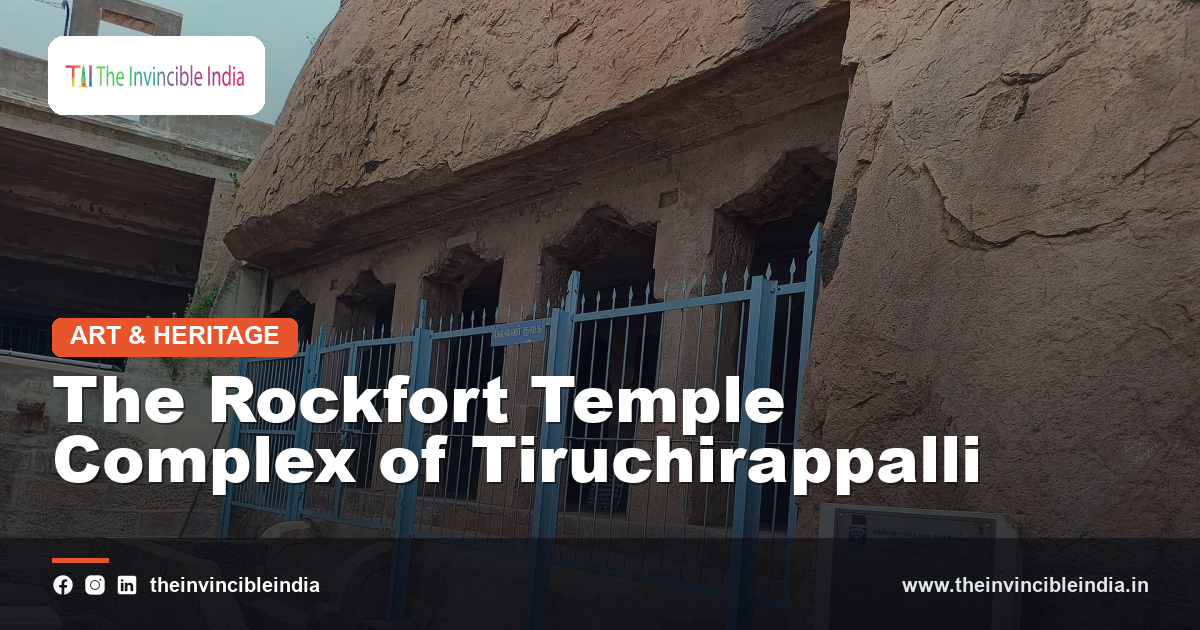
The Rockfort of Tiruchirappalli, also called Trichy Rockfort and known in Tamil tradition by the sacred name of the hill at Tiruchirappalli, is a fortified complex built upon an ancient rock outcrop in the heart of the city in Tamil Nadu. The weathered rock, among the oldest in the region, rises steeply above the plain, and a long flight of steps cut and laid along its flank leads past shrines to the summit. At the top stands the Ucchi Pillayar temple, dedicated to Ganesha, while the Thayumanaswamy temple, sacred to Shiva, occupies a cavern on the slope. Famous for its rock-cut cave temples and its association with the Pallavas and the Madurai Nayaks, the Rockfort belongs to the wider story told in the guide to the great forts of India. This article explains its location, history, shrines and significance.
Quick answer: The Rockfort of Tiruchirappalli is a fortified temple complex built on an ancient rock outcrop in the city of Tiruchirappalli (Trichy), Tamil Nadu, India. The summit is crowned by the Ucchi Pillayar temple dedicated to Ganesha, while the Thayumanaswamy temple to Shiva occupies the slope, and the rock is famous for early rock-cut cave shrines. The site is associated over time with the Pallavas and was developed as a fortified centre by the Madurai Nayaks.
Key Takeaways
- The Rockfort of Tiruchirappalli is a fortified temple complex on an ancient rock outcrop in Trichy, Tamil Nadu.
- The Ucchi Pillayar temple, dedicated to Ganesha, crowns the summit of the rock.
- The Thayumanaswamy temple, sacred to Shiva, occupies a large cavern on the slope.
- The rock is famous for early rock-cut cave temples traditionally associated with the Pallavas.
- The fortified complex was developed in large part by the Madurai Nayaks.
- A long stairway cut along the rock leads pilgrims past shrines to the summit and its wide views.
The sections below explain where the Rockfort stands, how it developed and what visitors can see today.
Quick Facts
| Detail | Information |
|---|---|
| Location | Tiruchirappalli (Trichy), Tamil Nadu |
| Also known as | Trichy Rockfort, Rockfort temple complex |
| Type | Fortified temple complex on a rock outcrop |
| Associated dynasties | Pallavas (rock-cut shrines), Madurai Nayaks (fortification) |
| Principal shrines | Ucchi Pillayar (Ganesha) and Thayumanaswamy (Shiva) temples |
| Material | Living rock, dressed stone and masonry |
| Protected status | Monuments and shrines of recognised heritage importance |
| Nearest city | Tiruchirappalli, central Tamil Nadu |
What Is the Rockfort of Tiruchirappalli?
The Rockfort of Tiruchirappalli is a fortified temple complex built upon a massive, ancient rock that rises abruptly from the flat city around it. It is not a fort in the sense of a palace stronghold but a sacred and defensive hill, girded with walls and crowned with shrines, where devotion and defence meet. A long stairway leads up the rock, passing rock-cut caves and temples, to the Ucchi Pillayar temple at the summit. The outcrop itself is counted among the oldest rock formations in the region, lending the site great antiquity. Over centuries it served both as a place of worship and as a stronghold overlooking the plains. The Rockfort of Tiruchirappalli is therefore best understood as a layered monument in which a sacred rock, ancient cave temples and later fortifications together tell the long story of the city.
Where Is the Rockfort Located?
The Rockfort is located in the heart of Tiruchirappalli, a major city in the central part of Tamil Nadu in southern India. Tiruchirappalli, commonly called Trichy, stands near the Kaveri river, which has long made the surrounding region fertile and important. The rock rises in the old part of the city, surrounded by busy bazaars, temples and historic neighbourhoods, so that the climb to the summit offers wide views over the urban sprawl and the river beyond. The city is well connected by road, rail and air, serving as a gateway to the temple towns of the Kaveri delta. The great temple complex of Srirangam lies nearby across the river. The location of the Rockfort at the centre of Trichy places it at the historic and devotional core of one of Tamil Nadu’s principal cities.
How Old Is the Rock of Tiruchirappalli?
The rock of Tiruchirappalli is extremely old, counted among the most ancient rock formations of the region, formed over an immense span of geological time. The religious and historical use of the rock is also very old, with rock-cut cave temples traditionally dated to the early medieval period. These caves are associated with the Pallava dynasty, who were among the pioneers of rock-cut architecture in the south. Fortification and the building of the hilltop shrines came later, with major development under the Madurai Nayaks. Because the site grew over many centuries, different elements belong to different ages, and scholars date individual features by their style and by historical records. The general framework places the earliest cave shrines in the early medieval centuries. The great antiquity of the rock, combined with its long religious use, gives the Rockfort an unusual depth of history.
Who Built the Rockfort Complex?
The Rockfort complex is the work of several periods rather than a single builder, reflecting its long and layered history. The earliest rock-cut cave temples are traditionally associated with the Pallavas, who were influential patrons of rock-cut architecture in southern India. Later dynasties who held sway over the region, including the Cholas and the Pandyas, contributed to the religious life and structures of the area. The fortification of the rock and the development of the complex into a stronghold are attributed in large part to the Madurai Nayaks, who ruled the region in the later medieval period. As with many such sites, the precise sequence of building rests on inscriptions, tradition and architectural study. The builders of the Rockfort therefore span many centuries and dynasties, each adding to a site that combined sacred and strategic importance.
What Are the Rock-Cut Cave Temples?
The rock-cut cave temples of Tiruchirappalli are among the most important early features of the site, carved directly into the living rock rather than built up from blocks. In this technique, which flourished in early medieval southern India, craftsmen excavated chambers, pillars and sculpted panels out of the solid stone of a hill. The caves at Trichy are traditionally linked to the Pallavas, pioneers of the rock-cut style, and they contain carved pillars, shrines and relief sculpture. These spaces served as temples cut into the rock, demonstrating the skill and devotion of their makers. They form part of a wider tradition of cave temples found across the Deccan and the south. The rock-cut caves of the Rockfort therefore preserve an early chapter of South Indian temple art, carved into the same ancient rock that later carried the hilltop shrines and fortifications.
What Is the Ucchi Pillayar Temple?
The Ucchi Pillayar temple is the shrine that crowns the summit of the Rockfort, dedicated to Ganesha, the elephant-headed god revered as the remover of obstacles. The name Ucchi Pillayar refers to Ganesha worshipped at the very top, since ucchi means summit and Pillayar is a Tamil name for Ganesha. Reaching the temple requires climbing the long stairway that winds up the rock, a journey that is itself an act of devotion for pilgrims. From the summit the temple commands sweeping views over the city of Trichy and the Kaveri river. A well-known tradition connects the hilltop shrine with the story of the god and the great temple of Srirangam visible below. The Ucchi Pillayar temple therefore serves as both the devotional climax of the climb and a vantage point that links the Rockfort to the sacred landscape around it.
What Is the Thayumanaswamy Temple?
The Thayumanaswamy temple is a major shrine on the slope of the Rockfort, dedicated to Shiva, who is worshipped here under the name Thayumanaswamy. The temple occupies a large cavern and halls cut and built into the rock, forming an important centre of Shaiva worship within the complex. The name Thayumanaswamy carries the meaning of a god who became like a mother, drawn from a devotional tradition that tells of the deity aiding a devotee in the manner of a mother. The temple is richly associated with Tamil Shaiva devotion and attracts many worshippers. Its position on the rock, below the summit shrine of Ganesha, reflects the layered sanctity of the whole hill. The Thayumanaswamy temple therefore stands as the principal Shiva shrine of the Rockfort, complementing the hilltop Ganesha temple and deepening the religious importance of the site.
Why Is the Rockfort Important to Trichy?
The Rockfort is important to Trichy because it is the defining landmark of the city, visible for a great distance and central to its identity and devotion. The rock has shaped the layout of the old city, which grew around its base, and the climb to the summit is a familiar experience for residents and pilgrims alike. As a place of worship, the Rockfort draws devotees to its shrines of Ganesha and Shiva throughout the year, while its elevated temples offer a spiritual and literal high point above the bustle below. Historically, the rock served as a stronghold that commanded the surrounding plains and river crossings. It remains a symbol of the city on seals, images and the popular imagination. The importance of the Rockfort therefore unites religion, history and civic identity, making it inseparable from the story of Tiruchirappalli.
What Does the Climb to the Summit Involve?
The climb to the summit of the Rockfort involves ascending a long flight of steps cut and laid along the flank of the rock, passing shrines and cave temples on the way. The stairway rises steeply, and the ascent can be demanding, especially in the heat, so pilgrims and visitors usually climb early in the day or in the cooler evening. Along the route lie the rock-cut caves, the Thayumanaswamy temple and smaller shrines, so that the climb becomes a sequence of encounters with sacred spaces. Footwear is removed before entering the temple areas, in keeping with custom. At the top the Ucchi Pillayar temple rewards the effort, along with panoramic views over the city and the Kaveri. The climb to the summit therefore combines physical exertion with devotion, turning the ascent of the rock into a meaningful pilgrimage experience.
What Views Does the Rockfort Offer?
The Rockfort offers some of the finest views in Tiruchirappalli, since its summit rises high above the surrounding plain and city. From the top, visitors can look out over the dense old town, the spreading modern city and, in the distance, the broad course of the Kaveri river. The great temple town of Srirangam, with its many towers, can be seen across the water, linking the two sacred sites visually. The wide panorama changes with the light, and the view is especially rewarding in the gentler hours of morning and evening. These vistas have long made the summit a place to pause and contemplate after the climb. The views from the Rockfort therefore add a powerful sense of place to the experience, revealing how the ancient rock stands at the centre of a landscape shaped by the river and its temples.
How Was the Rockfort Used as a Stronghold?
The Rockfort was used as a stronghold because its steep, commanding rock provided a natural defensive position above the plains and the river crossings of the Kaveri valley. Fortifications, walls and gateways were added to strengthen the already formidable outcrop, turning the sacred hill into a military centre. The Madurai Nayaks in particular developed the site as a fort, recognising its strategic value in controlling the region. From the heights, defenders could watch over the surrounding country and the approaches to the city. Over the centuries the fort featured in the contests for power in the south, changing hands amid the shifting fortunes of the region. Its combination of height, visibility and sacred importance made it a prize worth holding. The use of the Rockfort as a stronghold therefore shows how a holy rock also became a key military asset in the history of Tamil Nadu.
How Does the Rockfort Relate to Srirangam?
The Rockfort relates closely to Srirangam, the great island temple town that lies nearby across the Kaveri river and is visible from the summit. Srirangam is home to one of the most important Vishnu temples in India, and its vast complex forms part of the same sacred landscape as the Rockfort. Tradition connects the two sites through stories told about the gods and the sacred geography of the region. Pilgrims often visit both, combining the hilltop shrines of the Rockfort with the expansive temple town below. The visual link between the elevated Rockfort and the spreading temple of Srirangam underlines the religious richness of the Trichy area. The relationship between the Rockfort and Srirangam therefore reflects the way the city sits within a network of sacred places, bound together by the river, by tradition and by the devotion of pilgrims.
What Architectural Features Can Be Seen?
The Rockfort displays a range of architectural features that span rock-cut, built-up and fortified construction, reflecting its long development. The earliest elements are the rock-cut cave temples, with pillars and carved panels excavated from the living stone in the early medieval manner. Later shrines, including the hilltop and slope temples, combine cut rock with built masonry, decorated in the South Indian tradition with sculpted figures and ornament. Fortification walls, gateways and the great stairway represent the defensive and practical additions of later rulers. The use of the natural rock as both foundation and material gives the complex a striking unity with its setting. Weathering over the ages has shaped the surfaces of the ancient stone. The architectural features of the Rockfort therefore form a layered record, in which rock-cut art, temple building and fortification are combined on a single dramatic outcrop.
How Is the Rockfort Protected and Preserved?
The Rockfort is preserved through a combination of official heritage protection and continuous religious use, as its shrines remain active centres of worship. Heritage authorities are concerned with documenting and safeguarding the historic caves, temples and fortifications, while temple bodies maintain daily ritual and upkeep. The site faces challenges common to old monuments in a busy city, including weathering of the ancient rock, heavy footfall and the pressures of the surrounding urban environment. Conservation aims to stabilise structures and protect the rock-cut shrines without altering their character. Because the precise arrangements and status of such a site can change, visitors interested in conservation should consult current official sources. Respectful behaviour, including care on the stairway and in the shrines, supports preservation. The protection of the Rockfort therefore depends on cooperation between heritage authorities, temple caretakers and the many pilgrims and visitors who value it.
How Can Visitors Plan a Trip to the Rockfort?
Visitors can plan a trip to the Rockfort easily, since it stands in the centre of Tiruchirappalli, a city well connected by road, rail and air. The cooler months from about November to February are generally the most comfortable for the climb, and early morning or evening is best to avoid the midday heat. Modest clothing is appropriate, and footwear is removed before entering the temple areas, so visitors should be prepared for the climb in bare or socked feet in the shrine zones. Carrying water and allowing time to rest on the ascent makes the experience more pleasant. Combining the visit with the nearby temple town of Srirangam creates a rewarding itinerary. Checking current timings for the shrines is advisable, as temples follow set hours. A well planned visit allows the Rockfort to be enjoyed as both a devotional climb and a historic landmark.
The Rockfort of Tiruchirappalli Today
The Rockfort of Tiruchirappalli today remains the beating heart of the city, a sacred and historic rock that draws pilgrims, travellers and residents alike. Its hilltop Ucchi Pillayar temple, its Thayumanaswamy shrine and its ancient rock-cut caves continue to serve devotion, while the fortifications and stairway recall its role as a stronghold. From the summit the views over Trichy, the Kaveri and distant Srirangam place the monument within a rich sacred landscape. As the city grows and changes around it, the ancient rock endures as a symbol of continuity and faith. Continued conservation, respectful tourism and living worship together help ensure that it remains vital for future generations. The Rockfort of Tiruchirappalli thus stands as a layered monument in which geology, devotion, art and history are united on a single commanding outcrop above the plains of Tamil Nadu.
Sources & Further Reading
- Archaeological Survey of India (asi.nic.in).
- Department of Tourism, Government of Tamil Nadu (tamilnadutourism.tn.gov.in).
Frequently Asked Questions
Where is the Rockfort of Tiruchirappalli located?
The Rockfort is located in the heart of Tiruchirappalli, commonly called Trichy, in central Tamil Nadu. It rises on an ancient rock in the old part of the city, near the Kaveri river and the temple town of Srirangam.
What temples are on the Rockfort?
The summit of the Rockfort is crowned by the Ucchi Pillayar temple dedicated to Ganesha, while the Thayumanaswamy temple sacred to Shiva occupies the slope. The rock also contains early rock-cut cave shrines.
Who built the Rockfort complex?
The Rockfort developed over many centuries, with its earliest rock-cut caves traditionally associated with the Pallavas. The fortification and much of the complex are attributed in large part to the Madurai Nayaks, with contributions from other dynasties of the region.
What is the Ucchi Pillayar temple?
The Ucchi Pillayar temple is the shrine of Ganesha at the very summit of the Rockfort, reached by a long stairway up the rock. Its name refers to Ganesha worshipped at the top, and it offers wide views over Trichy and the Kaveri.
Is the Rockfort difficult to climb?
The climb involves a long, steep flight of steps cut along the rock, which can be demanding, especially in the heat. Visitors usually climb early in the morning or in the evening and remove footwear before entering the temple areas.
What is the best time to visit the Rockfort?
The best time to visit is the cooler season from about November to February, and within the day the early morning or evening. These times make the climb more comfortable than the midday heat of the plains.


