

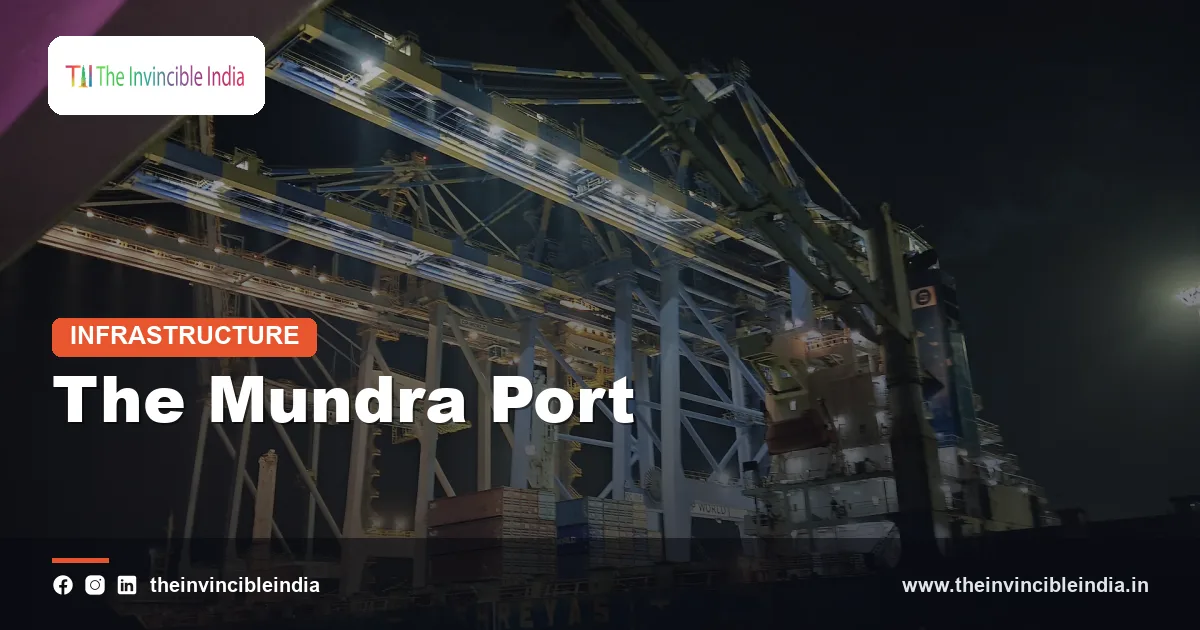
Mundra Port is India’s largest commercial port by cargo handled, a privately developed multi-purpose deepwater port on the Gulf of Kutch in Kutch district, Gujarat, operated by Adani Ports and Special Economic Zone Limited (APSEZ). It began operations in the late 1990s and has grown into a gateway for containers, coal, crude oil, vehicles and bulk cargo for northern and western India.
Mundra Port is also unusual because it is a private port that functions together with a large port-based special economic zone (SEZ), with rail links, road links and dedicated terminals for different cargo types. This explainer describes its location, history, terminals, cargo, connectivity, the Mundra SEZ and its place in India’s maritime economy, with 17 October 2026 as the reference date.
| Attribute | Detail |
|---|---|
| Port name | Mundra Port |
| Location | Gulf of Kutch, Mundra taluka, Kutch district, Gujarat |
| Operator | Adani Ports and Special Economic Zone Limited (APSEZ), part of the Adani Group |
| Ownership type | Private port, developed under a concession from the Gujarat Maritime Board |
| Operations began | Late 1990s (first vessel handled in 1998) |
| Cargo types | Containers, coal, crude oil, liquid chemicals, edible oils, vehicles and other bulk |
| Scale | Handles well over 150 million tonnes of cargo a year in recent years, the highest among Indian ports |
| Special economic zone | Mundra SEZ, one of the largest port-based SEZs in India |
| Nearby ports | Deendayal Port (Kandla) in Kutch, a government-run major port; Jawaharlal Nehru Port near Mumbai |
Key Takeaways
- Mundra Port is India’s largest commercial port by cargo volume and is located on the Gulf of Kutch in Gujarat.
- Mundra Port is operated by Adani Ports and Special Economic Zone Limited (APSEZ), and is India’s largest privately developed port.
- Mundra Port is a deepwater, multi-product port that handles containers, coal, crude oil, liquid cargo, vehicles and dry bulk.
- Mundra Port is attached to the Mundra Special Economic Zone, which combines industrial land with port and logistics facilities.
- Mundra Port is linked to the hinterland of northern and western India by rail, highways and an oil pipeline to Punjab.
- Mundra Port handled its first cargo in 1998 and expanded rapidly after 2000, as private ports became an important part of India’s maritime system.
What is Mundra Port?
Mundra Port is a deepwater commercial port on the northern coast of the Gulf of Kutch, in the Mundra taluka of Kutch district in Gujarat, India. It is a multi-purpose port, meaning that it handles several kinds of cargo at separate terminals, and it is the busiest port in the country when measured by total tonnage.
Mundra Port is classified as a non-major port in the sense used in Indian port law. This means that it does not belong to the group of major ports that are administered by the Union government through port trusts, but is overseen by the Gujarat Maritime Board, the state agency in charge of non-major ports. The port is not a government-owned port but a privately developed facility with a concession.
The port is located along a natural deepwater coast that is relatively free of siltation, which has allowed it to accommodate large vessels, including big container ships and bulk carriers, without heavy dredging.
Who runs Mundra Port?
Adani Ports and Special Economic Zone Limited (APSEZ), part of the Adani Group, runs Mundra Port. The company was earlier named Mundra Port and Special Economic Zone Limited and was renamed in 2012, as it expanded to operate other ports in India and abroad.
APSEZ is the largest private port operator in India. Besides Mundra, it manages ports on both the west and east coasts, as well as logistics assets such as rail, warehouses and inland container depots. Its parent group has interests in energy, logistics, resources and other sectors.
The development of the port began in the 1990s, when the Gujarat government encouraged private participation in ports. The first jetty was commissioned in the late 1990s, and the port then expanded in stages with new terminals.
What does Mundra Port handle?
Mundra Port handles containers, dry bulk such as coal, liquid cargo such as crude oil and chemicals, and vehicles, using dedicated terminals for each category. This diversity of cargo is the main reason why it is described as a multi-product port.
| Cargo type | How it is handled at Mundra |
|---|---|
| Containers | Multiple container terminals, including some operated with international shipping lines, handling several million TEUs a year |
| Coal | Dedicated coal import terminals serving power plants and industry |
| Crude oil | Single point mooring (SPM) facilities and storage, connected to inland refineries |
| Liquid cargo | Terminals for chemicals, edible oils and petroleum products |
| Vehicles | Roll-on roll-off (Ro-Ro) facilities for automobile export and import |
| Other bulk | Fertilisers, agricultural products, minerals and other dry bulk |
How big is Mundra Port?
Mundra Port is the largest Indian port by cargo volume, handling well over 150 million tonnes in recent years, and it is also among the largest handlers of containers in the country with several million twenty-foot equivalent units (TEUs) a year. These totals change annually, and readers should check the latest figures published by APSEZ.
The port’s scale has been achieved through steady expansion of berths, storage areas and equipment. It has deep drafts, large cranes and stack yards, and its container terminals are able to receive some of the largest container ships calling at Indian ports.
Mundra has often been compared with Jawaharlal Nehru Port (JNPT) at Navi Mumbai, which is the largest government-run container port in India. The two ports serve different catchments, with Mundra having a strong position in northern India and JNPT in western and central India.
What are the main terminals at Mundra Port?
The main terminals at Mundra Port are its container terminals, coal terminals, crude oil terminal, liquid terminals and the vehicle terminal, and they are spread along the coast and operated by APSEZ and by partners. The port has several container terminals that are numbered, as well as a terminal operated in partnership with a global shipping and logistics company.
Container terminals
Mundra’s container terminals are the busiest in India by volume of containers handled. They serve exporters and importers across northern India, including Punjab, Haryana, Delhi, Rajasthan and Uttar Pradesh, as well as Gujarat itself. The terminals have large quay cranes, a considerable yard area and rail connections to the terminals.
Bulk and liquid terminals
The coal terminals at Mundra supply fuel to power stations in the region, including power plants located in the Mundra area. The crude oil terminal receives imported crude through offshore mooring points and sends it by pipeline to refineries in the north. Liquid terminals handle edible oil, chemicals and other products.
What is the Mundra SEZ?
The Mundra SEZ is a multi-product special economic zone adjacent to Mundra Port, notified in the early 2000s, and it is considered one of the largest port-based SEZs in India. It covers several thousand hectares of land and is designed to host manufacturing, processing and logistics companies that export their products through the port.
A special economic zone is a designated area where businesses enjoy certain tax benefits and simplified procedures under the Special Economic Zones Act, 2005. The Mundra SEZ was initially established under the earlier SEZ framework and then continued under this Act. Zones such as this one aim to attract investment by providing integrated infrastructure, including roads, power and water.
Industries operating in or around the zone include power generation, metals, textiles, chemicals, engineering and food processing. The presence of industries next to the port reduces transport costs and helps the port secure steady cargo volumes.
How is Mundra Port connected by rail and road?
Mundra Port is connected to the Indian Railways network through a rail line that links the port with the main line near Adipur and Gandhidham, and it is linked to highways that lead to the rest of Gujarat and north India. Container trains run from the port to inland container depots and terminals in northern India, including facilities near Delhi.
Rail connectivity is among the most important advantages of the port because a large share of its container cargo is bound for the northern states. Double-stack container trains, in which containers are stacked two high on wagons, are used on some routes where the overhead clearance allows, which increases the capacity of each train. The Western Dedicated Freight Corridor, a project of the Dedicated Freight Corridor Corporation of India, is meant to speed up freight movement in the broader region, and extensions that reach the Kutch area have been planned.
By road, the port is reached by national and state highways from Gandhidham, Bhuj and the rest of Gujarat. There is also an airstrip at Mundra and a nearby airport for business and charter use. A crude oil pipeline runs from the Mundra area to a refinery in Bathinda in Punjab, which is an important link between the coast and the interior of the country.
How did Mundra Port become India’s largest port?
Mundra Port became India’s largest port by combining a natural deepwater site with continuous private investment, a business-friendly state policy and early attention to inland logistics. Its growth was gradual rather than sudden, with each new terminal adding capacity.
The Gujarat government’s maritime policy in the 1990s encouraged private ports as a way to supplement the capacity of public ports such as Kandla, which is today named Deendayal Port. Mundra’s location, close to the large markets of the north and the Persian Gulf region, was another advantage.
Over the years, Mundra added container, coal, crude and vehicle terminals, and set up railway operations and warehouses. It overtook government-owned ports in total cargo handling in the 2010s. The changes in the trade patterns of the country, including growing imports of coal, oil and containerised goods, also supported its volumes.
What is the difference between Mundra Port and a major port?
Mundra Port differs from a major port in ownership and governance: a major port is administered by a port authority under the Union government, whereas Mundra Port is developed and run by a private company under a state concession. Indian law has historically divided ports into major ports, of which there are a dozen, and a larger number of non-major or minor ports.
The distinction affects tariffs, land and planning, but not the kind of ships that call. Cargo owners choose between ports on the basis of cost, speed, rail and road access and the reliability of services. Mundra has attracted shipping lines and cargo owners by offering integrated services, including storage, rail movement and customs-related facilities at one location.
Why does Mundra Port matter to India?
Mundra Port matters because it handles a large share of India’s seaborne trade, provides an important gateway for the northern and western states and demonstrates the role of private investment in infrastructure. A significant amount of the country’s container, coal and crude oil flows moves through it.
The port also contributes to regional development in Kutch, which was devastated by the 2001 earthquake and has since seen industrial growth. It supports jobs in port operations, logistics, manufacturing and related services, and it generates revenue for the state through levies and concession payments.
At the same time, large ports raise questions about environmental impact, coastal ecosystems such as mangroves and creeks, and the livelihoods of fishing communities. These issues are regulated by environmental clearances and coastal regulations, and the port operators are required to follow them.
Bottom Line
Mundra Port is the largest commercial port of India by cargo and a showcase for a privately developed, multi-purpose deepwater port with a connected SEZ. Its strength lies in its natural depth, wide range of terminals and strong rail and road links to northern India.
Frequently Asked Questions
Where is Mundra Port located?
Mundra Port is located on the Gulf of Kutch in the Mundra taluka of Kutch district, Gujarat. It lies on the north-western coast of India, near the towns of Mundra and Gandhidham.
Who owns Mundra Port?
Mundra Port is owned and operated by Adani Ports and Special Economic Zone Limited (APSEZ), part of the Adani Group. The company holds a concession from the Gujarat Maritime Board to run the port.
Is Mundra Port the largest port in India?
Yes, Mundra Port is the largest commercial port in India by total cargo handled. It handles well over 150 million tonnes a year in recent years, and it is also among the leading container ports in the country.
What cargo does Mundra Port handle?
Mundra Port handles containers, coal, crude oil, liquid chemicals, edible oils, vehicles and other bulk cargo. Each type of cargo has its own terminals and handling equipment.
What is the Mundra SEZ?
The Mundra SEZ is a large multi-product special economic zone next to Mundra Port, where companies get tax benefits and shared infrastructure. It hosts industries that produce for export and uses the port for shipping.
How is Mundra Port connected to the rest of India?
Mundra Port is connected by a rail line to the Indian Railways network, by highways to Gujarat and beyond, and by a crude oil pipeline to Punjab. Container trains from the port carry cargo to inland depots in northern India.
{“@context”:”https://schema.org”,”@graph”:[{“@type”:”FAQPage”,”mainEntity”:[{“@type”:”Question”,”name”:”Where is Mundra Port located?”,”acceptedAnswer”:{“@type”:”Answer”,”text”:”Mundra Port is located on the Gulf of Kutch in the Mundra taluka of Kutch district, Gujarat. It lies on the north-western coast of India, near the towns of Mundra and Gandhidham.”}},{“@type”:”Question”,”name”:”Who owns Mundra Port?”,”acceptedAnswer”:{“@type”:”Answer”,”text”:”Mundra Port is owned and operated by Adani Ports and Special Economic Zone Limited (APSEZ), part of the Adani Group. The company holds a concession from the Gujarat Maritime Board to run the port.”}},{“@type”:”Question”,”name”:”Is Mundra Port the largest port in India?”,”acceptedAnswer”:{“@type”:”Answer”,”text”:”Yes, Mundra Port is the largest commercial port in India by total cargo handled. It handles well over 150 million tonnes a year in recent years, and it is also among the leading container ports in the country.”}},{“@type”:”Question”,”name”:”What cargo does Mundra Port handle?”,”acceptedAnswer”:{“@type”:”Answer”,”text”:”Mundra Port handles containers, coal, crude oil, liquid chemicals, edible oils, vehicles and other bulk cargo. Each type of cargo has its own terminals and handling equipment.”}},{“@type”:”Question”,”name”:”What is the Mundra SEZ?”,”acceptedAnswer”:{“@type”:”Answer”,”text”:”The Mundra SEZ is a large multi-product special economic zone next to Mundra Port, where companies get tax benefits and shared infrastructure. It hosts industries that produce for export and uses the port for shipping.”}},{“@type”:”Question”,”name”:”How is Mundra Port connected to the rest of India?”,”acceptedAnswer”:{“@type”:”Answer”,”text”:”Mundra Port is connected by a rail line to the Indian Railways network, by highways to Gujarat and beyond, and by a crude oil pipeline to Punjab. Container trains from the port carry cargo to inland depots in northern India.”}}]}]}


