

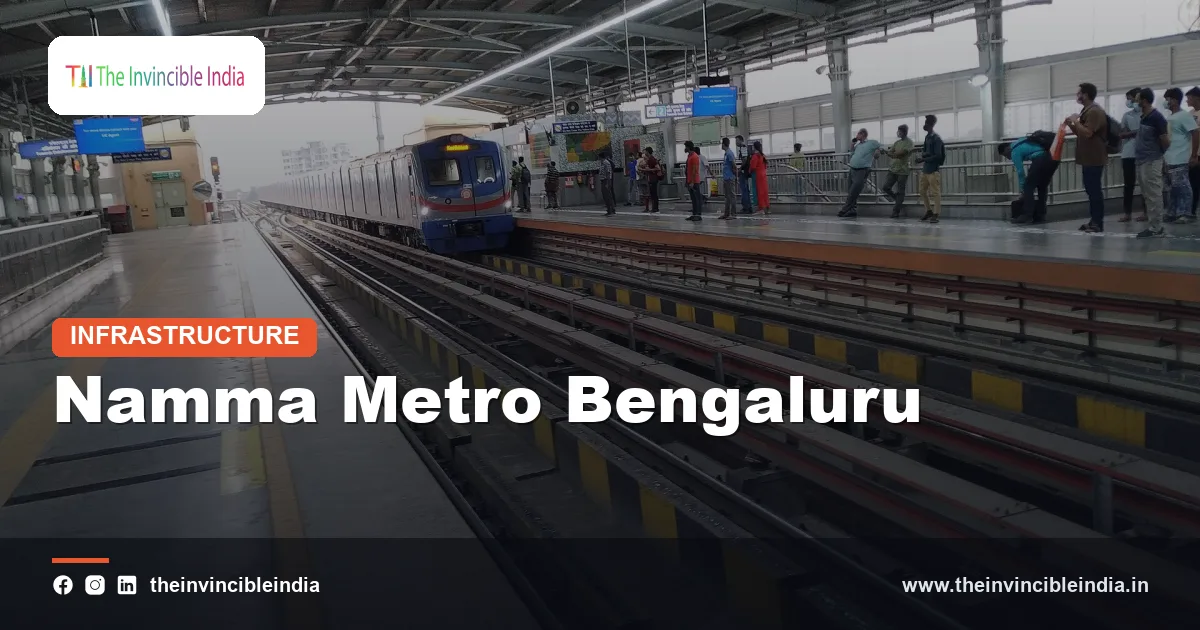
Namma Metro is the rapid-transit rail network of Bengaluru (Bangalore), Karnataka, operated by the Bangalore Metro Rail Corporation Limited (BMRCL), and it is the first metro system in South India. “Namma” means “our” in Kannada, and the name signals that the network is meant to belong to the city’s residents. The first stretch opened in October 2011, and the system has since grown into a network of multiple lines that includes South India’s first underground section.
Namma Metro is the main public-transport alternative to the notoriously congested roads of Bengaluru, a city that is the centre of India’s software industry. It is built partly elevated and partly underground, and it is being extended in phases to new parts of the city, including a line to the Kempegowda International Airport. This explainer covers its history, the Purple and Green lines, new lines, ridership, technology and its role in easing congestion, with 17 October 2026 as the reference date.
| Attribute | Detail |
|---|---|
| System name | Namma Metro (Bengaluru Metro) |
| Operator | Bangalore Metro Rail Corporation Limited (BMRCL) |
| Ownership | Joint venture of the Government of India and the Government of Karnataka, with equal shares |
| First commercial service | 20 October 2011, between Baiyappanahalli and M.G. Road |
| Type | Rapid-transit metro, both elevated and underground, on standard gauge |
| Core lines | Purple Line (east-west) and Green Line (north-south) |
| Newer lines | Yellow, Pink and Blue lines in different stages of opening or construction |
| Notable firsts | First metro in South India and the first underground metro section in the region |
| Interchange hub | Nadaprabhu Kempegowda Station, Majestic |
Key Takeaways
- Namma Metro is the metro rail network of Bengaluru and was the first metro system in South India, with its first stretch opening in October 2011.
- Namma Metro is operated by Bangalore Metro Rail Corporation Limited (BMRCL), a joint venture of the Government of India and the Government of Karnataka.
- Namma Metro has two core lines, the east-west Purple Line and the north-south Green Line, which cross at the Majestic interchange station.
- Namma Metro includes South India’s first underground metro stretch, which runs through the central area of Bengaluru around Majestic and Cubbon Park.
- Namma Metro carries several lakh passengers per day in recent years and has been expanded through Phase 2 with new lines, including a planned line to the airport.
- Namma Metro uses standard-gauge tracks and a 750 volt DC third-rail power system with air-conditioned trains.
What is Namma Metro?
Namma Metro is the urban mass rapid transit system serving Bengaluru, the capital of Karnataka and one of India’s largest cities by population and economic activity. The network connects the central business district, the old city around the City Market and Majestic, and a growing set of suburbs through a combination of elevated viaducts and underground tunnels.
The name “Namma Metro” is Kannada for “our metro” and was adopted as the brand for the system. It also appears in the signs and announcements, which are in Kannada, English and Hindi. The system was planned in response to a rapid rise in vehicles on the roads in the 1990s and 2000s, when Bengaluru became a hub of information technology.
The first formal proposals for a metro date back to the late 1990s and early 2000s, and construction began in the mid-2000s after years of planning, financing arrangements and clearances.
Who runs Namma Metro?
Bangalore Metro Rail Corporation Limited (BMRCL) runs Namma Metro and is an equal joint venture of the Government of India and the Government of Karnataka. It is responsible for planning, building and operating the network, and it also manages commercial activities such as advertising and land use around stations.
The project had a long gestation. Decisions about the track gauge, funding and phasing were made over several years, and the final system uses the standard gauge of 1,435 mm rather than the broad gauge used by Indian Railways. Phase 1 was built in stages between 2007 and the middle of the following decade.
The company is headquartered in Bengaluru. Government oversight includes the board of directors, which has members from both the Union and state governments.
When did Namma Metro open and how did it grow?
Namma Metro opened on 20 October 2011 with a short stretch of the Purple Line running from Baiyappanahalli to M.G. Road, and it grew in stages over the next decade. Phase 1, with a total length of about 42 km, was substantially complete in the mid-2010s, and Phase 2 added further extensions in the late 2010s and 2020s.
The underground section in the heart of the city, which includes the stations at Cubbon Park, Vidhana Soudha, Sir M. Visvesvaraya, Majestic and City Railway Station, was completed in the mid-2010s as part of Phase 1. It was the first underground metro stretch in South India and required tunnelling machines to bore through the city’s rock and soil.
Selected milestones
- 2011: First stretch of the Purple Line opens between Baiyappanahalli and M.G. Road.
- 2014 to 2016: Further sections of the Purple and Green lines open, including underground stations in the city centre.
- 2017: Phase 1, with about 42 km in total, is operational across both lines.
- 2021 onward: Extensions of the Purple Line towards Whitefield in the east and Challaghatta in the west, and extension of the Green Line at both ends.
- 2025: Opening of the Yellow Line between R.V. Road and Bommasandra.
What are the Purple and Green lines?
The Purple Line is the east-west corridor of Namma Metro, running from Whitefield (Kadugodi) in the east to Challaghatta in the west, while the Green Line is the north-south corridor running from Madavara in the north-west to Silk Institute in the south. The two lines cross at the Majestic interchange, formally called Nadaprabhu Kempegowda Station.
| Line | Direction | Approximate extent |
|---|---|---|
| Purple Line | East-west | Whitefield (Kadugodi) to Challaghatta, crossing the centre at Majestic |
| Green Line | North-south | Madavara (Nagasandra side) to Silk Institute, via Yeshwanthpur and Lalbagh |
| Yellow Line | North-south in the south | R.V. Road to Bommasandra, serving the Electronics City side |
| Pink Line | Partly underground | Kalena Agrahara to Nagawara, under construction in phases |
| Blue Line | Airport-bound | Central Silk Board towards KR Puram and the airport, under construction |
The Majestic station is one of the largest interchanges in India. It is located near the Kempegowda Bus Station and the Bengaluru City Railway Station, so that the metro, suburban rail, intercity trains and buses meet in one place.
What are the new lines of Namma Metro?
The new lines of Namma Metro under Phase 2 include the Yellow Line towards Electronics City, the Pink Line across the city from Kalena Agrahara to Nagawara, and the Blue Line towards the airport via KR Puram. The Yellow Line is the first of these to have opened, in 2025, and it connects R.V. Road with Bommasandra through Silk Board and Electronics City.
The Pink Line is designed as a mixed underground and elevated line that will pass through the core of the city. It is an important line because it connects the southern parts of the city with the northern ones and adds an interchange with the Purple and Green lines. The line is being opened in stages, and the dates should be taken from BMRCL.
The Blue Line is the airport line, which is intended to link the Central Silk Board junction with the Kempegowda International Airport in Devanahalli, passing through Hebbal and KR Puram. It is planned to be several tens of kilometres long, and its opening timelines have been revised many times.
What is Phase 3 of Namma Metro?
Phase 3 of Namma Metro is a proposed set of additional corridors, which have been approved for planning to extend the network to more western and southern areas of the city. The proposals have included lines in the west towards Kadabagere and a line connecting south-west to north-west areas.
Each phase of Namma Metro has been larger than the preceding one, and the planned total length of the system after all phases could exceed 200 km. The proposals still have to go through detailed project reports, funding approvals and construction, which means that completion is expected many years away.
How many people ride Namma Metro?
Namma Metro carries several lakh passengers on an average day, and on peak days in recent years the figure has crossed eight lakh passengers. The ridership grew significantly after the Purple Line was connected across the city and after the extension to Whitefield opened.
The busiest stations include Majestic, MG Road, Indiranagar and the Yeshwanthpur and Baiyappanahalli areas. Peak hours are marked by crowding on the Purple Line in particular, and BMRCL has added trains and shortened the interval between them to manage this.
The ridership figures are published frequently by the operator, and they respond to changes in fare, the opening of new stations and large events such as cricket matches and festivals. Fares are distance-based and were revised in the mid-2020s, so readers should look at current fare tables.
How does Namma Metro work technically?
Namma Metro runs electric multiple unit trains on standard-gauge tracks and uses a 750 volt direct-current third rail for traction power. Trains are air-conditioned and run with three or six coaches, depending on the line and the time of day.
Signalling on the newer lines uses communication-based train control (CBTC), which permits closely spaced trains, and the Yellow Line is intended to use driverless train technology in the future. The system is built with a combination of elevated viaducts and underground tunnels, the latter bored by tunnel boring machines and built using cut-and-cover methods in some places.
Depots such as the ones at Peenya and Baiyappanahalli are used for stabling and maintenance. Contactless smart cards, the National Common Mobility Card and QR-based tickets are accepted for payment.
How does Namma Metro help reduce congestion in Bengaluru?
Namma Metro helps reduce congestion in Bengaluru by giving commuters an alternative to private vehicles on the main corridors, thereby moving a large number of people without adding cars or two-wheelers to the road. A single six-coach train can carry well over a thousand passengers, which is equal to hundreds of vehicles.
The city has among the highest levels of vehicle ownership in India, and traffic on the Outer Ring Road, Hosur Road and the airport road is regularly slow. A metro by itself cannot solve this, but the network does reduce the share of commuters on the main axes, particularly on the east-west corridor between Whitefield and the centre.
Studies by urban planners have pointed out that the benefits depend on first-mile and last-mile connectivity. BMRCL and the city transport corporation have therefore introduced feeder buses to metro stations, and efforts are made to improve footpaths and parking near stations.
What are the challenges facing Namma Metro?
The main challenges of Namma Metro are construction delays, land acquisition, high capital costs and the need for better station access. Several sections were delayed by months or years because of challenges with utilities, tunnelling and approvals.
Critics have also pointed out that the network is still much shorter than the size of the city requires, and that some stations are located away from where people live. The funding for new lines, which depends on both governments and on loans from international lenders, can also affect the pace of work.
Bottom Line
Namma Metro is South India’s first metro and the backbone of Bengaluru’s public transport, with the Purple and Green lines at its core and new lines expanding its reach. The success of the planned airport line and of Phase 3 will largely decide how much it can reduce the congestion of one of India’s busiest cities.
Frequently Asked Questions
What does Namma Metro mean?
Namma Metro means “our metro” in Kannada and is the brand name of the Bengaluru metro rail network. The system is operated by Bangalore Metro Rail Corporation Limited (BMRCL).
When did Namma Metro start?
Namma Metro started on 20 October 2011 with a stretch of the Purple Line between Baiyappanahalli and M.G. Road. It was the first metro system in South India.
What are the lines of Namma Metro?
The two core lines of Namma Metro are the east-west Purple Line and the north-south Green Line, which cross at Majestic. Newer lines include the Yellow Line, the Pink Line and the Blue Line to the airport, which are in different stages of opening or construction.
Does Namma Metro go to Kempegowda International Airport?
Not yet fully, but an airport line is under construction. The Blue Line is planned to connect the Central Silk Board junction with Kempegowda International Airport via KR Puram, and the opening date should be checked with BMRCL.
Is there an underground section in Namma Metro?
Yes, Namma Metro has an underground section in the centre of Bengaluru that was the first of its kind in South India. It includes the stations at Cubbon Park, Vidhana Soudha, Majestic and City Railway Station.
How many people travel by Namma Metro each day?
Namma Metro carries several lakh passengers on a typical day, and peak days in recent years have exceeded eight lakh. The exact figures change with new openings and are published by BMRCL.
{“@context”:”https://schema.org”,”@graph”:[{“@type”:”FAQPage”,”mainEntity”:[{“@type”:”Question”,”name”:”What does Namma Metro mean?”,”acceptedAnswer”:{“@type”:”Answer”,”text”:”Namma Metro means “our metro” in Kannada and is the brand name of the Bengaluru metro rail network. The system is operated by Bangalore Metro Rail Corporation Limited (BMRCL).”}},{“@type”:”Question”,”name”:”When did Namma Metro start?”,”acceptedAnswer”:{“@type”:”Answer”,”text”:”Namma Metro started on 20 October 2011 with a stretch of the Purple Line between Baiyappanahalli and M.G. Road. It was the first metro system in South India.”}},{“@type”:”Question”,”name”:”What are the lines of Namma Metro?”,”acceptedAnswer”:{“@type”:”Answer”,”text”:”The two core lines of Namma Metro are the east-west Purple Line and the north-south Green Line, which cross at Majestic. Newer lines include the Yellow Line, the Pink Line and the Blue Line to the airport, which are in different stages of opening or construction.”}},{“@type”:”Question”,”name”:”Does Namma Metro go to Kempegowda International Airport?”,”acceptedAnswer”:{“@type”:”Answer”,”text”:”Not yet fully, but an airport line is under construction. The Blue Line is planned to connect the Central Silk Board junction with Kempegowda International Airport via KR Puram, and the opening date should be checked with BMRCL.”}},{“@type”:”Question”,”name”:”Is there an underground section in Namma Metro?”,”acceptedAnswer”:{“@type”:”Answer”,”text”:”Yes, Namma Metro has an underground section in the centre of Bengaluru that was the first of its kind in South India. It includes the stations at Cubbon Park, Vidhana Soudha, Majestic and City Railway Station.”}},{“@type”:”Question”,”name”:”How many people travel by Namma Metro each day?”,”acceptedAnswer”:{“@type”:”Answer”,”text”:”Namma Metro carries several lakh passengers on a typical day, and peak days in recent years have exceeded eight lakh. The exact figures change with new openings and are published by BMRCL.”}}]}]}


