

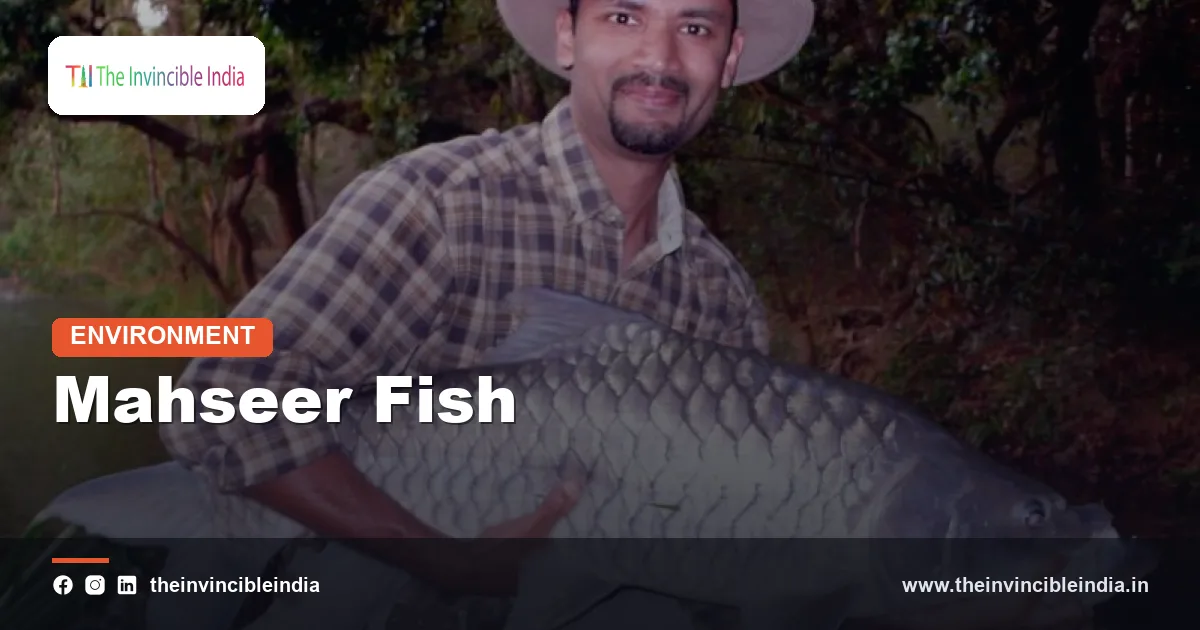
The mahseer is a group of large, powerful freshwater fish of the carp family (Cyprinidae), found in the rivers and lakes of the Himalayan foothills and the peninsular plateau of India, and known as the “tiger of the river” for their strength, size and fighting spirit when hooked. Mahseer conservation in India covers the effort to protect these fish, several species of which are threatened by dams, pollution, illegal fishing and habitat loss, through protected waters, hatchery breeding, restocking and angler-led stewardship.
The best-known species include the golden mahseer (Tor putitora) of the Himalayan rivers, the tor mahseer (Tor tor) of the Himalayan and central Indian waters, the blue-finned mahseer (Tor khudree) of the Western Ghats and Deccan, and the hump-backed mahseer (Tor remadevii) of the Cauvery basin. Together they are among the most celebrated game fish in Asia and indicators of river health.
| Quick Facts: Mahseer in India | |
|---|---|
| Group | Large freshwater cyprinid fishes, mainly in the genus Tor (also Neolissochilus) |
| Common nickname | “Tiger of the river”; the word mahseer is often explained as “big head” or “fish tiger” (explanations vary) |
| Key Indian species | Golden mahseer (Tor putitora), tor mahseer (Tor tor), blue-finned mahseer (Tor khudree), hump-backed mahseer (Tor remadevii) |
| Habitat | Fast, clear, rocky rivers, pools and associated lakes from the Himalayan foothills to the Western Ghats |
| Diet | Omnivorous: aquatic insects, crustaceans, molluscs, algae, fruits and small fish |
| Conservation status | Several species assessed as threatened on the IUCN Red List; golden mahseer reported as Endangered and hump-backed mahseer as Critically Endangered (status can change on reassessment) |
| Main threats | Dams and barriers, sand and boulder mining, pollution, dynamiting, poisoning, over-fishing, invasive species |
| Key conservation actors | Wildlife Institute of India (WII), ICAR research institutes, state fisheries departments, Tata Power, angling associations |
| Official recognition | Golden mahseer is the state fish of Himachal Pradesh and is also associated with Arunachal Pradesh |
Key Takeaways
- Mahseer are large Indian freshwater fishes of the carp family, mostly in the genus Tor, valued as both game fish and indicators of river health.
- The golden mahseer (Tor putitora) of the Himalayan rivers can grow to well over a metre in length and is regarded as one of the world’s great freshwater sport fishes.
- The hump-backed mahseer (Tor remadevii) of the Cauvery river system was formally described in the early 2000s and is assessed as Critically Endangered on the IUCN Red List.
- Dams, barrages, sand mining, pollution and destructive fishing have caused sharp declines in wild mahseer populations across India.
- Captive breeding programmes, led by bodies such as Tata Power and the Wildlife Institute of India among others, have produced mahseer fry for restocking rivers.
- Catch-and-release angling, regulated by local rules, has become a conservation tool by giving communities a stake in living fish.
What is a mahseer?
A mahseer is a large, scaly freshwater fish of the carp family that lives in swift, well-oxygenated rivers and lakes in South and Southeast Asia, with India holding several of the most famous species. The name is commonly said to derive from words meaning “big head” or “fish tiger,” although scholars have offered other etymologies.
Mahseer have thick, strong bodies covered by large scales, fleshy lips adapted for feeding on the river bottom, and powerful pharyngeal teeth used to crush snails, crustaceans and fruit. The species are long-lived, slow to mature and capable of reaching considerable sizes. Historical records describe golden mahseer exceeding 40 or even 50 kilograms, although such giants are now extremely rare, and most fish encountered today are far smaller.
Taxonomy of the group has been debated for years. Early naturalists such as Francis Hamilton in the early nineteenth century described several species, and later authors lumped or split them. Genetic studies since the 2000s have clarified that the Western Ghats mahseer, once treated as a single species, includes distinct forms, including the hump-backed mahseer, which was formally recognised as Tor remadevii in 2007. Because of this uncertainty, published species lists and conservation assessments can differ.
Which are the main mahseer species in India?
The main mahseer species in India are the golden mahseer (Tor putitora), the tor mahseer (Tor tor), the blue-finned mahseer (Tor khudree) and the hump-backed mahseer (Tor remadevii), each associated with a distinct river region. Other related species in the Northeast include the Chocolate mahseer (Neolissochilus hexagonolepis).
| Species | Typical range in India | Notes |
|---|---|---|
| Golden mahseer (Tor putitora) | Himalayan rivers from Jammu and Kashmir to Arunachal Pradesh | Golden flanks, reddish fins; the largest and most prized; assessed as Endangered |
| Tor mahseer (Tor tor) | Himalayan foothill rivers and parts of central and peninsular India | Slightly smaller, olive-bronze body; often found with golden mahseer |
| Blue-finned mahseer (Tor khudree) | Western Ghats, Deccan and southern rivers | Bluish fins; also called Deccan mahseer; its taxonomy has been revised |
| Hump-backed mahseer (Tor remadevii) | Cauvery river system in Karnataka and Tamil Nadu | Distinct humped back and large size; assessed as Critically Endangered |
| Chocolate mahseer (Neolissochilus hexagonolepis) | Northeastern hill streams and rivers | Dark brown colour; valued in local fisheries |
The golden mahseer is the species most closely associated with Himalayan rivers such as the Ganga, Ramganga, Kosi, Sharda, Beas, Sutlej, Teesta and Brahmaputra systems. The blue-finned and hump-backed mahseer are famed among anglers in the Cauvery, the Kabini, the Bhavani and other southern rivers.
Why is the mahseer called the “tiger of the river”?
The mahseer is called the “tiger of the river” because of its power, its speed and the ferocity of its runs when it is hooked, as well as its position near the top of the food chain in its stretch of river. Early British anglers in India, writing in the nineteenth and early twentieth centuries, compared its fight to that of the best game fish in the world, including salmon.
The comparison also reflects mahseer ecology. A large mahseer is an apex fish in many hill streams, taking invertebrates, small fish and fallen fruit. In some regions, mahseer are also called a “keystone” or indicator species, because their presence signals clean, free-flowing, oxygen-rich water, and their absence often indicates degradation.
The fish also holds a symbolic place in Indian life. In some Himalayan communities, mahseer are protected in temple pools and sacred stretches of rivers, where fishing is forbidden by tradition. Fish in the temple ponds at places along the Ganga and in the Himalayan foothills are sometimes mahseer and are fed by devotees.
What is the angling heritage of mahseer in India?
The angling heritage of mahseer in India dates to the colonial period, when British officers and sportsmen made mahseer fishing famous, and it continues today in the form of catch-and-release angling regulated by local associations and forest departments. Literature such as Henry Sullivan Thomas’s book The Rod in India, published in 1873, helped create an international reputation for the fish.
Several rivers developed an angling culture. The Ramganga and Kosi near Corbett, the Cauvery at Bheemeshwari and the Kabini in Karnataka, the Beas and the Sutlej in Himachal Pradesh, and the rivers of Arunachal Pradesh and Assam all became associated with sporting mahseer. Jim Corbett, the famed hunter-turned-conservationist, wrote about fishing for mahseer in the Himalayan foothills.
A modern shift has been significant. Today responsible angling codes call for barbless hooks, strong tackle to shorten the fight, careful handling and immediate release. In certain places, angling tourism provides income to local communities and gives them an incentive to oppose poaching. The Wildlife Association of South India, for instance, has long been associated with the Cauvery stretch, where angling was regulated so that the river’s mahseer could be protected.
Why are mahseer populations declining?
Mahseer populations are declining mainly because dams and barrages block their migrations, while pollution, sand mining, destructive fishing methods and invasive species degrade the habitat that remains. Most mahseer are migratory: they move upstream to clean gravel streams to breed during the monsoon, so any barrier that cuts off these routes can collapse local populations.
Main threats
- Dams and barrages: Hydropower projects and irrigation structures on rivers such as the Ganga and its tributaries and the Cauvery interrupt migration and change flow, temperature and sediment patterns.
- Destructive fishing: Dynamite, electric shocking and poisoning with plant extracts or chemicals kill fish of all sizes, including breeding adults and juveniles.
- Over-fishing and netting: Fine-mesh nets and unregulated harvesting of juveniles reduce recruitment.
- Sand and boulder mining: Removal of river-bed material destroys spawning gravel and deepens channels.
- Pollution: Untreated sewage, industrial effluent and agricultural runoff lower oxygen levels and harm eggs and fry.
- Invasive species: Exotic fish such as common carp and tilapia compete for food and space in some waters.
- Climate change: Altered monsoon patterns, glacial melt changes and warming water can affect breeding cues and habitat suitability.
The hump-backed mahseer is perhaps the clearest case of rapid decline. Once the pride of Cauvery anglers, it has become rare in much of its range, and conservation groups regard it as among the most threatened large freshwater fish of peninsular India. The decline of golden mahseer in parts of the Himalayan rivers is similarly noted in surveys, although healthy populations persist in some well-protected stretches.
How are mahseer protected in India?
Mahseer are protected in India through a combination of state fisheries regulations, protected-area rules, angling controls, community-managed sanctuaries and, for some species, listing under national and international conservation frameworks. The specific legal status of each species varies between states and over time, so the detailed schedule placement under the Wildlife (Protection) Act, 1972 should be checked in current official notifications.
At the central level, fisheries are a state subject under the Constitution of India, so most day-to-day regulation, such as closed seasons, size limits and gear restrictions, is carried out by state fisheries and forest departments. Some states have declared the golden mahseer a state fish, as Himachal Pradesh has done, to raise public awareness. Protected areas, including national parks and sanctuaries along rivers, shield key stretches. The Cauvery Wildlife Sanctuary in Karnataka, established in 1987, was designed in part to safeguard the mahseer habitat of the river.
On the global scale, the International Union for Conservation of Nature (IUCN) Red List assesses species such as the golden mahseer and hump-backed mahseer as threatened, which supports funding and policy attention. India’s biodiversity law and national plans for freshwater conservation provide additional frameworks, though enforcement on remote rivers is often limited by staff and resources.
What role does hatchery breeding play in mahseer conservation?
Hatchery breeding plays a supporting role in mahseer conservation by producing fry and fingerlings that can be used to restock depleted rivers, to maintain genetic stocks and to reduce pressure on wild populations. Mahseer are difficult to breed in captivity because they are migratory, mature slowly and need clean, well-oxygenated water, so successful programmes represent considerable scientific effort.
Tata Power, formerly Tata Electric Companies, has run a mahseer conservation programme in the Western Ghats region since the early 1970s, with a hatchery near Lonavla in Maharashtra that has bred the blue-finned mahseer and released fry into reservoirs and rivers. The company has also supported research into the hump-backed mahseer. The Wildlife Institute of India (WII) in Dehradun, an autonomous body under the Ministry of Environment, Forest and Climate Change, has carried out research into mahseer ecology, genetics and monitoring, and has worked with state agencies on conservation plans.
Research institutions under the Indian Council of Agricultural Research (ICAR), including the Directorate of Coldwater Fisheries Research at Bhimtal in Uttarakhand, have also worked on breeding and culture of golden mahseer. State fisheries departments in Himachal Pradesh, Uttarakhand, Jammu and Kashmir and Arunachal Pradesh run hatcheries for stocking.
Limits of restocking
Specialists caution that restocking is not a substitute for habitat protection. Hatchery-raised fish may be genetically narrow, may differ from the wild stock, and may not survive if the river remains polluted or fragmented. Responsible programmes use local brood stock, avoid mixing species and monitor survival after release.
How do communities and anglers contribute to mahseer conservation?
Communities and anglers contribute to mahseer conservation by guarding spawning stretches, enforcing local fishing bans, running eco-tourism and angling schemes, and reporting poaching. Community-managed fish sanctuaries, sometimes based on religious sentiment or customary rules, protect brood fish in temple pools and sacred river sections.
The angling community has been a surprisingly effective advocate. Catch-and-release clubs, such as those in Karnataka and Uttarakhand, collect catch data, support anti-poaching patrols and press for the clean-up of rivers. In some places, former fishermen have become angling guides and boat operators, earning more from living mahseer than they did by selling dead ones. The approach, sometimes called “conservation through sport,” has been influential in the Cauvery and the Himalayan rivers.
Citizen science is another contribution. Observers who photograph and record mahseer sightings, test water quality or document dynamiting help fill data gaps that official surveys cannot always cover. Awareness campaigns in schools and villages build understanding of why the fish matters for river health.
Why does mahseer conservation matter?
Mahseer conservation matters because the fish is a flagship species whose survival depends on healthy, connected, free-flowing rivers, so protecting mahseer also protects water quality, other aquatic life and the livelihoods that depend on rivers. Conserving a flagship species allows planners and communities to rally around a visible symbol of river health.
The fish also has economic and cultural value. Angling tourism can support local economies, and mahseer have been a traditional food fish in several hill regions. Their decline signals a larger crisis affecting freshwater biodiversity in South Asia, which is among the most threatened components of global biodiversity because rivers are heavily used for power, irrigation and water supply.
Finally, mahseer conservation links to broader policy debates on river management: the need for environmental flows, fish passes on dams, regulation of mining, and restoration of habitats. Success for mahseer will require cooperation between energy planners, fisheries managers, conservationists and local residents.
What can be done to secure the future of the mahseer?
Securing the future of the mahseer requires protecting free-flowing river stretches, designing dams with fish passage and adequate environmental flows, curbing illegal fishing and mining, improving water quality, and supporting science-based breeding and monitoring. No single measure is enough, and the most effective approach combines habitat protection with community involvement.
Experts often recommend the following priorities:
- Identify and legally protect critical spawning and nursery stretches in each river basin.
- Require environmental impact assessments of hydropower projects to consider fish migration and provide workable fish passes where appropriate.
- Strengthen enforcement against dynamiting, poisoning and electric fishing, with community support.
- Use genetic tools to guide breeding, avoiding hybridisation and preserving distinct populations.
- Maintain long-term monitoring of populations, including through angler logbooks and citizen science.
- Promote regulated catch-and-release tourism where it benefits local communities.
Bottom Line
Mahseer are India’s celebrated river giants, and their decline reflects the pressure on the country’s rivers. Conservation depends on keeping rivers connected and clean, supported by hatchery science, regulated angling and community stewardship rather than by captive breeding alone.
Frequently Asked Questions
What is a mahseer fish?
A mahseer is a large freshwater fish of the carp family found in fast-flowing rivers of South and Southeast Asia, including India. It is famed as a game fish and nicknamed the “tiger of the river.” Key Indian species include the golden, tor, blue-finned and hump-backed mahseer.
Is the mahseer endangered?
Yes, several mahseer species are considered threatened. The golden mahseer has been assessed as Endangered and the hump-backed mahseer as Critically Endangered on the IUCN Red List, though assessments can change when they are reviewed. Dams, pollution, mining and destructive fishing are the main causes.
Where is the golden mahseer found in India?
The golden mahseer is found mainly in Himalayan and sub-Himalayan rivers, from Jammu and Kashmir through Himachal Pradesh, Uttarakhand and Nepal-border rivers to the northeast, including Arunachal Pradesh. It prefers clear, rocky rivers with deep pools. Rivers such as the Ramganga, Kosi, Beas and Teesta are associated with the species.
What is the hump-backed mahseer?
The hump-backed mahseer (Tor remadevii) is a large mahseer of the Cauvery river system in southern India, recognised for its humped back. It was formally described in 2007 and is assessed as Critically Endangered. Its decline is linked to over-fishing, habitat change and dams.
Can mahseer be bred in hatcheries?
Yes, mahseer have been bred in captivity by organisations such as Tata Power, ICAR institutes and state fisheries departments. Fry from these hatcheries are used for restocking and research. Specialists caution that hatchery breeding must be paired with habitat protection to be effective.
Is mahseer fishing legal in India?
Mahseer fishing is regulated rather than uniformly banned, and rules differ from state to state and river to river. Many stretches allow only licensed catch-and-release angling, while others are fully protected, and destructive methods such as dynamiting are illegal everywhere. Anglers should check local fisheries or forest-department rules before fishing.
{“@context”:”https://schema.org”,”@graph”:[{“@type”:”FAQPage”,”mainEntity”:[{“@type”:”Question”,”name”:”What is a mahseer fish?”,”acceptedAnswer”:{“@type”:”Answer”,”text”:”A mahseer is a large freshwater fish of the carp family found in fast-flowing rivers of South and Southeast Asia, including India. It is famed as a game fish and nicknamed the “tiger of the river.” Key Indian species include the golden, tor, blue-finned and hump-backed mahseer.”}},{“@type”:”Question”,”name”:”Is the mahseer endangered?”,”acceptedAnswer”:{“@type”:”Answer”,”text”:”Yes, several mahseer species are considered threatened. The golden mahseer has been assessed as Endangered and the hump-backed mahseer as Critically Endangered on the IUCN Red List, though assessments can change when they are reviewed. Dams, pollution, mining and destructive fishing are the main causes.”}},{“@type”:”Question”,”name”:”Where is the golden mahseer found in India?”,”acceptedAnswer”:{“@type”:”Answer”,”text”:”The golden mahseer is found mainly in Himalayan and sub-Himalayan rivers, from Jammu and Kashmir through Himachal Pradesh, Uttarakhand and Nepal-border rivers to the northeast, including Arunachal Pradesh. It prefers clear, rocky rivers with deep pools. Rivers such as the Ramganga, Kosi, Beas and Teesta are associated with the species.”}},{“@type”:”Question”,”name”:”What is the hump-backed mahseer?”,”acceptedAnswer”:{“@type”:”Answer”,”text”:”The hump-backed mahseer (Tor remadevii) is a large mahseer of the Cauvery river system in southern India, recognised for its humped back. It was formally described in 2007 and is assessed as Critically Endangered. Its decline is linked to over-fishing, habitat change and dams.”}},{“@type”:”Question”,”name”:”Can mahseer be bred in hatcheries?”,”acceptedAnswer”:{“@type”:”Answer”,”text”:”Yes, mahseer have been bred in captivity by organisations such as Tata Power, ICAR institutes and state fisheries departments. Fry from these hatcheries are used for restocking and research. Specialists caution that hatchery breeding must be paired with habitat protection to be effective.”}},{“@type”:”Question”,”name”:”Is mahseer fishing legal in India?”,”acceptedAnswer”:{“@type”:”Answer”,”text”:”Mahseer fishing is regulated rather than uniformly banned, and rules differ from state to state and river to river. Many stretches allow only licensed catch-and-release angling, while others are fully protected, and destructive methods such as dynamiting are illegal everywhere. Anglers should check local fisheries or forest-department rules before fishing.”}}]}]}


