

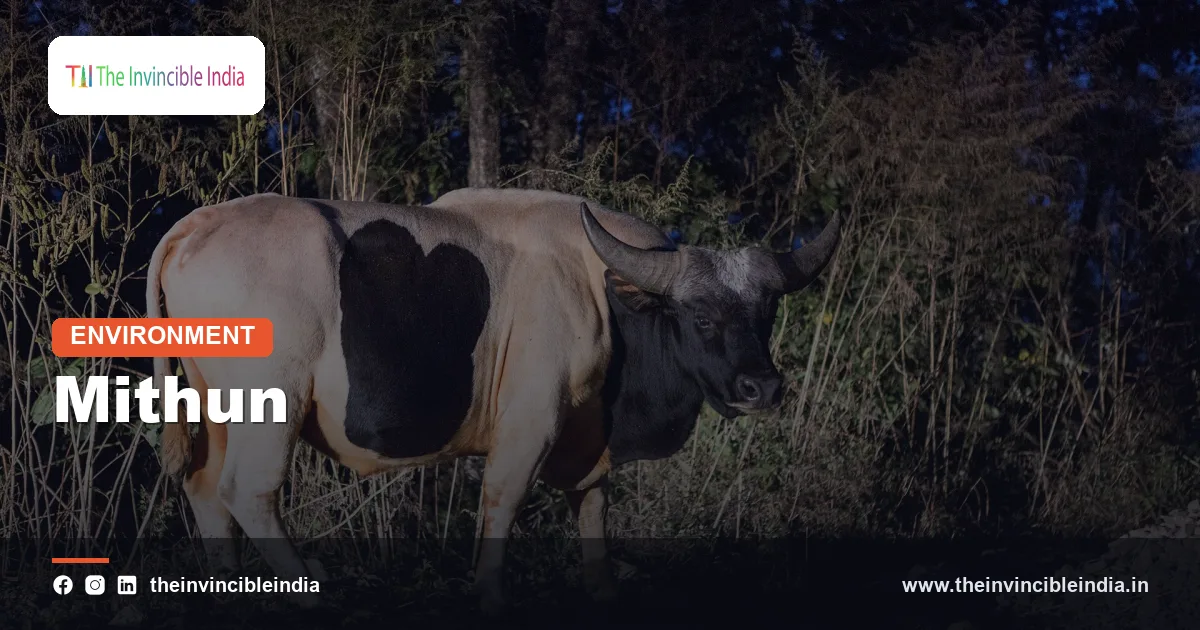
The mithun (Bos frontalis), also called the gayal, is a large semi-domesticated bovine of the hill forests of Northeast India, and mithun conservation in India means safeguarding both the animal and the free-ranging, community-based husbandry system that has sustained it for centuries. The mithun is the state animal of Arunachal Pradesh and Nagaland, and it functions as living wealth, a ceremonial offering and a cultural emblem for many hill communities.
Unlike most livestock, the mithun is not kept in a shed or paddock. It roams forests on its own, returning to villages for salt. This explainer covers what the mithun is, where it lives, how it is reared, why it matters culturally, what changed with its 2023 recognition as a food animal, and what the ICAR-National Research Centre on Mithun does to protect the species. It was last reviewed on 17 October 2026.
Quick Facts
| Common names | Mithun, mithan, gayal, “cattle of the hills”; local names include sial among the Mizo |
|---|---|
| Scientific name | Bos frontalis |
| Type of animal | Semi-domesticated bovine, closely related to the wild gaur (Bos gaurus) |
| Main Indian states | Arunachal Pradesh, Nagaland, Manipur and Mizoram |
| State animal of | Arunachal Pradesh and Nagaland |
| Husbandry system | Free-ranging in forests with periodic salt supplementation |
| Dedicated research body | ICAR-National Research Centre on Mithun (NRC on Mithun), Medziphema, Nagaland, established in 1988 |
| Food-animal recognition | Recognised as a food animal by the Food Safety and Standards Authority of India (FSSAI) in 2023 |
| Population | Estimated at a few lakh animals in India according to livestock censuses; the exact figure varies by census year |
Key Takeaways
- The mithun (Bos frontalis) is a semi-domesticated bovine of the Northeast Indian hills, and it is not a pure wild species or a fully tame farm animal.
- Mithun is the state animal of both Arunachal Pradesh and Nagaland, and its head appears in the cultural symbolism of several hill communities.
- Mithun husbandry is free-ranging: animals graze in forests for most of the year and are drawn back to villages with salt.
- The ICAR-National Research Centre on Mithun, set up in 1988 at Medziphema in Nagaland, leads scientific work on mithun breeding, health, nutrition and conservation.
- The 2023 recognition of mithun as a food animal by the FSSAI opened the way for regulated, legal marketing of mithun meat.
- Mithun conservation depends on keeping forest grazing land, traditional rearing knowledge and genetic diversity intact, because the animal is conserved on community land and not mainly in protected areas.
What Is the Mithun?
The mithun is a stocky, dark-coated bovine of the Bos genus that lives in the hills of Northeast India, Bhutan, Myanmar and neighbouring areas, and it is reared in a semi-wild manner by tribal communities. The scientific name Bos frontalis refers to its broad, flat forehead. Adult animals are heavy and muscular, with a pronounced dewlap, no hump on the shoulders, and thick horns that curve outward from the sides of the head.
The coat of the mithun is usually dark brown to black, with white or cream “stockings” on the lower legs. Adult bulls are commonly described as weighing in the range of several hundred kilograms and standing roughly 1.2 to 1.5 metres at the shoulder, though weights vary with region, age and feed. The animal has short legs, strong shoulders and a calm temperament toward people it knows.
The English word “mithun” is the same as the Hindi word for the zodiac sign Gemini, but the two are unrelated. In the animal’s case, the word comes from tribal languages of the region, and the species is known by different local names across Arunachal Pradesh, Nagaland, Manipur and Mizoram.
Where Is the Mithun Found in India?
The mithun is found mainly in the hill states of Northeast India, chiefly Arunachal Pradesh, Nagaland, Manipur and Mizoram, usually at mid to high altitudes in forested terrain. Arunachal Pradesh and Nagaland hold the largest and most culturally prominent populations, while smaller numbers are kept in other Northeastern hill areas.
Outside India, mithun or gayal populations are reported from Bhutan, Myanmar, Bangladesh (especially the Chittagong Hill Tracts) and parts of southwestern China. Mithun thrive in cool, humid, forested hill country and are generally less comfortable in hot, dry plains, which limits how far they can be moved from their home range.
Within the Indian Northeast, mithun-rearing communities include groups such as the Nyishi, Apatani, Galo, Adi and Mishmi peoples of Arunachal Pradesh, several Naga tribes of Nagaland, and communities in Manipur and Mizoram. The exact tribal composition differs from valley to valley, and each community has its own customs about ownership, naming and sharing of mithun.
Is the Mithun a Wild or a Domestic Animal?
The mithun is best described as semi-domesticated: it is owned and marked by families but spends most of its life in forests without confinement, feeding, breeding and calving largely on its own. This puts it between a wild species such as the gaur and a fully domestic breed such as the zebu cow.
The origin of the mithun is still discussed by scientists. The main hypotheses are that the mithun was domesticated from the wild gaur (Bos gaurus), that it arose from crosses between gaur and domestic cattle, or that it is a distinct lineage related to both. Genetic studies broadly place it close to the gaur, with some evidence of cattle ancestry in certain lineages. The chromosome number is commonly reported as 58 for the mithun, between the 56 of the gaur and the 60 of domestic cattle, though readers should verify against current literature.
Mithun can also be crossed with domestic cattle, producing hybrids that tribal farmers sometimes keep. Such crossbreeding is a conservation concern because it can dilute the pure mithun gene pool, and for that reason agencies encourage controlled breeding.
How Is the Mithun Reared?
The mithun is reared under a free-ranging system in which animals graze in community forests for most of the year and return to villages or collection points when called with salt. Salt is the key tool of the system, because mithun crave it and a keeper can use it to gather or check on the herd.
Under this system, a family may own several animals that live together as a loose herd. Owners mark the animals, often by notching the ear, so that mithun belonging to different households can be told apart in the forest. Herds forage on leaves, shoots, shrubs, grasses and bamboo, moving up and down the slopes with the seasons.
Strengths of the free-ranging system
- Very low input cost, since the animals feed themselves from forest vegetation.
- Natural mating and selection, which maintains a diverse gene pool.
- Animals that are hardy and well adapted to steep, forested terrain.
- A close link between the animal, the village and the forest, which gives communities an incentive to protect the habitat.
Weaknesses of the free-ranging system
- Limited ability to monitor health, so disease can spread unnoticed.
- Risk of theft, straying across boundaries and conflict over grazing rights.
- Slow genetic improvement, because breeding is uncontrolled.
- Vulnerability when forest land is cleared, fenced or converted to plantations.
Why Is the Mithun Culturally Important?
The mithun is culturally important because it serves as a measure of wealth, a gift in marriage and diplomacy, and a sacrificial animal in ceremonies among many hill communities of Northeast India. In several societies, the number of mithun a family owns signals its standing, and gifting mithun to another household is a sign of respect and alliance.
Mithun are commonly offered in bride-price negotiations, in settling disputes, at community feasts and in funerary and festival rituals, though the specific practice differs between tribes. In some Naga societies, feasts of merit have traditionally involved the sacrifice of mithun to raise a family’s prestige. Mithun heads and horns are also displayed as decoration and as trophies of generosity.
The animal also appears in state symbolism. The mithun is the state animal of Arunachal Pradesh and Nagaland, and its image is used in emblems and cultural motifs. This symbolic role means that mithun conservation is as much about heritage as about livestock.
Mithun as a form of living wealth
Because a healthy mithun appreciates in value without needing feed or housing, many families treat their herd like a savings account. Animals can be sold or slaughtered in a time of need, which is why communities place such value on keeping the herd intact across generations.
What Did the 2023 FSSAI Food-Animal Recognition Change?
In 2023 the Food Safety and Standards Authority of India (FSSAI) recognised the mithun as a food animal, which brought mithun meat within the formal food-safety framework and supported its regulated sale. Before this recognition, the meat circulated mainly in local and customary markets, with little official standardisation.
The recognition was welcomed by farmers and researchers because it can help create a legal market, set quality and hygiene standards, and give mithun keepers a clearer route to income. It also allows state animal husbandry departments and the NRC on Mithun to work on slaughter, processing and certification systems.
The step also raises a conservation question. A larger commercial market can strengthen the economic reason to keep mithun, but if demand grows faster than breeding, it could place pressure on herds. Policymakers and researchers therefore stress balanced marketing, with continued breeding support and records of animal numbers.
Possible benefits of recognition
- A defined legal status for mithun meat in the food chain.
- A basis for hygiene, labelling and quality standards.
- Better income prospects for hill farmers.
- Greater policy attention to mithun as a livestock resource.
What Threats Does the Mithun Face?
The mithun faces threats from shrinking forest grazing land, disease, inbreeding and crossbreeding, theft and weakening of traditional rearing practices. None of these threats pushes the mithun to the edge of extinction in a simple way, but together they can reduce numbers and genetic diversity.
Loss and fragmentation of forest grazing land
Roads, hydropower projects, settlements, plantations and shifting land use reduce the forest area available for free-ranging herds. Where forests are fenced or converted, mithun lose access to their grazing grounds and salt licks.
Disease
Because the herds are rarely handled, infections such as foot-and-mouth disease and other bovine illnesses can spread before they are detected. Contact with domestic cattle and with wild bovines in shared forests adds to the risk, and veterinary services in remote hill areas are limited.
Inbreeding and hybridisation
Small herds and the sharing of a few breeding bulls can lead to inbreeding. Uncontrolled crossing with domestic cattle may dilute the pure mithun lineage, reducing the traits that make the animal suited to hill life.
Changing livelihoods
As younger people move to towns and take up other work, the knowledge of forest herd management can weaken. Fewer families rearing mithun means fewer animals and less shared know-how.
What Is the ICAR-National Research Centre on Mithun?
The ICAR-National Research Centre on Mithun (NRC on Mithun) is the Indian Council of Agricultural Research institute dedicated to the study and improvement of the mithun, and it was established in 1988 with its headquarters at Medziphema in Nagaland. It is the principal scientific body for mithun in the country.
The centre works on several fronts: studying the genetics and diversity of mithun populations, developing feed and health protocols, improving reproduction through techniques such as semen collection and preservation, and training farmers. It also maintains breeding herds, documents traditional knowledge, and supports state governments in the Northeast.
Scientific conservation efforts of this kind are often described as “in situ” when animals are protected in their natural setting, and “ex situ” when herds, semen or tissue are held at a research facility. For the mithun, the NRC on Mithun supports both, with an emphasis on keeping the animal in its traditional landscape.
Key roles of the NRC on Mithun
- Characterising mithun populations and their genetic variation.
- Developing improved husbandry, feeding and health practices.
- Training and extension work for mithun-rearing households.
- Supporting policy on mithun recognition, marketing and welfare.
What Is the Legal and Conservation Status of the Mithun?
The mithun is treated as livestock and not as a scheduled wild species, so it is governed mainly by animal husbandry, veterinary and food-safety rules rather than by the Wildlife (Protection) Act, 1972. Its close wild relative, the gaur, is a protected species, which makes the legal distinction between the two important.
The International Union for Conservation of Nature (IUCN) does not evaluate domesticated animals in the same way as wild species, so the mithun does not carry a standard IUCN threat category. Instead, domestic breeds and populations are tracked through livestock censuses and through bodies such as the National Bureau of Animal Genetic Resources, and their conservation is considered a matter of animal genetic resource management. Readers who need a precise legal or status position should check the latest government notifications.
Mithun compared with the gaur and domestic cattle
| Feature | Mithun (Bos frontalis) | Gaur (Bos gaurus) | Domestic cattle (Bos taurus indicus) |
|---|---|---|---|
| Status | Semi-domesticated livestock | Wild; protected species in India | Fully domesticated |
| Hump | No hump | Pronounced ridge on the back | Hump in zebu breeds |
| Horns | Thick, spreading outward | Curved upward and inward | Variable by breed |
| Habitat | Hill forests of the Northeast | Forests across peninsular and central India and the Northeast | Villages and farms across India |
| Management | Free-ranging with salt | Unmanaged in the wild | Housed and fed by owners |
| Chromosome number (commonly reported) | 58 | 56 | 60 |
How Can Mithun Conservation Be Strengthened?
Mithun conservation can be strengthened by protecting community forest grazing land, improving veterinary care, supporting controlled breeding, keeping records of herds and building fair markets, all while keeping traditional owners at the centre. Because the mithun is conserved by the people who keep it, community involvement is more effective than any approach that excludes them.
- Secure grazing land: recognise and protect community forests that herds depend on, including salt-lick sites.
- Health services: extend vaccination and disease surveillance to remote hill villages.
- Genetic management: exchange breeding bulls between villages, record pedigrees where possible, and conserve semen as a back-up.
- Population records: maintain regular counts and identification so that trends can be tracked.
- Fair markets: use the 2023 food-animal recognition to create transparent supply chains that reward herd owners.
- Cultural continuity: support festivals, knowledge-sharing and youth participation in mithun rearing.
Researchers also point to the potential of mithun milk and meat as specialised products from the hills, and to the value of the animal in ecotourism and cultural heritage. These opportunities can give families a stronger reason to keep their herds.
Why Does Mithun Conservation Matter for India?
Mithun conservation matters because the mithun is a unique animal genetic resource, a cultural symbol of two states and the economic base of many hill households. Losing the mithun would remove a rare example of a semi-domesticated bovine that is well adapted to high-rainfall mountain forests.
The animal also illustrates a broader lesson in conservation: species are often protected most effectively when local communities benefit from keeping them alive. The mithun survives not because of a fence or a sanctuary but because families value the animal and the forest it needs. Strengthening that relationship, through research, policy and markets, is the heart of mithun conservation in India.
Bottom Line
The mithun is a semi-domesticated bovine of the Northeast hills, the state animal of Arunachal Pradesh and Nagaland, and a living symbol of wealth and ceremony. Its future depends on forest grazing land, healthy herds, genetic diversity and fair markets, supported by the ICAR-National Research Centre on Mithun and by the communities that have kept the animal for generations.
Frequently Asked Questions
What is a mithun?
A mithun is a large, semi-domesticated bovine, scientifically Bos frontalis, found in the hill forests of Northeast India. It is also called the gayal and is closely related to the wild gaur. Families own mithun but let them roam forests freely, calling them back with salt.
Which Indian states have the mithun as their state animal?
Arunachal Pradesh and Nagaland have the mithun as their state animal. The animal is also important in Manipur and Mizoram. Its symbolism reflects its role in the culture, wealth and ceremonies of hill communities.
Is the mithun a wild animal?
No, the mithun is generally regarded as semi-domesticated and not wild. Owners mark and claim their animals, although the herds graze in forests with little human control. It is treated as livestock and not as a scheduled wild species, unlike its relative the gaur.
Why did the FSSAI recognise the mithun as a food animal in 2023?
The recognition brought mithun meat into the formal food-safety system. It supports regulated sale and gives hill farmers a clearer route to a legal market. Policymakers also stress that breeding and conservation must continue alongside any rise in demand.
What does the ICAR-National Research Centre on Mithun do?
The ICAR-National Research Centre on Mithun is the national research institute for the animal, based at Medziphema, Nagaland, and established in 1988. It studies mithun genetics, feed, health and reproduction, and trains farmers. It also supports conservation and policy on mithun husbandry.
What are the main threats to the mithun?
The main threats are loss of forest grazing land, disease, inbreeding and crossbreeding with domestic cattle, theft, and the decline of traditional rearing knowledge. These pressures can reduce herd numbers and genetic diversity over time. Community-based management and veterinary support are the main responses.
{“@context”:”https://schema.org”,”@graph”:[{“@type”:”FAQPage”,”mainEntity”:[{“@type”:”Question”,”name”:”What is a mithun?”,”acceptedAnswer”:{“@type”:”Answer”,”text”:”A mithun is a large, semi-domesticated bovine, scientifically Bos frontalis, found in the hill forests of Northeast India. It is also called the gayal and is closely related to the wild gaur. Families own mithun but let them roam forests freely, calling them back with salt.”}},{“@type”:”Question”,”name”:”Which Indian states have the mithun as their state animal?”,”acceptedAnswer”:{“@type”:”Answer”,”text”:”Arunachal Pradesh and Nagaland have the mithun as their state animal. The animal is also important in Manipur and Mizoram. Its symbolism reflects its role in the culture, wealth and ceremonies of hill communities.”}},{“@type”:”Question”,”name”:”Is the mithun a wild animal?”,”acceptedAnswer”:{“@type”:”Answer”,”text”:”No, the mithun is generally regarded as semi-domesticated and not wild. Owners mark and claim their animals, although the herds graze in forests with little human control. It is treated as livestock and not as a scheduled wild species, unlike its relative the gaur.”}},{“@type”:”Question”,”name”:”Why did the FSSAI recognise the mithun as a food animal in 2023?”,”acceptedAnswer”:{“@type”:”Answer”,”text”:”The recognition brought mithun meat into the formal food-safety system. It supports regulated sale and gives hill farmers a clearer route to a legal market. Policymakers also stress that breeding and conservation must continue alongside any rise in demand.”}},{“@type”:”Question”,”name”:”What does the ICAR-National Research Centre on Mithun do?”,”acceptedAnswer”:{“@type”:”Answer”,”text”:”The ICAR-National Research Centre on Mithun is the national research institute for the animal, based at Medziphema, Nagaland, and established in 1988. It studies mithun genetics, feed, health and reproduction, and trains farmers. It also supports conservation and policy on mithun husbandry.”}},{“@type”:”Question”,”name”:”What are the main threats to the mithun?”,”acceptedAnswer”:{“@type”:”Answer”,”text”:”The main threats are loss of forest grazing land, disease, inbreeding and crossbreeding with domestic cattle, theft, and the decline of traditional rearing knowledge. These pressures can reduce herd numbers and genetic diversity over time. Community-based management and veterinary support are the main responses.”}}]}]}


