

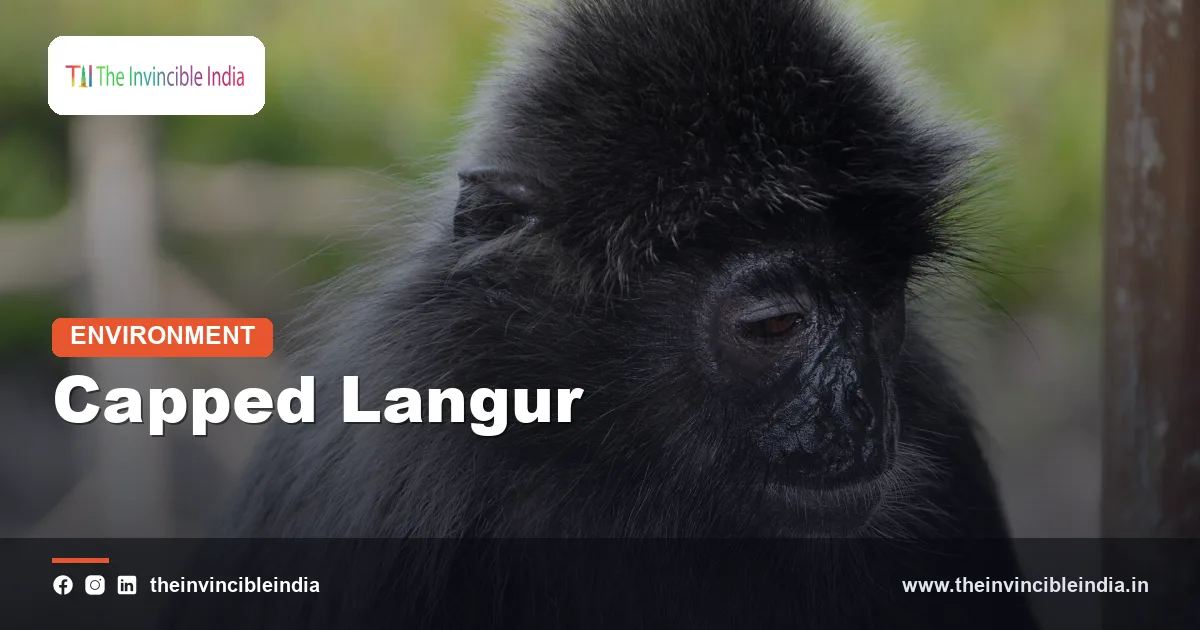
The capped langur (Trachypithecus pileatus), also called the capped leaf monkey, is a long-tailed, leaf-eating primate of the forests of Northeast India and neighbouring Bhutan, Bangladesh and Myanmar, and capped langur conservation focuses on protecting its shrinking tree-canopy habitat from clearance, fragmentation and hunting. The species gets its name from the dark cap of hair on its head, and it is listed as Vulnerable by the International Union for Conservation of Nature (IUCN).
The capped langur is a canopy specialist that spends most of its life in trees, feeding mainly on leaves. Because it needs connected forest, it is sensitive to habitat loss. This explainer covers its appearance, range, behaviour, threats and legal protection in India. It was last reviewed on 17 October 2026.
Quick Facts
| Common names | Capped langur, capped leaf monkey |
|---|---|
| Scientific name | Trachypithecus pileatus |
| Family | Cercopithecidae, subfamily Colobinae (leaf monkeys) |
| Indian range | Northeast India, including Assam, Arunachal Pradesh, Meghalaya, Mizoram, Manipur, Nagaland and Tripura, in suitable forest |
| Range beyond India | Bhutan, Bangladesh and Myanmar, with some reports from neighbouring areas |
| Habitat | Evergreen, semi-evergreen and moist deciduous forest, including bamboo and secondary growth |
| Diet | Mainly leaves, supplemented by fruits, flowers, seeds and buds |
| IUCN status | Vulnerable, according to IUCN assessments |
| Legal protection in India | Protected under the Wildlife (Protection) Act, 1972, in the highest-protection schedule at the time of writing; readers should check the current Schedule |
Key Takeaways
- The capped langur (Trachypithecus pileatus) is a leaf-eating monkey found in the forests of Northeast India, Bhutan, Bangladesh and Myanmar.
- The capped langur is classified as Vulnerable by the IUCN because its forest habitat is shrinking and its populations are believed to be declining.
- The capped langur takes its name from the cap of dark, upright hair on its crown, which contrasts with its paler cheeks and golden or cream underparts.
- Capped langurs live in troops, often with one or more adult males and several females, and they feed mainly on leaves in the forest canopy.
- Major threats to the capped langur include forest clearance, jhum and plantation expansion, roads and railways that break canopy, and hunting for meat and traditional medicine.
- Capped langur conservation in India depends on protecting connected forest, including sanctuaries, community-managed forests and canopy corridors.
What Is the Capped Langur?
The capped langur is a medium-sized, slender monkey of the leaf-monkey group, known scientifically as Trachypithecus pileatus, and it lives high in the trees of the forests of Northeast India and nearby countries. It is a close relative of other langurs of the genus Trachypithecus, including the golden langur of Assam and Bhutan.
The common name comes from the cap of hair on its head, which stands up in a crest or sweeps back over the crown. The body is slim, the limbs are long and the tail is longer than the head and body combined, serving as a balancing aid when the monkey leaps between branches.
The capped langur is one of several primates of the Northeast, a region that is exceptionally rich in monkeys, apes and lorises. Its presence is a sign of relatively healthy forest, and it is often used as an indicator when forests are surveyed.
What Does a Capped Langur Look Like?
A capped langur has a dark, almost blackish face with a cap of hair on the crown, darker grey or brownish fur on the back, and paler cheeks and underparts that can range from cream to golden orange. The exact colours differ between animals and across the geographical range.
Adults typically weigh in the region of ten kilograms or so, with males somewhat heavier than females. The tail is long and tapering, and the hands and feet are dark. Infants are born with a coat that differs from the adult pattern, usually paler and more brightly coloured, and the colour changes as the young monkey matures. Such natal coats are common in langurs and are thought to attract the attention of group members.
Subspecies and variation
Some scientists have recognised several subspecies of the capped langur, differing in colour pattern, including forms found north and south of the Brahmaputra and in Myanmar. Taxonomy is still discussed, and different checklists may treat these forms differently. For this reason, the species is usually described as a whole in conservation assessments.
Where Does the Capped Langur Live in India?
The capped langur lives in the forests of Northeast India, chiefly in Assam, Arunachal Pradesh, Meghalaya, Mizoram, Manipur, Nagaland and Tripura, usually in lowland and foothill forests. Populations are patchy and tend to be concentrated in protected areas and larger forest blocks.
The species occurs in protected areas such as Manas National Park, Kaziranga National Park, Namdapha National Park and the Gibbon Wildlife Sanctuary in Assam, although the specific list of sites changes as surveys improve. Beyond India, the species has been recorded in Bhutan, Bangladesh and Myanmar, and its overall distribution forms an arc around the Brahmaputra and Bengal plains.
Within these forests, the capped langur uses a range of forest types, from tall evergreen and semi-evergreen stands to moist deciduous forest and bamboo-rich areas. It can also use secondary forest and some degraded habitat, but it needs enough continuous tree cover to move without descending to the ground.
How Does the Capped Langur Live and Feed?
The capped langur is a folivore, meaning it feeds mainly on leaves, and it has a multi-chambered stomach in which bacteria help break down tough plant fibre. This digestive system is shared by all colobine monkeys and allows them to live on a diet that other primates cannot easily use.
Young leaves, shoots, buds, flowers and fruits are eaten when they are available, and the monkeys often feed in the early morning and late afternoon, resting in the middle of the day. Because leaves are low in energy, the animals move slowly and spend much time resting while they digest.
Group structure
Capped langurs live in troops that commonly include several adult females, their young and one or more adult males. Troop size varies between small groups of a handful of animals and larger groups of a dozen or more. Females generally stay in or near the group where they are born, while males may move between troops. Troops usually occupy a home range within which they travel between feeding and sleeping trees.
Reproduction
Females give birth to a single infant after a gestation of around six months. Infants are cared for by their mothers, and in many langurs other females in the troop show interest in them as well. Offspring remain with the group as they mature and begin to feed on leaves.
Role in the forest
By eating leaves, flowers and fruits, capped langurs influence plant growth and may help disperse some seeds. They are also prey for large raptors, clouded leopards and other carnivores, and form part of the forest food web.
Why Is the Capped Langur Vulnerable?
The capped langur is considered Vulnerable because its forest habitat in the Northeast and neighbouring countries has been shrinking and fragmenting, and because hunting adds to the pressure. IUCN classification as Vulnerable means the species faces a high risk of extinction in the wild in the medium term if threats continue.
Population figures for the capped langur are uncertain, and surveys across its whole range are patchy. Published estimates are therefore best treated as approximate, but the general trend identified by assessments is a decline, linked to the loss of habitat and to hunting.
What Are the Main Threats to the Capped Langur?
The main threats to the capped langur are habitat loss and fragmentation, hunting, and the effect of linear infrastructure such as roads and railway lines that cut through forest. Several of these pressures act together in the same landscape.
Habitat loss and fragmentation
Forests in the region have been cleared for agriculture, tea and other plantations, settlements and timber. Shifting cultivation, known as jhum, with shortened cycles can prevent forests from regrowing fully. Small isolated forest patches cannot support large troops over the long term.
Hunting
In parts of the region, langurs and other primates are hunted for meat and for use in traditional medicine. Hunting is illegal under the Wildlife (Protection) Act, 1972, but enforcement in remote areas is difficult, and hunting traditions persist in some communities.
Roads, railways and power lines
Because the capped langur prefers to travel through the treetops, gaps in the canopy can force monkeys to cross on the ground, where they are exposed to vehicles, dogs and people. Accidents and electrocution on power lines are recorded for arboreal primates in several parts of India.
Floods, climate and disturbance
The lowland forests of the Brahmaputra valley are subject to seasonal flooding, and climate change may alter flood patterns and forest composition. Disturbance from logging, fuelwood collection and grazing can further degrade habitat.
How Is the Capped Langur Protected in India?
The capped langur is protected in India by the Wildlife (Protection) Act, 1972, which prohibits hunting and trade in listed species and provides for protected areas such as national parks and wildlife sanctuaries. The species has been included in the schedule offering the highest level of protection, though Schedule listings were reorganised by the 2022 amendment and readers should check the current text.
Internationally, the capped langur is listed in the appendices of the Convention on International Trade in Endangered Species of Wild Fauna and Flora (CITES), which regulates cross-border trade. Within India, the main protection comes from forest departments, wildlife wardens and the protected-area network of the Northeast.
Protection tools at a glance
| Tool | What it does for the capped langur |
|---|---|
| Wildlife (Protection) Act, 1972 | Prohibits hunting and trade; enables sanctuaries and national parks |
| National parks and sanctuaries | Secure core forest habitat, for example in Manas, Kaziranga, Namdapha and Gibbon Wildlife Sanctuary |
| CITES listing | Controls international trade in the species |
| Community and reserved forests | Extend habitat outside protected areas when managed for biodiversity |
| Canopy bridges and corridors | Help monkeys cross roads and railways without descending to the ground |
| Research and monitoring | Provide data on numbers, ranging and threats |
What Conservation Measures Help the Capped Langur?
Conservation measures that help the capped langur include securing and connecting forest, curbing hunting, building canopy bridges, involving local communities and carrying out regular surveys. These measures work best when combined into a landscape approach and not applied to a single reserve.
- Protect core forests: maintain strong protection in national parks and sanctuaries where langurs live.
- Link forest fragments: restore corridors and plant native trees so that troops can move between patches.
- Reduce road and rail impacts: install canopy bridges and design infrastructure to reduce canopy gaps.
- Counter hunting: run awareness programmes, support alternative livelihoods and improve patrolling.
- Work with communities: support village forests and customary conservation traditions in the Northeast.
- Improve data: carry out repeated surveys using standard methods, so that population trends are known.
How Does the Capped Langur Differ From Other Northeast Primates?
The capped langur differs from other Northeast Indian primates in being a long-tailed leaf monkey with a cap of hair, whereas neighbouring species include apes, macaques and lorises with different diets and body forms. The region is one of the richest in primate diversity in India, and several species share the same forests.
| Species | Group | Key feature | Main diet |
|---|---|---|---|
| Capped langur | Leaf monkey | Cap of hair, long tail | Leaves |
| Golden langur | Leaf monkey | Golden or cream coat; very limited range | Leaves |
| Western hoolock gibbon | Ape | Tailless; arm-swinging | Fruit and leaves |
| Stump-tailed macaque | Macaque | Short tail; shaggy coat | Fruit, leaves and insects |
| Assamese macaque | Macaque | Sturdy build; medium tail | Fruit, leaves and insects |
Because several of these species depend on the same tall forest, protecting capped langur habitat often protects other threatened primates too. The Gibbon Wildlife Sanctuary in Assam is a well-known example of a small forest that supports multiple primate species.
Why Does Capped Langur Conservation Matter?
Capped langur conservation matters because the species is a Vulnerable primate that indicates forest health, and because its protection also supports the broader biodiversity of the Northeast. A forest that keeps its langurs is likely to keep much else as well.
Monitoring such animals gives wildlife managers early warning of problems like forest fragmentation. The capped langur also adds to the natural heritage and tourism potential of the region, as visitors to Northeast forests often value the chance to see primates in the wild.
Bottom Line
The capped langur is a Vulnerable, leaf-eating primate of Northeast India’s forests, recognisable by the cap of hair on its head. Its survival depends on connected forest, strict protection from hunting and well-planned infrastructure, which together make landscape-scale conservation the key to securing the species.
Frequently Asked Questions
What is a capped langur?
A capped langur is a slender, long-tailed leaf monkey, scientifically Trachypithecus pileatus, found in the forests of Northeast India and nearby countries. It is named for the cap of dark hair on its head. It feeds mainly on leaves and lives in the tree canopy.
Where are capped langurs found in India?
Capped langurs are found in the forests of Northeast India, mainly in Assam, Arunachal Pradesh, Meghalaya, Mizoram, Manipur, Nagaland and Tripura. They also live in Bhutan, Bangladesh and Myanmar. Sites such as Manas, Kaziranga and the Gibbon Wildlife Sanctuary are often mentioned as habitats.
Is the capped langur endangered?
The capped langur is classified as Vulnerable by the IUCN, which is one step below Endangered. This means it faces a high risk of extinction in the wild in the medium term. Habitat loss and hunting are the main reasons for its decline.
What does the capped langur eat?
The capped langur eats mainly leaves, along with fruits, flowers, seeds and buds. It has a specialised multi-chambered stomach that helps digest tough plant material. Because leaves give little energy, the monkey rests for long periods during the day.
What are the biggest threats to the capped langur?
The biggest threats to the capped langur are the loss and fragmentation of forest, hunting for meat and traditional medicine, and roads or railways that break the canopy. Floods and disturbance add further pressure. Together they reduce the area where troops can live safely.
How is the capped langur protected by law in India?
The capped langur is protected by the Wildlife (Protection) Act, 1972, which bans hunting and trade in listed species and allows national parks and sanctuaries to be set up. It is also covered by CITES for international trade. The exact Schedule listing should be checked in the latest version of the Act.
{“@context”:”https://schema.org”,”@graph”:[{“@type”:”FAQPage”,”mainEntity”:[{“@type”:”Question”,”name”:”What is a capped langur?”,”acceptedAnswer”:{“@type”:”Answer”,”text”:”A capped langur is a slender, long-tailed leaf monkey, scientifically Trachypithecus pileatus, found in the forests of Northeast India and nearby countries. It is named for the cap of dark hair on its head. It feeds mainly on leaves and lives in the tree canopy.”}},{“@type”:”Question”,”name”:”Where are capped langurs found in India?”,”acceptedAnswer”:{“@type”:”Answer”,”text”:”Capped langurs are found in the forests of Northeast India, mainly in Assam, Arunachal Pradesh, Meghalaya, Mizoram, Manipur, Nagaland and Tripura. They also live in Bhutan, Bangladesh and Myanmar. Sites such as Manas, Kaziranga and the Gibbon Wildlife Sanctuary are often mentioned as habitats.”}},{“@type”:”Question”,”name”:”Is the capped langur endangered?”,”acceptedAnswer”:{“@type”:”Answer”,”text”:”The capped langur is classified as Vulnerable by the IUCN, which is one step below Endangered. This means it faces a high risk of extinction in the wild in the medium term. Habitat loss and hunting are the main reasons for its decline.”}},{“@type”:”Question”,”name”:”What does the capped langur eat?”,”acceptedAnswer”:{“@type”:”Answer”,”text”:”The capped langur eats mainly leaves, along with fruits, flowers, seeds and buds. It has a specialised multi-chambered stomach that helps digest tough plant material. Because leaves give little energy, the monkey rests for long periods during the day.”}},{“@type”:”Question”,”name”:”What are the biggest threats to the capped langur?”,”acceptedAnswer”:{“@type”:”Answer”,”text”:”The biggest threats to the capped langur are the loss and fragmentation of forest, hunting for meat and traditional medicine, and roads or railways that break the canopy. Floods and disturbance add further pressure. Together they reduce the area where troops can live safely.”}},{“@type”:”Question”,”name”:”How is the capped langur protected by law in India?”,”acceptedAnswer”:{“@type”:”Answer”,”text”:”The capped langur is protected by the Wildlife (Protection) Act, 1972, which bans hunting and trade in listed species and allows national parks and sanctuaries to be set up. It is also covered by CITES for international trade. The exact Schedule listing should be checked in the latest version of the Act.”}}]}]}


