

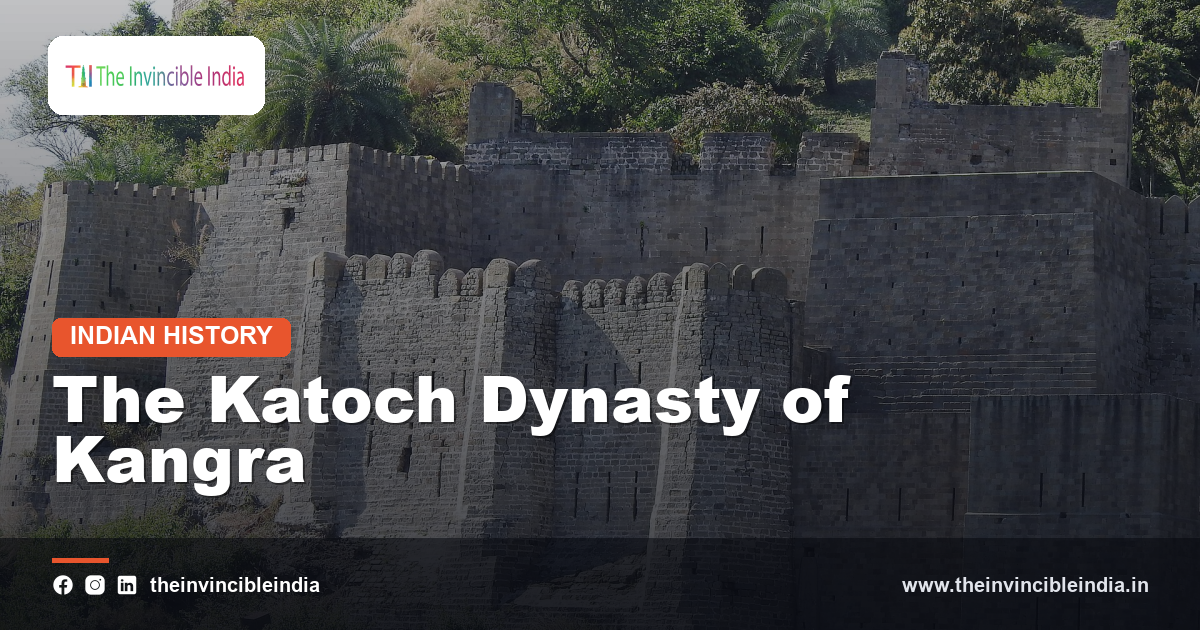
The Katoch dynasty of Kangra was an ancient hill ruling house of the region known in old tradition as Trigarta, in the Kangra valley of present-day Himachal Pradesh in the western Himalayan foothills. Counted among the very old lineages of the Indian hills and associated with a Rajput heritage, the Katoch are closely linked with the mighty Kangra Fort, also called Nagarkot, and with the celebrated school of Kangra miniature painting that flourished under their most famous ruler, Raja Sansar Chand II, in the late eighteenth and early nineteenth centuries. Over their long history the dynasty clashed with the Mughals and later with the Sikhs under Maharaja Ranjit Singh. Like the hill chiefs of the western mountains, the Katoch belonged to the broad world of the Rajput kingdoms. Because claims of great antiquity rest on tradition, this guide keeps to broad terms and flags legendary claims.
Quick answer: The Katoch dynasty of Kangra was an ancient hill ruling house of the region known as Trigarta, in the Kangra valley of present-day Himachal Pradesh. Associated with a Rajput heritage and regarded as a very old lineage, the Katoch are closely linked with the great Kangra Fort, or Nagarkot. Their most famous ruler, Raja Sansar Chand II, was a renowned patron of the celebrated Kangra school of miniature painting. Over their long history the dynasty clashed with the Mughals and later with the Sikhs under Maharaja Ranjit Singh.
Key Takeaways
- The Katoch dynasty of Kangra was an ancient hill ruling house of the region known as Trigarta, in present-day Himachal Pradesh.
- The dynasty is regarded as a very old lineage and is associated with a Rajput heritage of the western Himalayan foothills.
- The Katoch are closely linked with the mighty Kangra Fort, also called Nagarkot.
- Their most famous ruler, Raja Sansar Chand II, flourished in the late eighteenth and early nineteenth centuries.
- Sansar Chand II was a renowned patron of the celebrated Kangra school of miniature painting.
- Over their long history the Katoch clashed with the Mughals and later with the Sikhs under Maharaja Ranjit Singh.
Read on for the history, culture, and legacy in detail.
Quick Facts
| Detail | Information |
|---|---|
| Dynasty | Katoch dynasty of Kangra (ancient Trigarta) |
| Period | Ancient lineage into the modern era, early dates by tradition |
| Region | Kangra valley, Himachal Pradesh (western Himalayan foothills) |
| Stronghold | Kangra Fort (Nagarkot) |
| Notable Ruler | Raja Sansar Chand II |
| Patronage | Kangra miniature painting (Pahari school) |
| Rivals | The Mughals, and later the Sikhs under Ranjit Singh |
| Legacy | Kangra painting, Kangra Fort and the Trigarta heritage |
Who Were the Katoch?
The Katoch were an ancient ruling family of the western Himalayan foothills, lords of the Kangra region and bearers of one of the old hill lineages of northern India, associated with a Rajput heritage. Their kingdom lay in the Kangra valley, in the region known in old tradition as Trigarta, and the dynasty is regarded as among the very oldest of the hill ruling houses. For many centuries the Katoch held sway over the Kangra country, defending it from a powerful hill fortress and taking part in the shifting politics of the mountains and the plains below. They are especially remembered for their role as patrons of art in the later period of their history. The dynasty combined the martial traditions of the Rajput hill chiefs with a notable cultural legacy. The Katoch therefore represent an enduring hill dynasty of the western Himalayas, remembered for both their antiquity and their patronage of the celebrated painting of Kangra.
Where Is Kangra Located?
Kangra is located in the western Himalayan foothills, in the valley of the same name in present-day Himachal Pradesh in northern India, a region of green valleys, rivers and mountains beneath the high Himalayan ranges. The Kangra valley, watered by hill rivers and set against the backdrop of the snow-capped Dhauladhar range, is one of the most beautiful and fertile of the lower Himalayan regions. Its position in the hills, between the plains of the Punjab and the high mountains, gave it both natural protection and a place in the contests between hill and plains powers. The region was long a centre of hill culture, religion and art. Its scenery and climate have made it famous, and it formed the heartland of the Katoch kingdom. The geography of the Kangra valley therefore shaped the history of the Katoch dynasty, providing both a secure homeland and a setting of great natural beauty.
What Was Ancient Trigarta?
Trigarta was the ancient name of the region associated with the Kangra country and the Katoch dynasty, a land name of great antiquity in the traditions of northern India. The name Trigarta appears in old Indian tradition and literature as a kingdom of the hills and the adjoining plains, and the Katoch rulers traced their heritage to this ancient realm. The identification of Trigarta with the Kangra region connects the dynasty to the deep past of the western Himalayan foothills. Because the name belongs to ancient tradition, its precise historical boundaries and early history are understood in broad and sometimes legendary terms, and scholars treat claims of great antiquity with care. The association nonetheless gave the Katoch a sense of ancient and illustrious origin. Trigarta therefore stands as the ancient heritage from which the Katoch dynasty of Kangra claimed descent, linking the hill kingdom to the old traditions of northern India.
How Old Is the Katoch Lineage?
The Katoch lineage is regarded as a very old ruling line, and tradition claims for it an exceptional antiquity reaching far back into the ancient past of the Indian hills. The dynasty is counted among the oldest of the surviving hill royal houses, and its association with the ancient land of Trigarta reinforces this reputation for great age. Such claims of extreme antiquity, however, rest on tradition and genealogical memory rather than on firm contemporary record, and historians treat them with appropriate caution. What is well established is that the Katoch were a long-enduring dynasty that held the Kangra region through many centuries and through the rise and fall of greater powers around them. Their survival across so long a span is itself remarkable among Indian ruling houses. The antiquity of the Katoch lineage therefore forms a central part of the dynasty’s identity, celebrated in tradition while viewed carefully by historians.
Why Is Kangra Fort Important?
Kangra Fort, also known as Nagarkot, is one of the great hill fortresses of northern India and the historic stronghold of the Katoch dynasty, commanding the Kangra valley from a strong position above the rivers. The fort is celebrated as among the oldest and largest hill forts of the region, and its possession was long central to the power and prestige of the Katoch rulers. Its strong defences and strategic location made it a formidable stronghold and a prize contested by the powers that sought to dominate the hills. Over the centuries the fort witnessed sieges, conquests and the changing fortunes of the dynasty, including its loss to and recovery from greater powers. It preserves the memory of the Katoch and of the many struggles for the Kangra country. Kangra Fort therefore stands as the enduring symbol of the Katoch dynasty, embodying both its ancient power and the turbulent history of the western Himalayan hills.
What Was the Relationship with the Mughals?
The relationship between the Katoch and the Mughal Empire was marked by both conflict and submission, as the great power of the plains sought to extend its authority over the hill kingdoms of the western Himalayas. During the height of Mughal power the empire campaigned in the hills and brought the strong fortress of Kangra under its control, a notable event in the history of the fort and the dynasty. For a long period the Katoch, like other hill rajas, acknowledged Mughal supremacy while retaining their local position and identity. The relationship combined resistance, accommodation and the eventual recovery of lost power as Mughal strength declined. In the later period, as the empire weakened, the Katoch were able to reassert themselves and regain their great fortress. The details of these events are recorded in broad outline by historians. The relationship with the Mughals therefore shaped a key chapter in the long history of the Katoch dynasty and of Kangra Fort.
Who Was Raja Sansar Chand II?
Raja Sansar Chand II is the most celebrated ruler of the Katoch dynasty, remembered as a powerful hill king and, above all, as the great patron of the Kangra school of painting in the late eighteenth and early nineteenth centuries. Under his rule the Katoch kingdom reached a high point of power and cultural brilliance, and he recovered and held the great fortress of Kangra, extending his influence over the surrounding hill country. He is honoured chiefly for his magnificent patronage of the arts, which made his court a renowned centre of painting. His reign, however, also faced grave challenges from powerful neighbours, including the Gurkhas and, later, the rising Sikh power of the plains. The details of his life and campaigns are recorded in general terms. Sansar Chand II nonetheless stands as the glory of the dynasty, a ruler remembered both for his power in the hills and for the extraordinary artistic legacy of his court.
What Is Kangra Painting?
Kangra painting is one of the most admired styles of Indian miniature painting, a school of the broader Pahari, or hill, tradition that flourished under the patronage of the Katoch rulers, above all Raja Sansar Chand II. The style is celebrated for its delicate line, soft and lyrical colouring, and tender depiction of devotional and romantic themes, especially subjects drawn from the love of Radha and Krishna and from Hindu devotional poetry. Kangra paintings are renowned for their grace, their naturalistic landscapes evoking the hill country, and their refined beauty, which place them among the masterpieces of Indian art. The school developed at the hill courts and reached its height in the age of Sansar Chand. It remains one of the most treasured legacies of the Pahari tradition. Kangra painting therefore stands as the supreme cultural achievement associated with the Katoch dynasty, a school of art admired throughout India and beyond.
How Did Sansar Chand Patronise the Arts?
Raja Sansar Chand II patronised the arts with a generosity and discernment that made his court the leading centre of hill painting in its age and secured his lasting fame as a patron. He gathered artists and workshops at his court and supported the production of exquisite miniature paintings, nurturing the Kangra style to its height of refinement and beauty. His patronage encompassed the devotional, romantic and courtly themes beloved in the hill tradition, and the paintings produced under his support are counted among the finest in Indian art. The flourishing of this art under his rule reflected both his personal taste and the wealth and stability of his kingdom at its height. The tradition he fostered influenced painting across the hill region. Through this patronage Sansar Chand enriched the cultural heritage of the western Himalayas. His support of the arts therefore remains the most celebrated aspect of his reign and the enduring glory of the Katoch dynasty.
What Was the Conflict with the Gurkhas and the Sikhs?
The later history of the Katoch under Sansar Chand was marked by grave conflicts with the Gurkhas of Nepal and, decisively, with the rising Sikh power of the Punjab under Maharaja Ranjit Singh. The Gurkhas, expanding westward across the hills, invaded the Kangra region and besieged its great fortress, bringing hardship and danger to the kingdom. In the struggle that followed, the Sikh ruler Ranjit Singh intervened, and the mighty fortress of Kangra eventually passed into Sikh hands, a turning point that marked the decline of Katoch independence. The dynasty thereafter came under the dominance of the Sikh kingdom of the Punjab. These events, recorded in broad outline by historians, transformed the position of the Katoch from an independent hill power to a subordinate one. The conflicts with the Gurkhas and the Sikhs therefore brought the age of Katoch greatness under Sansar Chand to a difficult close.
How Did the Katoch Govern the Hill State?
The Katoch governed their hill state in the manner of the Rajput ruling houses of the western Himalayas, with a raja at the head supported by kinsmen, officials and the local chiefs and communities of the valley. The economy rested on agriculture in the fertile Kangra valley and on the resources of the hills, sustaining the court, the fortress and the dynasty’s military strength. The great fortress of Kangra served as the centre of power and the symbol of the dynasty’s authority over the region. Relations with neighbouring hill states, through alliance, rivalry and marriage, were an important feature of the political life of the mountains. Patronage of temples, religion and, in the later period, the arts formed part of the rulers’ conception of kingship. Because detailed records are limited, this picture is drawn in general terms. The Katoch state therefore exemplifies the pattern of enduring Rajput hill kingship in the western Himalayan foothills.
What Religion and Temples Did the Katoch Patronise?
The Katoch were patrons of the Hindu religious traditions of the hills, and the Kangra region is famous for its ancient and revered temples, which the dynasty and its people honoured and supported. The area is home to celebrated shrines, including the famous temple at Kangra dedicated to the goddess and the renowned nearby temple associated with the sacred flame, which draw pilgrims from across northern India. Royal patronage of temples, gifts to shrines and the support of religious festivals were expected duties of the hill rajas, binding them to the devotional life of the region. The strong tradition of goddess worship in the western Himalayas was an important part of the religious culture of the Kangra country. The region’s sacred sites remain major centres of pilgrimage today. The Katoch patronage of religion therefore tied the dynasty to the rich temple and pilgrimage heritage of the western Himalayan hills, honoured across the generations.
What Are the Masroor Temples?
The Masroor temples, located in the Kangra region, are a remarkable complex of ancient rock-cut temples carved from the living stone, counted among the notable monuments of the western Himalayan foothills. Hewn directly from a great outcrop of rock, the temples are admired for their ambitious conception and their fine carving, and they bear witness to the deep antiquity of temple building in the Kangra country. The complex is a striking example of the rock-cut architectural tradition of India, set in the scenic landscape of the hills. Though they belong to a period earlier than the famous later history of the Katoch, the Masroor temples form part of the rich heritage of the region the dynasty ruled. They remain an important site of historical and architectural interest. The Masroor temples therefore represent the ancient religious and artistic heritage of the Kangra region, adding to the long cultural legacy of the land of the Katoch.
How Did the Katoch State Change Under Later Powers?
The Katoch state changed profoundly under the later powers that came to dominate the western Himalayas, first the Sikh kingdom of the Punjab and then the British. After the great fortress of Kangra passed to the Sikhs under Ranjit Singh, the dynasty lost its independence and became subordinate to the Sikh power of the plains. When the Sikh kingdom in turn fell to the British in the nineteenth century, the Kangra region passed under British authority, and the Katoch, like other hill rulers, continued only in a diminished and subordinate position. The dynasty nonetheless survived as a lineage of great antiquity and continued to be honoured for its heritage. The political transformations of the age reduced the once-powerful hill kingdom to a shadow of its former strength. The details of these changes are recorded in broad outline. The Katoch state therefore followed the common fate of the hill kingdoms, absorbed into the larger powers that reshaped northern India.
Why Is the Katoch Dynasty Significant in Indian History?
The Katoch dynasty is significant in Indian history as one of the most ancient of the hill ruling houses and as the patrons of the celebrated Kangra school of painting, one of the glories of Indian art. Their long endurance in the Kangra valley, from the traditions of ancient Trigarta through many centuries of change, makes them a notable example of the survival of a hill lineage. Their great fortress of Kangra, contested by Mughals, Gurkhas and Sikhs, stands as a landmark of the turbulent history of the western Himalayas. Above all, the patronage of the arts under Raja Sansar Chand II produced the exquisite Kangra paintings that are admired throughout the world. For students of Indian history, the Katoch illustrate the world of the Rajput hill kingdoms and their rich cultural legacy. The significance of the dynasty therefore lies in its antiquity, its great fortress and its supreme contribution to Indian painting.
The Katoch Dynasty Today
The Katoch dynasty is remembered today through the heritage of the Kangra valley, the great fortress of Kangra, the temples of the region and the world-famous Kangra paintings nurtured under its rule. Kangra Fort, though long in ruins from the turbulent history and natural forces of the region, remains an evocative monument and a major site of historical interest in Himachal Pradesh. The exquisite paintings of the Kangra school are treasured in museums and collections around the world as masterpieces of Indian art. The ancient temples and pilgrimage sites of the Kangra region continue to draw devotees, and the memory of the dynasty and of Raja Sansar Chand II endures in the history and culture of the hills. Historians and conservators study and preserve the monuments, paintings and records of the dynasty. For readers of Indian history, the Katoch endure in the forts, temples and art of the beautiful Kangra valley.
Sources & Further Reading
- Archaeological Survey of India (asi.nic.in).
- Ministry of Culture, Government of India (indiaculture.gov.in).
- Himachal Pradesh Tourism, Government of Himachal Pradesh (himachaltourism.gov.in).
Frequently Asked Questions
Who were the Katoch?
The Katoch were an ancient hill ruling dynasty of the Kangra region in present-day Himachal Pradesh, associated with the old land of Trigarta and a Rajput heritage. They are regarded as one of the oldest of the surviving hill royal houses of northern India.
Where was the Katoch kingdom located?
The Katoch kingdom was located in the Kangra valley of the western Himalayan foothills, in present-day Himachal Pradesh. The region, set against the Dhauladhar range, was long known in tradition as Trigarta and formed the heartland of the dynasty.
Why is Kangra Fort important?
Kangra Fort, also called Nagarkot, is one of the great hill fortresses of northern India and the historic stronghold of the Katoch dynasty. Its strong position made it a contested prize, and it was held in turn by the Katoch, the Mughals and later the Sikhs.
Who was Raja Sansar Chand II?
Raja Sansar Chand II was the most celebrated Katoch ruler, who flourished in the late eighteenth and early nineteenth centuries. He was a powerful hill king and, above all, the great patron of the Kangra school of miniature painting, which reached its height at his court.
What is Kangra painting?
Kangra painting is a celebrated school of Indian miniature painting in the Pahari, or hill, tradition that flourished under Katoch patronage, especially under Sansar Chand II. It is renowned for its delicate line, soft colouring and lyrical devotional and romantic themes.
What happened to the Katoch dynasty?
The Katoch lost their independence when Kangra Fort passed to the Sikhs under Maharaja Ranjit Singh, following conflicts that included a Gurkha invasion. The region later came under British authority, and the dynasty continued as an ancient lineage in a diminished position.


