

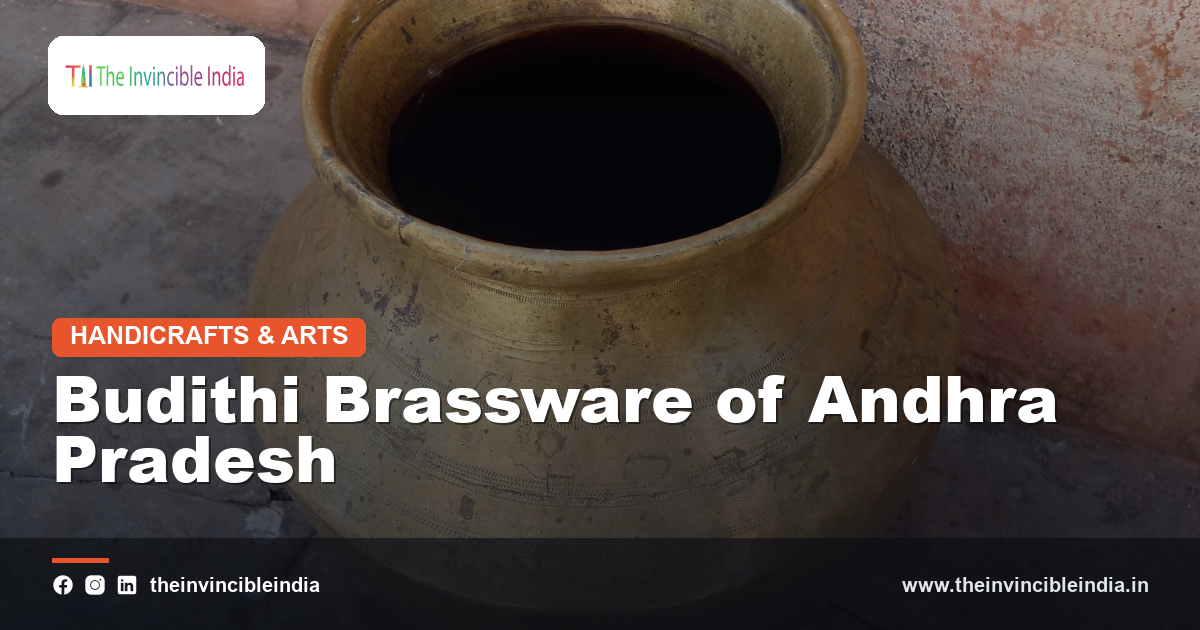
Budithi brassware is a traditional metal craft from the village of Budithi in the Srikakulam district of Andhra Pradesh, in which vessels and utility ware are shaped and finished by hand from sheet brass. Rather than casting, the craft works pieces of brass sheet into pots, bowls, lamps, containers and everyday utensils, which are then hammered, joined, smoothed and polished to a bright finish. The craft is closely identified with Budithi village, whose artisans have made brass objects for generations, supplying both household and ritual needs. Budithi brassware is valued for its clean forms, its gleaming surface and its sturdy, practical character. Readers who enjoy the broad sweep of the traditional handicrafts of Rajasthan will find in Budithi one of South India’s distinctive metal traditions. This guide describes the craft, its home, its history, its materials, its technique, its products, its artisans and its legacy.
Quick answer: Budithi brassware is a traditional metal craft from Budithi village in the Srikakulam district of Andhra Pradesh, India, in which vessels and utility ware are shaped and finished by hand from sheet brass. It is known for pots, bowls, lamps and utensils with clean forms and a bright polished surface. Made by the village’s hereditary artisans, the craft has been recognised with a Geographical Indication tag.
Key Takeaways
- Budithi brassware is a traditional sheet-brass metal craft from Budithi village in Srikakulam district, Andhra Pradesh, India.
- The craft shapes and finishes vessels and utility ware from brass sheet rather than by casting.
- Typical products include pots, bowls, lamps, containers and everyday utensils.
- The brass is hammered, joined, smoothed and polished by hand to a bright finish.
- The craft is made by the hereditary artisans of Budithi village.
- Budithi brassware has been recognised with a Geographical Indication tag.
The sections below explain what Budithi brassware is, where it is made, how it is worked, what it produces and why it still matters.
Quick Facts
| Detail | Information |
|---|---|
| Craft type | Hand-finished sheet-brass metalware |
| Region of origin | Budithi village, Srikakulam district, Andhra Pradesh |
| Also known as | Budithi brass craft |
| Materials | Brass sheet, solder, polishing abrasives |
| Technique | Hand shaping, joining, smoothing and polishing |
| Known for | Clean-formed vessels with a bright polished surface |
| GI status | Recognised with a Geographical Indication tag |
| Community | Hereditary Budithi brass artisans |
What Is Budithi Brassware?
Budithi brassware is a traditional metal craft in which vessels and utility ware are shaped and finished by hand from sheet brass in the village of Budithi. Rather than casting molten metal, the craft works flat pieces of brass sheet into hollow forms such as pots, bowls, lamps and containers, which are then joined, hammered, smoothed and polished to a gleaming finish. The craft is practical as well as decorative, producing items used in kitchens, homes and rituals as well as pieces admired for their clean shapes. Budithi brassware is valued for its bright surface, its sturdy construction and the skilled handwork that goes into each piece. It is closely tied to the artisan community of Budithi village, whose name the craft carries. Budithi brassware is one of Andhra Pradesh’s notable metal crafts. Its gleaming, functional forms define its character.
Where Is Budithi Located?
Budithi is a village in the Srikakulam district of Andhra Pradesh, in the north-eastern part of the state, long known as the home of this distinctive brass craft. Srikakulam lies toward the coastal belt of Andhra Pradesh, a region with its own traditions of craft and trade. Budithi village became identified with brassware because communities of metal artisans settled and worked there, supplying brass vessels and utensils to the surrounding area over generations. The village’s name has come to stand for the craft itself, much as other Indian crafts are known by their place of origin. The concentration of skilled brass workers in Budithi helped the craft develop its recognisable forms and finish. The village and the craft are closely bound together. Budithi is therefore both a place and a byword for its brassware.
What Is the History of Budithi Brassware?
Budithi brassware has a long history as a hereditary craft of its village, though its precise early origins are not documented in exact detail. The making of brass vessels and utensils served steady household and ritual needs across the region, and generations of artisans in Budithi built up the skills and forms for which the craft is known. Metalworking communities passed their knowledge from elders to the young, sustaining the tradition over time. Because much of the craft’s early story rests on local tradition rather than written record, it is best described in general terms as part of Andhra Pradesh’s metalworking heritage. What is clear is that Budithi became firmly established as a centre of brasswork. Its history reflects the enduring demand for durable metal vessels. The craft’s roots lie deep in village life.
What Materials Are Used in Budithi Brassware?
Budithi brassware is made chiefly from brass sheet, together with solder for joining and abrasives for smoothing and polishing. Brass, an alloy of copper and zinc, is valued for its warm golden colour, its workability and its resistance to corrosion, which make it well suited to vessels and utensils. The craft typically uses rolled brass sheet, which is cut and shaped into the parts of each object, rather than molten metal poured into moulds. Solder or brazing material is used to join sections, such as a body to a base or a spout to a pot. Files, abrasives and polishing materials bring the finished piece to a bright, smooth surface. Because practices vary between workshops, the exact materials and grades differ. These materials together yield durable, gleaming brassware. The quality of the brass is central to the result.
How Is Budithi Brassware Made?
Budithi brassware is made by shaping and finishing pieces of brass sheet by hand into the required forms. The artisan first cuts the brass sheet to size and shapes it, using hammering and forming over stakes or moulds to create the curved body of a vessel. Separate parts, such as bases, rims, spouts and handles, are made and then joined, often by soldering or brazing, to build up the complete object. The piece is then worked to refine its shape and to remove marks, before being filed, smoothed and polished to a bright finish. Decorative details or simple ornament may be added at this stage. The whole process relies on the artisan’s skill in forming and finishing metal by hand. Each stage demands care and experience. The result is a clean, gleaming piece of brassware.
What Is the Sheet-Brass Technique?
The sheet-brass technique is the method of making objects from flat brass sheet rather than by casting molten metal, and it is central to the Budithi craft. In this approach, the artisan works rolled brass sheet, cutting, hammering and forming it into hollow shapes such as the body of a pot or bowl. Because the metal is worked cold and by hand, the craftsman can raise, curve and refine the sheet into smooth vessels of various sizes. Separate components are then joined to complete the object. This differs from casting, in which molten metal is poured into a mould to take its shape. The sheet-brass method gives Budithi ware its characteristic smooth, light yet sturdy forms. It requires skill in both shaping and joining metal. This technique is the technical foundation of the craft.
What Objects Are Made in Budithi?
Budithi produces a wide range of brass vessels, utensils and utility ware for household, ritual and decorative use. Traditional products include pots, water vessels, cooking and storage containers, bowls, plates and tumblers used in kitchens and homes. Lamps, including oil lamps and standing lamps, and other ritual and ceremonial objects are also made, serving religious and festive needs. Decorative pieces and gift items have been added over time to suit contemporary markets. The forms are generally clean and functional, with smooth surfaces and simple, pleasing proportions. Artisans adapt their output to demand, making both everyday utensils and showpieces. Whatever the object, the hallmark is hand-shaped sheet brass with a bright finish. This range of products shows the craft’s practicality. It allows Budithi brassware to serve both the home and the market.
What Makes Budithi Brassware Distinctive?
Budithi brassware is distinctive for its clean sheet-metal forms, its bright polished surface and the skilled handwork behind each piece. Because the vessels are shaped from brass sheet rather than cast, they tend to be lighter and smoother than heavy cast metalware, with graceful curves and well-finished rims. The gleaming golden surface, achieved by careful polishing, gives the ware a rich, attractive look. The craft’s long association with Budithi village and its hereditary artisans adds to its identity and reputation. Its combination of practicality and refinement distinguishes it from mass-produced metal goods. These qualities together make Budithi brassware recognisable and valued. Its blend of function and finish is central to its appeal. The craft stands as a proud example of South Indian metalwork.
What Designs and Finishes Appear on Budithi Ware?
Budithi brassware is known more for its clean forms and bright finish than for heavy ornament, though decorative detail does appear on many pieces. The shapes themselves, with their smooth curves, well-proportioned bodies and neatly finished rims and bases, are a large part of the craft’s appeal. Surfaces are polished to a gleaming golden shine, which is one of the ware’s most attractive features. Where ornament is used, it may take the form of simple bands, engraved or embossed patterns, or shaped spouts and handles that add character. The restraint of the decoration lets the quality of the metalwork and finish stand out. Artisans balance function and beauty in each piece. These designs and finishes give Budithi ware its refined, practical elegance. The emphasis on form and shine is a hallmark of the craft.
Who Are the Budithi Artisans?
The Budithi artisans are hereditary metalworkers of Budithi village who have practised the brass craft for generations. The work requires skill in shaping, joining and finishing brass sheet, and this knowledge is traditionally passed down within families through long practice rather than formal schooling. Different members of a household or workshop may handle different stages, from cutting and forming the metal to joining, polishing and finishing. The artisans supply both local needs and wider markets, and craft cooperatives and government bodies have supported them with training, materials and access to buyers. Like many traditional crafts, Budithi brassware depends on keeping skilled artisans in the trade amid other opportunities. The knowledge held by these makers is the craft’s living heart. Their handwork sustains the tradition. The artisan community is the foundation of the craft.
Does Budithi Brassware Have a Geographical Indication?
Budithi brassware has been recognised with a Geographical Indication tag, which ties the craft name to Budithi village and its traditional artisans in Srikakulam district. A Geographical Indication protects a product whose qualities and reputation are linked to its place of origin, helping to guard genuine work against imitation. For the Budithi artisans, the tag affirms that authentic Budithi brassware comes from their village and is made by their traditional sheet-brass methods. Because sources can differ on the exact registration details, the precise date is best confirmed with the official Geographical Indications Registry. The recognition supports the craft’s reputation and the livelihoods of its makers. It also helps buyers identify genuine pieces made in Budithi. The GI status underlines the strong bond between the craft and its home village. It affirms the craft’s cultural value.
How Does Budithi Brassware Compare with Other Indian Brasswork?
Budithi brassware differs from other Indian metal traditions in its emphasis on hand-shaped sheet brass with clean forms and a bright finish. Many Indian brass and bronze crafts, such as certain temple-idol traditions, rely on casting molten metal in moulds to produce solid, often heavily detailed figures. Others, like various engraved or embossed wares, cover the surface with dense decoration. Budithi, by contrast, is known for working sheet brass into smooth, functional vessels and utility ware, with restraint in ornament and emphasis on form and polish. Comparing these traditions shows how brass is worked in different ways across India. Budithi contributes a refined, practical voice centred on vessels and utensils. Each regional craft has its own strengths and character. Budithi’s clean sheet-metal style is distinctly its own.
What Challenges Does the Craft Face Today?
Budithi brassware faces challenges common to many traditional metal crafts, including competition from cheap steel, aluminium and factory-made goods, the rising cost of brass and the difficulty of keeping young artisans in the trade. As inexpensive modern utensils spread, demand for handmade brass vessels for everyday use declined, narrowing the market for the craft. The price of metal and the labour-intensive nature of handwork add further pressure on artisan incomes. Younger members of craft families sometimes seek other livelihoods, which threatens the passing on of skills. At the same time, renewed interest in handmade, traditional and brass items, Geographical Indication protection and support from craft bodies offer encouragement. Fair pricing and honest labelling help genuine artisans. The craft’s survival depends on steady demand for real handmade brassware. Meeting these challenges is essential for its future.
How Can You Buy Authentic Budithi Brassware?
Authentic Budithi brassware can be bought from state handicraft emporiums, recognised artisan cooperatives, craft fairs and trusted stores that name Budithi and Srikakulam as the source. A genuine piece shows the clean hand-shaped forms, smooth joints and bright polished surface characteristic of the craft, with slight natural variation that marks it as handwork. Mass-produced or imported imitations may feel thinner or heavier, show machine-perfect uniformity or lack the quality of finish. Buyers can examine the shaping and joints, judge the weight and surface, and look for GI labelling where available. Buying directly from artisan societies helps income reach the makers in Budithi. A gentle clean and dry storage keep the brass gleaming. Careful buying rewards genuine craftsmanship and supports the village artisans. It also ensures a true example of the craft.
Budithi Brassware Today
Budithi brassware today remains a valued metal craft of Andhra Pradesh and a proud emblem of Budithi village’s artisan heritage. The village’s hereditary craftsmen continue to shape and finish brass vessels, lamps and utility ware by hand, serving both traditional needs and new markets for handmade and decorative items. Geographical Indication recognition, craft promotion and growing interest in traditional brassware have brought the craft renewed attention. At the same time, it faces real challenges of competition from cheaper metals, rising costs and the need to attract young artisans. Readers can support Budithi brassware by learning about its sheet-brass technique, visiting craft outlets and choosing authentic handmade pieces. The craft endures as a gleaming expression of South Indian metalwork. Budithi brassware continues to carry the name of its village with quiet pride. Its bright, practical forms keep the tradition alive.
Sources & Further Reading
- Development Commissioner (Handicrafts), Ministry of Textiles, Government of India (handicrafts.nic.in).
- Geographical Indications Registry, Government of India (ipindia.gov.in).
Frequently Asked Questions
What is Budithi brassware?
Budithi brassware is a traditional metal craft from Budithi village in Srikakulam district, Andhra Pradesh, in which vessels and utility ware are shaped and finished by hand from sheet brass. It is known for pots, bowls, lamps and utensils with clean forms and a bright polished surface. The craft is made by the village’s hereditary artisans.
Where is Budithi brassware made?
Budithi brassware is made in Budithi village in the Srikakulam district of Andhra Pradesh, in the north-eastern, coastal part of the state. The village has been home to brass artisans for generations. Its name has come to stand for the craft itself.
How is Budithi brassware made?
Budithi brassware is made by cutting and shaping pieces of brass sheet by hand into hollow forms, then joining separate parts such as bases, rims and spouts, usually by soldering. The piece is refined, smoothed, filed and polished to a bright finish. It is worked from sheet metal rather than cast from molten brass.
Does Budithi brassware have a GI tag?
Yes, Budithi brassware has been recognised with a Geographical Indication tag that links the craft to Budithi village and its traditional artisans. The tag helps protect genuine work against imitation. The exact registration details are best confirmed with the official Geographical Indications Registry.
What products are made in Budithi?
Budithi makes a wide range of brass vessels, utensils and utility ware, including pots, water vessels, bowls, plates, tumblers, lamps and ritual objects, along with decorative and gift items. The forms are generally clean and functional with smooth, polished surfaces. Artisans adapt their output to both household needs and modern markets.
How can I identify authentic Budithi brassware?
Authentic Budithi brassware shows clean hand-shaped forms, smooth joints and a bright polished surface, with slight natural variation that marks it as handwork. Mass-produced imitations may be machine-perfect, thinner or heavier, or lack the quality of finish. Buying from state emporiums or recognised cooperatives helps ensure authenticity.


