

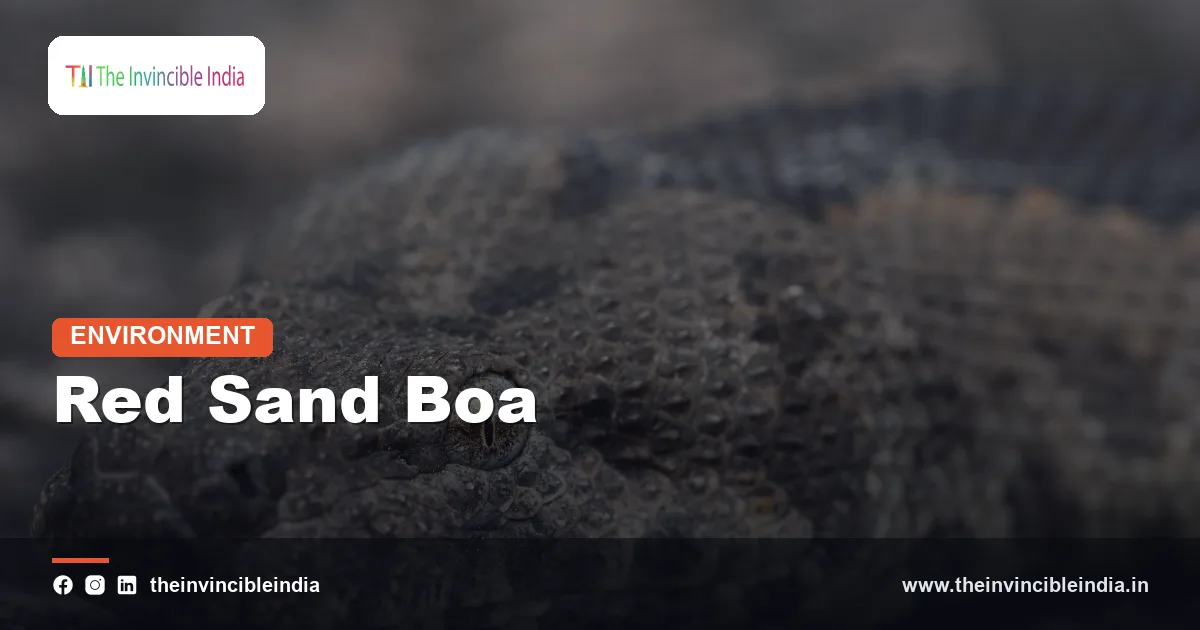
The red sand boa (Eryx johnii) is a stout, non-venomous, burrowing constrictor of the Indian subcontinent, easily recognised by its blunt, head-like tail that has led to the false belief that it is a “two-headed snake”. It is a gentle, slow-moving snake that spends most of its life underground, yet it has become one of the most heavily trafficked snakes in India because of superstition, black-magic myths and the exotic pet trade.
This evergreen explainer describes what the red sand boa looks like, where it lives, how it hunts and breeds, why the “two-headed snake” idea is wrong, and how the Wildlife (Protection) Act, 1972 protects it. Last updated: 22 October 2026.
| Quick Facts | Details |
|---|---|
| Common names | Red sand boa, brown sand boa, Indian sand boa; popularly (and wrongly) “two-headed snake” or “do-muhi” |
| Scientific name | Eryx johnii (Russell, 1801) |
| Group | Boas (constrictors); a small, stout, burrowing snake |
| Venom status | Non-venomous; kills small prey by constriction |
| Typical adult length | About 60 to 90 centimetres; females grow larger and heavier than males |
| Habitat | Dry, semi-arid regions with loose sandy or sandy-loam soil, scrub and farmland |
| Reproduction | Ovoviviparous (gives birth to live young), usually a small litter |
| Main diet | Rodents, small birds, lizards and other small vertebrates |
| Legal and conservation status | Protected under the Wildlife (Protection) Act, 1972; CITES Appendix II; assessed as Near Threatened by the IUCN |
Key Takeaways
- The red sand boa (Eryx johnii) is a non-venomous, burrowing boa that kills small prey by constriction and is harmless to humans.
- The red sand boa is not a two-headed snake: its thick, blunt tail simply resembles a head, which helps confuse predators.
- An adult red sand boa is usually 60 to 90 centimetres long, with a cylindrical body, tiny eyes and a short, rounded tail.
- The red sand boa is one of India’s most trafficked snakes, smuggled because of baseless beliefs about wealth, black magic and medicinal powers.
- Capturing, keeping, selling or killing a red sand boa is a punishable offence in India under the Wildlife (Protection) Act, 1972.
- No red sand boa has any magical, medicinal or money-bringing property, and buying one only fuels the illegal trade.
What is the red sand boa?
The red sand boa is a heavy-bodied, non-venomous snake of the boa family, scientifically known as Eryx johnii, that lives in dry, sandy parts of India and nearby countries and spends much of its life burrowing. It belongs to the same broad group as the anaconda and the boa constrictor, which also kill prey by squeezing, but the red sand boa is a small, calm and docile member of that group.
The species was named by the Scottish naturalist Patrick Russell in the early nineteenth century, and the scientific name “johnii” honours a missionary naturalist associated with early natural history work in south India. In English, it is called the red sand boa, brown sand boa or Indian sand boa. In Hindi-speaking regions, it is often called “do-muhi” or “dumuhi”, meaning “two-mouthed”, a nickname that reflects the superstition around it.
The red sand boa is a quiet snake. It rarely bites, does not hood or rear up, and typically tries to dig down or hide its head under its coils when disturbed. In many parts of India, rural people have lived beside it for generations without harm.
What does the red sand boa look like?
The red sand boa looks like a short, thick, cylindrical snake with smooth shiny scales, a small head barely wider than its neck, tiny eyes with vertical pupils and a blunt, rounded tail. Its colour ranges from reddish-brown, brick red and copper to dark brown and sometimes greyish, and the underside is usually pale cream or yellowish.
Several features set the red sand boa apart from other Indian snakes:
- Blunt tail: The tail is short, thick and almost the same width as the body, ending in a rounded tip that looks like a second head.
- Small eyes and pointed snout: The eyes are small and set high on the head, and the snout is slightly wedge-shaped, which is useful for pushing through loose soil.
- Smooth, polished scales: The scales are small, smooth and tightly packed, allowing the snake to slide through sand without friction.
- Dark blotches: Many individuals have scattered dark spots or patches along the body, especially in younger snakes.
- Anal spurs: Like other boas, the red sand boa has tiny remnants of hind limbs, called spurs, near the cloaca, and these are more prominent in males.
The adult usually measures between 60 and 90 centimetres, though females can be larger than males. Newborn red sand boas are only about 20 centimetres long and are lighter in colour.
Is the red sand boa a two-headed snake?
No, the red sand boa is not a two-headed snake: it has a single head, and the “second head” is only its blunt, rounded tail. Biologically, a naturally two-headed snake does exist as a very rare birth defect in many species, but it is not a separate kind of snake, and it is never a normal feature of any species.
The false impression is created by how the red sand boa moves and defends itself. When threatened, the snake often buries its head and raises its tail, waving it slowly as if it were a head. This behaviour has a real purpose: a predator such as a bird, mongoose or monitor lizard tends to strike at the tail instead of the more vital head. The tail of a red sand boa also has tough, scarred skin because it takes the brunt of predator attacks.
The popular belief that the “do-muhi” can move in either direction, that it has two brains or that it feeds from two mouths is simply false. Wildlife experts and herpetologists consistently point out that the snake has one mouth, one brain and one head.
Where does the red sand boa live?
The red sand boa lives in dry, semi-arid and scrub habitats with loose, sandy or sandy-loam soil, mainly across peninsular India and the drier northern and western regions, and its range extends into Pakistan and nearby countries. It is not found in dense wet forests or in the high mountains.
In India, red sand boas are reported from states such as Rajasthan, Gujarat, Maharashtra, Madhya Pradesh, Karnataka, Andhra Pradesh, Telangana, Tamil Nadu and some northern states, wherever the soil is soft enough for burrowing. The species prefers:
- Open scrubland with sparse vegetation
- Edges of farmland and fallow fields with loose soil
- Rocky or gravelly areas with soft pockets of earth
- Dry river banks and sandy stretches near villages
The red sand boa spends most of the day buried beneath the soil, often only a few centimetres down. Because it is rarely seen on the surface, many people live beside it without ever knowing it is there. Ploughing, quarrying, urban construction and soil removal can destroy burrows and kill the snakes underground.
What does the red sand boa eat and how does it hunt?
The red sand boa eats mainly rodents such as mice and young rats, along with lizards, small birds and other small vertebrates, which it catches by ambush and kills by constriction. It is a sit-and-wait predator rather than an active chaser.
A red sand boa usually waits buried in the soil with only its head near the surface, often close to a rodent burrow or trail. When prey comes within reach, the snake bites to grip it, quickly throws its coils around the animal and tightens them until the prey can no longer breathe. The snake then swallows the animal whole, usually head first.
This diet makes the red sand boa a quiet ally of farmers, because it keeps rodent numbers in check in dry farmland. It hunts mainly at dusk and night, and its slow, steady movement and strong, thick body are well suited to burrowing in search of prey.
How does the red sand boa breed?
The red sand boa breeds by giving birth to live young, which is called ovoviviparity: the eggs develop inside the mother’s body, and she delivers fully formed baby snakes. A litter is usually small, often between a few and about eight young, depending on the size and condition of the female.
Mating generally takes place in the cooler months, and births happen several months later, often around the onset of or during the monsoon season when food is more available. The newborns are independent from birth, about 20 centimetres long, and they begin hunting small lizards and young rodents.
Red sand boas grow slowly. Females mature later than males and may produce only a few litters in a lifetime. This slow reproductive rate is one reason why removing wild snakes for the illegal trade can quickly harm local populations. In protected conditions, individuals of the species can live for many years, often well over a decade.
Why is the red sand boa trafficked in India?
The red sand boa is trafficked in India mainly because of superstition and demand from the exotic pet market: sellers claim that the snake brings wealth, cures diseases or can be used in black magic, and dishonest traders exploit those beliefs to charge huge, inflated prices. None of these claims has any scientific or medical basis.
The main drivers of the illegal trade are well documented by wildlife agencies and conservation groups:
- Black magic and occult beliefs: Some people believe that the “two-headed” snake can be used in rituals or can double wealth, and they pay money for it.
- Aphrodisiac and medicinal myths: False claims that parts of the snake can boost virility or cure illnesses create a market for the animal and its body parts.
- Exotic pet trade: The docile nature and reddish colour appeal to collectors, and wild-caught animals are smuggled out of the country.
- Fraud: Sellers often invent absurd price tags and fake “certificates” to cheat gullible buyers.
Enforcement agencies, including the Wildlife Crime Control Bureau and state forest departments, have repeatedly seized red sand boas in raids and trafficking cases. Even so, the snake is thought to be among the most commonly smuggled snakes from India. Conservation groups encourage the public to report any offer to sell a “two-headed snake” to the forest department or a wildlife helpline instead of buying one.
Is the red sand boa protected by law?
Yes, the red sand boa is protected by law in India under the Wildlife (Protection) Act, 1972, which prohibits hunting, capturing, keeping and trading in protected species, and it is also listed in Appendix II of CITES, which regulates international trade in the species. Offences under the Act can lead to imprisonment and fines.
The IUCN has assessed the red sand boa as Near Threatened because of continuing collection from the wild and loss of habitat. Even if a particular snake looks common locally, its slow breeding, burrowing life and heavy demand make it vulnerable.
| Source of protection | What it does for the red sand boa |
|---|---|
| Wildlife (Protection) Act, 1972 | Bans killing, capture, possession, sale and transport of the species without permission |
| CITES Appendix II | Controls and monitors international trade so that it does not threaten wild populations |
| IUCN Red List | Records the species as Near Threatened, flagging it for conservation attention |
| State forest departments | Investigate seizures, rescue snakes and release them into suitable habitat |
A seized red sand boa is not simply released anywhere. Forest officials and trained rescuers check its health and then return it to a suitable habitat, preferably near the place where it was found.
Is the red sand boa dangerous to humans?
No, the red sand boa is not dangerous to humans: it is non-venomous, docile and extremely reluctant to bite. Its small size means it is unable to constrict anything near the size of a person, and it usually responds to being handled by hiding its head or releasing a smelly fluid from its vent.
A bite, if it ever occurs, may cause small puncture wounds that need washing with clean water and soap and a check-up for infection. Because many snakes look alike to a casual observer, any snakebite from a snake that has not been identified should be treated as a medical matter. The person should stay calm, keep the bitten limb still and go to a hospital without delay, and should avoid cutting the wound, applying tight bands or using traditional remedies, which can worsen outcomes.
Handling a wild red sand boa is also bad for the snake. It may be injured by rough handling, and the stress can reduce its ability to feed. The kindest approach is to leave it alone or call a trained rescuer if it is in a risky place such as a construction site.
How can people help protect the red sand boa?
People can help protect the red sand boa by refusing to buy or sell it, reporting trafficking, avoiding disturbance of its burrows and spreading accurate information that dispels the “two-headed snake” myth. Public awareness is the most effective protection because demand for the snake is driven almost entirely by false belief.
- Do not purchase any snake offered as a “do-muhi” or “lucky” snake, whatever the price.
- Report sellers or suspected trafficking to the forest department, the police or a wildlife helpline.
- Do not try to catch, pose with or film-and-share a handled snake in a way that encourages the trade.
- If a red sand boa is found in a risky place, call a trained snake rescuer who can move it to nearby suitable soil.
- Share clear facts: the snake has one head, no magical power and a legal status that makes any trade a crime.
Bottom Line
The red sand boa is a shy, harmless, burrowing snake with a tail that merely looks like a second head. It has no magical or medicinal value, and its protection depends on people rejecting the myths that drive the illegal trade.
Frequently Asked Questions
Is the red sand boa venomous?
No, the red sand boa is not venomous. It kills small prey by constriction and is docile and harmless to humans. Any snakebite, even from a snake believed to be harmless, should still be checked by a doctor.
Why is the red sand boa called a two-headed snake?
The red sand boa is called a two-headed snake because its short, blunt tail looks like a second head. The snake often hides its real head and waves its tail to confuse predators. In reality, it has only one head, one brain and one mouth.
Can a red sand boa bring wealth or be used in black magic?
No, a red sand boa cannot bring wealth or perform any magic, and these beliefs have no scientific basis. They are used by smugglers and fraudsters to sell snakes at inflated prices. Buying or selling the snake is illegal and harms wild populations.
Is it legal to keep a red sand boa as a pet in India?
No, it is illegal to keep a wild red sand boa as a pet in India because the species is protected under the Wildlife (Protection) Act, 1972. It is also listed in CITES Appendix II, which regulates trade. People who have one should contact the forest department instead of keeping or selling it.
Where does the red sand boa live and what does it eat?
The red sand boa lives in dry, sandy and scrubby habitats across much of peninsular and western India, where it burrows into loose soil. It eats rodents, small birds and lizards, which it kills by constriction. It is most active at dusk and night.
How big does a red sand boa get?
An adult red sand boa is usually about 60 to 90 centimetres long. Females are generally larger and heavier than males. Newborn snakes are only about 20 centimetres long.
{“@context”:”https://schema.org”,”@graph”:[{“@type”:”FAQPage”,”mainEntity”:[{“@type”:”Question”,”name”:”Is the red sand boa venomous?”,”acceptedAnswer”:{“@type”:”Answer”,”text”:”No, the red sand boa is not venomous. It kills small prey by constriction and is docile and harmless to humans. Any snakebite, even from a snake believed to be harmless, should still be checked by a doctor.”}},{“@type”:”Question”,”name”:”Why is the red sand boa called a two-headed snake?”,”acceptedAnswer”:{“@type”:”Answer”,”text”:”The red sand boa is called a two-headed snake because its short, blunt tail looks like a second head. The snake often hides its real head and waves its tail to confuse predators. In reality, it has only one head, one brain and one mouth.”}},{“@type”:”Question”,”name”:”Can a red sand boa bring wealth or be used in black magic?”,”acceptedAnswer”:{“@type”:”Answer”,”text”:”No, a red sand boa cannot bring wealth or perform any magic, and these beliefs have no scientific basis. They are used by smugglers and fraudsters to sell snakes at inflated prices. Buying or selling the snake is illegal and harms wild populations.”}},{“@type”:”Question”,”name”:”Is it legal to keep a red sand boa as a pet in India?”,”acceptedAnswer”:{“@type”:”Answer”,”text”:”No, it is illegal to keep a wild red sand boa as a pet in India because the species is protected under the Wildlife (Protection) Act, 1972. It is also listed in CITES Appendix II, which regulates trade. People who have one should contact the forest department instead of keeping or selling it.”}},{“@type”:”Question”,”name”:”Where does the red sand boa live and what does it eat?”,”acceptedAnswer”:{“@type”:”Answer”,”text”:”The red sand boa lives in dry, sandy and scrubby habitats across much of peninsular and western India, where it burrows into loose soil. It eats rodents, small birds and lizards, which it kills by constriction. It is most active at dusk and night.”}},{“@type”:”Question”,”name”:”How big does a red sand boa get?”,”acceptedAnswer”:{“@type”:”Answer”,”text”:”An adult red sand boa is usually about 60 to 90 centimetres long. Females are generally larger and heavier than males. Newborn snakes are only about 20 centimetres long.”}}]}]}


