

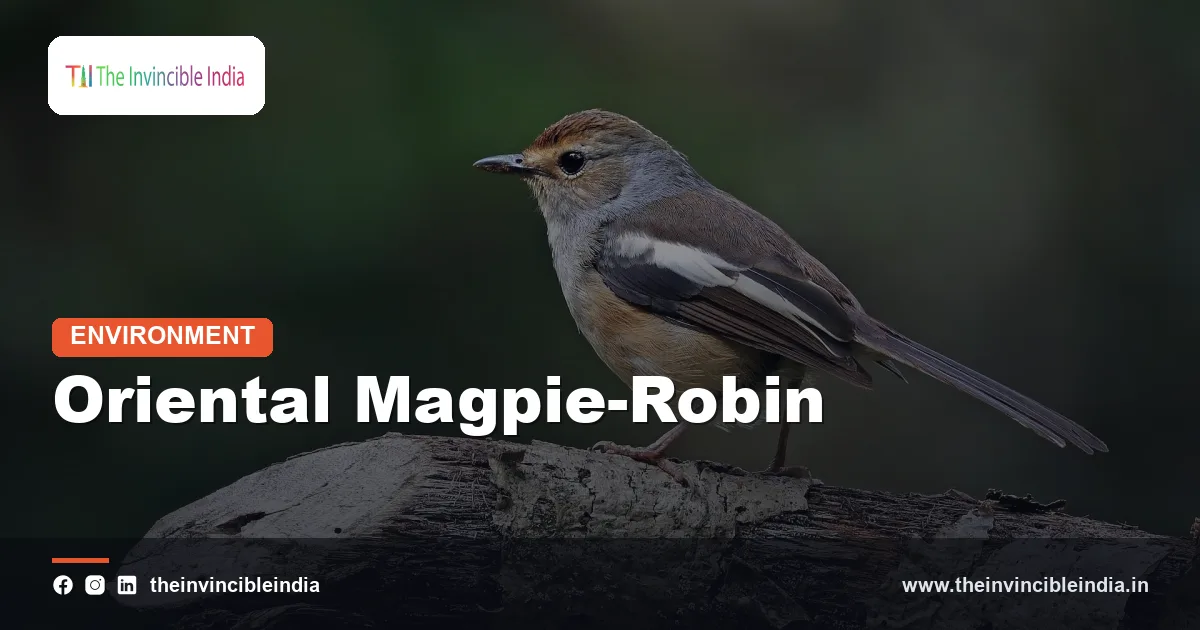
The Oriental magpie-robin (Copsychus saularis) is a small, glossy black-and-white songbird of the Old World flycatcher family (Muscicapidae) that lives in gardens, villages, farmland and light woodland across the Indian subcontinent and much of South-East Asia, and is best known for its clear, melodious song and its habit of holding its tail cocked upright. In Hindi and many other Indian languages it is called the dayal, dhayal or doyel, and it is one of the few wild birds that most Indians have heard at dawn from their own rooftops, wires and trees.
This explainer covers how to recognise the Oriental magpie-robin, where it lives, what it eats, how it sings and nests, why it was once heavily trapped as a cage bird, and how it is regarded in law and culture, including its place as the national bird of neighbouring Bangladesh. Last updated 22 October 2026.
| Common name | Oriental magpie-robin (also dayal, dhayal, doyel) |
|---|---|
| Scientific name | Copsychus saularis |
| Family | Muscicapidae (Old World flycatchers and chats) |
| Body length | Roughly 19 to 23 cm, including the long tail |
| Habitat | Gardens, villages, farmland, scrub, light forest and city parks |
| Diet | Mainly insects and other small invertebrates; occasionally nectar and small vertebrates |
| Nesting | Cavities in trees, walls, buildings and nest boxes; usually 3 to 5 eggs |
| IUCN Red List status | Least Concern |
| Cultural status | National bird of Bangladesh; widely loved as a garden songbird in India |
Key Takeaways
- The Oriental magpie-robin is a medium-small songbird with glossy blue-black and white plumage in males and a duller grey-and-white version in females.
- The Oriental magpie-robin is a member of the Old World flycatcher family and is not a true magpie or a true robin; the name only describes its pied colouring and its robin-like manner.
- The Oriental magpie-robin is a common resident across most of India, adapting easily to gardens, village edges and city parks, and is rated Least Concern by the IUCN.
- The male Oriental magpie-robin sings from high perches, especially at dawn and in the breeding season, and can weave mimicked notes of other birds into its song.
- The Oriental magpie-robin nests in holes and crevices, including pots, walls and nest boxes, and both parents feed the chicks mostly on insects.
- The Oriental magpie-robin has been protected in India under the Wildlife (Protection) Act, 1972, because it was historically trapped in large numbers as a cage songbird.
What Does the Oriental Magpie-Robin Look Like?
The Oriental magpie-robin is a slim, long-tailed bird about the size of a bulbul, with a striking black-and-white pattern that makes it easy to identify at a glance. The adult male has a glossy blue-black head, throat, breast, back and central tail, contrasted with a clean white belly and a bold white wing patch that shows as a stripe along the folded wing. The outer tail feathers are white, which flash conspicuously when the bird flicks or fans its tail.
The female has the same basic pattern but in softer shades. Her upper parts and breast are slate-grey rather than glossy black, and her belly is a duller white, sometimes washed with buff. Young birds are even more subdued, with mottled and scaly markings on the breast and throat before they moult into adult plumage.
Size and proportions
The Oriental magpie-robin measures roughly 19 to 23 cm from bill tip to tail tip, and a large share of that length is tail. The bill is slender and dark, the legs are dark, and the eye is dark and bright. The upright posture, relatively long legs and quick hops on the ground give the bird its characteristic alert outline.
Why is it called a magpie-robin?
The name Oriental magpie-robin refers to the bird’s pied colouring, which resembles that of true magpies, and to its upright, perky manner, which resembles that of the European robin. The bird belongs to neither group. It is classified with the chats and flycatchers, and its closest relatives include the shamas of the genus Copsychus, such as the white-rumped shama, a famed songster of forests in eastern and southern Asia.
Where Is the Oriental Magpie-Robin Found in India?
The Oriental magpie-robin is found almost throughout India, from the foothills of the Himalaya to the southern tip of the peninsula, and is generally absent only from the driest deserts and the highest mountains. It is a resident bird, meaning it stays in the same region through the year, although individuals may move short distances with the seasons or in response to food and water.
Beyond India, the species ranges across Pakistan, Nepal, Bangladesh, Sri Lanka, Myanmar and much of mainland and island South-East Asia, reaching southern China and parts of Indonesia. Taxonomists have recognised several regional forms, and some authorities treat the bird of Sri Lanka and certain island populations as separate species or subspecies; the exact arrangement has been revised over time.
Preferred habitats
The Oriental magpie-robin is a bird of human-modified landscapes more than of deep forest. It is regularly seen in:
- Home gardens, courtyards and balconies with a few trees and shrubs.
- Village edges, temples, orchards and farm boundaries.
- City parks, university campuses and tree-lined roads.
- Open woodland, mangrove edges and forest clearings with a mix of trees and ground cover.
The bird needs only a few essentials: a perch from which to sing and survey, patches of open ground or leaf litter for foraging, and a hole or crevice for nesting. Where these exist, the Oriental magpie-robin often thrives close to people.
Why Is the Oriental Magpie-Robin Famed for Its Song?
The Oriental magpie-robin is famed for its song because the male produces a rich, fluting series of whistles and warbles that carries well and is delivered with enthusiasm from an exposed perch. The song is varied, made up of clear phrases that rise and fall, and it is one of the most recognisable sounds of the early morning in many Indian neighbourhoods.
Singing is most intense in the breeding season, which in much of India begins around the late winter and spring and runs into the early monsoon, though timing varies with region and local rainfall. A male typically sings from a rooftop, wire, antenna or treetop to advertise his territory to rivals and his availability to females.
Mimicry and calls
Many Oriental magpie-robins incorporate imitations of other birds’ notes into their repertoire, which adds to the impression of a very large song vocabulary. Besides the full song, the species uses a harsh, scolding, buzzing call when alarmed or when defending a territory, and a variety of softer notes when communicating with a mate or young.
Dawn and dusk singing
The Oriental magpie-robin is among the first birds to join the dawn chorus and often sings again around dusk. In well-lit urban areas, individual males have been noted singing earlier than usual, a pattern linked in various studies of songbirds to artificial lighting, though local observations differ.
Why Does the Oriental Magpie-Robin Hold Its Tail Upright?
The Oriental magpie-robin holds its tail upright because the raised and flicked tail is part of its normal body language, used for signalling to other magpie-robins as well as to potential threats. Observers describe the posture as a cocked tail, and it is one of the most reliable field marks for the species.
During territorial disputes, the male fans and raises the tail, shows the white outer feathers and may lower or flutter the wings while singing. The display communicates the bird’s condition and readiness to defend its patch. Females and juveniles also cock the tail when excited or alarmed, but the effect is most dramatic in a singing male.
The tail posture also helps in distinguishing the bird from lookalikes. A black-and-white bird that hops about on a lawn with a high, flicking tail is very probably an Oriental magpie-robin rather than a drongo, a bulbul or a shrike.
What Does the Oriental Magpie-Robin Eat?
The Oriental magpie-robin eats mainly insects and other small invertebrates, which it picks from the ground, from low vegetation and from tree trunks. Typical prey includes ants, beetles, caterpillars, crickets, grasshoppers, flies, spiders and earthworms. This diet makes the bird a quiet ally of gardeners and farmers, since many of these animals damage crops and plants.
The bird forages in several ways. It hops across lawns and open ground, pausing to look and listen before seizing prey, searches leaf litter and low branches, and sometimes makes short flycatcher-style sallies to catch insects in the air. It is also recorded taking small lizards, the occasional tiny frog or other small vertebrates, and, at times, nectar and fruit.
Feeding young
During the nesting period both parents carry insects, caterpillars and other soft-bodied prey to the chicks. The high-protein diet supports rapid growth, and the adults make many trips a day. A bird keeping a steady line of flights to the same hole or crevice is a sign of an active nest.
How Does the Oriental Magpie-Robin Breed and Nest?
The Oriental magpie-robin breeds by nesting in a cavity, using a hole in a tree, a gap in a wall, a hollow in a building, a flowerpot, a drainpipe or an artificial nest box. Because it readily uses man-made sites, it is one of the garden birds most likely to nest in a home courtyard or porch.
The nest itself is a loose pad of grass, rootlets, fibre, hair, feathers and sometimes bits of cloth or plastic, set in the chosen cavity. The female lays a clutch of usually three to five eggs, which are pale bluish or greenish with reddish-brown speckling. The female does most of the incubating, while the male defends the territory and often feeds her.
Timeline of a nesting attempt
| Stage | What happens |
|---|---|
| Territory and pairing | The male sings and displays from high perches to attract a female and warn rivals. |
| Nest preparation | The female builds or arranges the nest material inside a hole, crevice or box. |
| Egg laying and incubation | Usually 3 to 5 eggs are laid; incubation takes roughly two weeks. |
| Nestling period | Both parents feed the chicks, which stay in the nest for around two weeks. |
| Fledging and dependency | Young birds leave the nest, are fed for a further period and learn to forage; pairs may raise more than one brood in a season. |
The durations in this table are approximate and can vary with climate and region. Pairs are strongly territorial and will chase away other birds, including much larger ones, that come too close to the nest.
Why Was the Oriental Magpie-Robin Trapped as a Cage Bird?
The Oriental magpie-robin was trapped as a cage bird because of its attractive song, its bold plumage and its willingness to adapt to captivity. For generations, bird catchers in parts of South Asia captured wild magpie-robins, especially males, and sold them for the pleasure of their singing. The popularity of the trade contributed to local declines in some places.
Trapping has been restricted in India for decades. The bird is covered by the Wildlife (Protection) Act, 1972, which prohibits hunting and capture of protected wild birds, and keeping or trading wild-caught birds without legal authority can attract penalties. The schedule in which the species is placed has been adjusted through later amendments, so the current legal listing should be checked against the latest version of the Act before relying on it.
Why wild-caught birds suffer
Capture removes breeding adults from the wild, and many trapped birds die in transport or in cramped cages. Conservationists recommend enjoying the song in gardens and natural habitats rather than keeping wild birds. A garden with trees, water and nest sites can attract the species without harming it.
Is the Oriental Magpie-Robin a National Bird?
The Oriental magpie-robin is the national bird of Bangladesh, where it is known as the doyel, but it is not the national bird of India, which is the Indian peafowl. The Bangladeshi association reflects the bird’s abundance in Bengal and its place in the folk culture and literature of the region, and the doyel appears in songs, poems and public imagery there.
In India, the species has no national designation but is cherished as a garden bird, and in Bengali-speaking parts of eastern India its name is familiar from the same cultural world. Several Indian states and union territories have chosen state birds, but those lists feature other species, so readers should not assume the Oriental magpie-robin holds that status in any Indian state without checking an official source.
Elsewhere in its range, the bird is a familiar urban resident. In some countries it has become a symbol of the neighbourhood garden because it is one of the few wild birds that routinely lives within sight of homes.
How Can You Tell the Oriental Magpie-Robin from Similar Birds?
You can tell the Oriental magpie-robin from similar birds by combining its pied pattern, its upright tail and its ground-hopping habits; no other common Indian garden bird has the same mix. The comparison below shows how it differs from the species it is most often confused with.
| Bird | Key differences from the Oriental magpie-robin |
|---|---|
| Black drongo | All-black plumage with a deeply forked tail; hunts insects in the air from wires and does not show a white belly. |
| Indian robin | Male is mostly black with a chestnut patch under the tail and a small white shoulder patch; lacks the white belly of the magpie-robin. |
| White-rumped shama | Chestnut belly and a conspicuous white rump; found in denser forest rather than gardens. |
| Pied bushchat | Black-and-white male with a more compact shape and a shorter tail; favours open scrub and fields. |
| Magpie (true) | Much larger corvid with a heavy bill and long, graduated tail; not found in most of peninsular India. |
Behaviour helps as much as colour. The Oriental magpie-robin spends time on the ground, jerks its tail and sings from perches, whereas the black drongo rarely forages on the ground and the pied bushchat sits low on bushes and stones.
Is the Oriental Magpie-Robin Threatened?
The Oriental magpie-robin is not globally threatened; the IUCN Red List classifies it as Least Concern because it has a very large range and is common across most of that range. In India it is widespread and generally abundant in suitable habitat, and it tolerates human presence better than many forest birds.
Local pressures still exist. Capture for the cage-bird trade, loss of old trees and wall cavities, use of pesticides that reduce insect prey, and attacks by cats and crows can reduce numbers around villages and cities. In a few island and regional populations outside India, the bird has declined sharply because of trapping and habitat change, which shows how quickly a common songbird can disappear when pressures combine. Population estimates should be treated as approximate, and they are updated periodically by bodies such as BirdLife International and national bird atlases.
How to help the Oriental magpie-robin in your neighbourhood
- Leave dead branches, old walls and cavities undisturbed where it is safe to do so.
- Provide a shallow dish of fresh water, kept clean, especially in summer.
- Plant native shrubs and trees that support insects.
- Reduce pesticide use and keep pet cats indoors during the nesting season.
- Put up a suitable nest box in a sheltered, shaded position away from heavy foot traffic.
- Never buy a wild-caught bird, and report illegal trapping to the local forest department.
Bottom Line
The Oriental magpie-robin is an adaptable, pied songbird whose cocked tail, dawn singing and cavity-nesting habits make it one of the most recognisable and approachable birds of the Indian subcontinent. It is common and not globally threatened, but it has been shaped by a long history of trapping, and its future around homes depends on keeping gardens green, old cavities available and wild birds in the wild.
Frequently Asked Questions
What is the Oriental magpie-robin?
The Oriental magpie-robin is a black-and-white songbird of the species Copsychus saularis, found across India and much of Asia. It belongs to the Old World flycatcher family and is common in gardens, farms and city parks. Males are glossy blue-black and white, while females are greyer.
Is the Oriental magpie-robin the national bird of India?
No, the Oriental magpie-robin is not the national bird of India, which is the Indian peafowl. It is, however, the national bird of Bangladesh, where it is known as the doyel. In India it is simply a much-loved and widespread garden songbird.
What does the Oriental magpie-robin eat?
The Oriental magpie-robin eats mostly insects and other small invertebrates such as ants, beetles, caterpillars, crickets and earthworms. It also takes small lizards on occasion and, at times, nectar or fruit. It forages mainly on the ground and in low vegetation.
Where does the Oriental magpie-robin build its nest?
The Oriental magpie-robin nests in cavities such as tree holes, wall crevices, building hollows, flowerpots and nest boxes. The female lays usually three to five pale, speckled eggs on a pad of grass, fibre and feathers. Both parents then feed the chicks mainly with insects.
Why does the Oriental magpie-robin keep its tail up?
The Oriental magpie-robin keeps its tail cocked because upright and flicked tail posture is part of its normal signalling. Males fan the tail and show white outer feathers while singing or defending a territory. The posture also helps people identify the bird.
Is it legal to keep an Oriental magpie-robin as a pet in India?
No, keeping a wild-caught Oriental magpie-robin is not permitted without legal authority, because the species is protected under the Wildlife (Protection) Act, 1972. The bird was historically trapped for its song, which is why the law applies. The exact schedule placement has changed through amendments, so check the current text of the Act.
{“@context”:”https://schema.org”,”@graph”:[{“@type”:”FAQPage”,”mainEntity”:[{“@type”:”Question”,”name”:”What is the Oriental magpie-robin?”,”acceptedAnswer”:{“@type”:”Answer”,”text”:”The Oriental magpie-robin is a black-and-white songbird of the species Copsychus saularis, found across India and much of Asia. It belongs to the Old World flycatcher family and is common in gardens, farms and city parks. Males are glossy blue-black and white, while females are greyer.”}},{“@type”:”Question”,”name”:”Is the Oriental magpie-robin the national bird of India?”,”acceptedAnswer”:{“@type”:”Answer”,”text”:”No, the Oriental magpie-robin is not the national bird of India, which is the Indian peafowl. It is, however, the national bird of Bangladesh, where it is known as the doyel. In India it is simply a much-loved and widespread garden songbird.”}},{“@type”:”Question”,”name”:”What does the Oriental magpie-robin eat?”,”acceptedAnswer”:{“@type”:”Answer”,”text”:”The Oriental magpie-robin eats mostly insects and other small invertebrates such as ants, beetles, caterpillars, crickets and earthworms. It also takes small lizards on occasion and, at times, nectar or fruit. It forages mainly on the ground and in low vegetation.”}},{“@type”:”Question”,”name”:”Where does the Oriental magpie-robin build its nest?”,”acceptedAnswer”:{“@type”:”Answer”,”text”:”The Oriental magpie-robin nests in cavities such as tree holes, wall crevices, building hollows, flowerpots and nest boxes. The female lays usually three to five pale, speckled eggs on a pad of grass, fibre and feathers. Both parents then feed the chicks mainly with insects.”}},{“@type”:”Question”,”name”:”Why does the Oriental magpie-robin keep its tail up?”,”acceptedAnswer”:{“@type”:”Answer”,”text”:”The Oriental magpie-robin keeps its tail cocked because upright and flicked tail posture is part of its normal signalling. Males fan the tail and show white outer feathers while singing or defending a territory. The posture also helps people identify the bird.”}},{“@type”:”Question”,”name”:”Is it legal to keep an Oriental magpie-robin as a pet in India?”,”acceptedAnswer”:{“@type”:”Answer”,”text”:”No, keeping a wild-caught Oriental magpie-robin is not permitted without legal authority, because the species is protected under the Wildlife (Protection) Act, 1972. The bird was historically trapped for its song, which is why the law applies. The exact schedule placement has changed through amendments, so check the current text of the Act.”}}]}]}


