

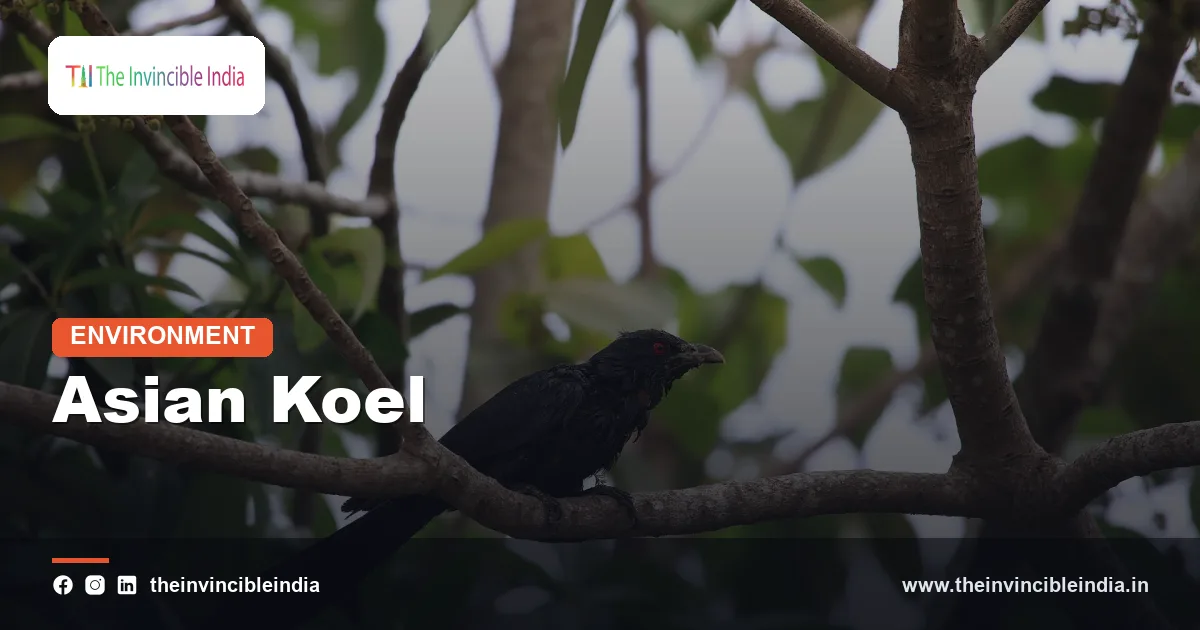
The Asian koel (Eudynamys scolopaceus) is a large, long-tailed cuckoo whose loud, rising “ku-oo” call is the sound most Indians associate with summer and the arrival of the monsoon. The Asian koel does not build a nest of its own. Instead, the female secretly lays her eggs in the nests of other birds, most often the house crow, a habit known as brood parasitism.
This explainer covers how to identify the Asian koel, why males and females look so different, how its call changes through the year, how brood parasitism works, what the bird eats, and how the koel became one of the most celebrated birds in Indian poetry. Information was last reviewed on 22 October 2026.
| Quick Fact | Detail |
|---|---|
| Common name | Asian koel (Hindi: koel, koyal; Sanskrit: kokila) |
| Scientific name | Eudynamys scolopaceus |
| Family | Cuculidae (cuckoos) |
| Typical length | About 39 to 46 cm including the long tail |
| Breeding habit | Brood parasite; lays eggs in the nests of other birds |
| Main host in India | House crow (Corvus splendens) and jungle crow |
| Diet | Mainly fruit, plus insects and caterpillars |
| Global IUCN status | Least Concern |
| Symbolic role | Herald of spring and summer in Indian literature; state bird of Puducherry |
Key Takeaways
- The Asian koel (Eudynamys scolopaceus) is a cuckoo about 39 to 46 cm long that is widespread across the Indian subcontinent and South-East Asia.
- Male Asian koels are glossy blue-black with a pale greenish bill and red eyes, while female Asian koels are brown and heavily spotted and barred with white.
- The Asian koel is a brood parasite, and the female lays her eggs in nests of other birds, in India most often those of house crows.
- The male Asian koel’s rising “ku-oo” call is heard most often from March to August, the pre-monsoon and monsoon breeding season in much of India.
- The Asian koel eats mainly fruit, such as figs, mulberries and berries, and it helps disperse the seeds of many trees.
- The koel, called kokila in Sanskrit, is a favourite subject of Indian poetry as a messenger of spring and longing.
What is the Asian koel?
The Asian koel is a large cuckoo in the family Cuculidae, and Eudynamys scolopaceus is its scientific name. It is native to the Indian subcontinent, parts of China and much of South-East Asia, and it is one of the most familiar and easily heard birds in Indian towns and villages.
Unlike many shy cuckoos, the Asian koel lives comfortably in cities. It uses leafy gardens, avenue trees, orchards and village groves, and it is often heard before it is seen because it likes to call from the thick canopy.
The bird is known by many local names, including koel or koyal in Hindi, kokil in Bengali, kuyil in Tamil and kokila in Sanskrit. Several subspecies are recognised across its range.
How do male and female Asian koels differ?
Male and female Asian koels differ strongly in colour, and the difference is one of the clearest examples of sexual dimorphism among Indian birds. The male is glossy black and the female is brown with bold white spots.
| Feature | Male Asian koel | Female Asian koel |
|---|---|---|
| Body plumage | Glossy blue-black all over | Dark brown with white spots on the upperparts and bars on the underparts |
| Bill | Pale greenish or greyish | Similar pale bill |
| Eye colour | Crimson red | Crimson red |
| Voice | Loud, rising “ku-oo” | Shrill “kik-kik-kik” and other short calls |
| Head pattern | Plain dark head | Pale-streaked head and dark crown |
Young Asian koels resemble the female or the male with brownish tones, and young males gradually turn dark. Newly fledged young are often confused with other species, but their red eyes and pale bills are consistent clues.
What does the Asian koel’s call sound like, and when is it heard?
The Asian koel’s call is a loud, accelerating series of “ku-oo, ku-oo” notes that climb in pitch and speed, and it is given mainly by the male. The cry often builds to a frantic, almost frenzied peak before it suddenly stops.
The calling is strongly seasonal. In northern and central India it becomes prominent as spring turns to summer, often from March, and it continues through the hot, humid months until the monsoon. In southern India, calling may be heard across a broader part of the year. Males call at dawn, through the day and sometimes at night, and their persistence has made the call a well-known sign of the season.
The female’s voice is higher and sharper, a rapid “kik-kik-kik” that is often given when chasing or being chased. Both sexes may produce a soft, chuckling note when feeding.
What is brood parasitism, and how does the Asian koel practise it?
Brood parasitism is a breeding strategy in which a bird lays its eggs in another species’ nest and leaves the host to raise the young, and the Asian koel is a well-known practitioner of it. The female koel finds a suitable host nest, usually that of a house crow, and lays a single egg in it, often while the owners are away.
In practice, the process follows a pattern.
- The male koel often acts as a distraction, calling loudly or provoking crows into a chase.
- The female slips in to the unguarded nest and lays an egg, which resembles the host’s eggs in colour and size, being pale bluish-green with brown speckles.
- A female may lay several eggs in a season, spreading them across different nests.
- The koel egg hatches quickly, and the chick begs vigorously for food from the foster parents.
- The young koel leaves the nest after a few weeks and is fed for some time more by its foster parents.
Studies of the Asian koel suggest that the chick does not always push out the host chicks the way some cuckoos do, and in some nests host young survive beside the koel. Outcomes vary, and researchers continue to study how hosts and parasites adapt to one another.
Which birds does the Asian koel use as hosts?
The Asian koel mostly uses the house crow (Corvus splendens) as a host in India, and it also parasitises the jungle crow (Corvus macrorhynchos). Other birds, such as mynas and drongos, have also been reported as hosts in some places.
Crows are good hosts because they are large, common, abundant in cities and highly protective of nests, yet they accept eggs that look similar to their own. Crows sometimes recognise and attack koels, and the chases between the two birds are a regular sight in summer.
The relationship is a good example of an evolutionary arms race. Hosts that can recognise foreign eggs or chicks are favoured, and parasites that mimic hosts better are favoured in turn.
What does the Asian koel eat?
The Asian koel eats mainly fruit, and it supplements this diet with insects, caterpillars, eggs and small invertebrates. This habit makes it unusual among cuckoos, many of which rely heavily on caterpillars.
- Fruits: figs from banyan and peepal trees, mulberries, neem berries, papaya, guava and many wild berries.
- Animal food: caterpillars, beetles, grasshoppers and other insects.
- Behaviour: it hops among branches and often swallows fruit whole.
Because the Asian koel swallows fruit whole and later passes the seeds, it works as an important seed disperser in orchards and urban green spaces. This role is one reason ecologists regard the koel as a beneficial bird, even though its nesting habits may seem unfair to crows.
Where does the Asian koel live in India?
The Asian koel lives throughout India, from the plains to the lower hills, and it favours habitats with plenty of tall trees and fruiting plants. It is common in gardens, village groves, temples, campuses and parks, as well as in lightly wooded farmland.
It generally avoids dense forest interiors and very dry deserts, although it follows suitable trees in settlements. The Asian koel is a resident bird in much of its range, with some local movement in response to food and season. Its adaptability to cities is closely tied to the presence of its main host, the house crow.
Why is the koel important in Indian culture and poetry?
The koel is important in Indian culture because it has long been treated as the herald of spring and a symbol of longing in classical and folk poetry. In Sanskrit literature, the kokila appears often as a companion of Vasanta, the spring season, and of Kamadeva, the god of love.
Classical poets such as Kalidasa refer to the koel’s call in descriptions of spring, and its voice is a regular motif in Hindi, Urdu, Bengali, Tamil and other regional traditions. In Tamil literature, Subramania Bharati wrote a well-known long poem, Kuyil Paattu, which uses the koel as a central figure.
Idioms add to its fame. The sweetness of the koel’s voice is often contrasted with the harshness of the crow’s, and a person with a melodious voice is sometimes praised as a koel. This poetic image is somewhat ironic, since the sweet calls come mostly from the male while the bird itself relies on crows for nesting.
Is the Asian koel threatened, and is it protected?
The Asian koel is not threatened, because the IUCN rates it as Least Concern, and its population is believed to be large and stable or increasing in many areas. Its success in cities and gardens has helped it keep a wide range.
Native wild birds in India fall under the Wild Life (Protection) Act, 1972, which prohibits hunting and trade. The schedule placement of individual species has been revised over time, so the current listing should be checked in the latest version of the Act.
The bird is also an official symbol in some places, and Puducherry has adopted it as its state bird. Anyone using official state symbols in an exam or publication should verify them with a current government source.
How can you watch Asian koels in your neighbourhood?
You can watch Asian koels most easily in the early morning or late afternoon in spring and summer, by listening for the male’s call and then scanning leafy trees. The bird is shy about being seen, so patience and binoculars help.
- Look in dense, fruiting trees such as fig, mulberry and neem, where koels feed quietly.
- Watch for crows chasing a dark, long-tailed bird, which often signals a male koel near a crow nest.
- Notice the red eye and pale bill, which separate the koel from crows and other black birds.
- Avoid disturbing crow nests, because breeding birds need peace to raise their young.
Keeping a tree or two with fruit in the garden, and leaving mature trees standing, helps both koels and their crow hosts.
Bottom Line
The Asian koel is a fruit-eating cuckoo whose calling announces the Indian summer and whose hidden breeding method, laying eggs in crow nests, makes it one of the best-known brood parasites in the country. Understanding the Asian koel helps people appreciate both its natural role as a seed disperser and its long-standing place in Indian poetry.
Frequently Asked Questions
Why does the Asian koel lay eggs in crow nests?
The Asian koel lays eggs in crow nests because it is a brood parasite that leaves the work of raising its young to other birds. The female lays a single egg in a host nest, usually that of a house crow, often while the male distracts the crows. The foster parents then feed the koel chick.
How can I tell a male Asian koel from a female?
A male Asian koel is glossy blue-black with a pale greenish bill, while a female is brown with bold white spots and bars. Both sexes have crimson red eyes. The male also gives the loud, rising ku-oo call, whereas the female gives a sharper kik-kik-kik.
When does the Asian koel call?
The Asian koel calls most often from March to August in much of India, covering the pre-monsoon and monsoon breeding season. Males call at dawn and through the day, and sometimes at night. In southern India, calling may extend across a longer part of the year.
What does the Asian koel eat?
The Asian koel eats mainly fruit, such as figs, mulberries and berries, along with insects and caterpillars. It swallows fruit whole and passes the seeds, which makes it a useful seed disperser. This fruit-heavy diet is unusual among cuckoos.
Does the Asian koel harm crow chicks?
The Asian koel can reduce the success of crow nests, but studies suggest it does not always push out host chicks. Koel chicks often compete with host young for food, and some host chicks survive alongside them. Outcomes vary from nest to nest.
Is the Asian koel a protected bird in India?
Yes, the Asian koel is protected as a native wild bird under the Wild Life (Protection) Act, 1972, which prohibits hunting and trade. The schedule placement of individual species has been revised over time, so the latest text of the Act should be checked. The IUCN lists the species as Least Concern.
{“@context”:”https://schema.org”,”@graph”:[{“@type”:”FAQPage”,”mainEntity”:[{“@type”:”Question”,”name”:”Why does the Asian koel lay eggs in crow nests?”,”acceptedAnswer”:{“@type”:”Answer”,”text”:”The Asian koel lays eggs in crow nests because it is a brood parasite that leaves the work of raising its young to other birds. The female lays a single egg in a host nest, usually that of a house crow, often while the male distracts the crows. The foster parents then feed the koel chick.”}},{“@type”:”Question”,”name”:”How can I tell a male Asian koel from a female?”,”acceptedAnswer”:{“@type”:”Answer”,”text”:”A male Asian koel is glossy blue-black with a pale greenish bill, while a female is brown with bold white spots and bars. Both sexes have crimson red eyes. The male also gives the loud, rising ku-oo call, whereas the female gives a sharper kik-kik-kik.”}},{“@type”:”Question”,”name”:”When does the Asian koel call?”,”acceptedAnswer”:{“@type”:”Answer”,”text”:”The Asian koel calls most often from March to August in much of India, covering the pre-monsoon and monsoon breeding season. Males call at dawn and through the day, and sometimes at night. In southern India, calling may extend across a longer part of the year.”}},{“@type”:”Question”,”name”:”What does the Asian koel eat?”,”acceptedAnswer”:{“@type”:”Answer”,”text”:”The Asian koel eats mainly fruit, such as figs, mulberries and berries, along with insects and caterpillars. It swallows fruit whole and passes the seeds, which makes it a useful seed disperser. This fruit-heavy diet is unusual among cuckoos.”}},{“@type”:”Question”,”name”:”Does the Asian koel harm crow chicks?”,”acceptedAnswer”:{“@type”:”Answer”,”text”:”The Asian koel can reduce the success of crow nests, but studies suggest it does not always push out host chicks. Koel chicks often compete with host young for food, and some host chicks survive alongside them. Outcomes vary from nest to nest.”}},{“@type”:”Question”,”name”:”Is the Asian koel a protected bird in India?”,”acceptedAnswer”:{“@type”:”Answer”,”text”:”Yes, the Asian koel is protected as a native wild bird under the Wild Life (Protection) Act, 1972, which prohibits hunting and trade. The schedule placement of individual species has been revised over time, so the latest text of the Act should be checked. The IUCN lists the species as Least Concern.”}}]}]}


