

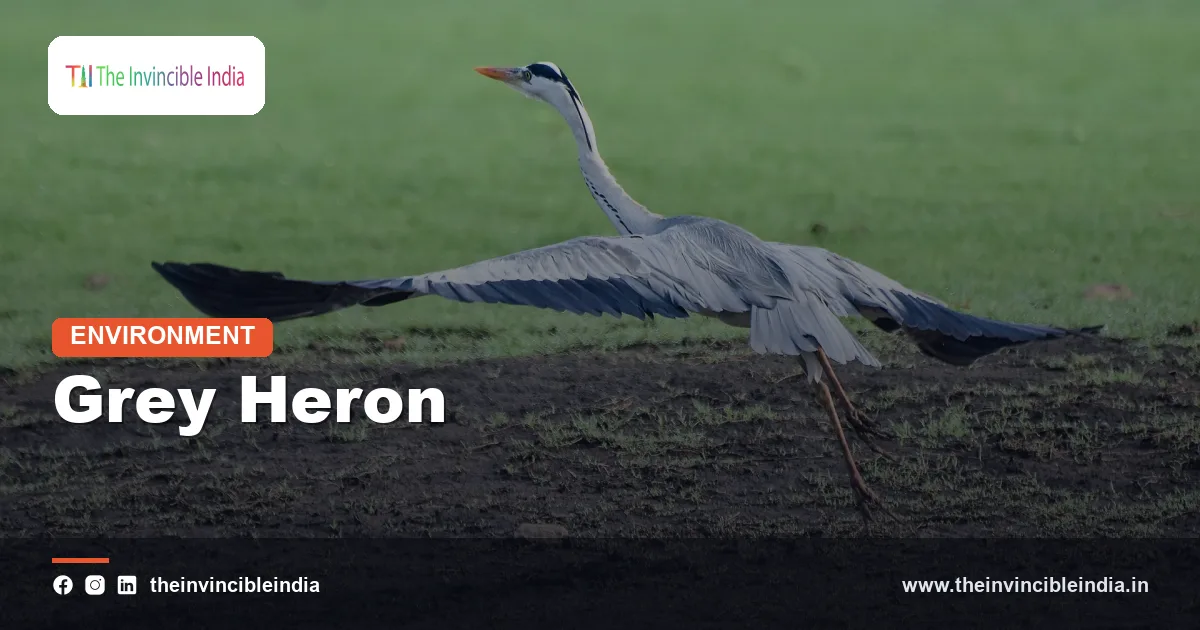
The grey heron (Ardea cinerea) is a tall, long-legged wading bird of the family Ardeidae that stands motionless in shallow water and spears fish with a dagger-like bill, and it is one of the most familiar large waterbirds across India’s lakes, rivers, paddy fields and coastal creeks. A typical adult is about a metre long from bill tip to tail, with a pale grey back, a white neck and a black stripe running from the eye to a drooping crest.
In India the grey heron is both a breeding resident and a winter visitor, so its numbers swell between roughly October and March as birds arrive from colder regions to the north. This explainer covers how to identify the grey heron, where it lives, how it feeds and nests, how it differs from look-alike birds, and why its colonies, called heronries, are valuable indicators of healthy wetlands. Population figures are given only in broad terms because counts vary by year and by site.
| Attribute | Detail |
|---|---|
| Scientific name | Ardea cinerea |
| Family and order | Ardeidae (herons, egrets and bitterns); order Pelecaniformes |
| Typical length | About 90 to 100 cm, with a wingspan of roughly 155 to 195 cm |
| Typical weight | Roughly 1 to 2 kg |
| Status in India | Resident breeder and winter visitor, widespread in suitable wetlands |
| Preferred habitat | Lakes, marshes, rivers, reservoirs, paddy fields, tidal creeks and mudflats |
| Main diet | Fish, frogs, crustaceans, insects and occasionally small mammals and birds |
| Nesting | Colonial stick nests in trees or reeds; usually 3 to 5 pale blue-green eggs |
| Global conservation status | Least Concern on the IUCN Red List |
Key Takeaways
- The grey heron (Ardea cinerea) is a large wading bird, about 90 to 100 cm long, found in wetlands across most of India.
- The grey heron hunts mainly by standing still or walking slowly in shallow water and striking at fish and frogs with its long, pointed bill.
- Grey herons fly with the neck folded back in an S-shape and slow, deep wingbeats, unlike storks, ibises and spoonbills, which fly with the neck stretched forward.
- Grey herons nest in colonies called heronries, building large platforms of sticks in trees or reedbeds, often alongside egrets, cormorants and other waterbirds.
- The IUCN lists the grey heron as a species of Least Concern, though the wetlands it depends on continue to be drained, polluted and built over.
- Wild birds in India, including herons, are protected under the Wildlife (Protection) Act, 1972, which prohibits hunting and trade.
What does a grey heron look like?
A grey heron looks like a very tall, upright, grey-and-white wader with a long yellowish bill, a long neck and long legs that trail behind it in flight. The upperparts are blue-grey, the underparts are paler, and the neck and face are whitish, with a row of dark streaks down the front of the neck.
A black band begins above the eye and extends backwards into a thin, drooping crest of black plumes. The bill is stout, pointed and yellowish to brownish, and it turns a brighter orange or pinkish shade in the breeding season. The legs are brownish, and they too flush reddish during courtship.
Young grey herons look duller. A juvenile has a greyer neck, a dark grey crown without the long black plumes, and a duller bill. The sexes look alike, although males are on average slightly larger.
When the bird hunches, the neck folds into a compact S-shape and the head sinks between the shoulders, which makes a tall bird look small and squat. When it spots prey, the neck uncoils and extends to its full length. The tall, stiff posture seen at rest is one of the features that makes the grey heron easy to recognise at a distance.
Where is the grey heron found in India?
The grey heron is found throughout most of India wherever there is shallow, fish-bearing water, from the plains and peninsular lakes to the foothills of the Himalaya and coastal estuaries. It is less common in very arid regions and in dense forest away from water.
Typical Indian habitats include:
- Freshwater lakes, tanks, reservoirs and village ponds
- Slow rivers, canals and irrigation channels
- Marshes and seasonally flooded grasslands
- Paddy fields and flooded agricultural land
- Tidal creeks, estuaries, mudflats and the edges of mangroves
Well-known wetland reserves such as Keoladeo National Park in Rajasthan, Chilika Lake in Odisha and the Sundarbans in West Bengal are regularly cited as places where large numbers of herons and egrets can be seen, though exact numbers change from season to season. The species also appears around city lakes and even small urban water bodies, provided they hold fish.
Globally, the grey heron breeds across much of Europe, Asia and Africa. Birds from colder northern regions move south in winter, and some of these winter visitors join the resident Indian birds on lakes and rivers.
How does the grey heron hunt?
The grey heron hunts mainly by stand-and-wait ambush, remaining almost perfectly still in shallow water until a fish, frog or crab comes within reach and then striking with a lightning-fast thrust of the neck. The pointed bill is used to spear or pincer the prey, which is then usually flipped and swallowed head first.
Several hunting methods are recorded:
- Standing still: the bird waits at the water’s edge for long periods, sometimes for many minutes.
- Slow stalking: the bird walks deliberately through shallows, lifting each foot with care to avoid ripples.
- Dusk and night feeding: grey herons often forage in low light, when fish come closer to the surface.
- Opportunistic hunting: in fields and grassland the bird may catch frogs, large insects, rodents and the young of ground-nesting birds.
A special adaptation helps the bird strike fast. One of the neck vertebrae is elongated and shaped so that the neck forms a permanent kink when folded. When muscles release this kink, the head shoots forward like a spring. Herons also have powder down, a fine powder produced by special feathers, which they spread over their plumage to absorb fish slime and oil. A comb-like edge on the middle claw is used to preen it through.
What does the grey heron eat?
The grey heron eats mainly fish, along with frogs, tadpoles, crabs, crayfish, aquatic insects, small snakes and, sometimes, small mammals such as voles and young waterbirds. Fish form the bulk of the diet in most wetlands, and the species usually takes fish up to a modest size that it can swallow whole.
The bird’s diet reflects what the local water body offers. Near paddy fields, frogs and insects matter more. Along the coast, small fish, prawns and crabs are common prey. Because grey herons occasionally take fish from fish farms and hatcheries, they can come into conflict with aquaculture operators, who sometimes cover ponds with netting or use scaring devices.
Grey herons also play a quiet ecological role. By taking weak or sick fish and controlling frogs, crabs and insect populations, they form a link in the wetland food web between small aquatic animals and larger predators such as raptors and mammals that may take eggs or chicks.
How does the grey heron fly and sound?
The grey heron flies with slow, heavy, arched wingbeats and with its neck drawn back into an S-shape, which is the most reliable way of telling a flying heron from a stork, ibis, spoonbill or crane. In flight the broad, rounded wings show a two-toned pattern of pale grey coverts and darker flight feathers, and the legs trail well behind the tail.
The call is a loud, harsh, croaking “fraank”, often given when the bird is disturbed or takes off. Around nests, herons clatter their bills and produce a range of grunts, squawks and gurgles. Heronries can be surprisingly noisy places, especially when chicks are begging for food.
Despite its size, a grey heron is light for its dimensions, weighing only one to two kilograms. Its bones are thin and partly hollow, and this combination allows the bird to take off from shallow water with only a few powerful wingbeats and a short run.
When and where does the grey heron breed?
The grey heron breeds in colonies called heronries, and in India the breeding season usually follows the rains, often between about June and December depending on the region, with considerable local variation. Birds in the south and in coastal areas may nest at different times from birds in the north or the hills.
A heronry is normally placed in tall trees, mangroves or dense reedbeds close to water. Many heronries are shared by several species, including egrets, cormorants, night herons, spoonbills and storks. Nests are substantial platforms of sticks and twigs, often reused and added to year after year.
| Stage | Typical detail |
|---|---|
| Courtship | Males display at the nest site, stretching the neck and clattering the bill; bill and legs flush brighter |
| Nest | Large stick platform, built by the female with material gathered by the male |
| Eggs | Usually 3 to 5, pale blue-green |
| Incubation | Roughly 25 days, shared by both parents |
| Chick period | Both parents feed the chicks by regurgitation; young leave the nest at roughly seven to eight weeks |
| Independence | Juveniles disperse after fledging and may breed from about two years of age |
Because herons nest together, a single disturbed tree can affect a large number of birds. Felling nesting trees, lopping branches during the season or harassing the colony can cause chicks to fall and the colony to be abandoned.
How is the grey heron different from other herons and egrets?
The grey heron differs from other herons mainly in size, colour and neck pattern: it is larger and paler than the purple heron, and unlike egrets, which are largely white, it is grey above and white below. The easiest comparison is with the purple heron, which is slimmer, more reddish-brown and has a longer, more snake-like neck.
- Purple heron: darker, with chestnut and rufous tones and black stripes on the neck; usually in dense reeds.
- Great egret: all white with a yellow bill and black legs, often with a distinct kink in the neck.
- Little egret: small, white, with a black bill and yellow feet.
- Black-crowned night heron: short-legged, stocky and mainly active at dusk.
- Great-billed heron: a very large, dark heron of a few eastern and island mangrove habitats, with a thick bill; far less widespread than the grey heron.
The term “egret” is a common name for white or whitish herons rather than a strict scientific group, and several egret species are placed in the same genus as the grey heron. Birdwatchers separate them chiefly by structure and bare-part colours.
Is the grey heron endangered in India?
No, the grey heron is not considered endangered: the IUCN classifies it as Least Concern globally because it has a very large range and a large, generally stable population. In India it is widely distributed, although local numbers can fall where wetlands are lost.
Threats to grey herons and their colonies include:
- Draining and filling of wetlands for construction and farming
- Water pollution and the decline of fish stocks
- Cutting down of nesting trees and disturbance at heronries
- Persecution at fish farms in some areas
- Collision with overhead power lines
- Poisoned or contaminated prey from pesticides and industrial discharge
Wild birds in India are covered by the Wildlife (Protection) Act, 1972, which prohibits hunting, capture and trade. The exact schedule placement of individual species has been revised by amendments over the years, so anyone needing the precise legal listing should check the current schedules published by the Ministry of Environment, Forest and Climate Change.
Why do heronries matter for wetlands?
Heronries matter because a healthy heronry shows that a wetland still has enough fish, clean water and safe trees to support a large community of birds. Conservation groups often use waterbird colonies as simple indicators of wetland condition.
Heronries also provide benefits to people. Bird droppings, known as guano, fertilise the soil around nesting trees, and in some villages across India communities protect nesting trees because they value the birds and the enriched fields nearby. Such village-level protection has helped certain colonies survive for generations.
Bird counts such as the annual Asian Waterbird Census, coordinated in the region by Wetlands International with the help of volunteers, record herons and egrets along with other waterbirds, and these records help track trends over time.
How can you watch grey herons responsibly?
The best way to watch grey herons is from a distance, at dawn or dusk, using binoculars, staying quiet and keeping clear of nests and nesting trees. Herons are wary birds, and a bird that flushes repeatedly burns energy and loses feeding time.
- Visit wetlands in the early morning or evening, when herons are most active.
- Stay on paths and observation points; never walk into a heronry.
- Keep voices low and avoid sudden movements.
- Do not use playback calls or flash photography near nesting colonies.
- Carry back all litter, especially fishing line and plastic, which can entangle waterbirds.
Winter, roughly November to February, is generally the easiest season for beginners, because wetlands hold a large variety of resident and migratory waterbirds and the vegetation is lower.
Bottom Line
The grey heron is a large, grey-and-white fish-eating wader that is widespread across Indian wetlands and breeds in noisy tree colonies. It is not globally threatened, but it depends on clean, fish-rich water and undisturbed nesting trees. Protecting wetlands and heronries protects the grey heron and the many other birds that share the same habitat.
Frequently Asked Questions
Is the grey heron found all over India?
The grey heron is found in most parts of India wherever there is shallow water with fish or frogs. It is widespread in the plains, peninsula, coasts and Himalayan foothills, but is rare in very dry deserts and dense forests away from water. Numbers rise in winter when migrants arrive.
How tall is a grey heron?
A grey heron stands roughly 90 to 100 cm long from bill to tail and has a wingspan of about 155 to 195 cm. It weighs only about one to two kilograms because its bones are thin and light. It is one of the largest herons commonly seen in India.
What is the difference between a grey heron and a purple heron?
The grey heron is larger, paler and mainly grey and white, while the purple heron is slimmer and darker with chestnut and rufous tones and black neck stripes. The purple heron also has a longer, more snake-like neck and prefers dense reeds. Both belong to the same genus, Ardea.
What do grey herons eat?
Grey herons eat mostly fish, but they also take frogs, crabs, aquatic insects, small snakes, rodents and young waterbirds. They hunt by standing still or stalking slowly in shallow water and striking with their pointed bill. Their diet changes with what each wetland offers.
What is a heronry?
A heronry is a breeding colony of herons, usually in tall trees, mangroves or reedbeds close to water. The nests are large stick platforms, and many colonies are shared with egrets, cormorants and other waterbirds. Disturbing a heronry can cause birds to abandon eggs and chicks.
Is the grey heron protected in India?
Yes, wild birds including herons are protected in India under the Wildlife (Protection) Act, 1972, which prohibits hunting, capture and trade. The exact schedule listing has changed with amendments, so the current schedules should be checked for the precise legal status. Globally the grey heron is rated Least Concern by the IUCN.
{“@context”:”https://schema.org”,”@graph”:[{“@type”:”FAQPage”,”mainEntity”:[{“@type”:”Question”,”name”:”Is the grey heron found all over India?”,”acceptedAnswer”:{“@type”:”Answer”,”text”:”The grey heron is found in most parts of India wherever there is shallow water with fish or frogs. It is widespread in the plains, peninsula, coasts and Himalayan foothills, but is rare in very dry deserts and dense forests away from water. Numbers rise in winter when migrants arrive.”}},{“@type”:”Question”,”name”:”How tall is a grey heron?”,”acceptedAnswer”:{“@type”:”Answer”,”text”:”A grey heron stands roughly 90 to 100 cm long from bill to tail and has a wingspan of about 155 to 195 cm. It weighs only about one to two kilograms because its bones are thin and light. It is one of the largest herons commonly seen in India.”}},{“@type”:”Question”,”name”:”What is the difference between a grey heron and a purple heron?”,”acceptedAnswer”:{“@type”:”Answer”,”text”:”The grey heron is larger, paler and mainly grey and white, while the purple heron is slimmer and darker with chestnut and rufous tones and black neck stripes. The purple heron also has a longer, more snake-like neck and prefers dense reeds. Both belong to the same genus, Ardea.”}},{“@type”:”Question”,”name”:”What do grey herons eat?”,”acceptedAnswer”:{“@type”:”Answer”,”text”:”Grey herons eat mostly fish, but they also take frogs, crabs, aquatic insects, small snakes, rodents and young waterbirds. They hunt by standing still or stalking slowly in shallow water and striking with their pointed bill. Their diet changes with what each wetland offers.”}},{“@type”:”Question”,”name”:”What is a heronry?”,”acceptedAnswer”:{“@type”:”Answer”,”text”:”A heronry is a breeding colony of herons, usually in tall trees, mangroves or reedbeds close to water. The nests are large stick platforms, and many colonies are shared with egrets, cormorants and other waterbirds. Disturbing a heronry can cause birds to abandon eggs and chicks.”}},{“@type”:”Question”,”name”:”Is the grey heron protected in India?”,”acceptedAnswer”:{“@type”:”Answer”,”text”:”Yes, wild birds including herons are protected in India under the Wildlife (Protection) Act, 1972, which prohibits hunting, capture and trade. The exact schedule listing has changed with amendments, so the current schedules should be checked for the precise legal status. Globally the grey heron is rated Least Concern by the IUCN.”}}]}]}


