

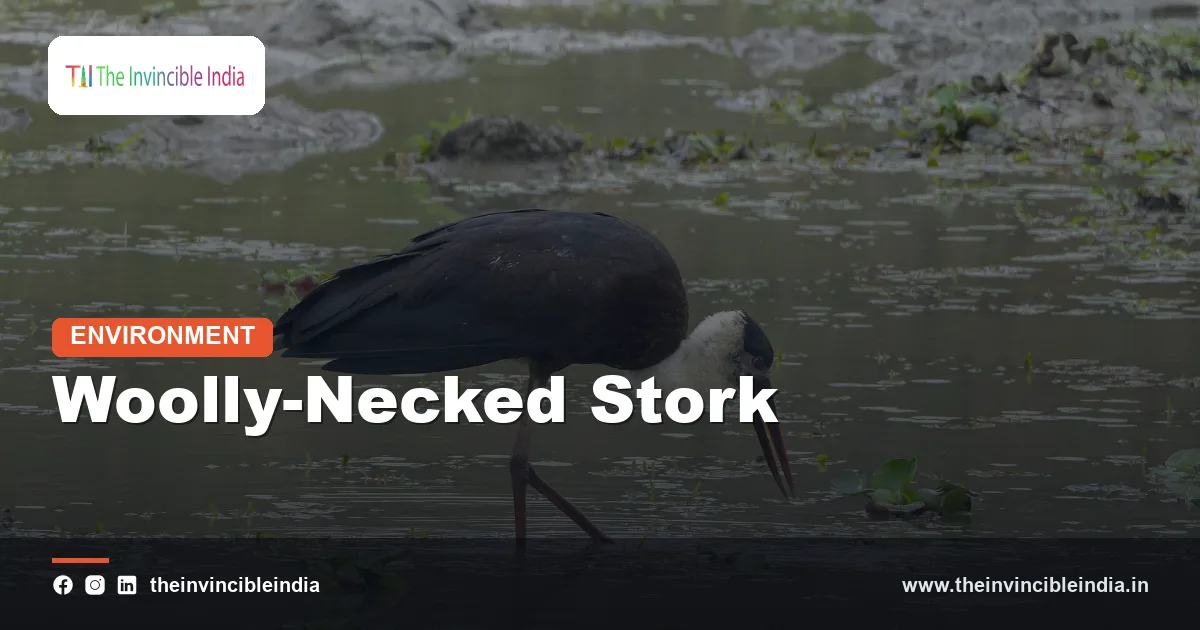
The woolly-necked stork (Ciconia episcopus), also called the white-necked stork or bishop stork, is a medium-large, glossy dark stork with a fluffy white neck and a black cap that is found in wetlands, paddy fields and open country across India and the wider Asian region. The woolly-necked stork is usually seen alone, in pairs or in small groups, wading in marshes and fields or soaring on thermals with a straight neck and trailing legs.
The woolly-necked stork is a quiet, widely scattered bird whose populations are shrinking as wetlands, large trees and traditional farmland change. This explainer covers how to identify the woolly-necked stork, where it lives in India, what it eats, how it nests, how it differs from other storks and what threatens it.
| Quick Facts | Details |
|---|---|
| Common names | Woolly-necked stork, Asian woolly-necked stork, white-necked stork, bishop stork |
| Scientific name | Ciconia episcopus |
| Family | Ciconiidae (storks) |
| Size | Roughly 75 to 95 cm tall, wingspan around 1.2 to 1.5 m |
| Key features | Glossy black body, white woolly neck, black cap, white lower belly and tail, red legs, dark bill with reddish tip |
| Habitat | Wetlands, marshes, paddy fields, riverbanks, pools and open farmland with tall trees |
| Diet | Frogs, fish, insects, crabs, snakes and other small animals |
| Social habits | Usually solitary, in pairs or in small groups; nests alone or in loose groups |
| IUCN status | Threatened category (Vulnerable) in recent assessments, with a declining population |
Key Takeaways
- The woolly-necked stork is a glossy black stork with a thick white woolly neck, a black cap and a white lower belly and tail.
- The woolly-necked stork is also known as the bishop stork because its black cap resembles a bishop’s skullcap, which is reflected in the species name episcopus.
- The woolly-necked stork feeds in shallow wetlands and wet fields on frogs, fish, insects, crabs and snakes.
- The woolly-necked stork is a solitary or pair-living bird that builds large stick nests in tall trees near water and farmland.
- The woolly-necked stork is considered threatened in recent IUCN assessments because wetlands are shrinking and old nesting trees are being lost.
- The woolly-necked stork helps farmers by eating pests such as locusts, grasshoppers and rodents in addition to aquatic prey.
What is the woolly-necked stork?
The woolly-necked stork is a medium-large wading bird of the stork family, native to tropical Asia and Africa, that is recognised by its fluffy white neck, black cap and dark glossy body. The scientific name Ciconia episcopus comes from Latin words for “stork” and “bishop”, a reference to the dark, cap-like crown.
The species was once treated as one widespread bird across Asia and Africa. Many authorities now separate the Asian woolly-necked stork, which lives in India and Southeast Asia, from the African woolly-necked stork. Indian field guides still use the names woolly-necked stork and white-necked stork for the Asian bird.
The woolly-necked stork belongs to the genus Ciconia, which also includes the white stork and the black stork, both of which visit India in winter. Unlike the large colonial storks, the woolly-necked stork prefers a quieter, more solitary life.
How can you identify a woolly-necked stork?
A woolly-necked stork can be identified by its glossy black upperparts, fluffy white neck, black skullcap, white lower belly and undertail and long red legs. The thick, dark bill often shows a reddish tinge near the tip.
Plumage and bare parts
- The upperparts and breast are glossy black with a bronze, green or purple sheen.
- The neck is covered with soft, white, woolly-looking feathers.
- The crown is glossy black, forming the “skullcap” that gives the bird its bishop name.
- The lower belly, vent and undertail coverts are white, and the tail is deeply forked and mostly white.
- The legs are red, and the bill is black to dark brown with a reddish tip. The facial skin is dark.
Juveniles
Young woolly-necked storks are duller and browner, with a less distinct cap and a paler, greyish neck. They gain the glossy adult plumage and clean white neck gradually over their first years.
In flight
In flight, the woolly-necked stork shows black wings, a white neck and white lower body, with the neck stretched forward and the legs trailing behind. The species soars on rising warm air and glides with little flapping, often at a considerable height.
Where does the woolly-necked stork live in India?
The woolly-necked stork lives across much of India in wetlands, marshes, paddy fields, riverbanks, ponds and open farmland with tall trees. It is widely but thinly distributed, from the foothills of the Himalaya and the Gangetic plain to the peninsula and Sri Lanka.
Beyond India, the Asian woolly-necked stork occurs in Nepal, Bangladesh, Sri Lanka and Southeast Asia, extending to parts of Indonesia and the Philippines. Birds are mostly resident, although they may move locally with water, food and rainfall. Seasonal wetlands and flooded paddy fields attract them during the rains.
Typical habitats
- Freshwater marshes, wet meadows and the margins of lakes and reservoirs.
- Flooded and irrigated paddy fields and other wet farmland.
- River banks, canals and seasonal pools.
- Mangroves and coastal wetlands in some regions.
- Open areas near villages with large old trees for nesting.
What does the woolly-necked stork eat?
The woolly-necked stork eats frogs, fish, insects, crabs, snails, snakes and other small animals, which it finds by walking slowly through shallow water and wet fields. It strikes with its bill with a quick stab when prey moves.
The bird often hunts alone, standing still or stalking through reeds and short vegetation. In farmland it eats grasshoppers, locusts, beetles and other insects, as well as rodents and small reptiles. Because of this broad diet, the woolly-necked stork can make use of both wet and dry ground.
The woolly-necked stork is not a filter feeder like the painted stork, and it relies more on sight than on touch. It therefore prefers shallow, clear to moderately turbid water where it can see prey.
How does the woolly-necked stork breed and nest?
The woolly-necked stork breeds by building a large stick nest in a tall tree, usually near water, and laying a clutch of about three to five eggs. Pairs often nest alone or in loose clusters, and they may reuse and add to the same nest for several years.
Season and nest sites
The breeding season depends on region and rainfall. In many parts of northern India nesting follows the monsoon, while in southern regions it may fall in the cooler months. The nest is a bulky platform of sticks, lined with finer material, often placed high in a tree such as a banyan, peepal, mango, silk cotton or eucalyptus.
Eggs and chicks
- Clutches usually contain three to five whitish or pale bluish eggs.
- Both parents are believed to share incubation and feeding of the young.
- Chicks are fed by regurgitation and remain in the nest for several weeks.
- Pairs are sensitive to disturbance and may desert nests if people approach too closely.
The woolly-necked stork is generally silent, but it communicates by bill clattering, especially at the nest, and by soft grunting and hissing sounds.
How is the woolly-necked stork different from other storks?
The woolly-necked stork differs from other Indian storks in its glossy black body combined with a fluffy white neck and black cap, which is not shared by any other resident stork. The table compares it with the other storks recorded in India.
| Stork | Appearance | Status in India |
|---|---|---|
| Woolly-necked stork | Glossy black body, white woolly neck, black cap, red legs | Resident, widespread but thinly scattered |
| Painted stork | White with black bands, pink tertials, yellow curved bill | Resident colonial breeder |
| Asian openbill | White or grey with black wings, gapped bill | Resident, common in many regions |
| Black-necked stork | White with glossy black neck and wing band, long black bill | Resident, uncommon |
| Lesser adjutant | Grey and black, bare head and neck | Resident, uncommon |
| Greater adjutant | Large, grey and black, bare head with a neck pouch | Resident, rare, with a small Indian population |
| White stork | White with black flight feathers, red bill and legs | Winter visitor and passage migrant |
| Black stork | Glossy black with white belly, red bill and legs | Winter visitor |
The black stork looks somewhat similar from a distance but has an entirely black neck and head. The woolly-necked stork’s white neck is the clearest difference.
Is the woolly-necked stork endangered?
The woolly-necked stork is considered a threatened species in recent assessments by the International Union for Conservation of Nature (IUCN), with the Asian population described as Vulnerable and believed to be declining. Readers should check the current IUCN Red List entry, as classifications are revised over time.
The main threats are the loss and degradation of wetlands, the draining of marshes, the felling of large nest trees and pollution of water bodies. Pesticide use in farmland can reduce prey and poison birds, and hunting and disturbance of nests add to the pressure. Collision with power lines is also a concern for large soaring birds. In India, wild birds are protected under the Wildlife (Protection) Act, 1972.
What helps the species
- Protection of wetlands, including small village ponds and marshes.
- Conservation of large old trees in and near fields.
- Traditional, low-chemical farming that keeps frogs, fish and insects plentiful.
- Safe, bird-friendly design of power lines near wetlands.
- Community awareness, since farmers often host nesting pairs on their land.
Why does the woolly-necked stork matter to farmland and wetlands?
The woolly-necked stork matters because it is a predator of frogs, fish, insects and rodents, and it indicates that wetlands and farmland still support a diverse food web. By eating locusts, grasshoppers and other pests in fields, the bird offers a modest natural form of pest control.
The species also links wetlands with agricultural land, since it feeds in wet fields and nests in tall trees nearby. Its decline can warn of chemical overuse, wetland loss or the disappearance of old trees. Because it is often seen close to villages, the woolly-necked stork is an easy species for citizen scientists to record and monitor.
Where and when can you see the woolly-necked stork?
The woolly-necked stork can be seen through the year at wetlands, rice fields and riverbanks across India, and it is easiest to find early in the morning or in the late afternoon. Protected wetlands and national parks, such as Keoladeo National Park, Kaziranga National Park and many sanctuaries and paddy-growing regions, are good places to look.
- Scan wet fields and marsh edges for a single dark bird with a white neck.
- Look skyward for soaring birds with a white neck and black wings.
- Check tall trees near water for large stick nests.
- Keep a safe distance from nests, especially in the breeding season.
- Use binoculars and avoid flushing feeding birds from fields.
Bottom Line
The woolly-necked stork is a striking dark stork with a fluffy white neck and black cap, and it is a quiet but valuable resident of Indian wetlands and farmland. Its threatened status calls for protecting marshes, village ponds and large old trees so that these elegant birds continue to stalk fields and soar over the countryside.
Frequently Asked Questions
Why is it called the woolly-necked stork?
The woolly-necked stork is called so because the feathers on its neck are soft, fluffy and white, giving the neck a woolly look. The bird is also called the bishop stork because its black cap resembles a bishop’s skullcap. The species name episcopus is Latin for bishop.
What does a woolly-necked stork look like?
A woolly-necked stork has glossy black upperparts, a fluffy white neck, a black cap, a white lower belly and tail and long red legs. The bill is dark with a reddish tip. Juveniles are duller and browner, with a greyish neck.
Where is the woolly-necked stork found in India?
The woolly-necked stork is found across much of India in wetlands, marshes, paddy fields, riverbanks and open farmland with tall trees. It is widely distributed but usually thinly scattered. It also occurs in Nepal, Bangladesh, Sri Lanka and Southeast Asia.
What does the woolly-necked stork eat?
The woolly-necked stork eats frogs, fish, insects, crabs, snails, snakes and other small animals. In farmland it also eats grasshoppers, locusts and rodents. It hunts by walking slowly through shallow water and wet fields and stabbing at moving prey.
Is the woolly-necked stork endangered?
The woolly-necked stork is considered a threatened species in recent IUCN assessments, with the Asian population described as Vulnerable and believed to be declining. Wetland loss, loss of large nest trees, pollution and disturbance are the main threats. Readers should check the current IUCN Red List entry for the latest status.
How does the woolly-necked stork differ from the black stork?
The woolly-necked stork has a fluffy white neck and a black cap, while the black stork has an entirely glossy black head and neck. The woolly-necked stork is a resident of India, whereas the black stork is mainly a winter visitor. Both belong to the genus Ciconia.
{“@context”:”https://schema.org”,”@graph”:[{“@type”:”FAQPage”,”mainEntity”:[{“@type”:”Question”,”name”:”Why is it called the woolly-necked stork?”,”acceptedAnswer”:{“@type”:”Answer”,”text”:”The woolly-necked stork is called so because the feathers on its neck are soft, fluffy and white, giving the neck a woolly look. The bird is also called the bishop stork because its black cap resembles a bishop’s skullcap. The species name episcopus is Latin for bishop.”}},{“@type”:”Question”,”name”:”What does a woolly-necked stork look like?”,”acceptedAnswer”:{“@type”:”Answer”,”text”:”A woolly-necked stork has glossy black upperparts, a fluffy white neck, a black cap, a white lower belly and tail and long red legs. The bill is dark with a reddish tip. Juveniles are duller and browner, with a greyish neck.”}},{“@type”:”Question”,”name”:”Where is the woolly-necked stork found in India?”,”acceptedAnswer”:{“@type”:”Answer”,”text”:”The woolly-necked stork is found across much of India in wetlands, marshes, paddy fields, riverbanks and open farmland with tall trees. It is widely distributed but usually thinly scattered. It also occurs in Nepal, Bangladesh, Sri Lanka and Southeast Asia.”}},{“@type”:”Question”,”name”:”What does the woolly-necked stork eat?”,”acceptedAnswer”:{“@type”:”Answer”,”text”:”The woolly-necked stork eats frogs, fish, insects, crabs, snails, snakes and other small animals. In farmland it also eats grasshoppers, locusts and rodents. It hunts by walking slowly through shallow water and wet fields and stabbing at moving prey.”}},{“@type”:”Question”,”name”:”Is the woolly-necked stork endangered?”,”acceptedAnswer”:{“@type”:”Answer”,”text”:”The woolly-necked stork is considered a threatened species in recent IUCN assessments, with the Asian population described as Vulnerable and believed to be declining. Wetland loss, loss of large nest trees, pollution and disturbance are the main threats. Readers should check the current IUCN Red List entry for the latest status.”}},{“@type”:”Question”,”name”:”How does the woolly-necked stork differ from the black stork?”,”acceptedAnswer”:{“@type”:”Answer”,”text”:”The woolly-necked stork has a fluffy white neck and a black cap, while the black stork has an entirely glossy black head and neck. The woolly-necked stork is a resident of India, whereas the black stork is mainly a winter visitor. Both belong to the genus Ciconia.”}}]}]}


