

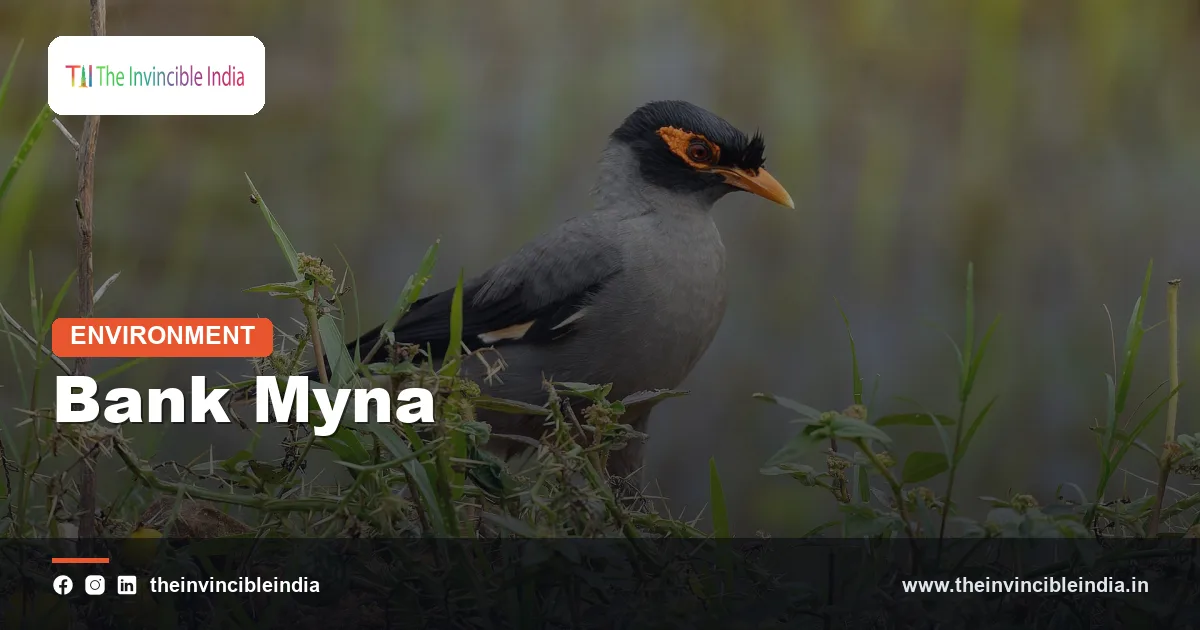
The bank myna (Acridotheres ginginianus) is a small, bluish-grey myna of the Indian subcontinent, easily recognised by the bare orange-red patch of skin behind its eye, and named for its habit of nesting in colonies in tunnels dug into river banks, canal cuttings and old walls. It is a common, sociable bird of roadsides, railway stations, fields and town edges across much of northern and central India, often seen walking on the ground in small flocks or perched on grazing cattle.
The bank myna is smaller and more delicately coloured than the familiar common myna, and it is sometimes overlooked because it blends into the dusty plains it prefers. This explainer sets out how to identify the bank myna, where it lives in India, what it eats, how its burrow colonies work, how it differs from other mynas and how it copes with urban life. Estimates of numbers are kept qualitative because they vary by region and year.
| Quick Facts: Bank Myna | |
|---|---|
| Scientific name | Acridotheres ginginianus |
| Family | Sturnidae (starlings and mynas) |
| Common names | Bank myna, bank mynah |
| Typical length | About 21 to 23 cm |
| Plumage | Bluish or ash-grey body, blackish cap, orange-buff patch in the wing visible in flight |
| Distinctive mark | Bare orange-red skin patch behind the eye |
| Range | Mainly the Indian subcontinent: India, Pakistan, Nepal and Bangladesh; commoner in the north and centre |
| Nesting | Colonial; tunnels dug in earthen banks, cuttings and walls |
| Conservation status | Least Concern on the IUCN Red List |
Key Takeaways
- The bank myna is a small, bluish-grey myna whose most distinctive feature is the bare orange-red skin patch behind each eye.
- The bank myna nests in colonies, digging tunnels into vertical river banks, canal sides, road cuttings and old mud walls.
- The bank myna is native to the Indian subcontinent and is especially common across the northern and central plains of India.
- The bank myna eats insects, grain, fruit and scraps, and frequently feeds on the ground or beside grazing cattle.
- The bank myna is smaller and paler than the common myna and lacks the common myna’s bright yellow bill and brown body.
- The bank myna is classed as Least Concern by the IUCN because it is widespread and adapts well to human-altered habitats.
What is the bank myna?
The bank myna is a member of the starling family Sturnidae and one of several mynas that occur in India, characterised by its soft bluish-grey plumage, black cap and a patch of bare orange-red skin behind the eye. It is a resident bird of the plains and low hills, and it is native to the Indian subcontinent rather than introduced from elsewhere.
The bird’s scientific name, Acridotheres ginginianus, is generally understood to refer to Gingee (Jinji) in Tamil Nadu, the place from which early specimens were described, though the species is far commoner in the north of India than in the south. The genus name Acridotheres means “locust hunter”, a reference to the way mynas eat insects.
The name “myna” comes from a Hindi word for these birds, and it is used for several species of starling relatives across Asia. In English, the bank myna is also written “bank mynah”, and local names in Hindi and other languages vary by region.
How do you identify a bank myna?
A bank myna can be identified by its compact size, soft bluish-grey body, dark cap and the bare, orange-red patch of skin behind the eye, with an orange-yellow bill and legs and a rich buff patch in the wing that flashes in flight. The overall impression is of a tidy, pale, greyish myna that looks a shade cooler in colour than the brown common myna.
Field marks to look for:
- Head: a blackish crown and face, with the bare orange-red patch behind the eye standing out clearly.
- Body: ash-grey or bluish-grey above and a slightly paler, pinkish-grey tone below.
- Bill and legs: orange or yellow-orange, with the bill sometimes tipped paler.
- Wings: a cinnamon or orange-buff band across the flight feathers, visible when the bird takes off.
- Tail: darker, with a buff tip on the outer feathers.
- Behaviour: walks on the ground with a brisk, bobbing gait, usually in small groups.
Young birds are duller and browner than adults, with less distinct skin patches. The calls are a mixture of chattering, chirruping and harsh notes, generally softer and less varied than the loud calls of the common myna.
Where does the bank myna live in India?
The bank myna lives mainly in the plains of northern and central India, including the Gangetic plains, Punjab, Rajasthan, Gujarat and Madhya Pradesh, and it extends in smaller numbers into parts of the south and east. It is also found in neighbouring Pakistan, Nepal and Bangladesh, and the species has been recorded in some other countries following introductions.
The bank myna favours habitats that offer both open ground for feeding and suitable earthen banks for burrows:
- Riverbanks, canal sides and the steep sides of ravines.
- Dry farmland, fallow fields and grazing land with cattle.
- Roadsides, railway embankments and railway stations.
- Villages, small towns and the outskirts of cities.
- Old walls, ruins and mud-brick structures with soft mortar.
The species is less common in dense forest and in very humid hill regions. In the extreme south of India, the bank myna becomes patchy, whereas the common myna is nearly everywhere.
What does the bank myna eat?
The bank myna is an omnivore that eats insects, grain, fruit, flower nectar and scraps, and it spends much of the day walking on the ground in search of food. Like other mynas, it takes advantage of whatever is available and shifts its diet with the seasons.
Common foods include:
- Insects: grasshoppers, beetles, caterpillars, crickets and flies, often disturbed by cattle or by farm work.
- Grain and seeds: spilled wheat, millet and rice around threshing floors and railway yards.
- Fruit: figs, berries and ripe cultivated fruit.
- Nectar: flowers of certain trees during the dry season.
- Human food waste: scraps around markets, bus stations and railway platforms.
Bank mynas are well known for following grazing animals and sometimes perching on their backs to pick off ticks and flushed insects. This feeding partnership can benefit both sides, although observers disagree on how large the benefit is to the livestock.
How does the bank myna nest in banks and walls?
The bank myna nests in colonies by digging narrow horizontal tunnels, often a metre or less in length, into soft earthen banks, and it places a grass-and-feather-lined nest chamber at the end of the burrow. This tunnelling behaviour is the source of its common name and is relatively unusual among mynas, which typically nest in tree holes.
The main features of bank myna nesting are:
- Site: vertical banks of rivers and canals, road cuttings, mud walls and sometimes brick walls with loose mortar.
- Burrow: a short tunnel dug with the bill and feet; the entrance is just wide enough for one bird.
- Chamber: lined with grass, rags, feathers and sometimes plastic or paper.
- Eggs: usually four or five pale blue, unmarked eggs.
- Season: usually breeds in the warmer months, with timing that varies by region and sometimes includes a second brood.
- Colony size: from a handful of burrows to many dozens, close to each other.
Both parents dig the burrow, incubate the eggs and feed the chicks on insects. Because the burrows can be reused, the same bank may be occupied across several years if it stays stable.
How is the bank myna different from the common myna?
The bank myna differs from the common myna (Acridotheres tristis) in colour, eye patch, size and nesting habit: it is smaller, bluish-grey with an orange-red eye patch and burrows in banks, whereas the common myna is brown with a black head, a bright yellow bill and eye patch, and nests in holes in trees and buildings. The two species often share the same fields, roosts and railway stations, so knowing the differences helps.
The table below compares the bank myna with the other two mynas most often seen with it in India.
| Feature | Bank myna | Common myna | Jungle myna |
|---|---|---|---|
| Scientific name | Acridotheres ginginianus | Acridotheres tristis | Acridotheres fuscus |
| Overall colour | Bluish or ash-grey | Brown with black head | Dark grey-brown |
| Eye patch | Orange-red, bare skin | Yellow, bare skin | No bare patch |
| Forehead | Smooth | Smooth | Small upright tuft |
| Nest site | Burrows in banks and walls | Holes in trees and buildings | Tree holes and wall holes |
| Typical habitat | Plains, riverbanks, railway lines | Towns, villages, cultivation | Groves, fields, forest edges |
The bank myna also tends to be more strictly tied to the north and centre of India, while the common myna and jungle myna are more widely spread across the country.
How does the bank myna roost and socialise?
The bank myna is a highly social bird that forages in small flocks and gathers in large noisy roosts at dusk, often sharing roost trees or bamboo clumps with common mynas, crows, parakeets and other urban birds. Communal roosting is thought to provide warmth and safety from predators, and it is a common sight near railway stations and in market towns.
Social behaviours of the bank myna include:
- Flocking in loose groups while feeding, with birds calling to each other as they move across the ground.
- Mobbing predators such as cats, snakes and birds of prey when they approach the colony.
- Using the same roosting site night after night, often assembling from several directions at sunset.
- Defending burrow entrances from neighbours and rival pairs, with short chases and loud chattering.
Within the colony, each pair shows strong attachment to its own burrow, even though dozens of burrows may sit within a few metres. Pairs are generally monogamous during a breeding season.
Is the bank myna threatened, and how does it fare in cities?
The bank myna is not threatened and is listed as Least Concern by the IUCN, since it remains widespread and tolerates human settlements, though local colonies can be lost when river banks are stabilised, filled or lined with concrete. Its adaptability to railway cuttings, canal banks and old walls helps it persist where natural river cliffs have been altered.
Threats and conservation considerations include:
- Bank engineering: concrete lining of canals and the levelling of earthen banks remove nest sites.
- Sand mining: excavation at river banks can destroy colonies in the breeding season.
- Pesticide use: may reduce insect prey on farmland, though impacts are not well measured.
- Competition: pressure for roost and nest sites from the common myna and other adaptable species.
- Disturbance: repair of old walls and demolition of ruins during the nesting period.
In cities, the bank myna is typically less numerous than the common myna but may become locally abundant around railway tracks, open drains and construction sites with earth banks. Where possible, leaving a section of undisturbed earthen bank during the breeding season benefits the species.
How can you watch bank mynas?
The easiest way to watch bank mynas is to visit a riverbank, canal, railway embankment or a field with grazing cattle in northern or central India in the early morning, when the birds are active on the ground. Binoculars help in spotting the orange-red eye patch and the wing flash, and a quiet approach avoids startling the flock.
Practical tips for observers:
- Stay at a distance from active burrow colonies during the breeding season to avoid causing birds to abandon their nests.
- Watch for birds walking beside cattle or along ploughed furrows, where insects are disturbed.
- Check roadside cuttings and old mud walls for rows of small round holes.
- Note the time of dusk roost gatherings, which are often easy to observe from a distance.
- Record sightings on a citizen-science platform so that regional trends can be tracked.
Bottom Line
The bank myna is a small, bluish-grey, orange-eyed myna that lives in colonies and tunnels into river banks and walls across the plains of India. It is a resilient bird, but its dependence on earthen banks means that river engineering and construction are the main local pressures to watch.
Frequently Asked Questions
Why is it called the bank myna?
The bank myna is named for its habit of nesting in burrows dug into the banks of rivers and canals. It also uses road cuttings and old mud walls. The tunnels are dug by both parents and end in a lined nest chamber.
How can I tell a bank myna from a common myna?
The bank myna is smaller and bluish-grey, with a bare orange-red patch behind the eye and an orange bill. The common myna is brown with a black head and a bright yellow bill and eye patch. The bank myna also nests in banks, while the common myna uses holes in trees and buildings.
Where are bank mynas found in India?
Bank mynas are found mainly across the plains of northern and central India, including the Gangetic belt, Punjab, Rajasthan and Gujarat. They are patchier in the south and in dense forest and humid hill regions. The species also occurs in Pakistan, Nepal and Bangladesh.
What do bank mynas eat?
Bank mynas eat insects, grain, fruit, nectar and food scraps. They forage mostly on the ground and often follow cattle to catch insects the animals disturb. Around towns and railway stations they also pick up spilled grain and waste.
How many eggs does a bank myna lay?
A bank myna usually lays four or five pale blue eggs in a chamber at the end of its burrow. Both parents incubate the eggs and feed the chicks. Breeding takes place mostly in the warmer months, and some pairs may raise a second brood.
Is the bank myna a protected bird?
The bank myna is not endangered and is rated Least Concern by the IUCN, but it is a wild bird and should not be trapped or disturbed at its nests. Its main local risk is the loss of earthen banks to concrete lining, sand mining and construction. Readers should check current provisions of the Wildlife (Protection) Act, 1972 for the legal position on wild birds.
{“@context”:”https://schema.org”,”@graph”:[{“@type”:”FAQPage”,”mainEntity”:[{“@type”:”Question”,”name”:”Why is it called the bank myna?”,”acceptedAnswer”:{“@type”:”Answer”,”text”:”The bank myna is named for its habit of nesting in burrows dug into the banks of rivers and canals. It also uses road cuttings and old mud walls. The tunnels are dug by both parents and end in a lined nest chamber.”}},{“@type”:”Question”,”name”:”How can I tell a bank myna from a common myna?”,”acceptedAnswer”:{“@type”:”Answer”,”text”:”The bank myna is smaller and bluish-grey, with a bare orange-red patch behind the eye and an orange bill. The common myna is brown with a black head and a bright yellow bill and eye patch. The bank myna also nests in banks, while the common myna uses holes in trees and buildings.”}},{“@type”:”Question”,”name”:”Where are bank mynas found in India?”,”acceptedAnswer”:{“@type”:”Answer”,”text”:”Bank mynas are found mainly across the plains of northern and central India, including the Gangetic belt, Punjab, Rajasthan and Gujarat. They are patchier in the south and in dense forest and humid hill regions. The species also occurs in Pakistan, Nepal and Bangladesh.”}},{“@type”:”Question”,”name”:”What do bank mynas eat?”,”acceptedAnswer”:{“@type”:”Answer”,”text”:”Bank mynas eat insects, grain, fruit, nectar and food scraps. They forage mostly on the ground and often follow cattle to catch insects the animals disturb. Around towns and railway stations they also pick up spilled grain and waste.”}},{“@type”:”Question”,”name”:”How many eggs does a bank myna lay?”,”acceptedAnswer”:{“@type”:”Answer”,”text”:”A bank myna usually lays four or five pale blue eggs in a chamber at the end of its burrow. Both parents incubate the eggs and feed the chicks. Breeding takes place mostly in the warmer months, and some pairs may raise a second brood.”}},{“@type”:”Question”,”name”:”Is the bank myna a protected bird?”,”acceptedAnswer”:{“@type”:”Answer”,”text”:”The bank myna is not endangered and is rated Least Concern by the IUCN, but it is a wild bird and should not be trapped or disturbed at its nests. Its main local risk is the loss of earthen banks to concrete lining, sand mining and construction. Readers should check current provisions of the Wildlife (Protection) Act, 1972 for the legal position on wild birds.”}}]}]}


