

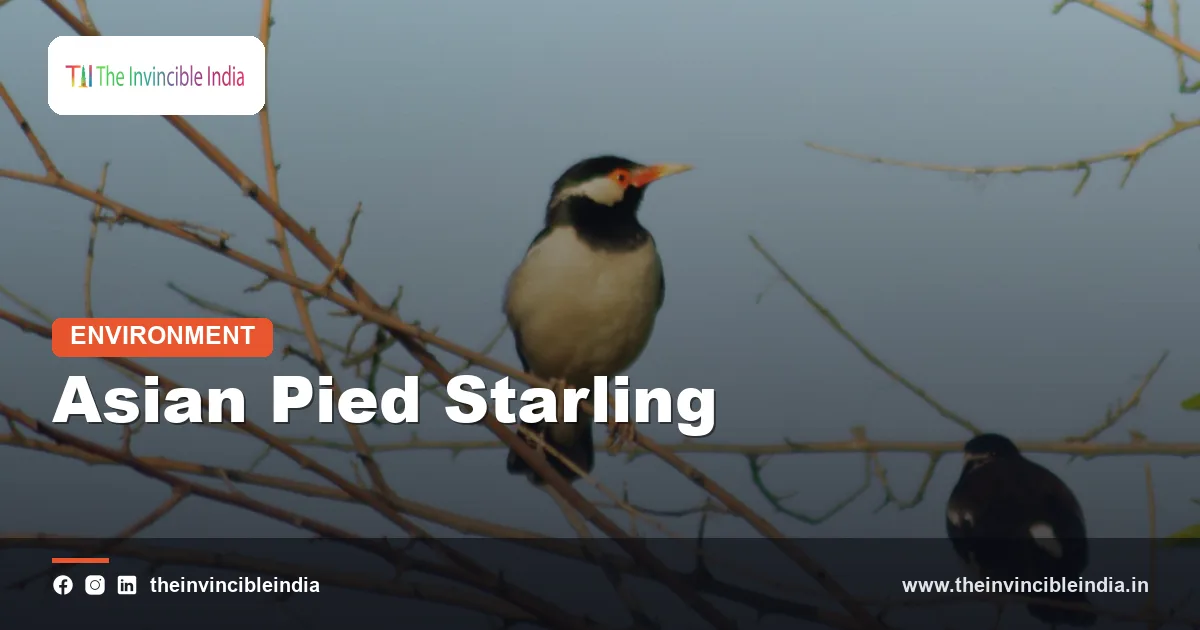
The Asian pied starling (Gracupica contra) is a black-and-white starling, widely known in India as the pied myna, that lives in villages, wet fields, ponds and farmland across the northern and eastern parts of the subcontinent and much of South-East Asia. It belongs to the starling and myna family, Sturnidae, and is easy to recognise by its black head and chest, white cheek and shoulder patches, and a bill and patch of bare skin around the eye that are bright orange to reddish.
The Asian pied starling is a bold, sociable bird that forages on the ground, often among cattle and in freshly ploughed or flooded fields, and it builds a large, untidy nest of twigs and straw in tall trees. This guide explains how to identify the Asian pied starling, where it lives in India, what it eats, how it sings and breeds, how it differs from lookalike birds, and why it is a useful indicator of healthy, mixed farmland. Details were last checked on 23 October 2026.
| Quick Fact | Detail |
|---|---|
| Common names | Asian pied starling, Indian pied myna, pied myna |
| Scientific name | Gracupica contra (earlier placed in the genus Sturnus) |
| Family | Sturnidae (starlings and mynas) |
| Size | About 23 cm, a little larger than a bulbul |
| Distinctive marks | Black head and chest, white cheek patch, white rump, orange bill base and orange eye-skin |
| Range | Northern, eastern and parts of central India, Nepal, Bangladesh and South-East Asia |
| Habitat | Wet fields, paddy, ponds, villages, orchards and open woodland near water |
| Conservation status | Least Concern on the IUCN Red List |
Key Takeaways
- The Asian pied starling (Gracupica contra) is a resident black-and-white starling, also called the pied myna, found mainly in northern and eastern India.
- The Asian pied starling is identified by its black head and chest, white face and shoulder patches, orange bill base and a patch of orange bare skin around the eye.
- The Asian pied starling feeds on the ground on insects, grubs, grains, fruit and nectar, and often forages beside grazing cattle.
- The Asian pied starling builds a large, untidy nest of twigs, straw and rags in a tall tree and lays pale-blue eggs.
- The Asian pied starling has a loud, bubbling song made of whistles, chatters and gurgles, delivered from rooftops, wires and treetops.
- The IUCN lists the Asian pied starling as Least Concern, and the species has been expanding its range locally in parts of northern and western India.
What is the Asian pied starling?
The Asian pied starling is a medium-sized, ground-feeding starling with bold black-and-white plumage that is resident in South and South-East Asia. In India, it is better known by the older name pied myna, and field guides often list it under Indian pied myna.
The bird was long placed with the typical starlings in the genus Sturnus, but taxonomists later moved it, together with a few close relatives, to the genus Gracupica. The name “pied” simply means patchy in two colours, and “contra” in the scientific name echoes the strong contrast in its plumage. Males and females look almost the same, which is common in starlings.
How do you identify an Asian pied starling?
You identify an Asian pied starling by its black head, throat and chest, a clean white patch on the cheek and ear region, white wing coverts forming a shoulder patch, and a white rump and underparts. The bill is the most helpful clue, being orange-red at the base with a yellowish tip, and the bare skin around the eye is a bright orange-pink.
The crown is dark with a small white streak or spot over the eye, the back is brownish-black with pale feather edges, and the legs are pale yellowish. Young birds are duller, with browner heads, less distinct white patches and a duller bill and eye-skin. In the field, the bird stands upright, walks briskly rather than hops, and often flashes the white rump when it flies.
Quick identification checklist
- Black hood and chest against a white belly.
- White cheek patch and white shoulder patch.
- Orange bill base and orange bare skin around the eye.
- Walks on the ground with a confident, strutting gait.
- Calls loudly, often several birds together.
Where is the Asian pied starling found in India?
The Asian pied starling is found mainly across northern and eastern India, including the Gangetic plains, the Terai, Punjab and Haryana, Bihar, West Bengal, Odisha and the north-east, with smaller and more patchy populations further west and south. It is largely resident, though some local movement occurs.
The distribution has changed over the past decades. Birds that were once mostly confined to eastern wetlands and Gangetic villages have been reported from additional parts of northern and western India, and some observers note an expanding presence in towns. The exact limits are best checked against recent eBird maps, since sightings keep changing. Outside India, the species occurs in Nepal, Bangladesh, Myanmar, Thailand, and other parts of South-East Asia, and it has been introduced to some islands.
What habitat does the Asian pied starling prefer?
The Asian pied starling prefers wet, open habitats close to human settlement, including paddy fields, flooded meadows, village ponds, canal banks, orchards and well-wooded gardens. It avoids dense forest and very dry, treeless country.
The bird needs two basic features: soft, moist ground for foraging and tall trees or similar structures for roosting and nesting. Mixed farmland, where fields, hedgerows, ponds and mango or banyan trees sit side by side, suits it well. In many villages, it is a daily neighbour, appearing on thatched roofs, electric wires and cattle sheds.
What does the Asian pied starling eat?
The Asian pied starling eats a varied diet of insects, grubs, worms, grains, seeds, berries, fruits and nectar, and it takes most of its food from the ground. It is an omnivore and shifts its diet with season and availability.
Typical animal prey includes grasshoppers, beetles, termites, caterpillars and earthworms, which it extracts from soft or freshly turned soil with its pointed bill. Plant foods include rice and other grains left after harvest, ripe figs and mulberries, and nectar from flowering trees. Birds often follow cattle, picking up insects flushed by the grazing animals, and they gather at ploughed fields where grubs are exposed. This feeding is generally helpful to farmers because it removes crop pests.
What does the song of the Asian pied starling sound like?
The song of the Asian pied starling is a loud, rambling, bubbling mixture of whistles, gurgles, chattering notes and harsh squeaks, delivered in a rhythm that rises and falls. The notes are less musical than a robin’s song but carry far across open fields.
Birds sing from prominent perches such as rooftops, treetops, wires and poles, particularly in the early morning and during the breeding season. Pairs sometimes sing together in duet-like exchanges, and flocks can be very noisy at roosts. Like other starlings and mynas, the species is capable of mimicking some sounds, though it is not famed for imitation the way the hill myna is.
How does the Asian pied starling breed?
The Asian pied starling breeds mainly in the warmer, wetter months, building a large, untidy, domed or bowl-shaped nest of twigs, straw, grass and sometimes rags in a tall tree. It lays pale-blue eggs and both parents take part in raising the young.
Nests are often placed high in a leafy tree such as a mango, tamarind or banyan, and several pairs may nest in the same tree or nearby trees. A typical clutch is about 4-6 eggs, though the exact number and timing vary by region. In some towns, the bird has adapted by using electricity pylons, tall palms and building ledges. Both parents feed the chicks with insects, which are collected from fields near the nest. Breeding calendars differ from state to state, so local observation is the best guide.
How is the Asian pied starling different from similar birds?
The Asian pied starling differs from other black-and-white birds of India mainly through its orange bill and eye-skin, white cheek patch and ground-walking habit. Several species can be confused with it at a glance, particularly in poor light.
| Bird | Key difference from the Asian pied starling |
|---|---|
| Black-collared starling | Larger, with a white head and a black collar, found mostly in the north-east |
| Oriental magpie-robin | Smaller and slimmer, with a long tail held upright and a black bill |
| Common myna | Brown body, yellow bill and yellow eye-patch, no black hood |
| Brahminy starling | Black cap with a pale-orange body and white-tipped tail |
| Rosy starling | Pink body with a black crested hood, a winter visitor |
| Pied bushchat | Smaller, with a thin dark bill and an upright perching posture |
The Asian pied starling is the only common black-and-white bird of Indian villages with an orange bill base, which makes it the best identification clue.
What role does the Asian pied starling play in farmland ecology?
The Asian pied starling plays a useful role in farmland ecology as an insect-eater, a seed-spreader and an indicator of healthy mixed landscapes. By eating grubs, caterpillars and grasshoppers, the bird helps keep crop pests in check.
The species also feeds on fruits and passes seeds in its droppings, which can help spread some native trees. Its large nests may later be used by other birds, and its alarm calls can warn nearby animals of danger. Heavy pesticide use, drainage of wetlands and removal of large village trees may reduce its habitat, so the presence of pied starlings often suggests that fields, water and trees remain in balance.
Is the Asian pied starling protected in India?
The Asian pied starling is not listed as threatened, and the IUCN classes it as Least Concern, but it is still protected from hunting and trade under India’s wildlife laws as a wild bird. The Wildlife (Protection) Act, 1972 prohibits capturing or keeping most wild birds, and keeping them in cages is illegal.
Common threats are modest and include loss of nesting trees, wetland drainage and heavy chemical use in farming. The species has adapted well to people and is a familiar village bird, so it is unlikely to be at risk in the near term. Still, local counts and citizen-science records remain valuable for spotting any decline early.
How can you attract and watch Asian pied starlings?
You can watch Asian pied starlings by visiting wet fields, village ponds and orchards in the morning or evening, and you can encourage them to visit by keeping tall trees, a shallow water source and some bare soil. Binoculars and patience are all that is needed.
- Visit freshly ploughed or irrigated fields, where birds feed in numbers.
- Look for the white cheek patch and orange eye-skin through binoculars.
- Avoid disturbing nesting trees during the breeding season.
- Keep a shallow dish of clean water in a garden to help birds drink and bathe.
- Avoid pesticides near nesting trees, since they reduce the insect food supply.
Bottom Line
The Asian pied starling is a common, striking and useful bird of Indian villages and wet farmland, easily recognised by its black-and-white plumage and orange bill base. It eats pests, sings a rich bubbling song and adapts well to human landscapes. Protecting large trees and small wetlands keeps it, and many other birds, in the countryside.
Frequently Asked Questions
Is the Asian pied starling the same as the pied myna?
Yes, the Asian pied starling and the pied myna are the same bird, Gracupica contra. The name pied myna is the older common name in India, while Asian pied starling is the name used in most modern checklists.
How can I tell an Asian pied starling from a magpie-robin?
An Asian pied starling is stockier, has an orange bill base and orange eye-skin, and walks on the ground with a short tail. An Oriental magpie-robin is slimmer, has a long tail often held upright and a black bill.
Where does the Asian pied starling build its nest?
The Asian pied starling builds its nest in tall trees, such as mango, tamarind or banyan, and sometimes on pylons or palms. The nest is a large, untidy mass of twigs, straw and other material, and the eggs are pale blue.
What does the Asian pied starling eat?
The Asian pied starling eats insects, grubs, worms, grains, seeds and fruits, and it feeds mostly on the ground. It often follows grazing cattle and gathers in ploughed or flooded fields to pick up exposed prey.
Is the Asian pied starling found in South India?
The Asian pied starling is mainly a bird of northern and eastern India and is uncommon or patchy in the far south. Its range has shifted over time, so recent local bird records are the best guide for a particular district.
Is the Asian pied starling a threatened species?
No, the Asian pied starling is listed as Least Concern by the IUCN. It is widespread, adapts well to farmland and villages, and has been spreading locally, though it is still protected as a wild bird under Indian law.
{“@context”:”https://schema.org”,”@graph”:[{“@type”:”FAQPage”,”mainEntity”:[{“@type”:”Question”,”name”:”Is the Asian pied starling the same as the pied myna?”,”acceptedAnswer”:{“@type”:”Answer”,”text”:”Yes, the Asian pied starling and the pied myna are the same bird, Gracupica contra. The name pied myna is the older common name in India, while Asian pied starling is the name used in most modern checklists.”}},{“@type”:”Question”,”name”:”How can I tell an Asian pied starling from a magpie-robin?”,”acceptedAnswer”:{“@type”:”Answer”,”text”:”An Asian pied starling is stockier, has an orange bill base and orange eye-skin, and walks on the ground with a short tail. An Oriental magpie-robin is slimmer, has a long tail often held upright and a black bill.”}},{“@type”:”Question”,”name”:”Where does the Asian pied starling build its nest?”,”acceptedAnswer”:{“@type”:”Answer”,”text”:”The Asian pied starling builds its nest in tall trees, such as mango, tamarind or banyan, and sometimes on pylons or palms. The nest is a large, untidy mass of twigs, straw and other material, and the eggs are pale blue.”}},{“@type”:”Question”,”name”:”What does the Asian pied starling eat?”,”acceptedAnswer”:{“@type”:”Answer”,”text”:”The Asian pied starling eats insects, grubs, worms, grains, seeds and fruits, and it feeds mostly on the ground. It often follows grazing cattle and gathers in ploughed or flooded fields to pick up exposed prey.”}},{“@type”:”Question”,”name”:”Is the Asian pied starling found in South India?”,”acceptedAnswer”:{“@type”:”Answer”,”text”:”The Asian pied starling is mainly a bird of northern and eastern India and is uncommon or patchy in the far south. Its range has shifted over time, so recent local bird records are the best guide for a particular district.”}},{“@type”:”Question”,”name”:”Is the Asian pied starling a threatened species?”,”acceptedAnswer”:{“@type”:”Answer”,”text”:”No, the Asian pied starling is listed as Least Concern by the IUCN. It is widespread, adapts well to farmland and villages, and has been spreading locally, though it is still protected as a wild bird under Indian law.”}}]}]}


