

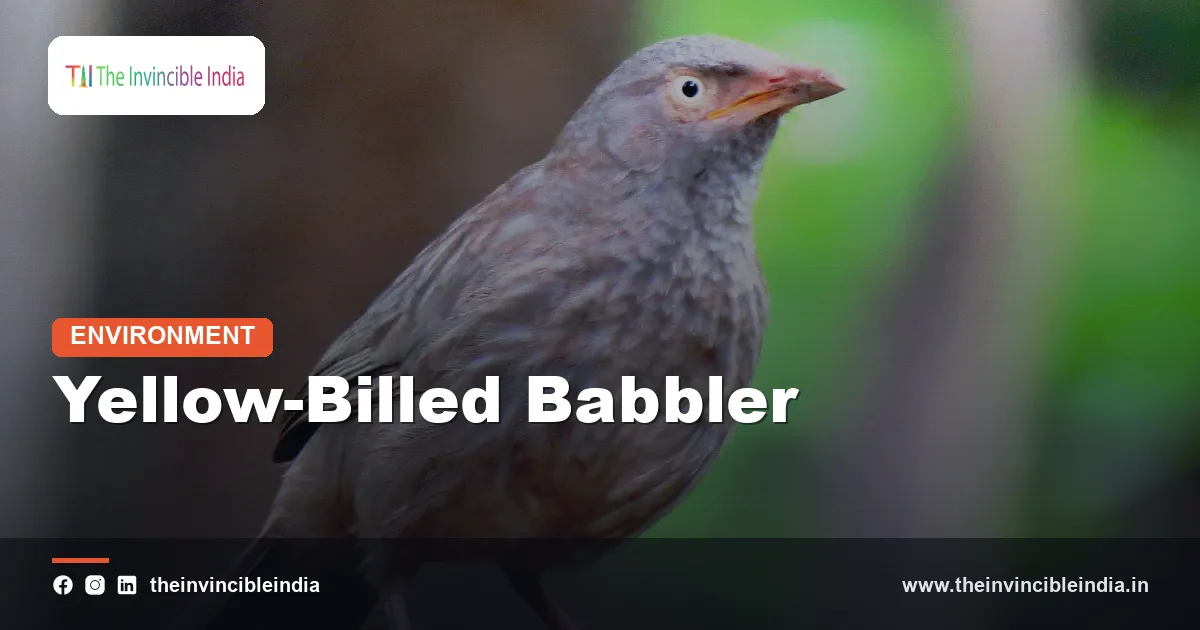
The yellow-billed babbler (Argya affinis, formerly Turdoides affinis) is a pale, noisy, highly social songbird of southern India and Sri Lanka that lives in tight groups, forages on the ground in gardens, scrub and open woodland, and is popularly grouped with the “seven sisters” babblers. It belongs to the babbler family, Leiothrichidae, and is recognised by its soft grey-brown plumage, bright yellow bill and the habit of moving, calling and feeding together in a chattering band.
The yellow-billed babbler is a close relative of the more widespread jungle babbler, and the two are often confused. This guide explains what the yellow-billed babbler is, how to tell it from the jungle babbler, where it lives in India, why it moves in groups, how its cooperative breeding works, what it eats, and what its presence says about the health of southern scrub, farmland and gardens. Details were last checked on 23 October 2026.
| Quick Fact | Detail |
|---|---|
| Common names | Yellow-billed babbler, orange-billed babbler; “seven sisters” in English |
| Scientific name | Argya affinis (formerly Turdoides affinis) |
| Family | Leiothrichidae (laughingthrushes and babblers) |
| Size | About 23 cm, similar to the jungle babbler |
| Range | Southern peninsular India and Sri Lanka |
| Habitat | Dry scrub, gardens, cultivation, open deciduous woodland and village edges |
| Social system | Cooperative groups, typically about 6-10 birds |
| Conservation status | Least Concern on the IUCN Red List |
Key Takeaways
- The yellow-billed babbler (Argya affinis) is a resident songbird of southern India and Sri Lanka that is recognised by its yellow bill and pale grey-brown plumage.
- Yellow-billed babblers live in cohesive groups, typically of about six to ten birds, which is why they are called “seven sisters” in English.
- The yellow-billed babbler is a close relative of the jungle babbler but is generally paler and greyer, with a brighter yellow bill, and occurs mainly in the south.
- Yellow-billed babblers breed cooperatively, with non-breeding group members helping to defend the nest and feed the chicks.
- The yellow-billed babbler feeds mostly on insects found by turning over leaf litter, and also eats fruits, nectar and grains.
- The IUCN lists the yellow-billed babbler as Least Concern, and the species adapts readily to gardens and farmland.
What is the yellow-billed babbler?
The yellow-billed babbler is a medium-sized, long-tailed, ground-foraging songbird found in the south of the Indian peninsula and in Sri Lanka. It is a member of the babbler family, a large group of social, mostly brown birds that are known for noisy group behaviour.
The bird was long placed in the genus Turdoides, but many checklists now place it in Argya after a revision of babbler relationships. Older books may use the former name, and some still call the bird the orange-billed babbler in reference to the deeper bill colour seen in some individuals. The species is not shy and is a familiar sight in many southern towns and villages.
How do you identify a yellow-billed babbler?
You identify a yellow-billed babbler by its overall pale grey-brown body, long rounded tail, strong legs, pale eyes and a bright yellow to orange-yellow bill. The head often looks a little paler or cleaner than the rest of the body, and the plumage lacks strong streaking.
The birds are about the size of a myna but slimmer, with a loose, slightly untidy look. They hop rather than walk, with the tail held low or slightly raised, and they often flick their wings. Young birds are duller and have a softer, paler bill. Exact plumage tone varies by region and subspecies, so a good field guide and clear photographs help in confirming identification.
Key identification clues
- Pale, soft grey-brown body without bold markings.
- Bright yellow bill and yellowish legs.
- Group of birds moving together and calling constantly.
- Hopping, bounding movement on the ground and in low branches.
- Location in southern India or Sri Lanka.
Where does the yellow-billed babbler live in India?
The yellow-billed babbler lives mainly in southern India, in the drier, lower-lying parts of the peninsula in states such as Karnataka, Tamil Nadu, Kerala, Andhra Pradesh and Telangana, as well as in Sri Lanka. It is largely resident and does not migrate.
The species prefers dry, open habitats: thorn scrub, dry deciduous woodland, plantations, gardens and the edges of villages. It is less common in dense evergreen forest and in the highest parts of the Western Ghats. The exact northern limit of its range is blurred by overlap with similar babblers, so local records on citizen-science platforms are useful for confirming where it occurs.
Within its range, the bird tolerates a wide range of conditions, from hot, dry plains to the cooler foothills, and it adapts to human-modified places. Groups regularly visit gardens, school grounds, temple compounds and the edges of farms, where hedges, mature trees and open ground sit side by side. Sparse rainfall, thorny shrubs and patches of bare soil suit it, because they offer both cover and easy foraging.
Why is the yellow-billed babbler called “seven sisters”?
The yellow-billed babbler and its relatives are called “seven sisters” because the birds travel in groups of about seven that stay close together and call in chorus. The number is traditional rather than exact, and real groups may be smaller or larger.
The nickname is shared with the jungle babbler, which is known as sat bhai (seven brothers) in Hindi and in several other Indian languages. Similar names exist in Marathi, Bengali and other tongues, which shows how familiar these birds are in everyday life. The saying also reflects the birds’ loyal, argumentative, family-like behaviour, since a group usually stays together for years.
How is the yellow-billed babbler different from the jungle babbler?
The yellow-billed babbler differs from the jungle babbler mainly in overall colour, bill tone and range: it is generally paler and greyer, with a brighter yellow bill, and it is found chiefly in southern India and Sri Lanka, while the jungle babbler is common across most of India. The two are close relatives and behave in very similar ways.
| Feature | Yellow-billed babbler | Jungle babbler |
|---|---|---|
| Scientific name | Argya affinis | Argya striata |
| Overall colour | Paler, greyer-brown | Darker, richer brown |
| Bill | Bright yellow to orange-yellow | Pale yellow |
| Main range | Southern India and Sri Lanka | Most of India and parts of neighbouring countries |
| Group size | About 6-10 | About 6-10 |
| Habitat | Dry scrub, gardens, open woodland | Gardens, villages, scrub, open forest |
Where their ranges meet, intermediate-looking birds can make identification difficult, and even experienced observers rely on a combination of colour, range and behaviour.
How do yellow-billed babblers behave in groups?
Yellow-billed babblers behave as a tight, cooperative unit, with all members foraging, moving, roosting and defending territory together. A group usually holds a territory and keeps in contact through a stream of squeaks, chuckles and whistling notes.
Group members groom each other, sleep huddled side by side, and take turns acting as sentinels, perching in a high spot while others feed. If a predator such as a snake, cat or hawk appears, the group sounds a loud alarm and often mobs the intruder by approaching it together and calling aggressively. Moving from one bush to the next, birds fly one after another in a loose line, with short, weak flights that rarely cover long distances.
The calls of the yellow-billed babbler are a large part of its identity. A foraging group produces a constant, mixed chorus of mewing, squeaking and chattering notes, which rises to a harsh, scolding racket when the group is alarmed. Observers often hear a group well before they see it, and the sound is usually the best clue that a band of babblers is moving through a hedge or garden.
Dominance within a group is flexible, and members usually cooperate rather than fight. Territories are defended against neighbouring groups through noisy displays and short chases, and boundaries tend to stay stable from year to year as long as the habitat remains intact. A group that loses members to predators or disease may take in young birds from the same area, although this is less well documented than the behaviour of better-studied babblers.
What does the yellow-billed babbler eat?
The yellow-billed babbler eats mainly insects and other small invertebrates, and also takes fruits, flower nectar and grains. It is an omnivore and adjusts its diet to what the season offers.
Birds forage by hopping through leaf litter, flicking leaves aside with the bill and pulling out beetles, ants, termites, caterpillars, spiders and small lizards. They also visit fruiting trees such as figs and berries, drink nectar from flowers, and eat spilled grain near homes and fields. By removing insect pests from gardens and crops, groups of babblers act as a natural form of pest control.
How do yellow-billed babblers breed?
Yellow-billed babblers breed cooperatively, meaning that one pair in the group nests while other members help guard and feed the young. This is called cooperative breeding and is common among babblers.
The nest is a rough cup of twigs, grass and roots, usually placed low to medium height in a thorny bush or small tree. A typical clutch is about three to four eggs of a deep greenish-blue colour, though numbers and timing vary with local rains. Helpers bring food to the chicks and join in defending the nest against predators. The nest is sometimes parasitised by cuckoos, such as the pied cuckoo, which lays its eggs among those of the babbler so that the host raises its chicks.
What is the ecological role of the yellow-billed babbler?
The yellow-billed babbler plays an ecological role as an insect controller, a seed disperser and a prey species that supports local food webs. By turning over leaf litter, the bird also exposes hidden insects and helps mix surface soil.
Its constant calls act as an early warning for other small animals when a predator is near, and mixed groups of birds often take advantage of this. Because it thrives in scrubby, partly cultivated land, the babbler is a useful sign that thorn scrub and garden hedges still provide cover and food. Clearing of thickets and heavy pesticide use can reduce its numbers locally.
Is the yellow-billed babbler protected?
The yellow-billed babbler is not threatened globally, and the IUCN classes it as Least Concern, but it is protected as a wild bird under the Wildlife (Protection) Act, 1972 in India. Capturing or keeping wild birds is generally illegal.
The species adapts well to gardens and farms and is commonly found in towns, so there is no widespread conservation concern. Local pressures include loss of scrub, removal of hedgerows and nest predation by crows and domestic animals. Retaining native shrubs and thickets in gardens and farm borders is a simple way to help.
How can you watch and support yellow-billed babblers?
You can watch yellow-billed babblers by sitting quietly near a garden, scrub patch or village edge in the early morning and listening for their chatter, and you can support them by keeping native shrubs, leaf litter and a shallow water source. Groups are confiding and easy to observe.
- Plant dense native shrubs and thorny hedges for nesting cover.
- Leave some leaf litter on the ground so that insects remain available.
- Provide a shallow dish of clean water in dry months.
- Avoid pesticides, which reduce insect food and can poison the birds.
- Do not feed processed food, which can harm wild birds.
Bottom Line
The yellow-billed babbler is a pale, talkative and cooperative bird of the southern Indian countryside, closely related to the jungle babbler and easily recognised by its yellow bill and group living. It controls insects, adapts to gardens and farms, and shows how social behaviour can help a small bird thrive. Native hedges and scrub are the simplest way to keep it nearby.
Frequently Asked Questions
Why is the yellow-billed babbler called “seven sisters”?
The yellow-billed babbler is called “seven sisters” because it moves and calls in groups of about seven birds. The number is traditional and not exact, and groups usually range from about six to ten individuals.
What is the difference between the yellow-billed babbler and the jungle babbler?
The yellow-billed babbler is generally paler and greyer, with a brighter yellow bill, and is found mainly in southern India and Sri Lanka. The jungle babbler is darker brown and is common across most of India, and the two behave in very similar ways.
Where is the yellow-billed babbler found in India?
The yellow-billed babbler is found mainly in southern peninsular India, in states such as Karnataka, Tamil Nadu, Kerala, Andhra Pradesh and Telangana. It prefers dry scrub, gardens, plantations and open woodland, and it also occurs in Sri Lanka.
What does the yellow-billed babbler eat?
The yellow-billed babbler eats mostly insects and other small invertebrates, such as beetles, ants, termites and caterpillars. It also eats fruits, flower nectar and grains, and it finds much of its food by turning over leaf litter on the ground.
Do yellow-billed babblers migrate?
No, yellow-billed babblers are resident birds that stay in the same area throughout the year. Groups hold territories, make only short flights between bushes, and rarely travel long distances.
Is the yellow-billed babbler a threatened bird?
No, the yellow-billed babbler is listed as Least Concern by the IUCN. It is fairly common, adapts well to gardens and farmland, and is protected as a wild bird under India’s Wildlife (Protection) Act, 1972.
{“@context”:”https://schema.org”,”@graph”:[{“@type”:”FAQPage”,”mainEntity”:[{“@type”:”Question”,”name”:”Why is the yellow-billed babbler called “seven sisters”?”,”acceptedAnswer”:{“@type”:”Answer”,”text”:”The yellow-billed babbler is called “seven sisters” because it moves and calls in groups of about seven birds. The number is traditional and not exact, and groups usually range from about six to ten individuals.”}},{“@type”:”Question”,”name”:”What is the difference between the yellow-billed babbler and the jungle babbler?”,”acceptedAnswer”:{“@type”:”Answer”,”text”:”The yellow-billed babbler is generally paler and greyer, with a brighter yellow bill, and is found mainly in southern India and Sri Lanka. The jungle babbler is darker brown and is common across most of India, and the two behave in very similar ways.”}},{“@type”:”Question”,”name”:”Where is the yellow-billed babbler found in India?”,”acceptedAnswer”:{“@type”:”Answer”,”text”:”The yellow-billed babbler is found mainly in southern peninsular India, in states such as Karnataka, Tamil Nadu, Kerala, Andhra Pradesh and Telangana. It prefers dry scrub, gardens, plantations and open woodland, and it also occurs in Sri Lanka.”}},{“@type”:”Question”,”name”:”What does the yellow-billed babbler eat?”,”acceptedAnswer”:{“@type”:”Answer”,”text”:”The yellow-billed babbler eats mostly insects and other small invertebrates, such as beetles, ants, termites and caterpillars. It also eats fruits, flower nectar and grains, and it finds much of its food by turning over leaf litter on the ground.”}},{“@type”:”Question”,”name”:”Do yellow-billed babblers migrate?”,”acceptedAnswer”:{“@type”:”Answer”,”text”:”No, yellow-billed babblers are resident birds that stay in the same area throughout the year. Groups hold territories, make only short flights between bushes, and rarely travel long distances.”}},{“@type”:”Question”,”name”:”Is the yellow-billed babbler a threatened bird?”,”acceptedAnswer”:{“@type”:”Answer”,”text”:”No, the yellow-billed babbler is listed as Least Concern by the IUCN. It is fairly common, adapts well to gardens and farmland, and is protected as a wild bird under India’s Wildlife (Protection) Act, 1972.”}}]}]}


